

NFL Referee Signals: What Each Hand Gesture Means
April 4, 2026NFL referees use specific hand signals to communicate key game events and penalties clearly. For instance, a touchdown is indicated by both arms extended overhead, while a safety features palms together, forming a triangle. Knowing these gestures helps you understand the flow of the game and adds to your experience as a fan. You’ll also discover why these signals evolved and how they impact game integrity, enhancing your enjoyment of every play.
Understanding the Importance of Referee Signals
In the NFL, referees use over 35 distinct hand signals to communicate penalties, like offensive holding, and other game situations clearly. This evolution in signals, starting in 1929, enhances your understanding of the game and keeps you informed during broadcasts.
The shift to clearer gestures, such as replacing the military salute with a wrist strike for unnecessary roughness, minimizes confusion for fans. Additionally, with referees using microphones since 1975, real-time communication about penalties and decisions adds transparency. Understanding referee signals is crucial for fostering trust and transparency between officials and participants.
Key Game Management Signals Every Fan Should Know
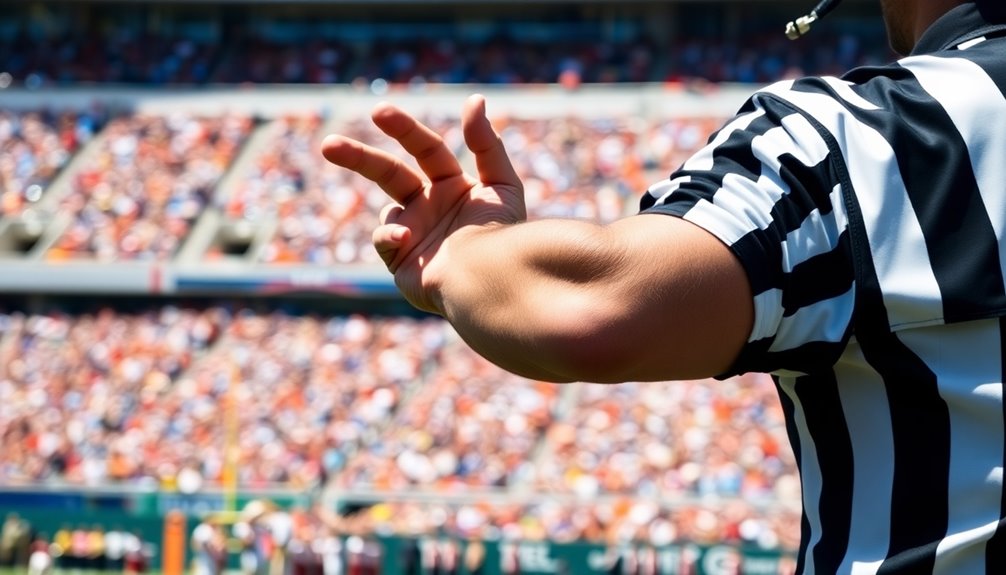
When you’re watching a game, knowing the key signals can enhance your experience. For instance, the “T” shape for a timeout and the circular motion to restart the clock are essential gestures that keep the game flowing. Understanding these signals helps you follow the action and stay engaged. Additionally, being aware of the offside rule can deepen your appreciation for strategic plays and decisions made during the game.
Essential Timeout Gestures
Although it might seem like a simple game, knowing the essential timeout gestures can enhance your experience as a fan. When a referee signals a timeout, they form a “T” shape with their arms, indicating a stoppage in play. This gesture alerts both teams and spectators that the game will pause.
For a two-minute warning, the referee raises both arms above their head while holding the football aloft. If the ball is ready for play, the referee swings one arm down while blowing the whistle.
At the end of a period, a long whistle accompanies the referee raising the football, marking the quarter’s completion. Understanding these signals helps you stay engaged and informed during the game.
Clock Restart Indicators
In the fast-paced world of NFL games, knowing the clock restart indicators can keep you in the loop. These signals are essential for understanding game management.
Here are three key gestures:
- Clock Restart: The referee makes a large circular motion with one hand, signaling to the timekeeper that the game is resuming.
- Ready for Play: The referee raises one arm and swings it down while blowing the whistle, indicating the start of the play clock.
- Ends Period: At the end of each period, the referee raises the football above their head and blows a long whistle, signaling that the period has concluded.
Stay sharp and recognize these signals to enhance your game experience!
Scoring Signals: How Do Referees Indicate Touchdowns and More?
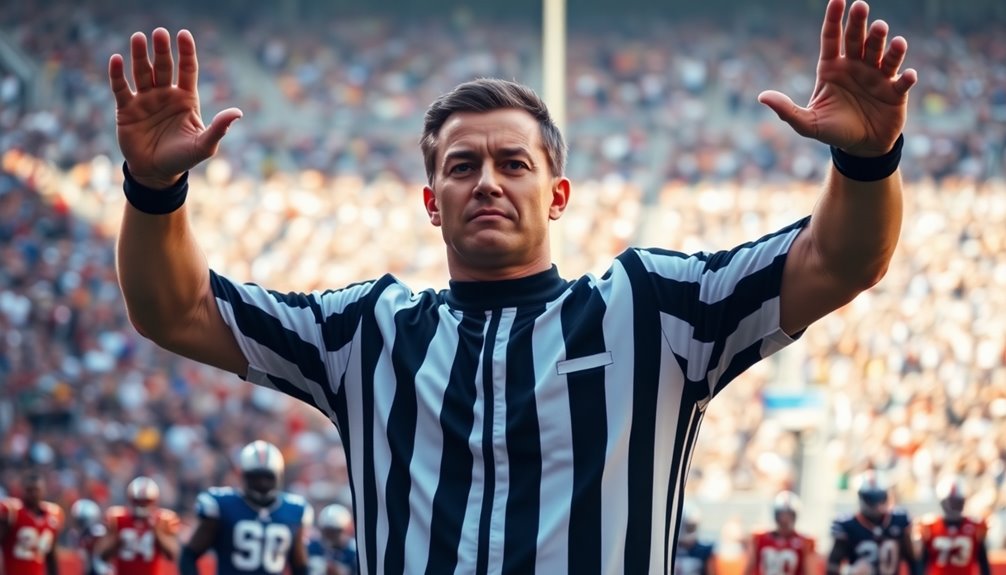
How do NFL referees clearly communicate scoring plays to everyone on the field and in the stands? They use distinct scoring signals that leave no room for confusion.
When a touchdown occurs, the referee extends both arms straight up overhead, indicating six points for the scoring team. For a safety, the referee raises their arms with palms together, forming a triangle to signify two points.
A field goal or extra point is confirmed with the same arms-raised gesture, signaling successful kicks. Similarly, a two-point conversion is indicated with arms extended straight above the head. These signals guarantee players, coaches, and fans understand the game’s scoring outcomes quickly and effectively, reinforcing the importance of teamwork in flag football.
Exploring Common Penalty Signals and Their Meanings
Now that you know how scoring works, let’s shift gears and explore common penalty signals.
You’ll see key gestures that referees use to communicate specific infractions, each carrying distinct consequences for the teams involved.
Understanding these signals can enhance your appreciation of the game and its rules. For instance, being aware of NFL MVP nominees can help you recognize the impact of player performance on the game.
Common Penalty Signals Explained
Understanding common penalty signals is essential for any football fan. These gestures help you grasp the flow of the game and the rules at play.
Here are some key penalty signals you should know:
- Holding: The referee grips one wrist and pulls down—this means a 10-yard penalty for the offensive team.
- False Start: A looping motion with the forearms indicates a 5-yard penalty against the offensive team.
- Pass Interference: Extending arms with palms up signals a defensive penalty that may result in a spot foul.
Other important signals include delay of game, where the referee folds their arms, and personal foul, indicated by a fist followed by a chop.
Recognizing these signals enhances your understanding of the game!
Key Penalty Signal Gestures
While watching an NFL game, it’s essential to recognize the key penalty signal gestures that referees use to communicate infractions.
For holding, the referee grasps one wrist with a clenched fist, indicating a 10-yard penalty for an offensive player or 5 yards for a defensive player.
A false start is signaled by spinning the forearms in a circular motion, resulting in a 5-yard penalty for illegal motion before the snap.
If there’s pass interference, the referee extends both arms in front with palms up, resulting in a spot foul.
A delay of game is shown by folding arms, leading to a 5-yard loss for the offense.
Finally, a personal foul involves raising one arm with a fist and a karate chop motion, signaling a 15-yard penalty.
Understanding Penalty Consequences
Recognizing referee signals is just the beginning; grasping the consequences of those penalties helps you appreciate the game’s flow.
Here are three common penalties and their impacts:
- Holding Penalty: When the referee grasps one wrist with the other hand, it results in a 10-yard penalty for the offense or a 5-yard penalty plus an automatic first down for the defense, depending on the situation.
- False Start: This is indicated by a looping motion of the forearms, incurring a 5-yard penalty against the offending team.
- Pass Interference: With arms extended and palms up, this leads to a spot foul for the defense or a 10-yard penalty with loss of down for the offense.
Understanding these signals increases your grasp of the game’s dynamics.
Less Common but Essential Referee Signals Explained
In the fast-paced world of football, referee signals play an essential role in maintaining the flow of the game and ensuring fair play.
Some less common but crucial signals include the illegal block in the back, where a referee uses a pushing motion with one arm while holding the opposite wrist, resulting in a 10-yard penalty.
Clipping is indicated by a chopping motion with one hand behind a leg, leading to a 15-yard penalty.
Targeting emphasizes player safety by signaling a hit that exceeds legal standards.
Unnecessary roughness is shown by one wrist striking the other above the head, while roughing the passer features a slashing motion toward the ground, resulting in a 15-yard penalty and automatic first down.
The Evolution of Referee Signals: A Historical Perspective
As the game of football has evolved, so too have the signals used by referees to communicate vital decisions. The history of hand signals reflects the sport’s need for officiating clarity and enhanced communication.
Here are three key developments:
Three pivotal moments highlight the evolution of football referees’ hand signals, enhancing communication and clarity in officiating.
- 1929 College Game: The first consistent use of hand signals began, improving communication with radio broadcasters and spectators.
- 1956 NFL Championship: Umpire Sam Wilson’s iconic touchdown signal underscored the importance of clear officiating.
- 1955 Military Salute Abandonment: The confusing salute for unnecessary roughness was replaced with a distinct signal, enhancing clarity for penalties.
These milestones show how football referees have adapted over time, ensuring that everyone understands vital game decisions. Furthermore, just as racial dynamics have evolved in basketball, officiating signals in football have become integral in maintaining the integrity of the game.
Tips for Fans: How to Read the Signals During a Game
Understanding referee signals can greatly enhance your enjoyment of an NFL game, especially when you’re cheering for your favorite team.
Start by recognizing the touchdown signal, where the referee extends both arms straight up—this means six points scored!
Keep an eye out for the “T” shape, indicating a timeout or two-minute warning, which stops the play clock.
If the referee raises and waves an arm back and forth, it signals a dead ball or touchback.
For a personal foul, look for the holding signal, where the referee grasps one wrist with the opposite hand, marking a 10-yard penalty.
Finally, watch for a circular motion with one hand, signaling the start of the play clock. Additionally, being aware of the disciplinary actions taken during the game can help you understand the consequences of player behavior.
Conclusion
In the fast-paced world of the NFL, understanding referee signals can enhance your game experience. Remember, “a picture is worth a thousand words,” and each gesture tells a vital story about the game unfolding before you. By familiarizing yourself with these signals, you’ll not only impress your friends but also gain a deeper appreciation for the sport. So next time you’re at a game or watching on TV, keep an eye on the refs and decode the action!

