

How to Volley in Tennis
April 26, 2026To volley effectively in tennis, focus on your grip and footwork. Use a continental grip for versatility and keep the racket face slightly open. Quick, agile steps will help you position yourself correctly at the net. Anticipate your opponent’s shots to make timely responses. Practice different volley types, like offensive and defensive, to enhance your game. Mastering these elements can elevate your performance and put pressure on your opponent. There’s much more to discover about perfecting your volley.
Understanding the Importance of Volleying in Tennis

Understanding the importance of volleying helps you exploit your opponent’s weaknesses and maintain control of the match. The volleying benefits include quick points and the ability to pressure your rival, forcing them into defensive positions.
When you master this skill, you can effectively implement your game strategy, shifting the momentum in your favor. A well-timed volley can disrupt your opponent’s rhythm, leading to errors and openings you can capitalize on. Additionally, understanding field dimensions can help you position yourself better for effective volleys.
Key Elements of a Successful Volley

To master the volley, you’ll need to focus on a few key elements. Proper grip technique, effective footwork, and sharp timing all play crucial roles in your success at the net. Additionally, understanding the importance of racial diversity in sports can enhance your overall appreciation and strategy on the court.
Proper Grip Technique
Mastering the proper grip technique is essential for a successful volley in tennis. Start by using the continental grip, which allows for quick adjustments. Your grip pressure should be firm but relaxed; too much tension can lead to a loss of control.
Focus on grip stability, ensuring your racket stays steady during the impact with the ball. As you prepare to volley, maintain a consistent grip, allowing for a natural feel while still being ready to react.
Footwork and Positioning
While a solid grip is essential, effective footwork and positioning can make or break your volley. Mastering these elements allows you to react quickly and reach the ball with precision.
Here are some key tips to enhance your footwork:
- Stay light on your feet: This helps you react swiftly to your opponent’s shots.
- Practice lateral movement: Being able to move side to side is vital for getting into the right position.
- Use quick pivots: They allow you to adjust your stance and angle for an ideal volley.
- Position yourself near the net: Being closer reduces the distance you need to cover.
- Maintain a balanced stance: This helps you strike effectively while being ready for your next move.
Timing and Anticipation
Stay light on your feet, ready to adjust your position swiftly.
Remember, the key is to meet the ball at its peak height for the most effective volley.
Choosing the Right Grip for Your Volley
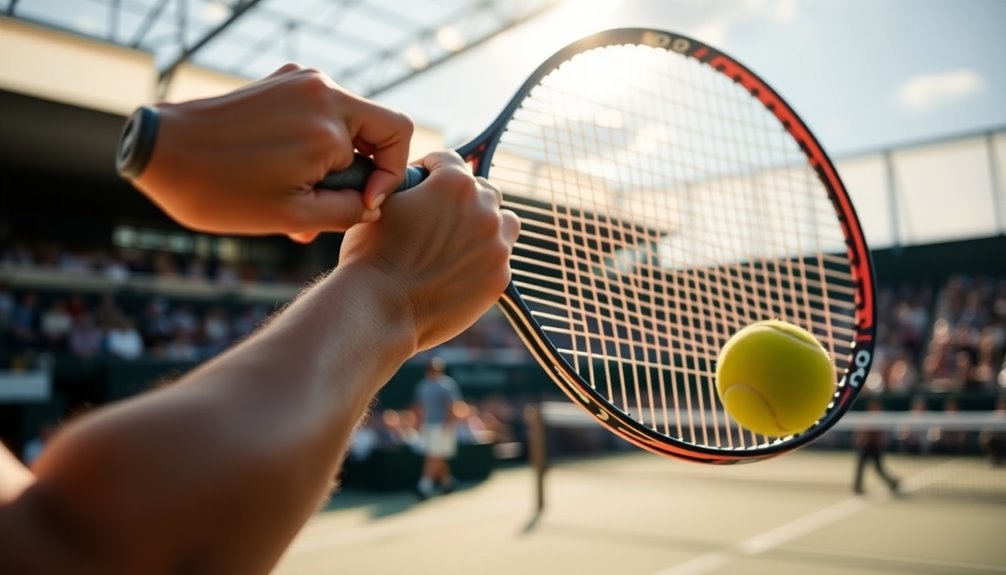
- Continental Grip: Ideal for versatility and quick adjustments.
- Eastern Grip: Offers more topspin and depth for your volleys.
- Grip Pressure: Maintain a firm but relaxed hold to enhance stability.
- Grip Stability: Guarantee your grip remains consistent during play for better accuracy.
- Grip Awareness: Stay mindful of your grip adjustments based on the incoming ball.
Experiment with these grips to find what feels comfortable for you. The right grip can elevate your volleying skills and boost your confidence on the court, especially when you incorporate drills that simulate game situations.
Mastering Footwork for Effective Volleying
When it comes to volleying, your footwork is essential. Quick steps help you get into the right position, allowing for ideal reach as you intercept the ball.
Plus, anticipating the ball’s trajectory will make all the difference in your performance at the net. Additionally, understanding soccer field dimensions can enhance your spatial awareness on the court.
Importance Of Quick Steps
Mastering quick steps is essential for effective volleying, as your footwork directly impacts your ability to position yourself for the ball.
With quick reflexes and explosive movement, you can anticipate your opponent’s shots and respond swiftly.
Here are some key points to focus on:
- Stay light on your feet: This helps you move quickly in any direction.
- Practice agility drills: Improve your foot speed and coordination.
- Engage your core: A strong core stabilizes your movements.
- Visualize your footwork: Picture your steps to enhance muscle memory.
- Warm-up properly: Preparing your body reduces injury risk and improves mobility.
Positioning For Optimal Reach
Quick footwork sets the stage for effective positioning, allowing you to reach the ball with ease and precision.
Focus on net awareness and body alignment as you move toward the ball, ensuring your court positioning is ideal. Maintain spatial awareness to adjust your angles and prepare for shot selection.
Quick reaction time is essential when handling pressure, as you need to execute strategic movements that enhance your volley.
As you navigate the court, practice angle adjustments to improve your effectiveness. Building confidence in your footwork will translate to better performance at the net.
Anticipating The Ball’s Trajectory
As you prepare to volley, anticipating the ball’s trajectory is essential for positioning yourself effectively. Mastering ball prediction and trajectory analysis helps you react quickly and strategically.
Here’s how to enhance your anticipation skills:
- Watch the opponent’s racket: Notice their grip and swing for clues on where the ball will go.
- Observe body movement: Players often lean toward their target, giving away their shot direction.
- Analyze ball spin: Different spins affect the ball’s bounce and speed, so pay attention!
- Stay light on your feet: This allows you to adjust your position swiftly.
- Practice with drills: Regular practice improves your instinct for predicting ball trajectories.
How to Position Yourself at the Net
Positioning yourself correctly at the net is essential for effective volleying, since a strong stance can make all the difference in your ability to intercept incoming shots.
Focus on developing net awareness through positioning drills that enhance your body alignment and reaction time. When you make your net approach, utilize the split step to prepare for your opponent’s shots.
Effective communication with your partner is key, especially during doubles, to guarantee ideal court coverage. Analyze your opponent’s tendencies to anticipate their shots and adapt your volleying strategy accordingly. Mastering defensive skills can also improve your ability to read the game and position yourself effectively at the net.
The Role of Racket Angle in Volleying
Here are some tips to help you master this skill:
- Keep the racket face slightly open to lift the ball over the net.
- Adjust the angle for different shots; a steeper angle helps with high balls, while a flatter angle works for low ones.
- Stay relaxed; tension can lead to poor angle adjustments.
- Practice with targets to develop your feel for the right racket angle.
- Observe your opponent’s shot; it can guide your angle choice.
- Understanding the importance of discipline in sportsmanship can also inform how you approach your volleying technique.
Timing Your Volley: When to Strike the Ball?
When should you strike the ball for an effective volley? Timing is essential for successful volleying. Use timing techniques to anticipate your opponent’s shot and position yourself accordingly.
Ideally, you want to meet the ball at its peak or just before it starts to drop; this maximizes your control and power. Focus on your strike mechanics, ensuring your racket face is angled correctly as you make contact.
A well-timed volley can catch your opponent off guard, creating an opening for a winning shot. Remember, the earlier you can react and position yourself, the better your chances of executing a clean volley. Incorporating elements of on-ball off-ball movements can also enhance your overall timing and placement.
Stay alert, watch the ball closely, and trust your instincts to find that perfect moment to strike.
Common Volleying Mistakes to Avoid
When you’re volleying, it’s easy to fall into common mistakes that can hurt your game.
Poor footwork and an incorrect racket angle can throw off your timing and accuracy.
Let’s explore how to recognize and correct these issues for better volleys. Additionally, similar to finishing drills in soccer, focusing on technique can significantly enhance your performance on the court.
Poor Footwork Technique
Poor footwork can sabotage even the best volleying skills. To improve your game, focus on these common pitfalls and work on your footwork technique:
- Neglecting footwork drills: Regular practice is key to mastering movement patterns.
- Ignoring balance techniques: Keep your weight balanced for better stability during volleys.
- Skipping stance adjustments: Always set up your stance based on the incoming ball.
- Failing to incorporate lateral shifts: Move side-to-side quickly to reach those tricky approach shots.
- Omitting recovery steps: Recover to a ready position after each volley to maintain flow.
Incorrect Racket Angle
Mastering your footwork lays a solid foundation, but having the right racket angle is just as important for effective volleying. An incorrect racket face can lead to mishit shots and lost points.
As you approach the net, focus on your body alignment and guarantee your grip pressure is firm yet relaxed. Good shot selection starts with evaluating the incoming ball; adjust your swing path accordingly.
When executing volley drills, practice keeping your racket face slightly open or closed, depending on the shot. Don’t forget to follow through appropriately; a solid finish reinforces control.
Strategies for Different Types of Volleys
Here are some key strategies to evaluate:
- Offensive Volleys: Aim for aggressive placements to put pressure on your opponent.
- Defensive Volleys: Use slice volleys to change the ball’s trajectory and buy time.
- Half Volley Techniques: Stay low and focus on timing; it’s all about quick reactions.
- Overhead Volleys: Position yourself well and anticipate the ball’s height for an effective smash.
- Approach Shots: Create opportunities by closing in on the net, setting up for a strong volley strategy.
Incorporating ball handling techniques into your training can further enhance your overall game performance.
With these tactics, you’ll enhance your volleying skills!
Practicing Your Volleying Skills: Drills and Exercises
While you can learn strategies for volleying in theory, putting those skills into practice is essential for improvement. Focus on targeted drills that enhance your technique and footwork.
Start with partner exercises, like hitting volleys back and forth, to build consistency. Incorporate reaction training by having your partner aim for different spots, forcing you to move quickly and adjust.
Don’t forget to work on your net play; practice your positioning and angles while volleying. Additionally, small-sided games can help simulate match situations and enhance your quick decision-making skills.
Finally, simulate match situations with practice matches to test your skills under pressure. Emphasizing these drills and exercises will boost your confidence and effectiveness at the net, making you a formidable opponent during real matches.
How to Incorporate Volleys Into Match Play
After honing your volleying skills through targeted drills, it’s time to bring those techniques into match situations. Incorporating volleys effectively requires a strategic approach that focuses on your mindset and adaptability.
Here are some tips to integrate your volley techniques:
- Analyze your opponent: Identify their weaknesses and adjust your shot selection.
- Utilize tactical positioning: Position yourself closer to the net for better volley opportunities.
- Shift your mindset: Embrace pressure situations and be confident in your volleys.
- Adapt your game: Be flexible in your strategies based on the flow of the match.
- Practice shot selection: Know when to hit aggressive volleys versus defensive ones.
Tips From the Pros: Learning From the Best Volleyers
To elevate your volleying skills, search no further than the professionals who’ve mastered this art. Studying pro player insights can transform your game.
Watch how they position themselves at the net; their footwork is precise and intentional. Focus on their grip—most top players use a continental grip for versatility.
Incorporate their volleying techniques by practicing quick reactions and anticipating your opponent’s shots.
Conclusion
Now that you know the ins and outs of volleying, imagine the thrill of dominating the net during your next match. With the right grip, footwork, and strategies, you can elevate your game and leave your opponents scrambling. Remember, practice makes perfect—so get out there and start volleying! Who knows? You might just become the player everyone else looks up to. Embrace the challenge, and watch your confidence soar!