

The Story Behind the NFL Referee Jersey and Penalty Flag
April 4, 2026The NFL referee jersey and penalty flag are iconic symbols that have evolved considerably over the years. You’ll discover that the penalty flag, introduced in 1941, replaced traditional whistles for better visibility, while jersey designs shifted from formal wear to stripes for professionalism. The color change to yellow in 1965 improved visibility during games. These innovations enhance the game’s integrity and fan engagement, and there’s even more to uncover about the journey of officiating in football.
The Origins of the Penalty Flag: A Game-Changer in Officiating
When you think about how officiating has evolved in the NFL, it’s hard to overlook the impact of the penalty flag. First introduced by Dwight Dike Beede in 1941, this game-changer replaced horns and whistles, making penalties more visible.
The NFL officially adopted the penalty flag on September 17, 1948, enhancing clarity for fans and players alike. Initially red, the flag changed to yellow in 1965 due to visibility issues.
Further improvements included adding sand or bean weights for accuracy, abandoning lead sinkers after a serious injury in 1999. This evolution not only improved officiating standards but also boosted audience engagement, providing a clear visual cue for penalties during play.
The penalty flag truly transformed the game, much like how the offside rule ensures fairness and balance in soccer.
Evolution of the NFL Referee Jersey: From Bow Ties to Stripes
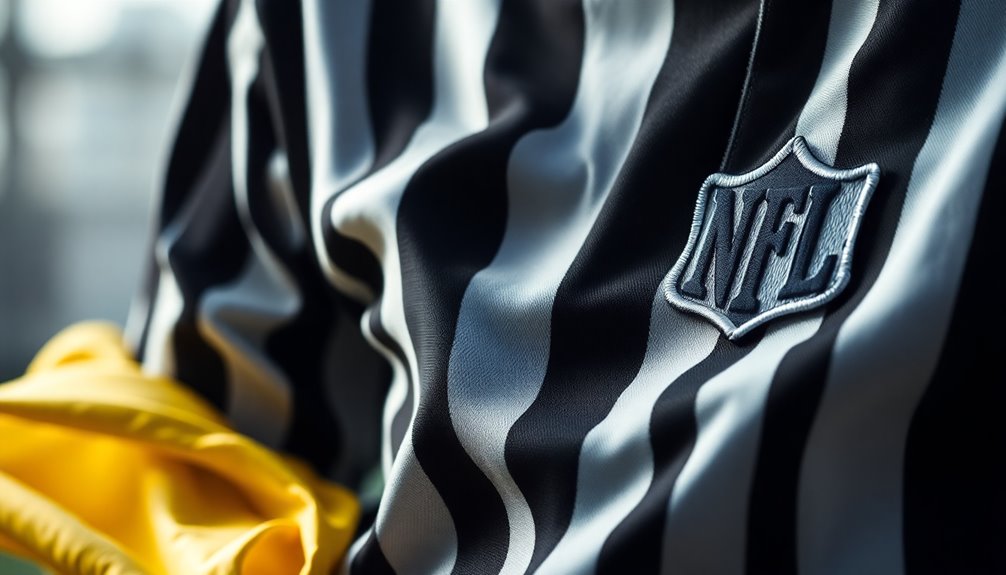
As the NFL evolved, so did the attire of its referees, reflecting changes in both style and functionality. Initially, referees donned white dress shirts and black bow ties, but this formal look gave way to more practical uniforms.
The evolution of NFL referee attire showcases a shift from formal to functional, enhancing both style and on-field presence.
Key developments include:
- Standardized uniforms introduced in 1938 for credibility
- Adoption of the iconic black and white striped jersey in the 1960s
- Improved visibility to distinguish referees from players
- Modern jerseys made from moisture-wicking materials for comfort
- Unique identifiers like numbers and patches for professionalism
These advancements not only enhance the referee’s presence on the field but also contribute to the overall integrity of officiating, especially when a penalty is called. Additionally, the emphasis on safety regulations in NFL Flag Football has influenced how referees oversee games, ensuring fair play and player protection.
The Color Shift: Why Yellow Became the Standard for Penalty Flags?
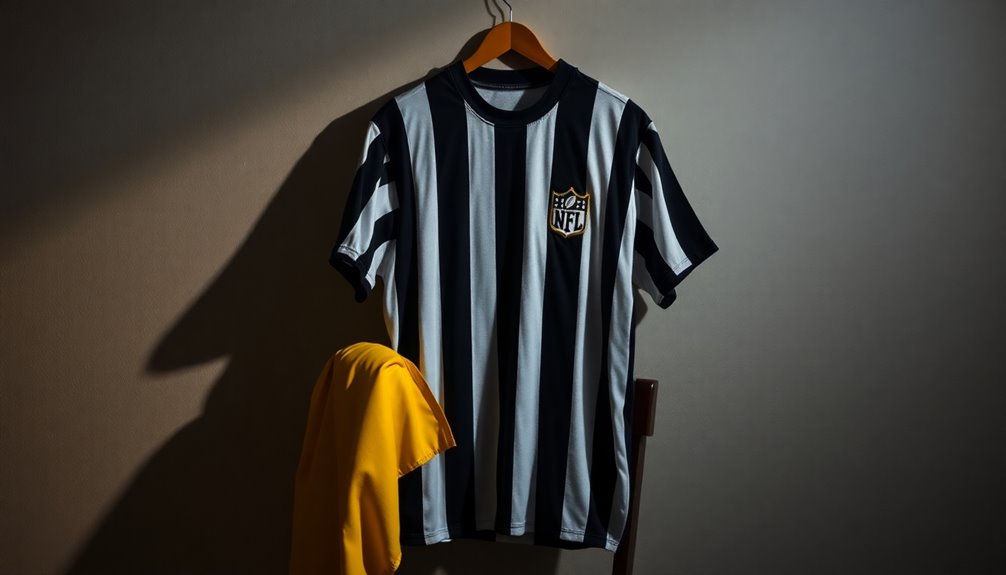
When you think about penalty flags, it’s easy to wonder why yellow took over as the standard color.
Initially, red and white flags created confusion on the field, blending in with other items. The choice of yellow enhances visibility, much like how strong defensive strategies are crucial for clear communication during gameplay.
Historical Color Choices
The evolution of penalty flag colors in the NFL highlights the importance of visibility on the field. Originally, red flags caused confusion because they resembled team towels and caps. White flags posed their own issues, blending in with debris during windy conditions.
In 1965, the NFL made a significant change to yellow penalty flags, enhancing visibility for both officials and fans. The switch aimed to clear up confusion, especially when over 90% of households had black-and-white TVs.
Today, the yellow cloth has become a standard symbol in football officiating.
- Clear recognition
- Enhanced visibility
- Reduced confusion
- Marked a significant change
- Celebrated its 50th anniversary
This color choice transformed how penalties are communicated during games.
Visibility and Recognition Factors
Visibility and recognition are essential in officiating, especially during fast-paced NFL games.
Initially, officials used red penalty flags, but confusion with other red items on the field led to issues. White flags posed their own problems due to towels and caps that could obscure visibility.
In 1965, the NFL changed to yellow flags to enhance clarity for both officials and fans, eliminating confusion during gameplay. This color shift was particularly important when over 90% of households viewed games on black-and-white TVs, emphasizing the need for distinct visual signals.
Today, the yellow penalty flag stands as a recognized symbol in football, marking a pivotal evolution in officiating and game management, ensuring everyone understands when a penalty occurs.
Key Figures in Officiating: Pioneers Who Shaped the Game
Pioneers in NFL officiating have fundamentally transformed how the game is played and perceived. Their innovations laid the groundwork for the officiating standards we recognize today.
Pioneering NFL officials have reshaped the game, establishing enduring standards that enhance both play and perception.
Here are some key figures who shaped the game:
- Hugh “Shorty” Ray: Developed a thorough rulebook and organized training clinics for officials starting in 1938.
- Art McNally: Established a modern evaluation system, introducing weekly performance reviews and game film analysis from 1968 to 1991.
- Jerry Seeman: Invested $500,000 in technology for a command center to streamline officiating reviews in 1991.
- Dwight Beede: Invented the penalty flag in 1941, officially adopted in 1948, transforming how penalties were communicated.
- Major John Griffith: Recognized the penalty flag’s potential, integrating it into NFL rules for better game clarity.
- The importance of effective communication during halftime has parallels in officiating, emphasizing the need for clarity and precision in the rules.
Modern Innovations in Officiating: Technology Meets Tradition
While tradition plays an essential role in NFL officiating, modern innovations have greatly enhanced the game’s integrity and flow. With the introduction of wireless microphones in 1975, officials can communicate clearly, making announcements in real-time.
The Art McNally GameDay Central, launched in 2014, boasts 89 monitors and 16 replay stations, utilizing advanced NFL Vision software to streamline the review process for officiating calls. Instant replay, made a permanent fixture in 1999, considerably boosts the accuracy of officiating decisions, helping to minimize officials’ penalties.
Additionally, Jerry Seeman’s focus on fitness and technology investment in the early ’90s led to rigorous evaluation systems, ensuring officials maintain high standards and adapt to the ever-evolving demands of the game. This commitment to injury risk reduction through improved training and evaluation techniques reflects the ongoing evolution of officiating standards.
The Impact of the Penalty Flag on Game Integrity and Fan Engagement
The penalty flag plays a vital role in enhancing visual communication during NFL games, making it easier for you to understand what’s happening on the field. Its bright yellow color stands out, reducing confusion and allowing for a more transparent gameplay experience. As fans, your reactions to the flag can influence the atmosphere, highlighting its impact on engagement and game integrity. The effectiveness of gameplay relies on team coordination, ensuring that all players understand their roles and responsibilities during crucial moments.
Visual Communication Enhancement
As the game unfolds, the penalty flag plays an essential role in enhancing visual communication, ensuring fans stay engaged and informed. This visual cue has transformed how you experience the game, making it easier to follow along. Here’s how:
- Introduced in 1948, it replaced auditory signals, boosting game transparency.
- The shift to the yellow flag in 1965 improved visibility, reducing confusion.
- Its weighted design allows officials to signal penalties accurately from afar.
- The penalty flag’s presence keeps fans on the edge of their seats, reinforcing excitement.
- This evolution reflects a commitment to higher officiating standards, creating a fairer game.
These elements make the penalty flag a crucial part of the NFL experience, enhancing your understanding and enjoyment.
Fan Reaction Dynamics
How do penalty flags shape your experience as a fan? Since their introduction in 1948, penalty flags have become an essential part of the game, enhancing your understanding of officiating decisions during live broadcasts.
The gold flags, adopted in 1965, improve visibility, reducing confusion on the field. When these flags are thrown, your reactions—often boos or frustrated comments—reflect your emotional investment in the game.
Penalties called at critical moments can greatly sway fan engagement, impacting attendance and viewership for future games. Ultimately, penalty flags symbolize authority in officiating, reinforcing fair play, which you expect from professional football.
Your experience hinges on these dynamics, making the integrity of the game that much more important.
Conclusion
In the world of NFL officiating, the penalty flag and referee jersey are more than just tools; they symbolize fairness and integrity in the game. Imagine a vital moment—your team’s last chance to score—and a questionable call changes everything. That flag, with its vivid yellow, sparks debate and discussion among fans, reminding us that every decision counts. Ultimately, these elements shape not just the game, but the very experience of being a football fan.

