
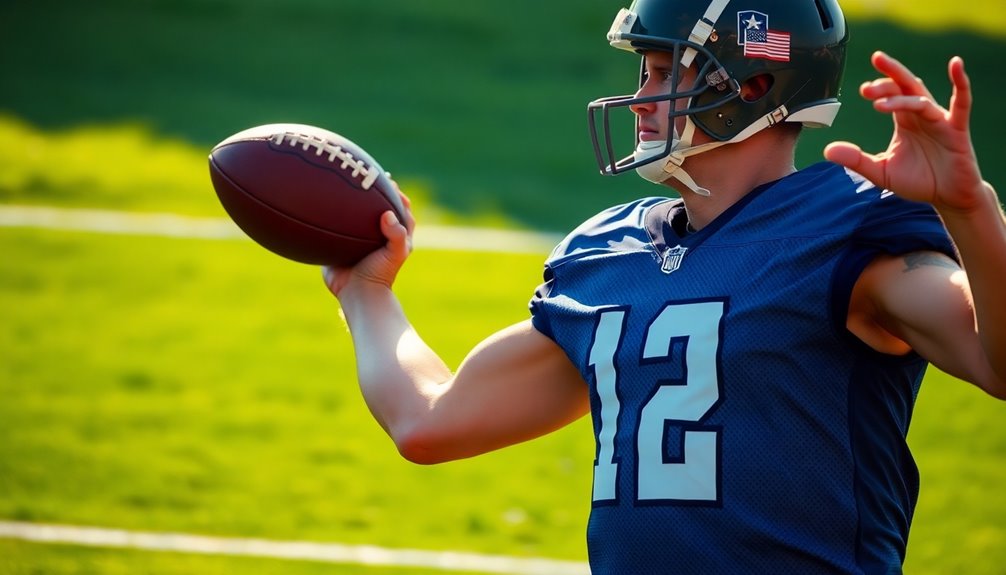
Football Throwing Mechanics: Building Power and Accuracy
March 21, 2026To build power and accuracy in your football throws, focus on effective energy transfer starting from your feet. Engage your ankles and knees while maintaining a wider-than-shoulder-width stride for stability and balance. Mastering torque through hip and shoulder rotation is essential, as is keeping your head behind your center of gravity. Proper timing and a relaxed arm can enhance your release. Stick around to discover advanced techniques that can take your throwing game to the next level.
The Importance of Energy Transfer in Throwing
When you throw a football, effective energy transfer is essential for maximizing your power and accuracy. It all starts at the ground level, where your ankles and knees engage to generate force. A wider-than-shoulder-width stride enhances your balance and facilitates better energy transfer throughout your body.
As you move, keep your head behind your center of gravity to maintain power and efficiency in your throw. The torque created by rotating your left shoulder opposite to the direction of the throw stores and releases energy effectively. Additionally, incorporating hip rotation into your throwing mechanics can significantly enhance the overall effectiveness of your throw.
Achieving Optimal Stride for Power and Balance

To achieve ideal stride for power and balance, you need to focus on your stride width and stability. Keep your head behind your center of gravity to maintain energy during the throw. Additionally, ensure your feet are positioned about one inch wider than shoulders to enhance stability and power transfer during your throw.
Stride Width and Stability
Achieving the right stride width is essential for enhancing your stability and power during a football throw. A stride wider than shoulder width provides a solid foundation, allowing you to maintain balance and generate more power.
This wider stance supports the rotational torque created by your hips and shoulders, ensuring effective energy transfer to your throwing arm. When your stride width is ideal, you prevent energy loss, maximizing your throwing efficiency.
Consistently practicing wider strides can greatly improve your throwing mechanics and overall performance on the field. Remember, your stability during the throw starts with the right stride width, setting you up for success in every pass you make.
Head Positioning Essentials
How can proper head positioning elevate your throwing mechanics? By keeping your head behind your center of gravity during your stride, you maintain balance and maximize power transfer throughout the throwing motion.
A wider-than-shoulder-width stride enhances your stability, allowing for better torque generation from your lower body. When you maintain a level head, you promote consistent energy transfer, preventing power loss due to misalignment.
It’s essential for young players to avoid tilting their heads to the left, as this can diminish throwing power and accuracy. Aligning your head with the target creates a direct line for energy transfer, greatly improving the precision and effectiveness of your throws.
Focus on these head positioning essentials to elevate your game.
Torque and Energy Transfer
Proper head positioning sets the stage for maximizing torque and energy transfer in your throwing mechanics.
Start by achieving an ideal stride wider than shoulder width; this enhances balance and power, allowing better energy transfer from the ground up.
As you throw, maintain torque by rotating your left shoulder opposite the throwing arm, which stores energy for a powerful release.
Keep your head behind your center of gravity during the stride to prevent energy loss and maintain strength.
A relaxed arm creates a whip-like motion, enabling quicker release and improved accuracy as energy flows from your legs through your torso to your arm.
Mastering Torque for Enhanced Throwing Efficiency

To enhance your throwing efficiency, mastering torque is essential, as it greatly influences both power and accuracy.
When throwing a football, generate torque by rotating your left shoulder opposite to your throw. This movement stores and transfers energy throughout your body.
Start with a wider-than-shoulder-width stride to create a solid base, maximizing your torque and overall throwing power. Achieving the reverse C position is vital; it aligns your hips and shoulders during the throw.
Keep a 90° angle in your throwing arm and focus on proper hip rotation to channel torque effectively toward your target. Additionally, focusing on follow-through mechanics can significantly improve your throw’s precision and distance.
Common Mistakes That Sabotage Your Throw
Mastering torque is only part of the equation when it comes to effective throwing mechanics. One common mistake is relying solely on your upper body for torque. If you don’t engage your legs, you’ll lose power and accuracy when you throw a football.
Incorrect head and shoulder positioning, like tilting your head to the left, can also divert energy away from your target. Maintaining a strong athletic position is essential; without it, you might struggle with balance and stability.
Additionally, poor body alignment leads to misdirected energy, resulting in inaccurate passes. Don’t forget to keep your arm relaxed; tension can hinder the whip-like motion necessary for ideal energy transfer and velocity in your throw. Incorporating proper hand placement during your throw can greatly enhance control and accuracy.
Advanced Techniques: The Reverse C Position Explained
To access your throwing potential, mastering the Reverse C position is essential. This technique not only boosts your power through proper hip rotation but also enhances your accuracy when you maintain the right elbow angle. Let’s explore the benefits, how to achieve that hip rotation, and common mistakes to avoid. Additionally, understanding scoring opportunities can help players make strategic decisions during gameplay.
Benefits of Reverse C
While many throwers focus solely on upper body strength, incorporating the Reverse C position can greatly enhance your throwing mechanics.
This technique helps you maintain efficient energy transfer by maximizing torque through shoulder rotation and hip alignment. By keeping your throwing arm at a 90° angle, you generate ideal power and accuracy.
The Reverse C position encourages a fluid motion, engaging your core and lower body instead of relying solely on your upper body. This engagement directs energy toward your target, ensuring the ball travels with greater velocity and precision.
Practicing the Reverse C position can considerably improve your overall throwing mechanics, leading to a more effective and consistent performance, especially in high-pressure situations.
Achieving Proper Hip Rotation
In the Reverse C position, your throwing arm reaches its highest point while your hips rotate forward, creating ideal torque. This motion allows you to harness energy generated from the ground, translating it into throwing velocity.
Maintaining a 90° angle in your throwing arm during this phase guarantees efficient energy transfer from your lower body to your upper body. Proper hip rotation also aligns your shoulder and arm for a direct path to the target, enhancing accuracy.
Common Mistakes to Avoid
Even the most skilled quarterbacks can fall into common pitfalls when executing the Reverse C position. One major mistake is failing to keep the throwing elbow above the shoulder, which limits torque and efficiency.
If you rely too heavily on your upper body, you’ll sacrifice power and accuracy. It’s also essential to maintain a 90° angle in your throwing arm; otherwise, you risk losing energy during the throw.
Rotating your left shoulder away from the target while in the Reverse C position allows for ideal energy storage, enhancing your release.
Finally, neglecting to adjust your hips can lead to poor balance and control. Avoid these mistakes to maximize your performance and improve both accuracy and velocity in your throws.
How to Perfect Your Release Point for Accuracy?
To perfect your release point for accuracy, you need to focus on a relaxed arm and a whip-like motion. This allows for a fluid transfer of energy from your legs through your arm to the ball.
Aim to release the ball at your target’s face level, ensuring your eyes stay level throughout the throw. Maintain a good athletic position with your head behind your center of gravity during your stride; this optimizes your release point and power transfer.
Practicing the reverse C position helps achieve a consistent release point, keeping your arm at that ideal 90° angle. Regular drills emphasizing timing and rhythm in your release can greatly improve your accuracy and help you anticipate defensive movements. Additionally, understanding flag pulling techniques can enhance your ability to throw accurately under pressure from defenders.
Integrating Leg Power: Why Shouldn’t Your Upper Body Dominate?
While perfecting your release point is essential for accuracy, the foundation of effective throwing mechanics lies in integrating leg power. By generating torque from the ground up, your legs should drive the throw instead of relying solely on your upper body.
A stride wider than shoulder-width enhances balance and allows your legs to greatly contribute to the throw. Keeping your arm relaxed creates a whip-like motion, maximizing speed and accuracy while ensuring leg power remains the primary force.
Focus on maintaining your head behind your center of gravity to direct energy toward your target. Finally, use your left arm for stabilization rather than power, reinforcing the essential role your legs play in the throwing process. Incorporating conditioning drills into your training can further enhance leg strength and overall throwing performance.
Building a Strong Foundation: Training and Recovery Strategies
As you focus on improving your throwing mechanics, building a strong foundation through targeted training and effective recovery strategies becomes vital.
Incorporate exercises that emphasize ground force and torque, like rotational medicine ball throws, to enhance your power and accuracy. Regularly practice your throwing mechanics, paying attention to stride width and body alignment, to develop muscle memory and improve efficiency.
Incorporate rotational medicine ball throws to boost power and accuracy while honing your throwing mechanics for improved efficiency.
Recovery strategies, including targeted stretching and strength training, are essential for maintaining ideal muscle function and preventing injuries during intense training sessions. Engaging in cross-training activities, such as baseball or tennis, can foster better rotational energy creation. Furthermore, incorporating agility training can significantly enhance your overall performance on the field.
Don’t forget to seek consistent mentorship from experienced coaches to receive tailored feedback and refine your techniques in throwing drills.
The Role of Mental Readiness in High-Pressure Throws
Mental readiness plays a critical role when you’re faced with high-pressure throws, ensuring you stay focused and composed amid external distractions.
To excel in these moments, visualize your successful throws before stepping onto the field. This mental rehearsal boosts your confidence and sharpens your execution.
Quick decision-making is essential; you need to read defenses rapidly and anticipate movements to make accurate throws. Incorporating mindfulness and breathing techniques helps manage anxiety, keeping you centered.
Additionally, analyzing film of past high-pressure situations allows you to learn from both successes and mistakes, refining your mental strategies. Understanding the importance of data analytics can also enhance your ability to make informed decisions under pressure.
Conclusion
In football, just like in life, the best throws come from a blend of power, precision, and timing. Think of it as a well-rehearsed dance: every step has its rhythm, and when you hit that sweet spot, the ball soars effortlessly. Remember, even the greats, like Tom Brady, fine-tune their mechanics constantly. So, embrace the process, integrate your training, and watch your throws transform into game-changing plays. After all, every throw is a chance to tell your story.