

Football 101: A Beginner’s Guide to the Game’s Most Important Positions and Rules
March 14, 2026If you’re new to American football, understanding the basics is key. Two teams of 11 players compete on a 100-yard field, aiming to score points by advancing the ball into the end zone. You’ll find positions like quarterback and running back on offense, while linebackers and cornerbacks lead the defense. Familiarize yourself with scoring methods, game flow, penalties, and the crucial role of special teams. Stick around, and you’ll uncover even more about this exciting sport.
Understanding the Basics of American Football
American football is a dynamic sport that captivates millions with its blend of strategy and athleticism. Played between two football teams of 11 players each, the game unfolds on a 100-yard field. Your goal is to score points by advancing the ball into the opponent’s end zone.
Each offensive team has four downs to gain 10 yards from the line of scrimmage. If they succeed, they reset the downs; if not, possession shifts to the opposing team. The quarterback leads the offensive strategy, often handing off to the running back, who carries the ball.
On the other side, the defensive team, featuring linebackers and cornerbacks, works to prevent scoring. Understanding these fundamentals sets the stage for enjoying the game. Additionally, knowing about NFL Flag Football rules can enhance your understanding of non-contact variations of the sport.
Key Scoring Methods in Football

Scoring in football isn’t just about getting points; it’s a critical aspect that can change the flow of the game.
The primary scoring method is the touchdown, worth six points, achieved by crossing the opponent’s goal line with the ball. After a touchdown, you can earn an extra point through a kick or attempt a two-point conversion from the 2 or 3-yard line.
Field goals, worth three points, are typically attempted on fourth down when you can’t advance 10 yards for a new set of downs.
A safety, which gives the defensive team two points, occurs when the offense is tackled in their own end zone.
Each scoring method notably impacts game momentum and strategy, and understanding flag football plays can further enhance a team’s scoring opportunities.
The Flow of the Game: Order of Play
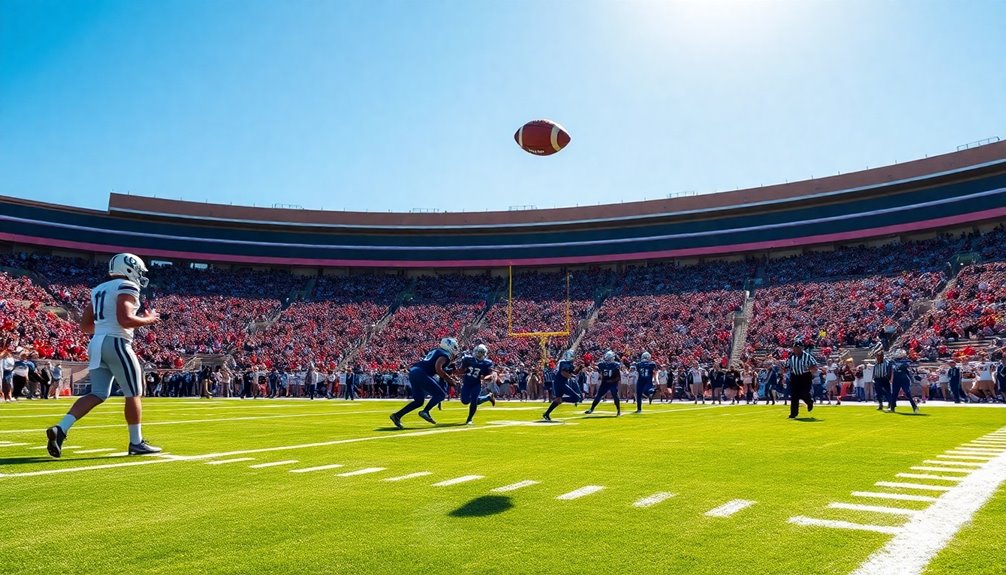
The game kicks off with one team sending the ball to the other, setting the stage for a strategic battle.
You’ll see the offense trying to advance 10 yards in four downs, while the defense aims to stop them.
A touchback can shift the momentum, giving the offense a fresh start at the 25-yard line. Understanding flag football scoring is crucial for strategic decision-making throughout the game.
Kickoff and Touchback Explained
Kickoff plays a pivotal role in football, setting the stage for each half and after every score. The kicking team sends the ball downfield to the receiving team, aiming to gain advantageous field position.
When the ball is kicked into the end zone and not returned, it’s called a “touchback.” This allows the receiving team to start their offensive drive at the 25-yard line, giving them a fresh start.
While the receiving team can attempt a return, they must navigate the defense to advance the ball as far as possible. Touchbacks help maintain momentum and strategy by minimizing risks from kickoff returns, enabling the offensive team to focus on executing their game plan effectively.
Understanding Downs and Plays
In football, understanding downs and plays is essential for grasping how the game flows. The offense has four downs to advance the ball at least 10 yards. If successful, they get a new set of downs to keep their drive alive.
A play kicks off when the center snaps the ball to the quarterback, who decides how to advance it, often facing a challenging defensive line. If the offense fails to gain those 10 yards in four downs, they usually turn the ball over by punting.
Scoring occurs when a player crosses the opponent’s goal line for a touchdown or attempts a field goal for three points.
Keep track of the clock too; it stops for various reasons during the game.
Essential Timekeeping Rules You Should Know
Understanding timekeeping rules in football is essential for following the game.
The game clock has specific management strategies, especially during key moments like the last minutes of each half.
You’ll want to know when the clock stops and how timeouts can be used to your team’s advantage. Additionally, stoppage time plays a crucial role in ensuring fairness and maintaining the game’s thrilling unpredictability.
Game Clock Management
While managing the game clock might seem straightforward, it’s crucial for teams to grasp the essential rules governing timekeeping. Understanding these key aspects can make or break a game:
- The game consists of four quarters, each lasting 15 minutes, but actual play time is longer due to stoppages.
- The game clock starts after the snap and stops for incomplete passes and scoring plays.
- Each team has three timeouts per half to strategically manage the clock.
- In the last two minutes of the first half and the last five of the second, the clock stops after a first down until the ball is spotted.
- Penalties can lead to additional stoppages, influencing both offensive and defensive lines’ strategies.
Mastering these rules helps teams optimize their game clock management.
Stoppage Rules Explained
Knowing the stoppage rules is essential for maneuvering the complexities of football. The game clock stops for incomplete passes, out-of-bounds plays, and timeouts, giving your team a chance to strategize.
In the last two minutes of each half, the clock halts after a first down until the ball is set, allowing offenses to manage time effectively. Each team has three timeouts per half, which can be used strategically to stop the clock and plan plays.
The play clock, set to 25 or 40 seconds, requires the offense to snap the ball in time; otherwise, they face a delay of game penalty.
After a scoring play, the clock stops until the subsequent kickoff, letting teams reset.
Offensive Positions: Roles and Responsibilities
In football, five key offensive positions work together to execute plays and score points. Each player has a distinct role that contributes to the team’s success:
- Quarterback (QB): The leader who throws passes, hands off the ball, and calls plays.
- Running Backs: Versatile players who carry the ball, catch passes, and block for the QB.
- Wide Receivers: Fast athletes responsible for catching passes and creating separation from defenders.
- Offensive Line: Five players dedicated to protecting the QB and creating running lanes.
- Tight Ends: Dual-role players who block in the run game and catch passes in vital situations.
Understanding these roles helps you appreciate how the offense functions as a cohesive unit. Additionally, effective communication among the offensive players is crucial for executing plays and adapting to defensive strategies.
Defensive Positions: How They Protect the End Zone
Understanding defensive positions is essential to grasping how teams protect the end zone.
Defensive linemen pressure the quarterback and stop running plays at the line, disrupting offensive strategies.
Linebackers act as the first line of defense, tackling ball carriers and covering short-range passes.
Cornerbacks, often the fastest players, focus on preventing successful receptions by sticking close to wide receivers.
Strong safeties and free safeties serve as the last line of defense, providing deep coverage against long passes while also supporting run defense.
Effective teamwork among these defensive players is vital; coordinated efforts lead to successful player tackles and even turnovers, greatly impacting the game’s outcome and keeping the end zone secure. Incorporating agility training can enhance their performance, allowing for quicker reaction times during crucial plays.
The Importance of Special Teams in Football
While many fans focus on the offense and defense, special teams play a significant role in shaping a football game. They can be the difference between winning and losing, as they handle key moments that can score points or shift momentum.
- Kickoff and punt returns maximize yardage and create opportunities.
- Kickers execute essential field goals that can change the game’s outcome.
- Punter delivers the ball when the offense stalls, influencing field position.
- Effective coordination among special teams players is critical for success.
- Blocked kicks or returns for touchdowns can swing momentum dramatically.
Understanding the importance of special teams helps you appreciate their impact, ensuring every play counts in football. Additionally, a well-prepared defense can intimidate opponents, creating pressure that affects special teams’ performance.
Common Penalties and What They Mean
Football games often hinge on the penalties that occur during play, and knowing these calls can enhance your viewing experience.
For instance, Encroachment results in a 5-yard penalty against the defense for making contact before the snap, while a False Start incurs the same penalty against the offense when a player moves illegally.
Offside also costs the defense 5 yards, giving the offensive team a better position. An Offensive Holding penalty is more severe, costing the team 10 yards and potentially disrupting a scoring opportunity.
Ultimately, Pass Interference grants the offense an automatic first down if a defender contacts a receiver before the ball arrives, impacting their goal to score. Understanding these penalties helps you appreciate the game’s strategy, especially when considering the importance of field markings that define the playing area.
Tips for New Fans to Enjoy the Game
To truly enjoy a football game, it’s essential to familiarize yourself with the key positions on the field, like the quarterback, running back, and linebacker. Understanding these roles enhances your viewing experience and helps you appreciate the strategies at play.
Here’s how to jump in:
- Learn the basic scoring methods: touchdowns (6 points), field goals (3 points), and safeties (2 points).
- Pay attention to the four downs system; teams need to advance 10 yards in four attempts.
- Watch for special teams plays; they can shift game momentum dramatically.
- Observe player interactions; teamwork is critical to success.
- Utilize resources like the NFL Video Rulebook to grasp rules and penalties better.
- Familiarize yourself with soccer field dimensions, as understanding the layout can enhance your appreciation of player movement and strategy.
These tips will elevate your enjoyment of the game!
Conclusion
As you immerse yourself in the world of football, you’ll find a thrilling mix of strategy and chaos. While players clash on the field, teamwork is their secret weapon, creating a beautiful dance of precision and power. Embrace the excitement of each play while remembering the rules that govern the game. Whether you’re cheering for a touchdown or groaning at a penalty, your passion fuels the spirit of football. So grab your friends, and get ready for the next big game!