

Football Conditioning Drills to Build Strength and Endurance
March 17, 2025Last updated: · By Jake Turner
Football conditioning training is structured exercise that builds the speed, strength, power, and endurance a game requires. The most effective approach copies the sport’s demands: short, near-maximal efforts with recovery between them, rather than long, steady runs. This guide explains what to train, how to structure your sessions, and what the research actually supports.
Football is played in bursts. Each play is short but intense, and you need to repeat that effort through a quarter, a full game, and a season. Good conditioning improves your repeatable power and helps you stay sharp late in games.
Key Takeaways
- A systematic review and network meta-analysis of randomized trials ranked strength training above other exercise interventions for improving football players’ performance, with the largest gains in squat 1-RM and 5-meter sprint time.
- In a randomized controlled trial of competitive players, single-leg cycling improved fatigue resistance, agility, and sprinting more than conventional double-leg cycling.
- In a season-long study of professional players, chronic workload affected recovery time more than acute workload, so tracking training load across weeks matters.
- In a four-year study of a collegiate football strength and conditioning program, most performance gains appeared in the first year, with inconsistent improvement afterward.
- Coaches commonly start with work intervals of about 4-10 seconds followed by 20-40 seconds of rest, a practical guideline that matches the stop-start pattern of play.
What Is Football Conditioning Training?
Football conditioning training is a planned program that develops the physical qualities a player uses on the field. Those qualities include top speed, acceleration, change of direction, muscular strength and power, and the aerobic base that helps you recover between efforts. Conditioning is not the same as skill practice, but it supports every skill you perform under fatigue.
Many players think conditioning means running long distances. In practice, the sport rewards repeated short efforts. A conditioning plan should prepare you for a tackle at the end of a long drive as much as for a sprint in the first quarter.
How Do Football Energy Systems Shape Your Training?
Your body produces energy through several overlapping systems, and the dominant one depends on how long and how hard you work. For football, the key systems are the ATP-PC system, which fuels maximal efforts lasting up to about 10 seconds, and anaerobic glycolysis, which supports harder efforts lasting roughly 10 seconds to a minute or two. Aerobic metabolism supports recovery between plays and sessions.
Because most individual efforts in football are short, your drills should emphasize the ATP-PC system while still building your ability to repeat those efforts. Use the table below as a guide when you choose work intervals.
| Energy system | Effort duration | Football relevance |
|---|---|---|
| ATP-PC (alactic) | Up to about 10 seconds | Single plays, acceleration, explosive starts |
| Anaerobic glycolysis | About 10 seconds to 1-2 minutes | Repeated sprints, longer drills, late-game fatigue |
| Aerobic | Longer, sustained efforts | Recovery between plays, overall work capacity |
What Does Research Say About Strength and Sprint Training?
The strongest evidence among exercise types favors strength training for improving football performance. The research below comes from randomized trials and longitudinal studies, and each has limits you should understand before you apply it.
Strength Training Ranks First
A systematic review and network meta-analysis of randomized clinical trials ranked strength training above other exercise interventions for improving football players’ performance. The largest gains appeared in measures such as squat 1-RM and 5-meter sprint time. Strength work should therefore sit at the core of your program, with sprinting and conditioning built around it.
Single-Leg Cycling as a Conditioning Tool
In a randomized controlled trial of competitive football players, single-leg cycling improved lower-limb strength balance, fatigue resistance, agility, and sprinting more than conventional double-leg cycling. The authors suggest it may also help reduce injury risk. Treat this as a useful addition to a program rather than a replacement for strength work.
Monitor Workload Across the Season
A season-long study of professional football players found that chronic workload affected recovery time more than acute workload. Chronic workload reflects your training load over weeks, while acute workload reflects a single session or week. The authors supported continuous workload monitoring during the season, which means your weekly totals matter as much as any one hard day.
Expect Gains to Level Off
A four-year study of a collegiate football strength and conditioning program found that most performance gains appeared in the first year, with inconsistent improvement in later years. Plan your program in phases and change the stimulus over time rather than repeating the same routine indefinitely.
Which Football Conditioning Drills Work Best?
The best football conditioning drills combine short, high-intensity efforts with change of direction and, where useful, resistance. Choose drills that match the demands of your position and the phase of your season. The list below covers the main categories.
Sprints and Change-of-Direction Drills
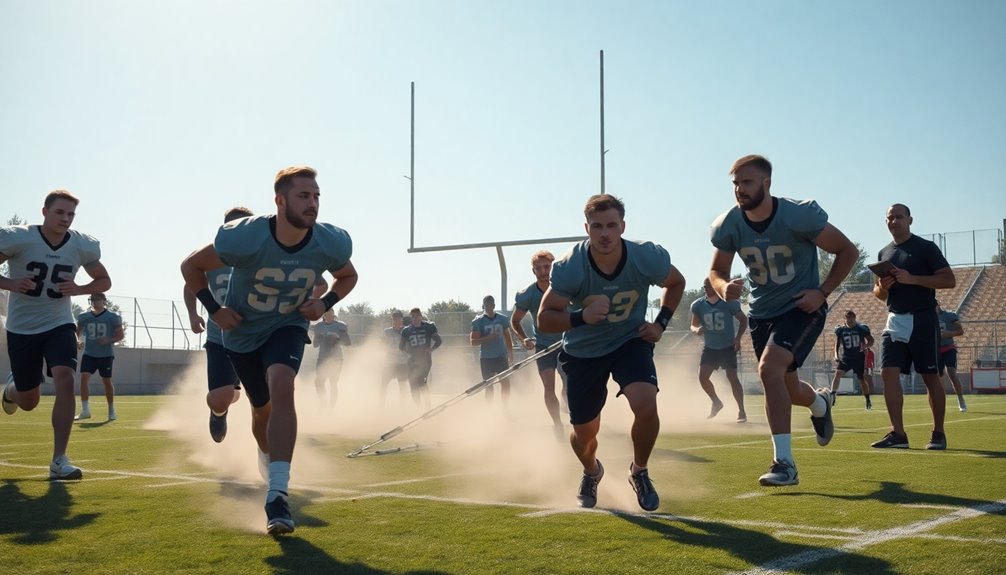
Straight-line sprints build top speed and acceleration, the qualities that matter most on any single play. Add direction changes to train deceleration and re-acceleration, which are common in tackles, routes, and pursuit. Use the Four Corners Drill, which sets quick direction changes in a 10-yard square, to build footwork in a compact space.
Strength and Power Work
Resisted sprints and sled pushes develop the force you need to accelerate and hold ground. Step jumps over cones, performed for about one minute, add coordination and lower-body power. Pair these with heavy lower-body lifts such as squats, since the meta-analysis above links strength gains to better sprint times.
Repeated-Effort Conditioning
Alternating box sprints, which mix jogging and sprinting, build the ability to repeat efforts. The 12-minute run is a useful field test: it measures how far you cover in 12 minutes and lets you track aerobic progress over time. Use longer efforts like these sparingly so they support, rather than replace, your short-burst work.
How Do You Structure a Football Conditioning Workout?
A football conditioning workout should start with preparation, place speed and power early, and use work-to-rest ratios that match the game. Follow these steps to build a session that matches the sport’s demands.
- Warm up for 5-10 minutes with dynamic stretches and a few build-up sprints.
- Start with speed or power work while you are fresh, such as sprints or step jumps.
- Use work intervals of about 4-10 seconds, performed at near-maximal effort.
- Rest about 20-40 seconds between efforts, then rest 3-5 minutes between sets.
- Finish with repeated-effort or aerobic work only if your training week calls for it.
- Log your session and total weekly load so you can adjust the next week.
These ranges are practical starting points rather than figures taken from the studies cited above. Adjust them based on your fitness, position, and how you recover.
Weekly Conditioning Checklist
- At least one session focused on top-speed sprints
- At least one session with change-of-direction work
- Strength training for the lower body and upper body
- Recovery time between hard sessions
- A written record of weekly training load
How Should Conditioning Change by Position?
Conditioning should match what your position asks of you on the field. Skill players need speed and agility, while linemen need strength and power that holds up through repeated short efforts. Knowing which demands matter most for your role helps you prioritize the right drills.
If you are not sure how your position fits into the team, this ranking of the most important positions in football can help you understand where your role fits on the field.
Conditioning for Skill Players
Receivers, running backs, and defensive backs benefit most from top-speed sprints, acceleration work, and change-of-direction drills. Use resisted sprints to build acceleration, then move to unloaded sprints to express that strength at full speed. Keep rest long enough that each sprint stays fast.
Conditioning for Linemen
Linemen benefit from strength, power, and the ability to repeat short, forceful efforts. Tire flips, sled pushes, and heavy lifts build that capacity. Pair them with short sprints so your conditioning still reflects the start-and-stop pattern of play.
Conditioning for Quarterbacks
Quarterbacks need lower-body explosiveness, balance, and the stamina to stay sharp late in games. Footwork drills and short sprints support those needs. For more on developing this skill set, see these drills for flag football quarterbacks, which emphasize footwork and quick decision-making.
Why Do Traditional Conditioning Drills Fall Short?
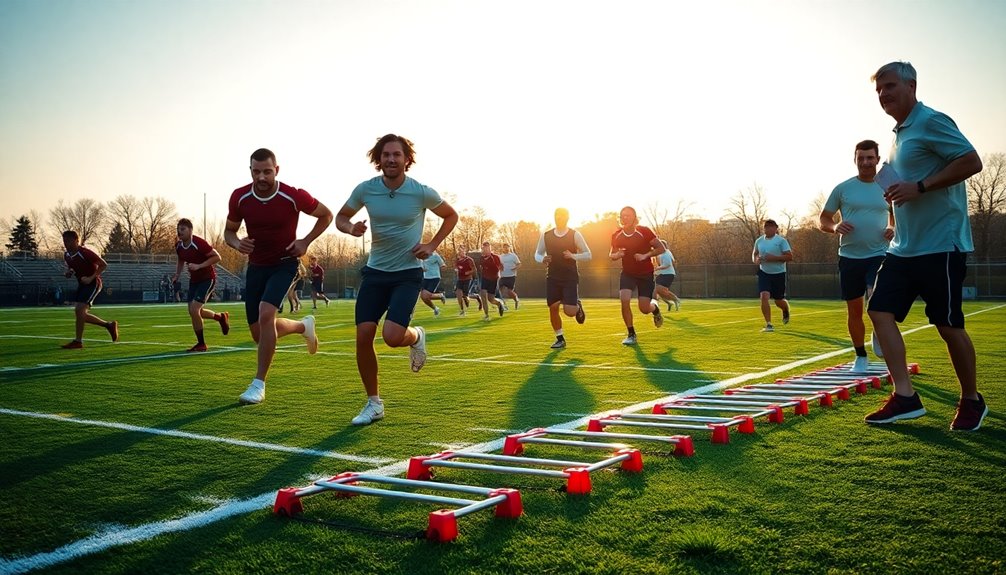
Traditional drills such as gassers and 300-yard shuttles are still common, but many coaches question whether they match the short bursts of play. They are long, repetitive efforts that can take time away from speed and power work. The studies cited in this article do not directly test these drills, so treat the critique as a reason to prioritize other work, not as settled proof.
Long-distance running still has a place. It can support general aerobic fitness and recovery, especially in the off-season. The problem arises when it becomes the centerpiece of your program and crowds out the sprinting and strength work that the research supports more strongly.
How Can You Adapt Conditioning for Youth and Team Settings?
Team conditioning works best when players stay engaged and the intensity is managed. Small-group drills let coaches watch form and effort more closely. Indian runs and 50-yard sprints build teamwork and competitiveness, while 2-4 player groups keep each athlete involved.
For younger players, shorten the work intervals and emphasize technique before intensity. This guide to fun and effective football drills for kids and youth players offers ideas that keep practices engaging while building fundamental movement skills.
Coaches planning full sessions can structure conditioning alongside skills and rest. This overview of flag football practice planning explains how to sequence drills so the session flows from warm-up to intensity to cooldown.
What Mistakes Should You Avoid?
The most common conditioning mistakes come from doing too much, too often, with too little recovery. Avoid these errors to get more from your training.
- Relying on long, steady runs as your main conditioning tool
- Skipping strength work and expecting sprint gains
- Ignoring workload totals across the week and season
- Resting too little between sprints, which turns speed work into fatigue work
- Copying a professional program without adjusting for your level and position
Frequently Asked Questions
How often should football players do conditioning?
Many programs schedule two to three conditioning sessions per week during the season, adjusted for game days and heavy lifting. Track your weekly workload so that a hard session does not pile onto an already demanding week. The research on workload suggests that how load builds over weeks matters as much as any single session.
Is strength training more important than running for football?
Strength training has the strongest support among exercise types in the systematic review and network meta-analysis cited above. It produced the largest gains in measures such as squat 1-RM and 5-meter sprint time. Running and sprinting still matter, and the best programs combine both.
How long does it take to see conditioning results?
Results depend on your starting fitness, consistency, and how the program is structured. A four-year collegiate study found that most performance gains came in the first year, with inconsistent improvement afterward. Plan your program in phases and change the training stimulus over time to keep progressing.
Can you do football conditioning training at home?
Yes, if you have enough space to sprint safely. Step jumps, bodyweight strength exercises, and short sprints can cover much of the work described here. Resisted sprints and heavy lifts are harder to replicate without equipment, so use what you can access and keep the work intervals short.
Are gassers and 300-yard shuttles still useful?
They can build general aerobic fitness, but they should not be the core of a program built around the short bursts of football. Many coaches now favor sprints, change-of-direction work, and strength training. If you use these drills, keep them as a supplement rather than the centerpiece.
Conclusion
Effective football conditioning training copies the game: short, intense efforts, adequate recovery, and strength work at the core. Use sprints, change-of-direction drills, and position-specific work, and track your weekly load so you can keep improving without overtraining. Start with the structure in this guide, adjust it to your level and position, and build your program one phase at a time.
More on Football Conditioning Training
Related guides: Building a Winning Team: Fun and Effective Football Drills for Kids and Youth Players · 15 Fun Soccer Games That Improve Skills Without Boring Drills · How to Coach Soccer: A Step-by-Step Guide for Beginners
Free tools: Keto Macro Calculator · Keto Net Carbs Chart