
Wall Drills to Improve Tennis Skills
May 9, 2026Wall drills are an effective way to boost your tennis skills. They enhance your hand-eye coordination and reaction time in a pressure-free environment, making it easy to customize drills for forehands, backhands, and serves. You just need quality tennis balls, a comfortable racket, and a solid wall surface to practice. Regularly evaluating your progress keeps you motivated. Keep going, and you’ll discover even more tips and techniques to elevate your game.
Understanding the Benefits of Wall Drills for Tennis
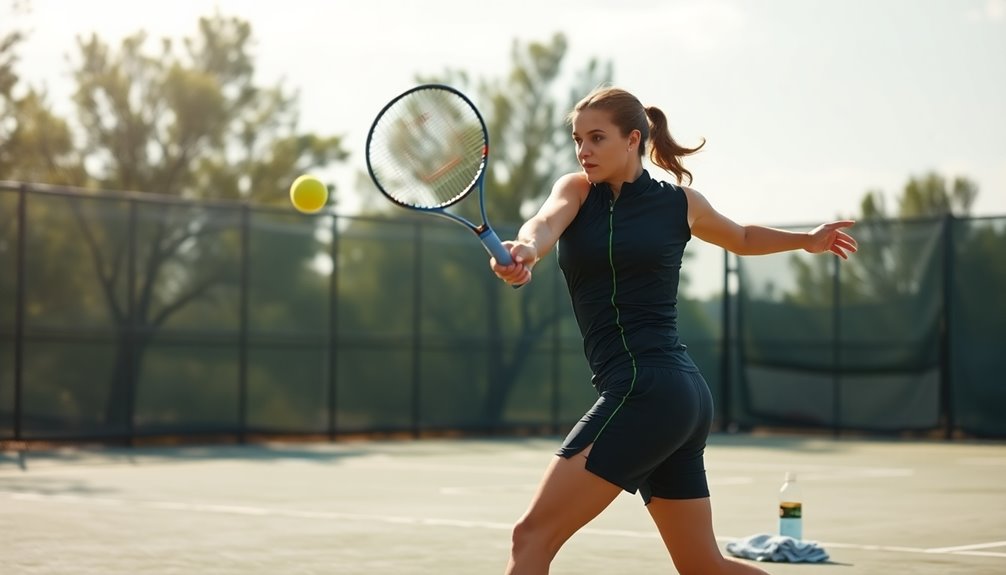
Wall drills are a fantastic way to enhance your tennis skills. They offer a benefits overview that’s hard to ignore.
First, you’ll improve your hand-eye coordination and reaction time, essential for effective gameplay. As you practice against the wall, you can focus on specific techniques without the pressure of a match. This creates a perfect environment for skill enhancement, allowing you to refine your strokes and footwork.
Additionally, wall drills can be easily customized; you can vary the intensity and focus on different shots, like forehands or backhands. Plus, you can practice anytime, making it a convenient option. Moreover, incorporating high-intensity sprints can elevate your overall athletic performance, similar to how soccer conditioning drills enhance endurance and speed.
Essential Equipment for Effective Wall Drills
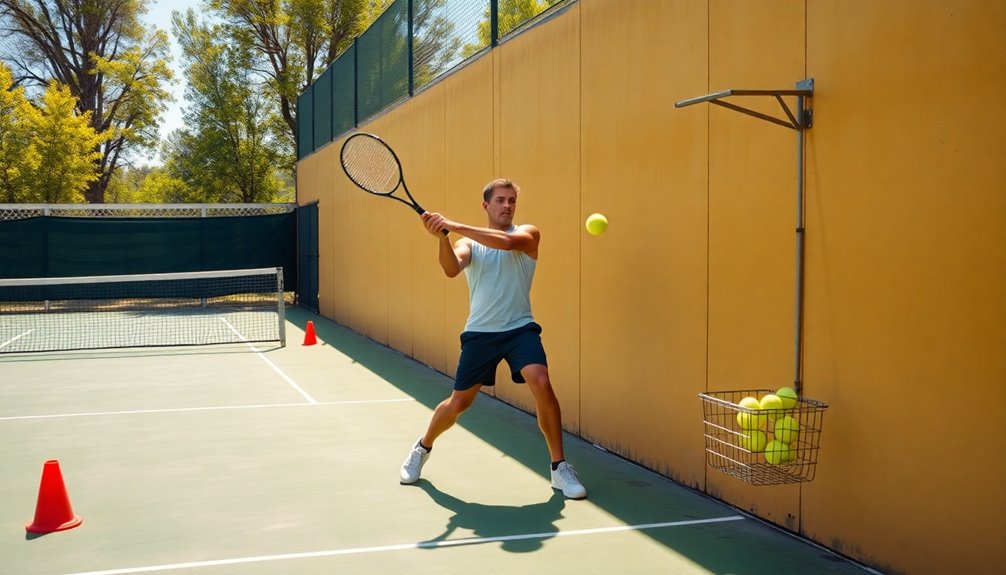
To maximize the benefits of wall drills, you’ll need some essential equipment that can enhance your practice sessions.
Start with a good-quality tennis ball; various ball types can help you work on different skills. Make sure you have a racket that feels comfortable and suits your playing style.
The wall surfaces you choose can affect your drills, so look for a solid, even surface that provides consistent rebounds.
Practice accessories like cones or markers can help you set up specific drills and improve your footwork.
Additionally, consider training aids like rebound nets to diversify your practice. Ensuring proper fit for your tennis gear, similar to how cleats impact soccer performance, can also enhance your comfort and effectiveness during drills.
Having the right equipment types and essential gear will make your wall drills more effective and enjoyable.
How to Find the Right Wall for Your Practice
Finding the right wall for your practice can greatly impact your training outcomes. Start by scouting the best locations in your area, like public parks or tennis facilities.
Check the wall conditions; it should be smooth, solid, and free of cracks. Consider safety considerations, making sure there’s enough space around you to avoid injuries.
Ensure the wall is smooth and solid, free of cracks, and that there’s ample space to practice safely.
Accessibility factors matter too—choose a spot you can reach easily, especially if you plan to practice regularly.
Evaluate surface types; a concrete wall offers a different bounce than a brick one. Be mindful of noise levels, as excessive sound can be distracting.
Finally, review lighting requirements to guarantee you can practice comfortably, and look for nearby facilities like restrooms or water fountains for convenience. Additionally, ensure the wall allows for a consistent bounce of the ball, as this is crucial for effective practice.
Basic Forehand Wall Drill: Technique and Tips
Improve your forehand by practicing the Basic Forehand Wall Drill, which helps develop consistency and technique. Start by establishing a solid forehand grip; this sets the foundation for effective swing mechanics.
As you prepare to hit, focus on your body positioning—keep your feet shoulder-width apart for ideal balance. Pay attention to your foot placement; stepping into the shot allows for better power and control.
As you swing, maintain a smooth rhythm, ensuring you follow through with your racket after contact. This reinforces follow-through techniques, essential for a successful forehand. Regularly practicing these elements will enhance your overall performance on the court, allowing you to hit with confidence and accuracy against your opponent. Additionally, incorporating dynamic stretches before your practice can help enhance flexibility and reduce the risk of injuries.
Mastering the Backhand Wall Drill: A Step-by-Step Guide
Elevate your game with the Backhand Wall Drill, an essential exercise for honing your backhand technique. To master this drill, focus on the following steps:
- Backhand Grip: Start with the correct grip to guarantee effective shot execution.
- Body Positioning: Position yourself at an ideal distance from the wall, allowing for fluid strokes.
- Foot Placement: Maintain proper foot placement to enhance balance and rotation mechanics during your swing.
- Wrist Action and Follow Through: Pay attention to your wrist action and follow through techniques to improve stroke consistency.
Incorporate timing drills and mental focus to elevate your balance practice and guarantee that every shot is precise and powerful. Remember, just as in soccer, proper equipment regulations can significantly impact your performance and safety.
With dedication, you’ll see remarkable improvements in your backhand skills!
Improving Your Serve With Wall Drills
Building on your backhand skills with the wall drill, it’s time to focus on enhancing your serve. Start by practicing different serve techniques against the wall. Experiment with wall angles to find the best bounce and observe how it affects your serve placement.
Incorporate spin variations for added unpredictability, and use rhythm practice to develop a consistent motion. Timing drills will help you hit the ball at the perfect moment, ensuring effective follow-through focus. Additionally, mastering serving techniques can significantly improve your overall gameplay.
Don’t forget the importance of mental preparation; visualize your ideal serve before each practice session. By combining these elements, you’ll not only improve your serve mechanics but also gain confidence in your ability to place your serves precisely during matches.
Footwork Drills: Enhancing Agility Against the Wall
Sharpen your footwork with targeted drills against the wall to enhance your agility on the court. Practicing specific movements will improve your coordination skills and reaction time. Additionally, understanding the importance of racial diversity in sports can inspire a broader appreciation for the game while you train.
Here are four effective drills to incorporate into your routine:
- Lateral Movement: Use agility cones to practice quick side-to-side shifts, mimicking game scenarios.
- Quick Pivots: Execute fast pivots while shadow swinging to develop fluid footwork patterns.
- Rhythm Drills: Alternate between sprint drills and balance exercises to build endurance and stability.
- Shadow Swings: Combine footwork with shadow swings, focusing on maintaining proper form while moving.
These drills will make your footwork more precise, enhancing your overall performance on the court.
Incorporating Volleys in Your Wall Practice
After improving your footwork with wall drills, it’s time to add volleys into the mix. Start by focusing on your volley technique, ensuring you maintain proper wall positioning.
Stand a few feet back to simulate the distance between you and an opponent. As the ball rebounds, engage in footwork drills to enhance your movement and reaction speed. Use this time to make timing adjustments based on the ball’s speed and angle.
Keep your practice intensity high to simulate match conditions, and concentrate on shot accuracy with each volley. This won’t only sharpen your skills but also boost your mental focus, preparing you for real-game scenarios where quick reflexes and precision are essential. Additionally, incorporating agility drills can further enhance your ability to respond quickly during volleys.
Advanced Wall Drills for Competitive Players
Elevate your game with advanced wall drills that push your skills to the next level. These exercises will enhance your tactical shot selection and build mental resilience essential for competitive play.
- Target Practice: Set specific targets on the wall and aim for them with varying spins and speeds.
- Rapid Fire Returns: Rally against the wall with a partner, increasing the pace to develop quick decision-making and shot execution.
- Footwork Drills: Incorporate lateral movement while hitting, focusing on positioning to enhance your agility and balance.
- Pressure Situations: Simulate match scenarios by setting a score to achieve within a time limit, promoting focus under pressure.
Incorporating agility training can further enhance your performance by improving your reaction time and coordination.
These drills will sharpen your skills and prepare you for the challenges of competitive tennis.
Creating a Wall Drill Routine: Sample Workouts
Craft a personalized wall drill routine to maximize your practice sessions and target specific skills. Start by selecting drill variations that align with your focus areas, like forehand strokes or volleys.
Aim for a practice frequency of at least three times a week, dedicating 30 to 60 minutes per session for effective technique refinement. Incorporate skill assessments during each workout to identify strengths and weaknesses, allowing for targeted adjustments.
Don’t forget to balance intensity with injury prevention strategies, ensuring you build mental toughness without overexertion. As you progress, plan performance reviews to evaluate improvements and adjust your routine accordingly. Including finishing drills can enhance your overall training by simulating game-like scenarios that improve decision-making under pressure.
This structured approach will keep you motivated and enhance your overall tennis proficiency.
Tracking Your Progress: How to Measure Improvement
To truly measure your improvement in tennis, you need to set clear goals and keep track of your performance metrics.
By recording your progress, you can see where you excel and where you need to focus.
Analyzing your consistency over time will give you a clearer picture of your development.
Set Clear Goals
While you’re honing your tennis skills, setting clear goals is essential for tracking your progress and measuring improvement.
Effective goal setting helps you focus your training efforts and enhances your performance analysis. Here are four steps to help you set those goals:
- Define Specific Skills: Identify which aspects of your game need improvement, like serve accuracy or footwork.
- Set Measurable Targets: Use quantifiable metrics, such as achieving a certain number of successful volleys per session.
- Establish Realistic Timelines: Determine a timeframe for each goal, ensuring it’s achievable.
- Review and Adjust: Regularly assess your progress and adapt your goals as needed to stay on track.
Record Performance Metrics
After setting clear goals, tracking your performance metrics becomes essential for measuring improvement. Use training logs for data tracking, noting key performance indicators like shot accuracy and rally length.
Regular skill assessments help you identify strengths and weaknesses, while improvement metrics can highlight areas needing focus. Implement feedback loops by reviewing your performance after each session, allowing for quick adjustments to your training plan.
Competitive benchmarking against peers provides context for your progress. Also, visualize your progress through charts and graphs to stay motivated and engaged.
This structured approach not only enhances consistency evaluation but also facilitates goal adjustment, ensuring you’re always on the right path to elevating your tennis skills.
Analyze Consistency Over Time
As you focus on improving your tennis skills, analyzing your consistency over time is essential for understanding your progress.
Implementing effective tracking methods can enhance your performance analysis. Consider these key strategies:
- Establish Consistency Metrics: Measure your accuracy and shot placement to assess skill retention.
- Engage in Long-Term Tracking: Regularly log your training frequency and practice variations to identify patterns.
- Set Improvement Benchmarks: Define clear goals to evaluate your progress over time.
- Utilize Feedback Loops: Review your performance regularly to adjust your training approach based on insights gained.
Common Mistakes to Avoid During Wall Drills
Though wall drills are a fantastic way to enhance your tennis skills, many players fall into common traps that can hinder their progress. One major issue is a lack of mistake awareness; if you’re not recognizing errors, you’re unlikely to improve.
Focus on your technique—hastily hitting the ball can lead to timing errors and footwork flaws. Regular consistency checks are essential; aim for a steady rhythm rather than random shots.
Also, be mindful of shot selection; using the same shot repeatedly can limit your growth. Finally, maintain a positive mental approach and practice discipline.
How to Stay Motivated With Solo Practice
To stay motivated during solo practice, you need to set clear goals that give you something to aim for.
Tracking your progress can keep you accountable and show how far you’ve come.
Mixing up drills not only makes practice more enjoyable but also helps you develop a well-rounded skill set.
Set Clear Goals
Setting clear goals is essential if you want to stay motivated during solo practice. Effective goal setting gives you a roadmap to follow and helps you measure your progress.
Here are four steps to help you set meaningful goals:
- Define Specific Objectives: Identify what skills you want to improve, like your serve or backhand.
- Set Measurable Targets: Use performance metrics to quantify your goals, such as hitting a certain number of accurate serves.
- Establish a Timeline: Decide when you want to achieve these goals to keep yourself accountable.
- Adjust as Needed: Regularly revisit your goals to guarantee they stay relevant and challenging.
Track Your Progress
Once you’ve established clear goals, tracking your progress becomes essential for maintaining motivation during solo practice. Start by using training journals to document your sessions, noting progress milestones and performance reflections.
This consistency tracking helps you see how far you’ve come. Incorporate feedback loops by reviewing your practice regularly; identify areas needing improvement and set new improvement benchmarks.
Regular skill assessments allow you to adjust your goals as needed, ensuring they remain challenging yet achievable. When you notice growth, celebrate those small victories, as they fuel your motivation.
Mix Up Drills
Mixing up your drills can keep solo practice fresh and exciting, especially when motivation starts to wane. Incorporating diverse drill variations not only sharpens your skills but also enhances your mental focus.
Here are four ways to revitalize your training:
- Timing Adjustments: Change the pace of your shots to improve reaction time.
- Stroke Refinement: Focus on specific strokes, like serves or volleys, for targeted improvement.
- Injury Prevention: Include stretching and recovery drills to keep your body healthy.
- Performance Analysis: Record your sessions and assess your progress, fostering a competitive mindset.
Combining Wall Drills With Other Training Techniques
While wall drills are a fantastic way to sharpen your tennis skills, combining them with other training techniques can elevate your practice to new heights. By integrating various methods, you’ll maximize benefits and create training variety.
For instance, alternate wall drills with agility exercises to improve endurance while developing rhythm. Incorporating visualizations during drills can enhance focus, fostering creativity in your gameplay.
Additionally, practicing specific strategies against the wall helps refine your tactics, allowing you to boost confidence when facing opponents.
When to Transition From Wall Drills to Court Practice?
Knowing when to shift from wall drills to court practice is essential for your development.
You should make the switch once you’ve mastered the basic skills and feel confident in your technique.
Additionally, timing your shift to align with upcoming matches can enhance your readiness and performance.
Skill Mastery Level
Shifting from wall drills to court practice is an essential step in your tennis development. To know when you’re ready, consider these indicators of skill mastery:
- Consistent Ball Control: You can accurately place your shots during wall drills without much thought.
- Varied Shot Types: You’ve mastered different strokes, like topspin, slices, and volleys, and can execute them reliably.
- Game Situations: You can simulate match scenarios in your drills, showing you understand tactical play.
- Feedback Integration: You’re able to adjust your technique based on self-assessment or coaching feedback.
Once you hit these milestones, you’re set for performance enhancement on the court, allowing for a smoother shift to real-game conditions.
Match Preparation Timing
As you refine your skills through wall drills, you’ll want to recognize the right moment to shift to court practice. Pay attention to your match rhythm; if your timing feedback suggests you’re consistently hitting targets and maintaining shot anticipation, it’s time to change.
When your practice intensity reaches a level where you can simulate game scenarios, you’re ready. Focus on incorporating pressure scenarios into your drills to enhance your mental focus. This will prepare you for real matches, where timing strategies become vital.
If you find you’re executing shots with confidence and precision, it’s a clear sign you should move to the court. The blend of wall drills and court practice will elevate your game to new heights.
Conclusion
In tennis, mastering skills at the wall isn’t just practice; it’s your secret weapon. By incorporating wall drills into your routine, you’re not just hitting a ball—you’re building confidence and precision that’ll shine on the court. As you shift from solo drills to the dynamic environment of a match, remember: every stroke you perfect brings you one step closer to your goals. So, why wait? Grab your racket and start transforming your game today!