

Wide Receiver Route Tree Explained (with Diagram)
March 27, 2026The wide receiver route tree is your go-to framework for understanding how receivers run routes. It’s essential for effective communication and play-calling on the field. Routes are categorized into short, intermediate, and deep types, with an easy numbering system to distinguish between them. Mastering these routes can boost your timing with the quarterback and enhance your game strategy. Keep exploring, and you’ll discover more about each route and how they can elevate your performance.
What Is the Wide Receiver Route Tree?
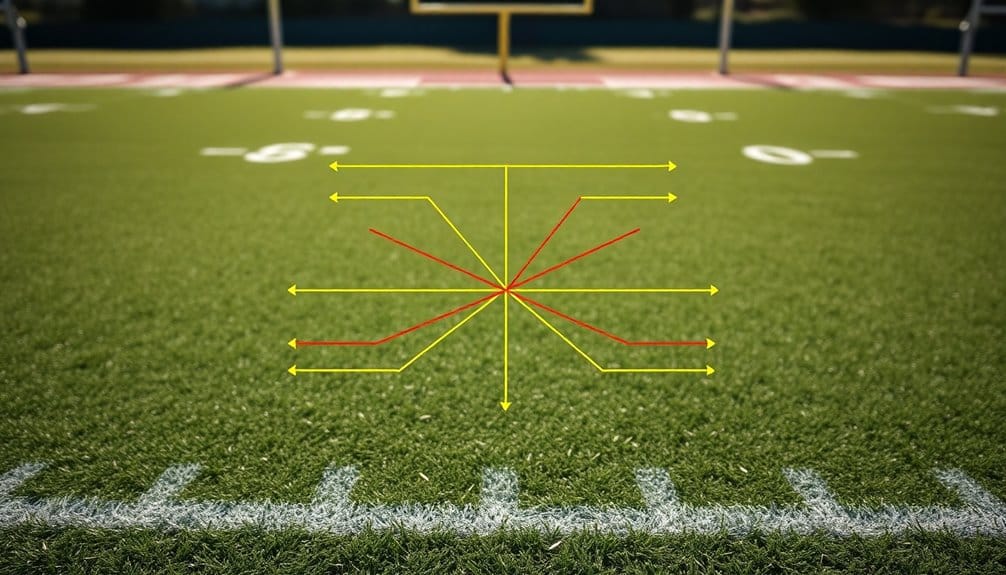
The Wide Receiver Route Tree serves as an essential framework for understanding the various routes a receiver can run. This visual representation categorizes routes into a structured format, making it easier for you to learn and communicate.
Each route’s assigned number and name standardize play-calling, enhancing communication between you and the quarterback. Routes are divided into short, intermediate, and deep categories, with odd-numbered routes breaking outward and even-numbered routes breaking inward. Mastering basic route types is crucial for effective performance on the field.
Why Does Understanding the Route Tree Matter?
Understanding the route tree is essential for enhancing your offensive strategy and timing with the quarterback.
When you grasp the routes, you can better recognize defensive alignments and exploit weaknesses.
This knowledge not only sharpens your route-running skills but also boosts your team’s overall effectiveness on the field. Additionally, mastering quick passing techniques enables players to make faster decisions and capitalize on defensive lapses.
Improves Offensive Strategy
Knowing the route tree is essential for enhancing your offensive strategy, as it enables players to recognize and execute a variety of passing routes efficiently.
When receivers master the route tree, they can create separation from defenders through precise route running, which is critical against different coverage schemes. Clear communication between quarterbacks and receivers minimizes miscommunication, allowing for smoother play execution.
By tailoring your offensive strategy using the route tree, you can exploit defensive weaknesses effectively, combining short and deep routes to create mismatches. This familiarity supports effective play-calling, allowing coaches to design complex plays that maximize your team’s offensive potential.
In short, understanding the route tree is significant for elevating your game and achieving success on the field.
Enhances Receiver Timing
Mastering the route tree directly enhances receiver timing, allowing you to sync your movements with the quarterback’s throws. When you understand each route’s depth and angle, you can create separation from defenders, making your timing essential for effective execution.
This knowledge also helps you anticipate defensive coverage, enabling quick adjustments that boost overall play efficiency.
- Improved communication reduces miscommunication, leading to accurate throws and catches.
- Consistent practice of the route tree strengthens your timing and rhythm, especially in high-pressure situations.
- A well-timed route allows for seamless offensive plays, increasing your chances of success.
Overview of Basic Routes in the Route Tree

The route tree features five basic routes that every wide receiver should know: the Flat, Slant, Comeback, Curl, and Out routes. Each of these basic routes serves a specific purpose on the field.
The Flat route is often run by slot receivers or tight ends, making a quick out after three vertical steps. The Slant route allows you to cut inside at a 45-degree angle, perfect for quick throws in short-yardage situations.
For the Comeback route, you fake a fade before breaking back outside, requiring a precise back-shoulder throw. The Curl route has you turning back toward the quarterback after running straight, while Out routes entail a sharp 90-degree cut after 10-15 yards, demanding strong arm strength from the quarterback. Mastering throwing techniques will significantly enhance the effectiveness of these routes.
Breaking Down the Flat Route
Understanding the flat route can markedly enhance a receiver’s effectiveness on the field. This quick out-breaking pattern, often executed by slot receivers or tight ends, enables fast completions and maximizes separation from defenders.
- It typically involves three vertical steps before breaking outside, creating space for quick passes.
- Flat routes shine in high-pressure situations, allowing quarterbacks to make quick options for rhythm throws.
- These short routes exploit mismatches against slower defenders, making them a strategic choice.
- Incorporating effective flag-pulling techniques can further support the success of flat routes by minimizing the chance of defenders closing in quickly.
Understanding the Slant Route and Its Uses
One of the most effective routes in a receiver’s arsenal is the slant route. This route involves taking one to three steps forward before cutting inside at a 45-degree angle, allowing for quick separation from the defender.
It’s particularly effective against man coverage, as it exploits the defender’s positioning, leading to fast completions. Quick throws are essential here, providing immediate yardage when needed.
Slant routes are versatile options that can be utilized anywhere on the field, making them ideal in both short-yardage and red zone situations.
In run-pass option (RPO) plays, these routes enable quick adjustments pre-snap, enhancing your offense’s ability to exploit defensive mismatches effectively. Additionally, practicing offensive routes consistently builds timing and communication among players, further enhancing the effectiveness of the slant route.
The Comeback Route Explained
A comeback route is a powerful tool in a receiver’s playbook, designed to create separation and generate first downs. It starts with you sprinting straight downfield, then faking a fade before breaking back toward the sideline at a 45-degree angle, usually around 12-15 yards deep.
This route is effective against off-coverage, allowing you to exploit space created by your initial vertical movement.
- Timing with your quarterback is essential for success, ensuring the ball arrives as you turn.
- The back-shoulder throw is often used here, challenging yet rewarding.
- This route helps in gaining first downs, letting you pivot back toward the quarterback while maintaining leverage against defenders. Additionally, proper hand positioning is crucial to secure the catch effectively in this high-pressure situation.
How Do Curl Routes Create Opportunities?
After mastering the comeback route, it’s time to explore how curl routes can open up your game. Curl routes involve running vertically for a few yards before making a sharp break back toward the quarterback, creating opportunities for quick completions.
These routes excel against zone coverage, exploiting soft spots where defenders are dropping back. By positioning yourself just beyond the marker, you can secure essential first downs with quick catches.
Curl routes thrive against zone coverage, targeting soft spots for quick, essential first downs just beyond the markers.
Timing is vital here; the quarterback must anticipate your break to deliver an accurate pass before defenders react. You can further create separation with body positioning and subtle fakes, making curl routes versatile tools in your offensive playbook. Incorporating teamwork and communication into your practice can enhance the effectiveness of these routes during games.
Embrace this route to enhance your effectiveness on the field!
Exploring Out and In/Dig Routes
Out and in (dig) routes are important tools in a wide receiver’s arsenal, providing quick gains and opportunities to exploit defensive weaknesses.
- Out Route: Run 10-15 yards before making a sharp cut toward the sideline.
- In Route (Dig): Break inside at a 90-degree angle after running vertically for quick yards.
- Separation Techniques: Use body positioning and footwork to create separation.
Both routes require space awareness to stay in bounds while positioning for the ball.
They play a significant role in the passing game, especially during critical moments like third downs. Mastering these routes helps you gain valuable yardage and keeps defenses guessing, maximizing your impact on the field. Additionally, understanding offensive strategies can enhance the effectiveness of these routes in various formations.
Intermediate Routes: Corner and Post
Intermediate routes, like the corner and post, are essential for wide receivers looking to make impactful plays.
The corner route breaks at a 45-degree angle toward the sideline, running about 10-12 yards downfield. It’s effective against both man and zone coverages, helping you create space underneath.
Meanwhile, the post route involves sprinting straight downfield before cutting toward the goalposts, targeting the deep middle of the field. This is particularly useful against two-high safety defenses.
Both routes rely on precise timing and spacing with your quarterback to guarantee successful completions and create separation from defenders. Incorporating flag football drills into your practice can further enhance your skill set.
Mastering these intermediate routes can enhance your effectiveness in various offensive schemes, creating defensive conflict and opening up opportunities for big plays.
The Importance of Deep Routes: Fly and Go
When you think about deep routes like fly and go, remember their key benefits: they stretch the defense and create big-play opportunities.
Timing is essential here; you need to sync up perfectly with your quarterback for that deep throw.
Plus, by pulling defenders deep, you open up space for shorter routes, giving your team multiple attacking options. Additionally, successful execution of deep routes can significantly enhance the effectiveness of offensive plays, making it crucial for wide receivers to master their timing and route running.
Key Benefits of Deep Routes
Deep routes, like fly and go routes, are vital for stretching the defense vertically, which not only creates space for underneath plays but also enhances offensive spacing. By utilizing your speed, you can gain maximum separation from defenders, making deep routes effective against both man and zone coverage.
Successful execution draws safeties away from the line, allowing for quick passes to shorter routes.
- They open up opportunities for big plays.
- The timing of deep routes is essential for quarterback-receiver chemistry.
- Incorporating these routes boosts your team’s scoring potential.
Incorporating deep routes into your playbook guarantees that defenses can’t solely focus on short-to-intermediate coverage, keeping them guessing and off-balance.
Timing and Separation Strategies
Incorporating deep routes like fly and go routes not only keeps defenses guessing but also hinges on effective timing and separation strategies.
When you sprint downfield on a fly route, your goal is to exploit vertical space, while the go route focuses on maintaining speed to leverage the defender’s positioning. Timing is essential here; the connection with your quarterback needs to be precise, ensuring the throw arrives just as you reach ideal separation.
By creating space, you can force defenders to backpedal, which opens opportunities for shorter routes underneath. This dynamic not only stretches the defense but also enhances your team’s offensive strategy, considerably increasing scoring potential.
Mastering these deep routes can be game-changing for you and your quarterback.
Combinations and Their Strategic Value
While effective route combinations can dramatically shift the dynamics of a play, their strategic value lies in creating mismatches and exploiting defensive weaknesses. By pairing routes like the Dagger concept, you can draw defensive backs away from your intended target, optimizing separation.
Additionally, combinations such as the Post Corner route are particularly effective against man coverage, especially in the red zone.
Using short routes alongside deeper ones forces defenders into tough decisions, while combination routes manipulate zone defenses to find soft spots.
- Create space for your receivers
- Enhance timing and spacing for better execution
- Exploit aggressive defenders to maximize offensive efficiency
Mastering these route combinations is key to elevating your game on the field.
How to Read Defenses Using the Route Tree?
How can you effectively read defenses using the route tree? Start by understanding how different defensive alignments impact your receiver routes.
In man coverage, look for routes like slants and quick outs; they help you create space by exploiting defenders’ positioning. Conversely, against zone coverage, focus on finding soft spots. Routes such as curls and digs allow you to settle into gaps, maximizing your chances for successful completions.
Pre-snap reading is essential—observe the alignment of defenders and adjust your routes accordingly. Combining routes, like pairing a corner route with a drag, can further confuse defenders and create mismatches.
Pre-snap reads are crucial; analyzing defender alignments allows for strategic route adjustments and effective combinations to create mismatches.
Mastering these strategies helps you identify ideal routes for any situation on the field.
Drills to Improve Route Running Skills
To elevate your route running skills, focus on targeted drills that enhance agility, timing, and precision. Here are some effective drills to improve your route running:
- Agility Cones: Set up cones to practice cutting techniques and improve your spatial awareness for maneuvering tighter routes.
- Depth Markers: Run routes at specific depths to build consistency and timing, vital for connecting with quarterbacks.
- Resistance Band Sprints: Use resistance bands during sprints to develop explosive acceleration, helping you beat press coverage.
Additionally, incorporate sideline toe-tap drills to enhance your balance and body control while catching passes.
Concentration catch drills can simulate distractions, improving your focus and reliability under pressure.
Make these drills a regular part of your training routine!
Tips for Effective Communication With Quarterbacks
Effective communication with quarterbacks is key to a successful offense. To enhance this, focus on establishing consistent timing and route depth, which is essential for effective communication and successful plays.
Use non-verbal cues like eye contact or hand signals to make quick adjustments, especially in noisy environments. Regular one-on-one practice sessions with your quarterback will deepen your understanding of each other’s playing styles and preferences.
Analyzing game film together helps both of you identify nuances in defensive coverage, ultimately improving route execution. Open discussions about route adjustments and preferred throwing angles foster trust and coordination on the field.
Visual Diagram of the Route Tree for Quick Reference
A visual diagram of the route tree is essential for quickly grasping wide receiver movements.
By using a clear numbering system, you can easily identify routes and communicate effectively with your quarterback.
This quick reference tool not only enhances your understanding of each route but also boosts your overall game performance.
Visual Representation Importance
Visual diagrams of the route tree serve as essential tools for players and coaches alike. These visual representations organize various receiver routes, making complex passing concepts easier to understand. By assigning specific numbers and names to routes, the diagram fosters clear communication between quarterbacks and receivers during play-calling.
- Helps recognize relationships between routes to exploit defensive coverage
- Illustrates angles and distances for mastering route breaks
- Provides quick reference for responsibilities during high-pressure situations
With a well-designed route tree, players can enhance their timing and execution on the field, improving overall performance.
In high-stress moments, having a visual reference can be the difference between success and failure, ensuring everyone is on the same page.
Route Numbering System
Understanding the route numbering system is essential for mastering the route tree. This system assigns odd numbers—like 1, 3, 5, 7, and 9—to out-breaking routes and even numbers—such as 2, 4, 6, and 8—to in-breaking routes. This clear communication helps you grasp different offensive strategies effectively.
Each route has specific distances: short routes (0-5 yards), intermediate routes (5-12 yards), and deep routes (12+ yards). The standardized names associated with each route number make play-calling quicker and reduce confusion during games.
Coaches rely on the route tree as a foundational teaching tool, allowing you to understand essential routes and their applications within various offensive schemes, enhancing your overall performance on the field.
Quick Reference Utility
While mastering the route tree, having a quick reference diagram can greatly enhance your grasp of various routes. This visual tool helps you quickly identify route numbers and names, making it easier to execute passing plays with precision.
Odd-numbered routes break outward, while even-numbered ones break inward, aiding in clear communication during plays.
Here are some key benefits of using a quick reference diagram:
- Improved Play-Calling: You’ll make strategic decisions faster.
- Enhanced Communication: Clear understanding between quarterbacks and wide receivers guarantees better timing.
- Simplified Strategy Adjustments: Quickly adapt during gameplay based on the situation.
Utilizing this diagram not only boosts your confidence but also elevates your performance on the field.
Conclusion
Understanding the wide receiver route tree is essential for any aspiring player. Did you know that in the 2020 NFL season, wide receivers averaged about 12.8 yards per reception? This highlights just how effective precise route running can be in gaining significant yardage. By mastering the routes and improving communication with your quarterback, you can elevate your game and make a real impact on the field. Now, get out there and start practicing those routes!

