

Printable Football Route Tree for Quick Reference
March 27, 2026Last updated: · By Jake Turner
A printable football route tree is a one-page chart that shows the standard pass routes a receiver can run, usually with a number or name for each, so quarterbacks, receivers, and coaches can use the same language. You can use it as a printable football route tree for quick reference during practice, film study, and game preparation. Route numbering is not standardized across teams, so the most useful chart is one you check against your own playbook.
Key Takeaways
- A route tree is a diagram of the basic pass routes a receiver runs from a set alignment, and a printable version lets you study it anywhere.
- Many charts number routes so a quarterback can call them quickly, but no single numbering system is official across teams or levels.
- A common convention gives odd numbers to routes that break outside and even numbers to routes that break inside, though many teams use their own scheme.
- The NFHS describes its major rule comparison with the NCAA as a document that does not replace the official NFHS Football Rules Book.
- The Oregon School Activities Association describes the NFHS as the sole and exclusive source of model interpretations of NFHS football rules.
What Is a Printable Football Route Tree?
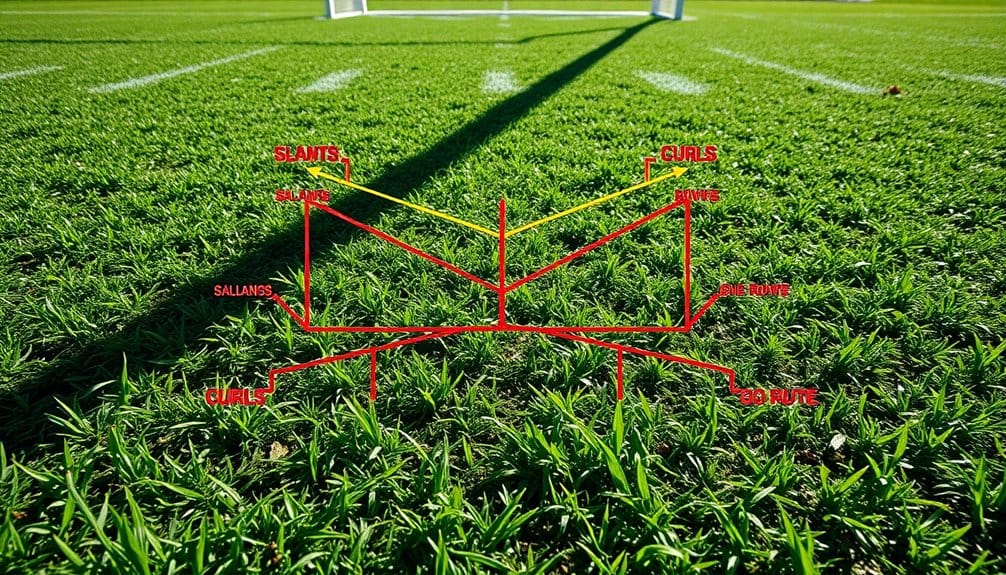
A football route tree is a diagram of the basic pass routes a receiver runs from a set alignment. A printable version puts that diagram on paper so you can study it, carry it to practice, and point to it during a play discussion. The routes branch out from a common starting point, which is why the layout is called a tree.
Each route has a name that describes its shape. A slant cuts diagonally across the field, a corner breaks toward the sideline near the end zone, and a post breaks toward the goalposts. For a labeled diagram with a deeper walkthrough of each branch, see our wide receiver route tree diagram and explanation.
How Does Route Numbering Work?
Route numbering lets a quarterback call a route by a number instead of a longer name, which saves time in the huddle. A common convention gives odd numbers to routes that break toward the sideline and even numbers to routes that break inside. That convention is a coaching habit, not an official standard, so treat it as a starting point.

Numbering varies from staff to staff. Some teams number routes from the outside in, and some assign numbers to route combinations or concepts. Before you rely on any printable chart, confirm the numbers against your team’s terminology and write your team’s labels in the margins.
Which Routes Should Be on Your Printable Chart?
Most printable charts include the short, intermediate, and deep routes a team uses most often, such as the slant, hitch, flat, out, curl, comeback, corner, post, and go. The table below summarizes the typical break and purpose of each route. Alignments are common placements, not fixed assignments.
| Route | Typical break | Main purpose | Common alignment |
|---|---|---|---|
| Slant | Step upfield, then cut inside at roughly 45 degrees | Quick throw across the middle | Slot or outside receiver |
| Hitch | Run a few steps, stop, and turn back to the quarterback | Quick throw with room to gain yards after the catch | Outside receiver |
| Flat | Short run, then break toward the sideline | Quick gain against soft coverage | Slot receiver or running back |
| Out | Run upfield, then break sharply toward the sideline | Sideline yardage | Outside receiver |
| Curl | Run upfield, stop, and turn back into open space | Find soft spots in zone coverage | Outside receiver |
| Comeback | Run upfield, then break back toward the sideline and quarterback | Back-shoulder throws and separation | Outside receiver |
| Corner | Run upfield, then break toward the corner of the end zone | Deep sideline throws | Outside receiver |
| Post | Run upfield, then break toward the goalposts | Throws over the middle of the field | Outside receiver or slot |
| Go | Run straight upfield | Stretch the defense deep | Any receiver |
How Do You Run the Key Routes Well?
The key to every route is the break point, the moment the receiver changes direction. A clean break depends on selling the route’s first phase, keeping your speed under control, and finishing the break on time with the quarterback’s release. Practice the break point more than the route shape itself.
How Does a Slant Create Separation?
A slant creates separation by using a short upfield step to set up a sharp inside cut, which can leave a defender reacting late. The receiver should keep the cut tight and finish it quickly so the ball arrives before the defender recovers. Timing with the quarterback matters more here than on most routes.
What Makes a Comeback Route Work?
A comeback works when the receiver sells a deep route and then turns back toward the quarterback at the moment the ball is released. The turn should lead the receiver to the sideline shoulder so the quarterback can throw a back-shoulder ball. Practice the turn at game speed, because a late break gives the defender time to close.
How Should You Time an Out Route?
An out route is a run upfield followed by a sharp break toward the sideline, and it is most effective when the break lands as the quarterback releases. Many coaches teach a consistent upfield depth so the quarterback can throw the same timing pattern each time. Confirm the depth your staff uses before you put it on a printed chart.
Why Use a Printable Route Tree for Quick Reference?
A printed chart gives you a fast visual check on route names, shapes, and numbers without opening an app or flipping through a binder. It is most useful as a memory aid and a communication tool between the quarterback and receivers. A chart supports practice, but it does not replace repetition.
- Keep one copy in your bag and one on the sideline for quick checks.
- Write your team’s terms next to each route so everyone uses the same words.
- Review route shapes before walkthroughs and before each game week.
- Use the chart to teach new players where each break point should happen.
What Do the Rulebooks Say About Routes and Receivers?
Official rulebooks define passing and receiver protection, but they do not standardize route trees. The rules matter for route design because they determine how the passing sequence is defined and when a receiver is protected from contact. Always check the rulebook for the level you play.
The 2021 NFHS Football Rules Book defines passing as throwing a ball that is in a player’s possession. That definition is the basic quarterback-to-receiver sequence that every route tree depends on.
The 2025 NCAA Football Rules and Interpretations defines a receiver attempting to catch a forward pass, or one in position to receive a backward pass, as a player covered by its protective rules. That matters in route-based contact situations, where the timing of the break and the throw can decide whether a receiver is protected.
A comparison of major NFHS and NCAA football rule differences from the National Federation of State High School Associations notes that it is not meant to replace the official NFHS Football Rules Book. Use it to spot differences, then confirm exact wording in the full rulebook. The Oregon School Activities Association’s 2023 football rule changes document describes the NFHS as the sole and exclusive source of model interpretations of NFHS football rules, which makes it the authority for high school rule explanations.
How Do You Build Your Own Printable Route Tree?
You can build a useful printable route tree by drawing your team’s routes from one common alignment, labeling each one, and checking the labels with your quarterbacks. A chart built from your own playbook is more accurate than a generic diagram. Keep it to one page so it stays easy to scan.
- Pick the routes in your playbook, starting with eight to ten of the most common.
- Draw each route from the same alignment, using a dashed line for the break point.
- Label each route with its name and the number your staff uses.
- Write the break point and target depth in plain words, such as

