

Printable Football Route Tree for Quick Reference
March 27, 2026A printable football route tree is a handy tool for you to quickly reference passing routes during practice or games. It organizes routes with a numbering system, helping you and your teammates communicate effectively. Odd-numbered routes are typically out-breaking, while even ones break in. Mastering these routes—like the Flat or Slant—can enhance your performance on the field. Plus, there are advanced concepts that can give your plays an edge, so keep exploring to discover more strategies!
What Is a Football Route Tree?
The Football Route Tree is an indispensable tool for quarterbacks and receivers, mapping out various passing routes in a clear, standardized format. This visual diagram organizes passing routes through a route numbering system, assigning specific numbers and names to each route, like the slant (2) and out (5).
Odd-numbered routes typically involve out-breaking patterns, while even-numbered routes focus on in-breaking routes, which helps in developing effective offensive strategies. Coaches use the route tree to teach route running and timing, ensuring players understand their roles within a play. Understanding defensive coverage types can further enhance a team’s ability to execute these routes effectively.
Why Use a Printable Route Tree?
Using a printable football route tree gives you a quick reference that streamlines communication on the field. It helps you grasp the purpose of each route, making it easier to execute plays effectively. Plus, having a physical copy allows you to study routes anytime, boosting your understanding and performance during games. Additionally, familiarizing yourself with offensive plays enhances your ability to adapt during dynamic game scenarios.
Benefits of Quick Reference
While practicing or strategizing for a game, having a printable football route tree at your fingertips can greatly streamline communication on the field. This quick reference tool allows players and coaches to visualize various route assignments clearly, enhancing decision-making and execution.
By providing a structured format, it helps reinforce learning, making it easier for you to memorize routes and their respective numbers. Plus, a customized route tree can align with your team’s offensive schemes, incorporating player strengths for tailored strategies.
Utilizing this resource minimizes miscommunication between quarterbacks and receivers, ensuring precise timing and accuracy in passing plays. In short, a printable route tree is essential for effective teamwork and success on the field.
Enhances Play Understanding
Understanding football routes is essential for success on the field, and a printable route tree makes this task much easier. This quick reference tool helps you visualize various routes, enhancing your comprehension of offensive plays.
By standardizing route terminology, it improves communication between quarterbacks and receivers, reducing the risk of miscommunication during critical moments. The organized structure of the route tree allows you to memorize routes efficiently, ensuring you execute your responsibilities flawlessly.
With a physical copy, you can quickly recall routes during practice and games, promoting on-field efficiency. Plus, it’s invaluable for teaching new players the fundamentals of route running, helping them grasp key concepts like timing and spacing in the passing game.
Key Components of the Football Route Tree
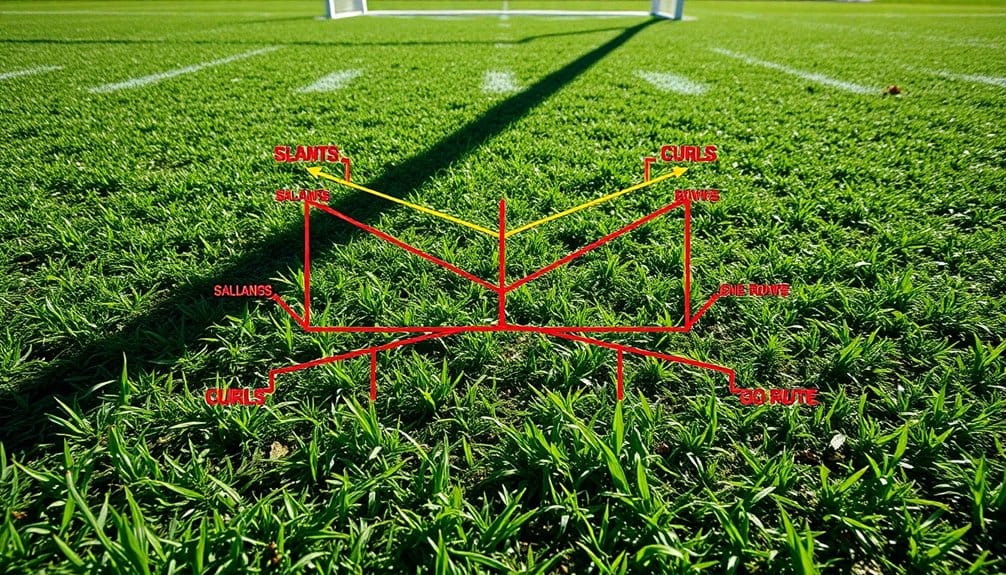
Understanding the key components of the football route tree is vital for any player. You’ll notice that each route type serves a specific purpose, and precision is essential for effective execution. Mastering basic routes is crucial for performance, as they have unique applications and effectiveness in different game situations.
Route Types Overview
The Football Route Tree is essential for organizing receiver routes, making it easier for players and coaches to communicate effectively.
In this route types overview, you’ll find that routes are categorized into three main types: short, intermediate, and advanced.
Short routes, like Flat and Hitch, focus on quick, short-yardage gains, ideal for high-pressure situations.
Intermediate routes, such as Post and Corner, target specific areas to exploit defensive weaknesses, demanding precise timing.
Advanced routes, including Post Corner and Dig, mix elements of various routes to create confusion for defenders.
Importance of Precision
Mastering the route types is just the beginning; precision plays an essential role in executing them effectively. Each route’s specific angle and depth dictate how well you can achieve separation from defensive coverage.
For example, a 45-degree cut on a slant or a sharp break on a comeback can make all the difference. Miscommunication often arises when you deviate from these precise routes, risking turnovers or missed completions.
Furthermore, timing between you and the quarterback improves with consistent execution, reducing the chances of defenders anticipating your movements. A well-defined route tree serves as a standardized language, ensuring everyone understands the plays and can react swiftly in dynamic game situations.
Embrace precision, and you’ll elevate your game considerably.
Understanding Basic Routes: An Overview
Football routes form the backbone of a successful passing game, allowing receivers to maneuver effectively against defenders. Understanding basic routes is vital for any receiver looking to excel in football.
Each route, like the Slant or Comeback, serves a specific purpose in offensive strategies. For instance, the Flat Route targets the sidelines for quick gains, while the Slant Route helps you gain separation across the middle.
The Comeback Route involves sprinting downfield before turning back to the quarterback, perfect for those back shoulder throws. Mastering these fundamental routes not only enhances your individual performance but also strengthens the team’s overall effectiveness in exploiting defensive weaknesses. Additionally, using gear like non-metal football cleats can improve your traction and performance on the field.
Embrace this understanding, and you’ll elevate your game and communication with teammates.
Flat Route: Quick Breakdown and Usage
The Flat Route is all about quick execution and gaining immediate yardage. You’ll want to understand its key characteristics and when to use it effectively to exploit defensive weaknesses. Utilizing color-coded wristbands can enhance communication during execution, ensuring that all players are on the same page.
Key Characteristics of Flat Routes
Flat routes are essential tools in a receiver’s arsenal, particularly for slot receivers and tight ends. This quick out-breaking route typically exploits soft coverage, allowing you to gain short yardage effectively.
As a receiver, you’ll take three quick steps vertically before breaking outside toward the sideline, aiming for a quick pass from the quarterback. Timing is vital here; the quarterback must deliver the ball swiftly to prevent defenders from closing in.
This route often creates mismatches against slower defenders, making it valuable in various offensive schemes, including RPOs (Run-Pass Options). By mastering the flat route, you can stretch the defense horizontally and keep the chains moving.
Ideal Situational Usage
When facing a zone defense, utilizing the flat route can be a game-changer. This route, often executed by slot receivers or tight ends, allows for quick passes that exploit soft spots near the sidelines. Timing is critical; your quarterback needs to deliver the ball swiftly to thwart defenders closing in.
- Create space: Combining flat routes with deeper routes can confuse defenders.
- Quick execution: The flat route enables fast gains, perfect for short yardage situations.
- Strategic advantage: Use it as part of your overall offensive strategy to keep the defense guessing.
Slant Route: How Does It Create Separation?
Mastering the slant route can transform a receiver’s game by creating quick separation from defenders. By taking just one or three steps forward before cutting at a 45-degree angle, you leverage your initial momentum.
This rapid change of direction makes it tough for defenders to react in time. The slant route is especially effective against tight coverage, allowing you to create space for a quick throw from the quarterback.
Timing is essential; when executed well, this route can lead to significant yards after the catch, especially if defenders are caught flat-footed.
Its versatility means you can run slant routes from any position, making them a valuable tool in various offensive schemes, including RPOs. Effective spacing among receivers facilitates the successful execution of slant routes by creating clear passing lanes.
Comeback Route: Timing and Execution Tips
When running a comeback route, timing is everything. You need to make that sharp cut just as the quarterback is releasing the ball for a precise connection.
To create effective separation, sell your initial speed and body language to keep the defender guessing. Incorporating quick routes like slants can also help to set up the defender for the comeback route.
Route Timing Importance
To effectively execute a comeback route, timing is essential, as it hinges on the receiver’s ability to sell a deep route before sharply breaking back toward the quarterback. This requires precise timing to guarantee the quarterback needs to anticipate the receiver’s break.
Successful execution allows the receiver to create separation from the defender, especially against man coverage.
- Maintain speed during the break to keep momentum.
- Practice timing with the quarterback for consistency.
- Focus on delivering the ball as the receiver turns for a back shoulder throw.
Effective Separation Techniques
Executing a comeback route effectively hinges on your ability to create separation from the defender. Start by selling the deep route; this will draw the defender in.
Timing is essential—aim to turn back just as the quarterback releases the ball for an accurate back-shoulder throw. To maximize your effectiveness, focus on your footwork; use quick, explosive steps to gain leverage before you break.
Incorporate subtle body language and head fakes to further deceive defenders, enhancing your chances of creating space for the reception. These techniques are effective against both man and zone defenses, ensuring you can make a clean catch and keep the offense moving.
Mastering this route will elevate your game considerably.
Curl Route: Finding Soft Spots in Coverage
As you run your Curl Route, the key lies in finding those soft spots in zone coverage. You want to identify pockets of space between defenders, allowing you to create an opportunity for a successful completion.
Timing and precision are essential; pivot sharply to face your quarterback for that accurate throw.
- Target areas where defenders are deeper than you.
- Use a quick break to create separation.
- Focus on securing the catch for potential yards after the catch.
Executing the curl route effectively can exploit off-coverage, making it a valuable asset in your receiving arsenal. Additionally, understanding basic plays and routes can further enhance your effectiveness in exploiting defensive weaknesses.
Out Route: Gaining Yardage Near the Sidelines
After mastering the Curl Route, the Out Route offers another opportunity to exploit defensive weaknesses. This route typically involves you running straight downfield for about 10-15 yards before making a sharp break toward the sidelines.
It’s particularly effective for gaining yardage near the sidelines, allowing your quarterback to make quick, rhythm throws. Timing is essential; you need to break for the sideline just as your quarterback releases the ball.
The Out Route works well in both short and intermediate passing plays, making it versatile against various defensive coverages. When executed effectively, it can create significant yardage gains, especially if defenders are playing off coverage.
Utilizing this route can also help create game-changing opportunities by pulling defenders away from the middle of the field. Use this route to keep defenses guessing and gain vital yards.
Intermediate Routes: Expanding Your Playbook
When you incorporate intermediate routes like corner and post routes into your playbook, you open up a world of opportunities to exploit defensive weaknesses. These routes, typically ranging from 10 to 15 yards, are effective against defenses and can create mismatches through quick shifts and deceptive combinations.
- The corner route breaks at a 45-degree angle, creating space underneath for an accurate throw.
- Post routes target the deep middle, pulling defenders away from the center.
- Square out routes exploit defenders playing off, requiring precise timing with the quarterback.
Incorporating agility drills into practice can further enhance route precision and receiver effectiveness.
Advanced Routes: Strategies for Big Plays
Building on the intermediate routes you’ve already integrated into your playbook, advanced routes take your offensive strategy to the next level, creating high-impact opportunities for big plays.
The Post Corner route effectively exploits overly aggressive defenders, creating separation in the red zone.
The Post Corner route capitalizes on aggressive defenders, generating crucial separation in the red zone for scoring opportunities.
Meanwhile, the Sluggo Route starts with a slant, then breaks deep, misleading defenders for potential big gains.
The Wheel Route curves upfield, confusing opponents and targeting mismatches against slower defenders.
Double Move Routes add misdirection, enhancing your chances for explosive plays.
Ultimately, the Yankee Concept combines a dig route with a deep post, stretching the defense and creating natural coverage conflicts.
Master these routes, and watch your offense thrive with big plays!
How to Design Offensive Plays With the Route Tree
To design effective offensive plays using the Route Tree, you need a clear understanding of each route’s purpose and how they interact.
Combine short, intermediate, and deep routes to manipulate defensive alignments and create opportunities. Here are some strategies to contemplate:
- Pair quick routes like slants and outs with deep routes to stretch the defense.
- Adapt your plays based on the opponent’s weaknesses, ensuring you exploit mismatches.
- Incorporate variations like double moves to keep defenses guessing.
Training Drills to Improve Route Running
Improving route running hinges on consistent practice and focused drills. Start with perfecting stance; make sure your foot placement allows for explosiveness.
Incorporate speed and agility drills, like cone exercises and ladder work, to enhance quickness and change of direction. Add varying releases, teaching techniques such as stutter steps and shoulder fakes to create separation from defenders.
Continuous practice is key—run timed routes to refine your timing and precision. Focus on building a diverse arsenal by mastering multiple route types, including quick-outs and deep-posts.
This adaptability will help you effectively counter different defensive coverages. With dedication to these drills, you’ll elevate your game and become a more effective receiver in the quick game.
Tips for Effective Communication Between Quarterbacks and Receivers
Effective communication between quarterbacks and receivers is essential for successful play execution. To enhance this crucial connection, consider these tips:
- Establish shared terminology that aligns with your route tree, ensuring both parties understand play calls and adjustments.
- Use visual aids, like route diagrams, to reinforce expectations during execution.
- Conduct regular practice sessions that focus on timing and emphasize both verbal and non-verbal cues.
Encourage receivers to provide feedback on routes and defensive alignments during games, allowing for real-time adjustments.
Encouraging receivers to share insights on routes and defenses fosters real-time adjustments and enhances overall team performance.
Additionally, utilize film study to analyze past plays and recognize successful communication patterns, pinpointing areas for improvement.
This proactive approach fosters a stronger bond, leading to more effective and instinctive play on the field.
Customizing the Route Tree for Your Team’s Needs
Customizing your route tree can greatly enhance your team’s performance on the field. Start by evaluating your strengths and weaknesses, tailoring the route tree to match your receivers’ skills and your quarterback’s throwing ability.
Incorporate unique route variations that reflect your offensive philosophy, allowing for creativity while ensuring clarity in communication. Use a digital or physical template that’s easy to modify, keeping it relevant throughout the season.
Regularly review and adjust the route tree based on opponent defensive schemes and player development to maximize effectiveness. Foster a shared understanding among players through meetings and practice sessions focused on the customized route tree, enhancing execution and timing during games.
Adaptability is key for success on the field!
Conclusion
To summarize, having a printable football route tree at your fingertips can greatly enhance your game strategy. Did you know that NFL quarterbacks complete over 60% of their passes when receivers run precise routes? By mastering this essential tool, you’ll improve communication and execution on the field. So, take the time to familiarize yourself with the route tree, and watch your team’s performance soar!

