
The D-Line: Understanding Defensive Line Positions and Techniques
March 20, 2026The defensive line plays a crucial role in football, acting as the first line of defense against offensive plays. You’ve got two key positions: defensive ends, who contain runs and pressure quarterbacks, and defensive tackles, who clog running lanes. Mastering techniques like gap control and understanding different defensive fronts, like Over and Bear, helps you optimize your strategy. Plus, honing essential pass-rush moves will enhance your effectiveness. There’s much more to explore about these positions and techniques.
What Is the Role of the Defensive Line in Football?
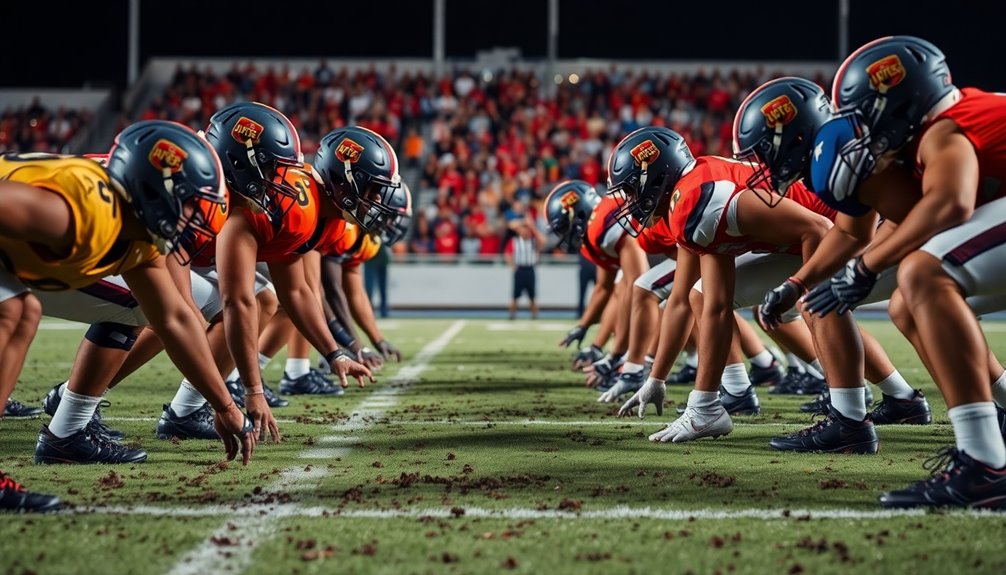
The defensive line is the front line of defense in football, tasked with stopping both the run and the pass. As a player, your role as a defensive lineman involves using your strength and technique to engage offensive blockers effectively.
In run stopping, you focus on gap control, ensuring that ball carriers can’t slip through unchallenged. Depending on your position—either a defensive tackle or a defensive end—you’ll adapt your approach.
Defensive tackles align inside the guards, while defensive ends apply pressure on the quarterback. Mastering your technique allows you to shed blocks and maintain gap integrity, making your defensive line a formidable barrier against opposing offenses. Effective communication among teammates is essential to ensure successful execution of defensive strategies.
Your performance directly influences the game’s outcome.
Key Positions: Defensive Ends and Defensive Tackles
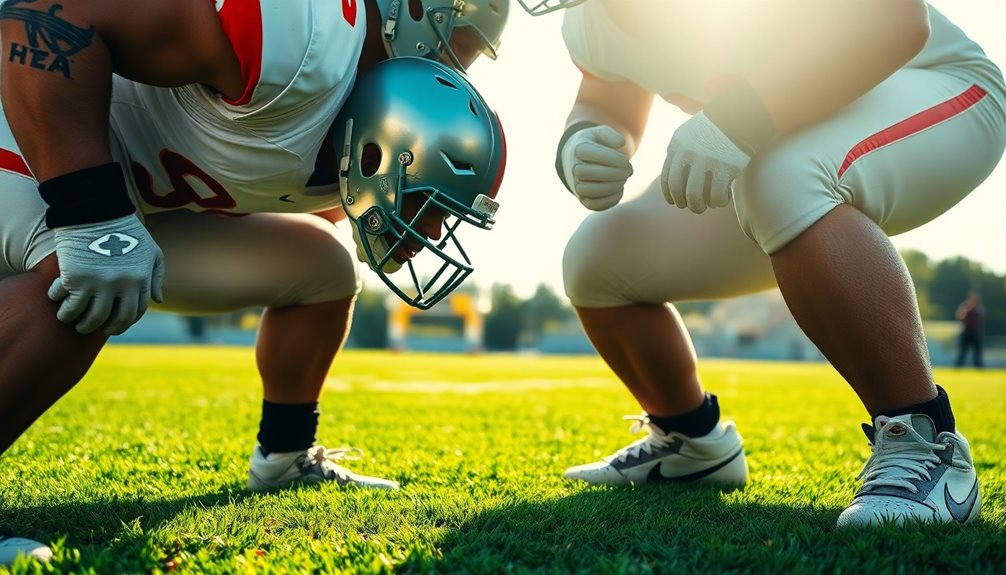
In football, defensive ends and tackles play essential roles in stopping the offense. DEs focus on containing runs and pressuring the quarterback, while DTs work to clog running lanes and shed blockers. Understanding their responsibilities and techniques can elevate your appreciation of defensive strategies on the field. Effective conditioning for these positions includes position-specific drills that enhance strength and agility to meet the demands of the game.
Roles Of Defensive Ends
While defensive ends (DEs) often line up on the outer edges of the defensive line, their roles extend far beyond mere positioning.
In a 4-3 defense, they align in 5-technique or 7-technique, focusing on containing the run and applying pressure on the quarterback.
You’ll notice that DEs employ various pass-rush techniques, like the bull rush and spin move, to outmaneuver offensive tackles and disrupt plays in the backfield.
Their quickness and strength are critical for engaging opponents and filling gaps effectively.
Whether it’s stopping a run play or launching an attack on passing downs, defensive ends are essential in shaping the outcome of each play, making their roles significant in any defensive scheme.
Responsibilities Of Defensive Tackles
Defensive tackles (DTs) play an essential role in a defense’s success, primarily focusing on stopping the run and disrupting passing plays. Positioned between offensive guards, you engage in inside play, tackling ball carriers within your assigned gaps.
In a 4-3 defense, two DTs work together to control the middle, while in a 3-4 defense, the nose tackle faces double teams directly over the center. Your primary responsibilities include using your quick get-off speed to beat offensive linemen off the snap, maintaining balance to absorb blocks, and leveraging your strength to shed them.
Staying alert and having good field vision helps you anticipate plays and react swiftly, making you a vital part of defense against both the run and pass.
Techniques For Both Positions
Understanding the techniques for defensive tackles (DTs) and defensive ends (DEs) is essential for maximizing their effectiveness on the field. Here are key techniques to focus on:
- Gap Control: DTs should master 1-gap and 2-gap techniques to dominate the A and B gaps, maintaining defensive integrity.
- Explosive Get-Off: Both positions need explosive get-offs at the snap to penetrate quickly and disrupt plays.
- Pass-Rush Moves: DEs can use the long-arm maneuver and spin move to evade blockers, while DTs often employ the bull rush to collapse the pocket.
- Edge Containment: DEs should adopt the 5-technique and 7-technique to effectively contain outside runs and apply pressure on the quarterback.
Mastering these techniques will elevate your game as a defensive lineman.
Understanding Gap Control vs. Man Control Techniques
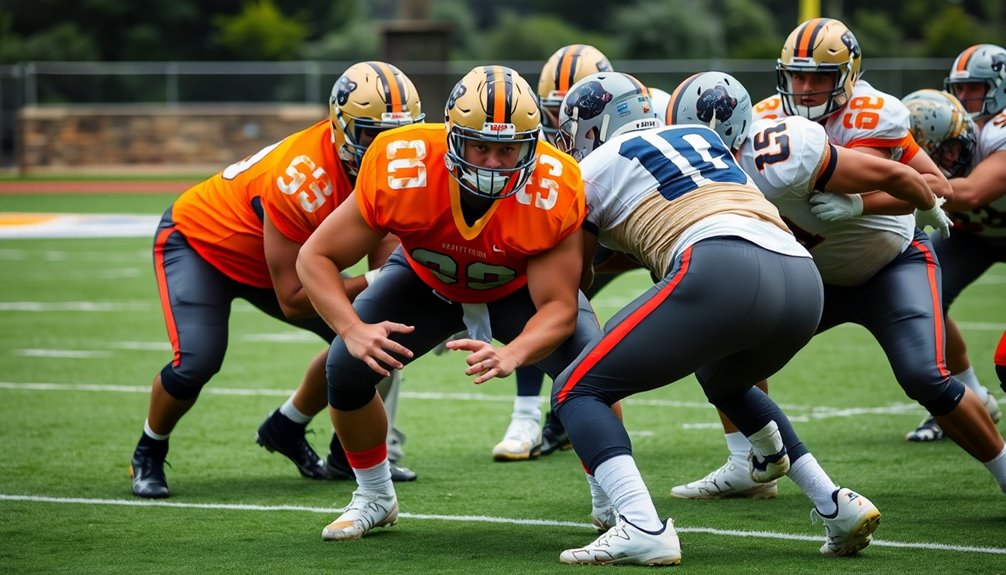
Gap control and man control techniques are essential for defensive linemen looking to dominate the line of scrimmage.
In gap control, you’re responsible for specific gaps—A, B, C, or D. Your goal is to prevent running backs from exploiting holes by maintaining your positioning and leverage. This technique focuses on slowing down or redirecting the running back, ensuring gap integrity.
Conversely, man control, or two-gapping, requires you to engage an offensive player while being ready to defend against the ball carrier in multiple gaps. This approach emphasizes shedding blocks to tackle effectively.
Mastering both techniques is vital for disrupting plays and stopping the run, making you a formidable force on the defensive line. Additionally, understanding formation adaptability is crucial for effectively countering various offensive strategies.
Defensive Lineman Alignments Explained
Mastering gap control and man control techniques lays the groundwork for effective defensive lineman alignments. Each alignment serves a specific purpose and can be essential in countering an offense’s strategy.
Here are four key alignments to know:
- 0 Technique: Directly over the center, ideal for clogging the middle.
- 2 Technique: Positioned over the guards, enhancing gap control.
- 4 Technique: Aligns outside the tackle’s inside shoulder, useful for disrupting plays.
- 5 Technique: Outside the tackle, vital for edge containment.
Understanding these alignments allows you to exploit weaknesses and maintain gap integrity, ensuring every defensive lineman plays their role effectively. Additionally, effective communication among teammates is essential for adapting to changing offensive strategies.
Mastering alignments enables you to identify weaknesses and uphold gap integrity, ensuring each defensive lineman executes their role effectively.
Always adjust based on the offensive formation to enhance your overall defensive strategy.
Popular Defensive Fronts: Over, Under, and Bear Fronts
When you’re looking to fortify your defense, knowing the different fronts—like the Over, Under, and Bear—can make all the difference.
The Over Front aligns the 3-technique defensive tackle to the offensive strength, creating pressure against running plays. Conversely, the Under Front positions the 3-technique on the weak side, enhancing run support and pass rush opportunities.
Meanwhile, the Bear Front features three interior linemen focused on gap control, disrupting the offensive line and excelling against power running schemes. Understanding formation structures allows defensive coordinators to optimize their strategies based on the offense’s strengths, ensuring your defense remains adaptable and effective.
Each front allows defensive coordinators to optimize their strategies based on the offense’s strengths, ensuring your defense remains adaptable and effective. Understanding these fronts is vital for making the right calls on game day.
How Stunts and Games Enhance Defensive Strategy
When you think about defensive strategy, stunts and games are key tools that can turn the tide in your favor.
By mastering various types of stunts and understanding how to execute pass rush games, you can create chaos for the opposing offense.
This not only disrupts their play but also puts pressure on the quarterback, giving your team a significant advantage. Incorporating agility drills into your training regimen can further enhance your defensive line’s effectiveness in executing these strategies.
Types of Defensive Stunts
Defensive stunts are essential tools that enhance a team’s strategy by creating confusion among offensive linemen. These tactics facilitate penetration and disrupt blocking schemes, leading to more effective defense.
Here are four common types of defensive stunts:
- TAG (Tackle in A Gap): This stunt sends the tackle directly into the A gap, creating mismatches.
- NATO (Nose and Tackle Exchange): A twist that confounds offensive linemen by swapping positions.
- Inside Move: Defenders spike at a 45-degree angle to close gaps and limit rushing lanes.
- Twist Stunt: A coordinated movement that maximizes pressure on the quarterback, resulting in increased quarterback hits.
Executing these stunts effectively not only disrupts the offense but also elevates your defensive game.
Pass Rush Games Explained
While it may seem straightforward, pass rush games are a complex dance of strategy and timing that can turn the tide of a game. In these coordinated movements, defensive linemen twist and exchange gaps to create pressure on the quarterback.
Stunts like TAG and NATO confuse offensive linemen, exploiting mismatches in their blocking assignments. For these games to succeed, precise timing and communication among defensive linemen are essential to penetrate the offensive line effectively.
Incorporating linebackers further complicates the offense’s blocking schemes, making it tough for them to predict where the pressure will come from. Ultimately, the success of pass rush games hinges on defensive linemen’s ability to read formations and adapt in real-time, maximizing their impact on each play.
Essential Pass-Rush Moves Every Lineman Should Master
Mastering essential pass-rush moves is crucial for any lineman looking to disrupt the offense effectively. These techniques enhance your defensive line play and give you an edge in the pass rush. Here are four moves you should master:
Mastering key pass-rush techniques is vital for any lineman aiming to effectively disrupt the offense.
- Bull-Rush: Use a powerful two-hand push to collapse the pocket, ideal for interior tackles.
- Spin Move: Quickly pivot to evade blockers, leveraging your speed and agility for an advantage.
- Rip-Hump Move: Combine a rip of the blocker’s arm with a sudden momentum shift to maximize your speed to the quarterback.
- Long-Arm Technique: Strike with your inside hand to control the tackle, creating leverage for your rush.
Perfecting these moves will elevate your game and increase your effectiveness on the field. Additionally, focusing on proper body positioning can significantly improve your pass-rush techniques and overall performance.
The Importance of Technique and Form in Defensive Play
Every lineman knows that mastering pass-rush moves is only part of the equation; technique and form play an essential role in defensive play. Your stance can greatly impact your explosiveness and reaction time, whether you’re in an Attack-Read Stance for runs or an Attack Stance for passes.
Proper footwork helps you maintain balance and shed blocks effectively. Additionally, your alignment based on offensive formations is crucial for preserving gap integrity and controlling the line of scrimmage.
Techniques like the long-arm move and bull rush are key for pressuring quarterbacks. Continuous training in these areas enhances your overall performance, allowing you to react swiftly and disrupt offensive plays, ensuring you stay a formidable force on the field. Furthermore, understanding soccer field dimensions can help you appreciate the spatial aspects of defensive positioning in any sport.
How to Develop Skills for Success on the D-Line
To excel on the defensive line, you need to focus on core fundamentals that enhance your performance. Mastering these skills will make you a more effective defensive lineman:
- Strength and Conditioning: Aim to back squat at least 450 lbs and box power clean 300 lbs to engage and shed blocks efficiently.
- Plyometric Training: Incorporate explosive drills to boost impulse and reaction time, essential for quick get-offs and tackles.
- Grip Strength Development: Use thick bars or grip trainers to improve your ability to control and tackle opponents effectively.
- Recovery and Mobility: Prioritize recovery techniques and mobility workouts to prevent injuries and maintain the agility required for your responsibilities on the field. Additionally, agility drills can significantly enhance your foot speed and coordination, making you more effective in evading blocks.
Conclusion
As you step onto the field, the weight of the pads on your shoulders feels like armor, ready to battle. Each play, you’re not just a wall of muscle; you’re a strategist, a dancer in the chaos. With every rush, you can taste victory, the roar of the crowd echoing in your ears. Embrace the grit, refine your technique, and remember: every snap is a chance to shine, to be the force that turns the tide of the game.