

Reactive Training: Boosting Agility in Hockey
August 23, 2025Reactive training boosts your agility in hockey by enhancing both your mental and physical responsiveness. It helps you track plays and react quickly to game flow, supporting swift decision-making under pressure. Engaging in drills like the Seated Sprint and Lateral Mirror Drill will sharpen your explosive power and coordination. Incorporating reactive tasks regularly will guarantee you adapt smoothly to game dynamics. Stick around to discover more drills and techniques to elevate your game even further.
Mental Agility and Confidence
When you’re on the ice, mental agility becomes essential, as it allows you to track multiple plays and react swiftly to the game’s unpredictable flow. Your confidence directly influences this agility, enabling quick decision-making under pressure.
When you’re “in the zone,” you execute complex plays without hesitation, leading to improved performance. However, mental blocks can hinder your ability to perform, making it vital to stay aware of ice conditions and opponent patterns.
Familiarization with your teammates and the surroundings helps cultivate mental comfort, enhancing both your mental agility and confidence. By developing this familiarity, you’ll find it easier to navigate the game, adapt to challenges, and ultimately elevate your performance on the ice. Additionally, practicing mental resilience techniques can further support your performance under pressure.
Physical Agility and Reactive Training
To excel in hockey, physical agility is essential, as it allows you to make quick directional changes and maintain balance during play.
Reactive training greatly enhances your agility by simulating real-game scenarios, forcing you to respond to unpredictable stimuli. This not only sharpens your reaction time but also improves your decision-making skills on the ice.
Reactive training boosts agility by mimicking real-game situations, enhancing both reaction time and decision-making skills on the ice.
Incorporating specific agility drills, like the Seated Sprint Drill and Lateral Mirror Drill, into your training programs can promote explosive power and adaptive movement patterns. Regularly incorporating endurance training methods into your regimen can further enhance your overall performance and stamina on the ice.
Aim to integrate reactive agility work 1-2 times per week, ideally before conditioning sessions, to optimize your performance.
Drills for Enhancing Agility
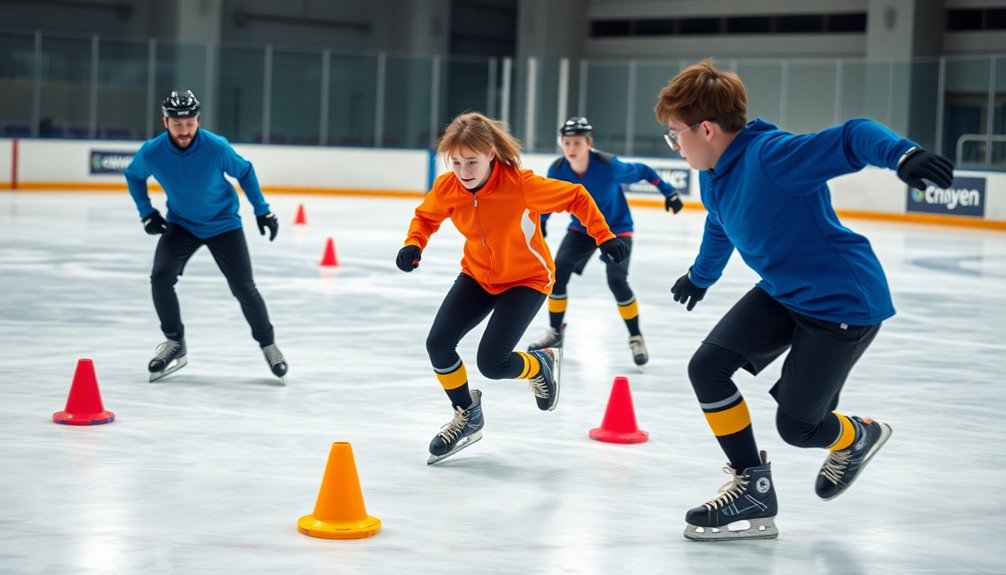
Building on the importance of physical agility and reactive training, specific drills can greatly enhance your performance on the ice.
For hockey players, incorporating the Seated Sprint Drill boosts explosiveness by simulating immediate response scenarios. The Lateral Mirror Drill improves quick directional changes through mirroring movements, enhancing reactive agility.
Another effective exercise is the 4-Corner Point and Touch drill, where one partner signals the other to sprint to designated cones, fostering quick decision-making in a dynamic setting. Additionally, incorporating high-intensity interval training can further enhance your overall fitness and agility on the ice.
To optimize performance, integrate these reactive agility training drills into your routine 1-2 times a week. These drills, especially those involving visual or auditory stimuli, will help you improve your decision-making and reaction times, essential for thriving in unpredictable game situations.
Timing and Integration of Reactive Training
Effective timing and integration of reactive training are essential for maximizing your agility on the ice. Incorporating reactive agility training 1-2 times a week, ideally before conditioning sessions, optimizes performance.
Performing reactive tasks post-workout can diminish reaction performance, making timing critical for effectiveness. Pre-fatigue exercises can be beneficial before conditioning, enhancing force production and overall athletic performance, even when fatigued.
It’s important to progressively integrate reactive training into your routine, ensuring skill enhancements translate directly to on-ice performance. Coaches should closely monitor the timing and intensity of reactive drills to align with your periodization schedule, ultimately supporting peak agility development. Additionally, incorporating teamwork enhancement exercises can further improve overall coordination and communication on the ice.
Prioritize these elements to elevate your agility work and elevate your game.
Developing Cognitive Decision-Making Skills

As you enhance your physical agility on the ice, developing cognitive decision-making skills becomes equally important for overall performance.
Agility requires not just speed but also the ability to make quick choices under pressure. Incorporating split-second decision drills can challenge you to evaluate ideal pass options, simulating high-stakes scenarios.
Tools like NeuroTracker can greatly boost your decision speed, training you to process fast-moving objects and anticipate plays effectively.
Engaging in small-sided games further sharpens your quick thinking and adaptability, as you’ll face congested areas where rapid decisions are essential. Additionally, practicing team coordination fosters synchronized movements that can significantly improve your response time during critical moments.
Conclusion
In the fast-paced world of hockey, agility isn’t just about speed; it’s the dance between mind and body. By embracing reactive training, you’re not just sharpening your skills; you’re crafting a mental sharpness that slices through pressure like a knife through ice. As you integrate these drills into your routine, picture yourself weaving through opponents, making split-second decisions with the grace of a seasoned artist. Keep pushing your limits, and let your agility become your competitive edge.