
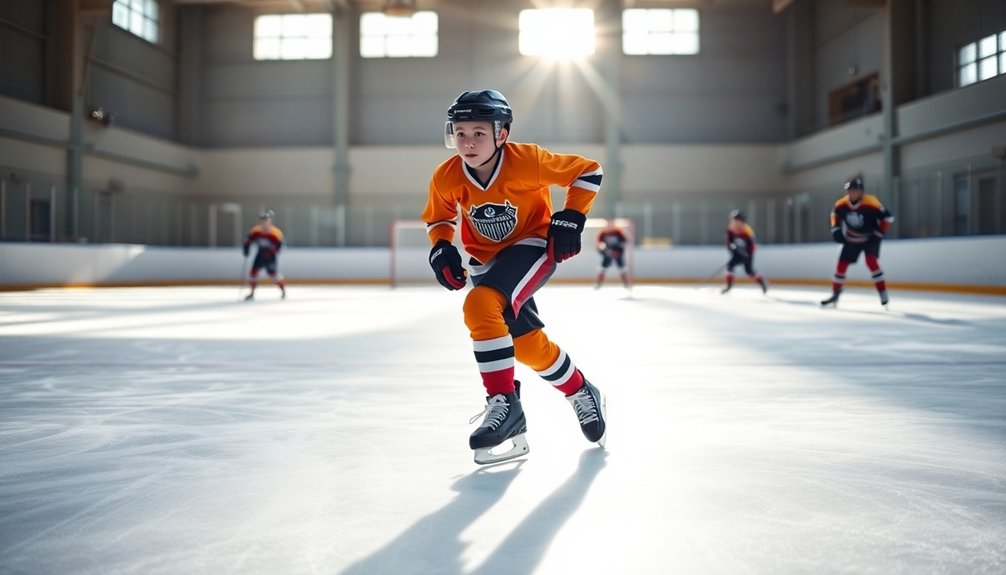
Essential Crossover Drills for Hockey Mastery
August 23, 2025To master hockey, focus on essential crossover drills that boost your agility and overall performance. Start with Single Crossovers to improve timing and edge control. Incorporate C-Cut Circles for backward propulsion and stability. Don’t forget the Outside Edge Kick to enhance power generation. Consistent practice builds muscle memory and sharpens your skills. These drills also improve your adaptability on the ice, making you a tough opponent. Discover more about advanced techniques and their benefits next.
Importance of Crossovers in Hockey
When you master crossovers in hockey, you reveal a key element that boosts your agility on the ice. Crossover training greatly enhances your ability to make tight turns and quick shifts, letting you navigate around opponents effortlessly.
This skill not only facilitates explosive acceleration, especially in corners or when pushing off walls, but also helps you maintain momentum during gameplay. By honing your crossovers, you gain greater edge control, essential for staying balanced while executing complex maneuvers.
Effective crossovers improve your positioning in both offensive and defensive scenarios, allowing for swift reactions to changing game situations. Ultimately, mastering crossovers translates to better game-ready mobility, whether you’re on a small rink or open ice, enhancing your overall performance. Additionally, incorporating high-intensity sprints into your training can further boost your cardiovascular endurance, which is vital for maintaining peak performance during intense gameplay.
Mechanics of a Proper Crossover
To execute a proper crossover, you need to focus on your body positioning and edge utilization.
Start with your knees bent and weight balanced, then push off the outside foot’s inside edge for maximum power.
As you cross your inside foot over, remember to keep both edges engaged to maintain speed and control. This technique mirrors the agility and skill emphasized in the ancient game of Cuju in China, which involved precise footwork to navigate the ball effectively.
Key Body Positioning
Mastering the crossover in hockey hinges on the right body positioning, and it all starts with a solid skating stance. Bend your knees, keep your chest up, and center your weight over your skates to establish a strong foundation.
As you initiate the crossover, push off the inside edge of your outside foot to generate power. Smoothly cross your inside foot over your outside leg while maintaining a low center of gravity for better balance.
During the crossover, utilize both inside and outside edges to maximize stability and force. Keep your head up and eyes forward to maintain awareness of your surroundings and guarantee proper body alignment throughout the maneuver.
Edge Utilization Techniques
Although effective crossovers rely heavily on proper body positioning, edge utilization is equally essential for maximizing speed and control.
Start with a solid skating stance—knees bent, chest up, and weight centered over your skates. As you execute a crossover, push off the inside edge of your outside foot to generate propulsion. Simultaneously, cross your inside foot over the outside leg in a smooth motion.
Remember to engage both inside and outside edges for enhanced balance and power, which allows for better control during shifts. Keep your head up and eyes forward to stay aware of your surroundings and facilitate dynamic movement.
Practicing with a focus on smooth, rhythmic motion will greatly improve your skating fluidity in game situations.
Characteristics of Effective Crossovers
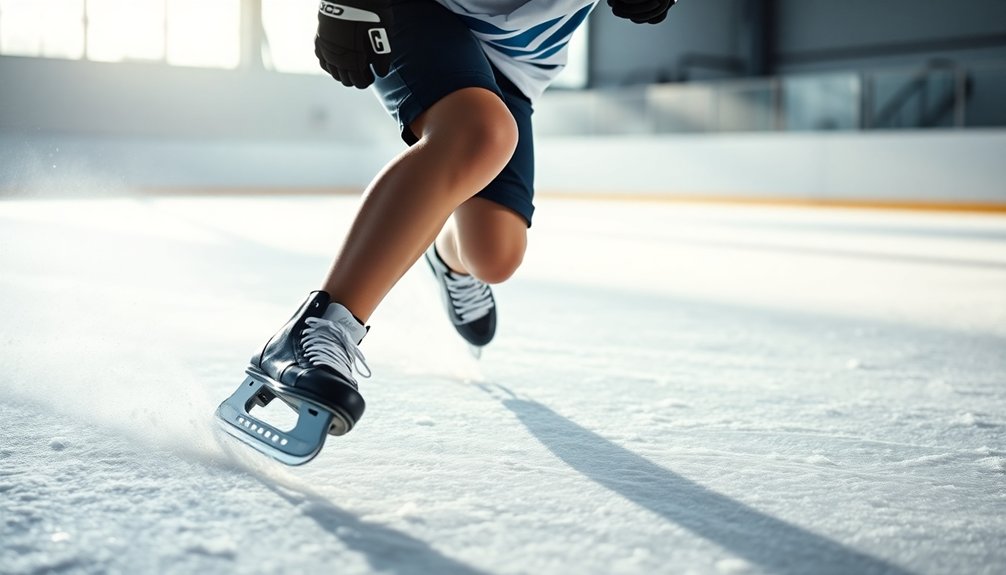
Effective crossovers are characterized by a smooth and rhythmic motion that helps you maintain speed and balance during tight turns and shifts.
To maximize your crossover effectiveness, focus on these key characteristics:
- Fluid Movement: Guarantee you’re capable of moving seamlessly in all directions, enhancing control and speed.
- Low Center of Gravity: Keep a low stance to maximize power and stability while utilizing both inside and outside edges.
- Head Up, Eyes Forward: Maintain awareness of the game, which is vital for effective puck protection and making quick decisions.
- Seamless Changes: Practice changing between crossovers and other skating techniques, essential for maneuvering effectively during gameplay. Additionally, being aware of offside position is crucial in maintaining game flow and strategy.
Training Tips for Crossovers
To enhance your crossover skills, it’s important to focus on specific training tips that help you refine your technique.
Start slow to develop your crossover mechanics, ensuring your knees bent and weight is centered for ideal balance. Push off the inside edge of your outside foot and smoothly cross your inside foot over your outside leg to gain power and fluidity.
Start with slow, controlled movements to master your crossover mechanics and achieve optimal balance and fluidity.
Consistency is key; practice crossover drills regularly to build muscle memory and confidence. As you become more comfortable, gradually increase your speed during drills.
Continuously analyze and correct your technique, focusing on maintaining a smooth and rhythmic motion. This will be crucial for maintaining speed and control in real-game situations. Additionally, incorporating agility drills can further enhance your ability to change direction quickly and effectively.
Benefits of Mastering Crossovers
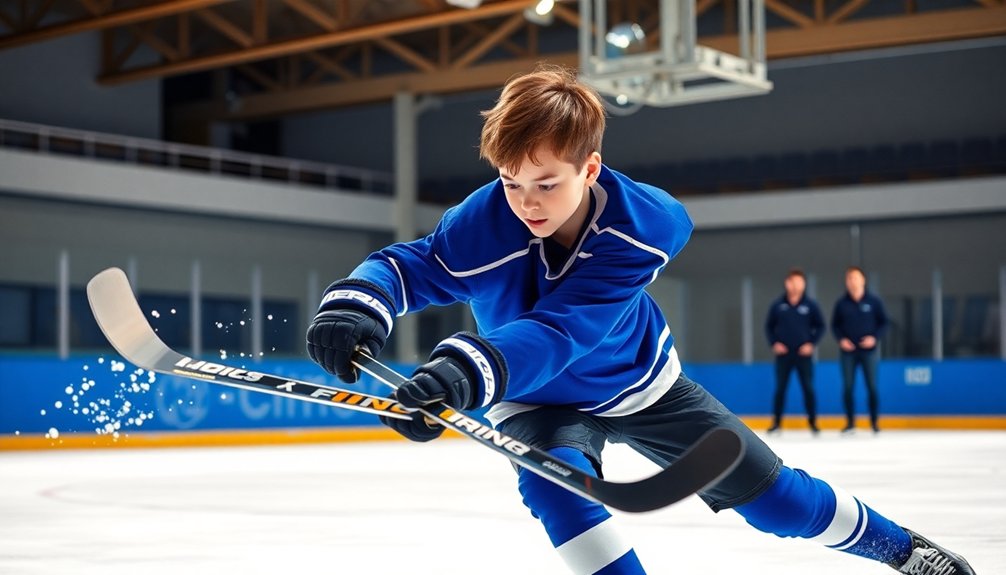
Mastering crossovers not only elevates your skating game but also enhances your overall performance on the ice.
When you develop this skill, you’ll enjoy several benefits:
- Improved Maneuverability: Your ability to navigate tight spaces improves, leading to better puck control.
- Heightened Agility: Effective crossovers boost your speed and agility, especially around corners and walls.
- Enhanced Game Readiness: You’ll adapt quickly in both offensive and defensive situations, making you a more versatile player.
- Dynamic Playing Style: Mastering the outside foot in crossovers makes you harder to defend against, increasing your impact on the game.
These advantages not only sharpen your skills but also help you stand out on the ice. Additionally, incorporating cardio workouts into your training regimen can further enhance your performance by building endurance.
Understanding Skate Edges
Crossovers are just one aspect of your skating skills, but understanding skate edges is equally important for taking your game to the next level. Each skate blade has two edges: inside and outside. Mastering these edges allows you to execute various maneuvers effectively.
The outside edge is essential when you’re making sharp turns and accelerating, as it helps maintain balance and control. Practicing drills in both clockwise and counterclockwise directions enhances your edge awareness and control.
This consistent practice leads to better proficiency in complex movements, like backward skating using crossovers. Focus on shifting between your outside edge and inside edge to elevate your overall skating ability, making you a more dynamic player on the ice. Additionally, incorporating small-sided games into your training can greatly improve your overall agility and responsiveness on the ice.
Inside and Outside Edges
Here are key points to focus on:
- Edge Awareness: Practice drills in both clockwise and counterclockwise directions to develop a feel for inside and outside edges.
- Acceleration: Use inside edges for quick starts and outside edges for maintaining speed during turns.
- Maneuverability: Focus on using the correct edge during complex skating maneuvers to enhance control.
- Foundation for Crossovers: A solid grasp of inside and outside edges is vital for executing effective crossovers in game situations. Additionally, discipline in player behavior is crucial as it helps maintain focus and respect during practice and games.
Backwards Crossovers Drills
When you practice backward crossovers, focus on balance and stability to enhance your control while skating in reverse. Timing and smooth edge switching are key to generating power and maintaining speed. Incorporating agility training can further improve your movement and reaction time on the ice.
Balance and Stability Focus
Mastering backwards crossovers requires a strong focus on balance and stability, as these skills are essential for effective backward skating.
Here are four key drills to enhance your balance and stability:
- Single Crossovers: Focus on edge switching while maintaining a stable hockey stance.
- C-Cut Circles: Develop propulsion while gliding backward, reinforcing controlled movements.
- Outside Edge Kick: Incorporate a push with your rear skate to promote stability and power generation.
- Consistent Practice: Regularly practicing these drills builds muscle memory, boosting your confidence and stability during complex maneuvers.
Timing and Edge Switching
Timing is essential for executing effective backward crossovers, as it allows you to shift smoothly between edges while maintaining speed and control.
To practice edge switching, push off the inside edge of your outside skate and cross your inside skate over. This technique enhances your agility and balance, vital for quick shifts during gameplay.
Drills like Single Crossovers and C-Cut Plus Crossover focus on timing and help you develop the skills needed for sharp turns.
Remember to maintain a stable hockey stance with bent knees and a strong core to facilitate effective edge switching.
Regularly incorporating these drills into your training routine will greatly improve your backward skating technique and overall on-ice performance.
Progressive Skill Development
Building on your understanding of edge switching and timing, progressive skill development in backward crossovers is essential for enhancing your performance on the ice.
To master this technique, focus on these drills to improve:
- C-Cut Circles: Start with foundational movements to develop propulsion and balance while gliding backward.
- Single Crossovers: Progress to simple crossovers to refine your timing and edge control.
- C-Cut Plus Crossover: Integrate more complex sequences to further enhance your skills.
- Clockwise and Counterclockwise Drills: Practice both directions to boost overall edge awareness.
Consistent repetition of these drills will build your muscle memory and confidence, ultimately allowing you to execute backward crossovers with fluidity and precision.
Key Drills for Crossovers
To develop effective crossovers in hockey, it’s essential to practice specific drills that enhance your balance, edge control, and overall technique.
Start with C-Cut Circles, where you glide while using C-cuts for propulsion, building foundational skills.
Next, focus on Single Crossovers, mastering the technique of crossing one foot over the other for smoother edge switching.
The C-Cut Plus Crossover drill combines propulsion with a crossover, helping you maintain your toe on the ice for better stability.
Don’t forget the Outside Edge Kick, which adds rear skate power, reinforcing the use of both edges.
Finally, practice the Putting It All Together drill to integrate all movements, emphasizing rhythm and coordination for executing effective crossovers seamlessly. Incorporating dynamic stretches into your warm-up can further enhance your performance and reduce the risk of injury during these drills.
Conclusion
Mastering crossovers is essential for elevating your hockey game. Remember, “practice makes perfect.” By focusing on the mechanics, characteristics, and specific drills we’ve discussed, you’ll improve your speed and agility on the ice. Don’t underestimate the importance of skate edges—both inside and outside—as they’re vital for effective crossovers. Keep training and refining your technique, and soon enough, you’ll be gliding past opponents with ease. Stay committed, and success will follow!