

How to Move Faster on the Tennis Court
April 30, 2026To move faster on the tennis court, focus on your footwork and positioning. Keep your feet light and use short, choppy steps for quick movements. Master the split step and practice lateral drills to improve agility. Anticipate your opponent’s moves and enhance your reaction time with simple drills. Stay fit with interval training and maintain hydration for peak performance. If you want to learn specific techniques and drills to elevate your game further, there’s more to explore.
Why Footwork Is Key to Tennis Speed

When you step onto the tennis court, the importance of footwork becomes immediately clear; it’s the foundation of your speed and agility. Proper foot placement allows you to maintain balance control, essential for quick shifts.
Focus on lateral movement to cover the court efficiently, while your stride length influences how swiftly you reach the ball. Mastering pivot techniques helps you change direction explosively without losing momentum.
Keep your body alignment aligned with your target to maximize power and accuracy. Your center of gravity and weight distribution play vital roles in maintaining stability during intense rallies. Additionally, practicing flag-pulling techniques can enhance your overall agility and responsiveness on the court.
Essential Techniques for Quick Movement
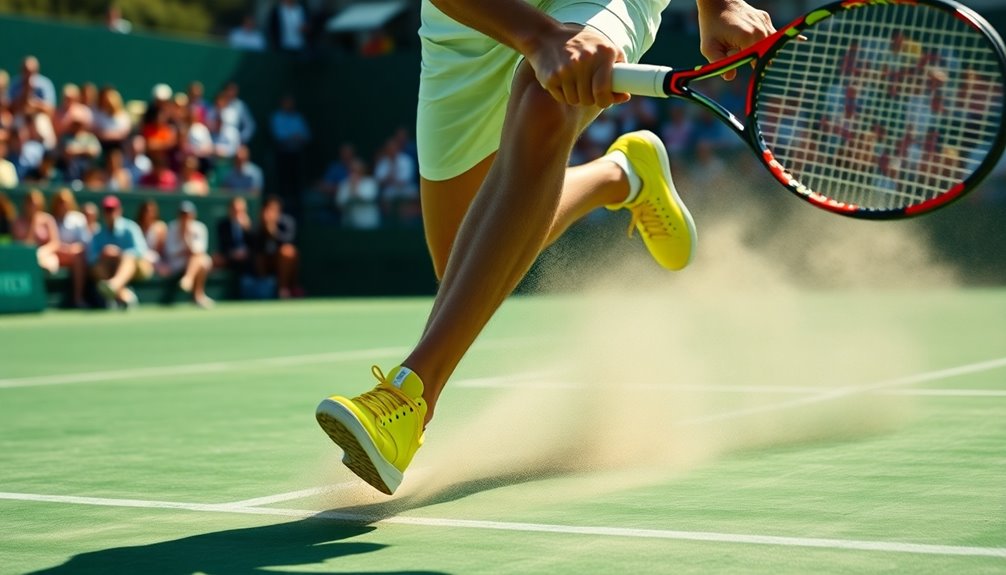
To boost your speed on the tennis court, mastering essential movement techniques is crucial. Start with the split step technique, which prepares you for quick reactions. As your opponent strikes the ball, perform a small hop to help you push off in any direction. This sets you up to respond faster.
Next, focus on lateral movement. Keep your feet light and maintain a low center of gravity to shift quickly side to side. Use short, choppy steps instead of long strides to adjust your positioning effectively. Additionally, incorporating pain shuttles drill into your training can enhance your overall agility and endurance, translating to quicker movements on the court.
Drills to Enhance Your Agility on the Court
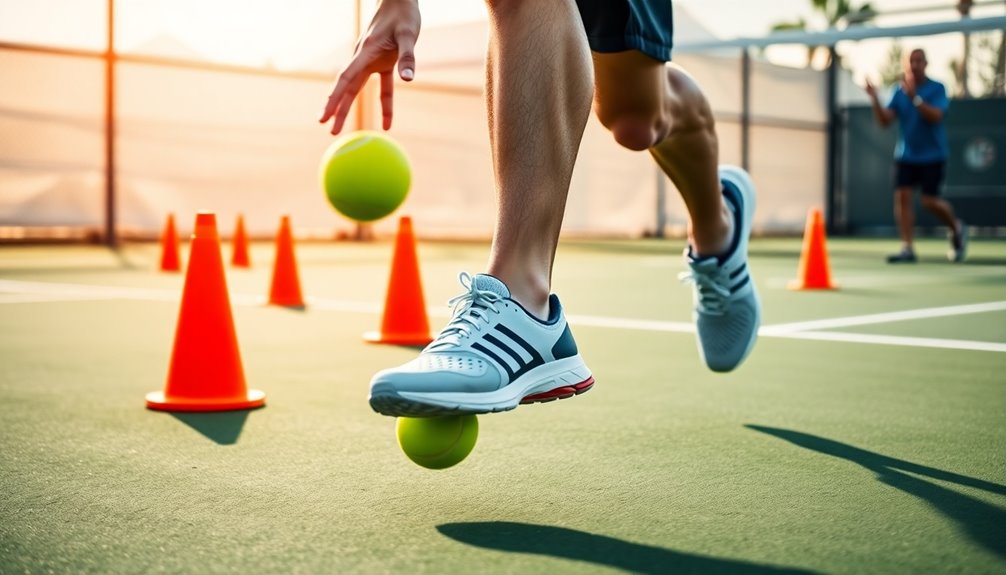
To boost your agility on the court, incorporating specific drills can make a big difference. Ladder agility drills, cone shuffle exercises, and quick feet sprints are all great ways to sharpen your footwork. Additionally, focusing on tight pivots can significantly enhance your ability to change direction quickly and maintain control during matches. Let’s explore how each of these drills can help you move faster and more efficiently during your matches.
Ladder Agility Drills
Agility is essential on the tennis court, and ladder drills can greatly enhance your quickness and footwork. By incorporating various ladder variations into your training regimen, you’ll develop better coordination and speed.
Start with basic drills like the two-foot in and out, and progress to more complex patterns such as lateral shuffles and crossover steps. These exercises not only improve your foot speed but also help you react faster during matches.
As you practice, focus on maintaining proper posture and quick foot movements to maximize agility benefits. Consistent training with these drills will translate to improved performance on the court, making it easier to reach those challenging shots and outmaneuver your opponent.
Cone Shuffle Exercises
Enhance your court speed with cone shuffle exercises, which are perfect for developing quick footwork and lateral movement.
Start by setting up cones in various arrangements to challenge your agility. Focus on proper cone placement to maximize your shuffle technique. Incorporate speed variations in your practice routines to improve your lateral speed and shift movements.
As you practice these coordination drills, pay attention to footwork fundamentals; they’re essential for effective movement on the court. Mix up the cone arrangements to keep your training dynamic and engaging.
The agility benefits will be evident as you become quicker and more responsive during matches. With consistent effort, you’ll notice significant improvements in your overall performance.
Quick Feet Sprints
Boost your speed on the court with quick feet sprints, a dynamic drill designed to sharpen your agility.
Start by setting up two markers about 10-15 feet apart. Begin with an explosive start, sprinting toward one marker. As you reach it, quickly change direction and move laterally to the other marker. Focus on maintaining low, quick steps to enhance your footwork.
Repeat this for 20-30 seconds, rest briefly, and then go again. You can increase the intensity by adding a ball to react to or by incorporating quick lateral movements in between sprints.
Regular practice of these drills will improve your reaction time and overall court speed, giving you the edge in your matches.
How to Improve Your Reaction Time?
To improve your reaction time on the court, you’ll want to focus on specific drills that sharpen your reflexes. By anticipating your opponent’s moves through keen observation, you can position yourself better for each shot. Incorporating targeted reaction time exercises into your training will give you the edge you need. Additionally, consistent practice and specialized drills can make reaction time a trainable skill, allowing for better anticipation of your opponent’s moves.
Drills For Quick Reflexes
Improving your reaction time is essential for excelling on the tennis court, and specific drills can make a significant difference.
Start with simple reaction drills, like using a tennis ball against a wall. As it rebounds, practice catching it or hitting it back quickly.
You can also incorporate speed training by setting up cones for quick lateral movements. Sprint from cone to cone, focusing on sharp, explosive starts.
Another effective drill is the “partner toss.” Have a friend throw balls to different spots; you’ll need to respond quickly and adjust your position.
Consistently practicing these drills helps sharpen your reflexes, allowing you to respond faster during matches, ultimately enhancing your overall performance on the court.
Anticipation Through Observation
Watching your opponent closely can dramatically enhance your reaction time on the court. By developing strong court awareness, you’ll start to notice patterns in their play.
Pay attention to their grip, stance, and body language; these cues can signal their next move. As you improve your observation skills, you’ll find yourself making predictive movements, positioning yourself where the ball is likely to go.
This proactive approach not only shortens your response time but also boosts your confidence. Anticipating your opponent’s shots means you’re more prepared to react effectively.
Reaction Time Exercises
Although many players focus on technique and strategy, enhancing your reaction time is equally crucial for success on the court. To improve, incorporate reaction drills into your training.
Start with simple exercises like catching a ball thrown at different angles; this hones your reflexes. You can also use visual cues, like colored lights or targets, to stimulate quick decision-making. For instance, have a partner call out colors while you react accordingly.
Additionally, practice agility ladder drills to boost foot speed and coordination, which will help you respond faster during matches. Consistently integrating these exercises into your routine will sharpen your reaction time, allowing you to anticipate your opponent’s moves and move swiftly on the court.
Perfecting Your Stance for Better Positioning
A solid stance is crucial for positioning yourself effectively on the tennis court, as it sets the foundation for every shot you make. Focus on ideal posture with your feet shoulder-width apart, allowing for quick stance adjustments.
Good foot positioning guarantees proper weight distribution, helping you maintain balance techniques during rallies. Pay attention to your body alignment—keeping your hips square to the net enhances your court awareness and prepares you for movement in any direction.
Incorporate hip rotation to generate power while maintaining stability. By perfecting these elements, you’ll improve your overall agility and readiness on the court, enabling you to respond quickly and effectively to your opponent’s shots. Remember, just like in soccer, equipment and attire regulations can influence your performance, so choose your footwear wisely.
Tips for Boosting Endurance and Stamina
Boost your endurance and stamina on the tennis court by incorporating a mix of cardio workouts into your training routine.
Use endurance strategies like interval training and stamina exercises, such as running or cycling, to build your aerobic capacity.
Incorporate interval training and stamina exercises like running or cycling to enhance your aerobic capacity on the court.
Don’t forget hydration tips; staying properly hydrated can greatly enhance performance.
Pay attention to the nutrition impact on your energy levels—focus on balanced meals rich in carbohydrates and proteins.
Implement recovery techniques like stretching and foam rolling to prevent fatigue.
Explore cross training benefits by engaging in different sports, which can enhance your overall fitness.
Finally, practice breathing methods to improve your oxygen efficiency and adopt mindset shifts to stay resilient during matches.
Strength training will also help you maintain power and stability on the court. Additionally, incorporating speed endurance drills can significantly improve your ability to accelerate and maintain high intensity during play.
The Role of Mental Focus in Speed
While physical training is essential for speed on the tennis court, mental focus plays a significant role in your performance. Achieving mental clarity allows you to react quickly and make better decisions during a match.
Utilize visualization techniques to picture your movements and anticipate your opponent’s shots. Mindfulness practices can help you stay present, reducing distractions that slow you down. Incorporate focus exercises into your routine to sharpen your concentration.
Engage in strategic thinking to outmaneuver your rival, while confidence building boosts your belief in your abilities. Mastering pressure management guarantees you stay calm under stress, and setting clear goals keeps you motivated. Additionally, embracing a growth mindset fosters resilience and adaptability, essential traits for improving your game.
Strengthening your mental game is just as important as physical training for enhancing your speed on the court.
Common Mistakes That Slow You Down
Even the most skilled players can fall into traps that hinder their speed on the court. One common mistake is adopting an improper stance, which can lead to inefficient movements.
A lack of focus during play often results in delayed reactions, making it hard to respond quickly. Poor conditioning and a weak core can further slow you down, as they limit your overall power and agility.
Wearing the wrong footwear can cause discomfort, affecting your balance and speed. Not warming up adequately can lead to limited flexibility, making quick movements difficult.
Ultimately, a negative mindset drains your energy and motivation. Recognizing these pitfalls is the first step toward enhancing your speed and overall performance on the court. Incorporating dynamic warm-up routines can significantly improve your readiness for fast movements.
Conclusion
In tennis, your footwork can make or break your game. Did you know that players with superior footwork can cover up to 20% more court area? By focusing on your agility, reaction time, and endurance, you’ll boost your speed on the court. Remember, it’s not just about being fast; it’s about being smart in your movements. Keep practicing these techniques, and you’ll find yourself moving quicker and playing better in no time!