

How to Do a Split Step
April 29, 2026To do a split step, start with your feet shoulder-width apart and knees slightly bent. Keep your weight balanced on the balls of your feet, ready to push off quickly. As your opponent moves, anticipate their actions and time your split step to stay agile. This position not only enhances your reaction time but also improves your balance and court coverage. If you want more tips on perfecting this technique, there’s plenty more to explore!
What Is a Split Step and Why Is It Important?

A split step is a quick, agile movement that players use to prepare for the next play, and it’s essential for maintaining balance and readiness on the court.
Understanding split step fundamentals can greatly improve your performance. By executing this movement correctly, you position yourself to respond quickly to your opponent’s actions, enhancing your agility and reaction time.
The split step benefits you by allowing for smoother shifts between movements, whether you’re defending or attacking. This technique also helps prevent injuries, as it promotes better body alignment and stability. Additionally, mastering the split step contributes to solid defensive metrics, which can significantly enhance your overall gameplay.
Incorporating the split step into your routine can elevate your game, keeping you one step ahead of your competition while ensuring you maintain control and balance throughout the match.
The Mechanics of a Proper Split Step
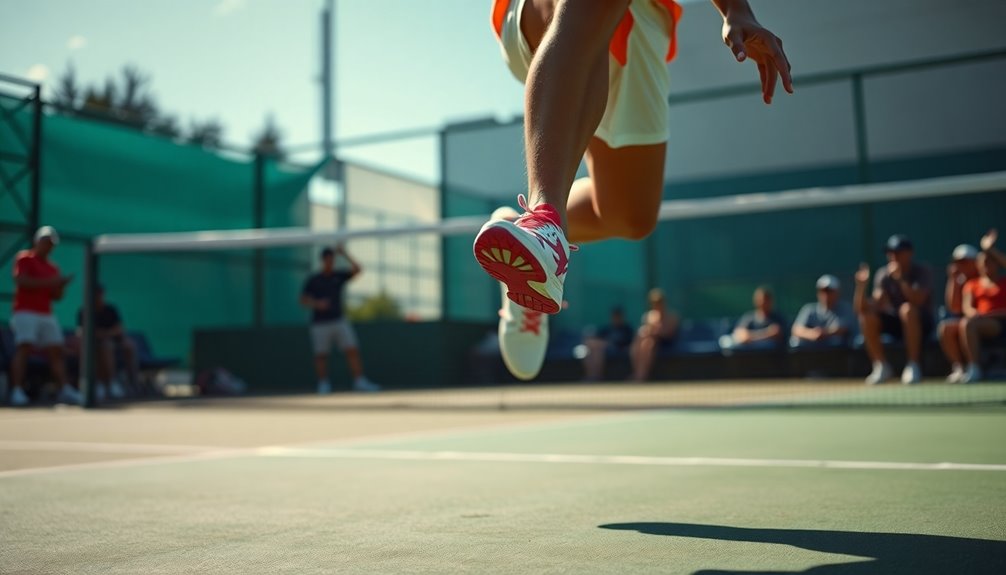
To execute a proper split step, you need to focus on your body positioning and timing. Your stance and rhythm play essential roles in how effectively you respond to your opponent’s movements. Let’s break down these mechanics to help you improve your game. An effective split step can significantly enhance your tactical adjustments during gameplay, allowing for quicker responses to your opponent’s actions.
Body Positioning Techniques
One key to mastering the split step lies in your body positioning. Start by ensuring your body alignment is upright and centered. Keep your knees slightly bent and your weight balanced on the balls of your feet. This stance allows for quick movement in any direction.
Next, focus on your foot placement. Position your feet shoulder-width apart to create a stable base. When you split, you should push off evenly with both feet, allowing for a swift response to your opponent’s actions.
Timing and Rhythm
Mastering the split step also hinges on your timing and rhythm. To execute a perfect split step, you need to be in sync with your opponent’s movements. Watch for timing cues—like their body language or the moment they initiate a shot. This awareness helps you anticipate the right moment to spring into action.
Incorporating rhythm exercises into your training can enhance your ability to react quickly. Try practicing with a partner; have them vary their pace and direction while you focus on maintaining your rhythm.
This not only sharpens your reaction time but also reinforces your split step mechanics. When you blend timing and rhythm, you’ll find yourself more agile and ready to respond effectively on the court.
Key Benefits of Mastering the Split Step

Mastering the split step can greatly boost your reaction time on the court, allowing you to respond quicker to your opponent’s moves. You’ll also notice enhanced court coverage, making it easier to reach those tricky shots. Additionally, quick decision-making during high-pressure situations is a crucial skill that can be improved through consistent practice.
Improved Reaction Time
While many athletes focus on strength and agility, improving your reaction time through the split step can make a significant difference in your performance.
Mastering this technique enables you to respond quicker, giving you an edge in competitions. Here’s why you should prioritize it:
- Quick Decision-Making: The split step trains your brain to react faster during critical moments.
- Better Anticipation: You’ll learn to read your opponent’s moves, enhancing your strategic play.
- Increased Confidence: Knowing you can react swiftly boosts your self-assurance on the court.
- Enhanced Performance: Combining reaction drills and speed exercises leads to a more dynamic game.
Embrace the split step, and watch your reaction time soar!
Enhanced Court Coverage
Improving your reaction time with the split step not only sharpens your instincts but also greatly enhances your court coverage. By mastering this technique, you’ll find that your court positioning becomes more effective, allowing you to reach balls quicker and with more accuracy.
The split step primes your body, enabling you to spring into action as soon as your opponent hits the ball.
Incorporating the split step into your footwork strategies means you can anticipate shots better, reducing the time spent moving into position. This agility gives you a competitive edge, helping you cover the court more efficiently.
As you practice, you’ll notice how this simple adjustment transforms your overall game, making you a more formidable player on the court.
How to Set Up for the Split Step
To effectively set up for the split step, you need to be aware of your positioning and balance on the court. Your foot placement plays a vital role in your readiness to react.
Follow these steps to guarantee you’re set up for success:
- Stay Low: Bend your knees slightly to maintain a strong, athletic stance.
- Feet Shoulder-Width Apart: This width provides stability and allows quick movement in any direction.
- Weight on the Balls of Your Feet: Keep your weight forward; this enhances your reaction time.
- Eyes on the Opponent: Focus on your opponent’s body language to anticipate their next move. A proper fit enhances player development and minimizes injury risks.
Executing the Split Step: Step-by-Step Guide
As you prepare to execute the split step, timing and precision are essential for maximizing your effectiveness on the court. Begin by staying on the balls of your feet, ready to move in any direction.
When your opponent strikes the ball, spring into action. Push off with both feet, landing with a slight bend in your knees to absorb impact. This allows you to react quickly, enhancing your agility and balance—key split step benefits. Incorporating quick decision-making into your split step practice can further improve your overall responsiveness.
Experiment with split step variations, such as the lateral split or forward split, depending on your opponent’s position and the ball’s trajectory.
Common Mistakes to Avoid When Performing a Split Step
While mastering the split step can greatly enhance your game, there are common mistakes that can undermine your efforts.
Mastering the split step can significantly elevate your game, but beware of common pitfalls that may hold you back.
Avoid these pitfalls to improve your performance:
- Incorrect Footwork: Not positioning your feet properly can lead to missed opportunities.
- Poor Timing: Jumping too early or late can leave you off-balance and unprepared.
- Improper Stance: A narrow or wide stance can hinder your agility, making it tough to react.
- Mental Distractions: A lack of focus can lead to hesitation, causing you to miss critical moments. Incorporating drills like Pain Shuttles Drill can help improve your overall agility and responsiveness.
Drills to Improve Your Split Step Technique
Master your split step technique with targeted drills that focus on timing, foot placement, and agility.
Start with basic drill variations, like hopping side to side, to enhance your explosiveness.
Next, practice partner exercises where your partner randomly moves in different directions, challenging you to react quickly with your split step. This mimics real-game scenarios and improves your responsiveness.
Incorporate agility ladders into your routine to refine your foot placement and coordination.
Finally, set up cones at varying distances and sprint to them using your split step, focusing on precision and speed. Regular practice of these drills will help develop injury prevention strategies that are essential for maintaining performance on the field.
How to Integrate the Split Step Into Your Sport
Integrating the split step into your sport can greatly enhance your performance, especially in fast-paced environments. By making sport-specific adaptations, you can maximize the split step benefits.
Integrating the split step can significantly boost your performance in fast-paced sports through tailored adaptations.
Here’s how to effectively integrate it:
- Practice Regularly: Consistency is key. Regular practice helps you develop muscle memory.
- Focus on Timing: Anticipate your opponent’s moves; a well-timed split step can give you the edge.
- Adjust Your Footwork: Tailor your foot positioning based on your sport, whether it’s tennis, basketball, or soccer.
- Incorporate Drills: Use drills that simulate game scenarios to make the split step second nature. Additionally, participating in engaging warm-up drills can help improve your overall agility and readiness for competition.
Tips for Maintaining Agility and Balance
Agility and balance are essential for executing a perfect split step, allowing you to respond quickly in dynamic situations.
To maintain these skills, incorporate agility drills into your routine. Ladder drills, cone sprints, and shuttle runs can greatly improve your footwork and quickness. These exercises challenge your coordination and help you develop a more explosive split step.
Balance exercises are equally important. Try single-leg stands, stability ball exercises, or yoga poses to enhance your core stability. Additionally, building core strength through targeted workouts will further improve your ability to maintain control during fast movements.
These activities improve your ability to maintain control during fast movements.
Variations of the Split Step for Different Sports
In different sports, the split step takes on unique forms to enhance your performance.
For instance, mastering the tennis split step can boost your reaction time on the court, while the basketball defensive split step helps you stay agile against opponents. Incorporating Rondo drills can also improve your footwork and agility, benefiting athletes across various sports.
Understanding these variations can elevate your game, no matter the sport you choose.
Tennis Split Step Techniques
Mastering the split step can elevate your game, whether you’re on the tennis court or playing another sport. Here are some tennis split step techniques that focus on footwork fundamentals and enhance your agility:
- Timing: Practice your split step drills to guarantee you react just before your opponent strikes the ball.
- Positioning: Keep your feet shoulder-width apart for balance and quick movement in any direction.
- Crouch: Bend your knees slightly to lower your center of gravity, making it easier to push off.
- Follow Through: After the split step, shift into your next movement smoothly, maintaining momentum.
Incorporating these techniques won’t only improve your performance but also build confidence on the court.
Basketball Defensive Split Step
When defending against an opponent in basketball, executing a defensive split step can enhance your ability to react swiftly to their movements. This technique allows you to maintain proper defensive positioning while staying light on your feet.
As your opponent makes a move, use the split step to create space and shift your weight, enabling quick lateral movement. Focus on opponent anticipation; read their body language and dribble patterns to predict their next action.
When to Use the Split Step During a Game?
How can you tell the right moments to use the split step during a game? Mastering your split step timing is essential in various game situations. Here are four key moments to keep in mind:
- Opponent’s Movements: When your opponent makes a sudden move, be ready to split step for quick reactions.
- Ball Passes: Anticipate when the ball is passed to an opponent; it’s your cue to split step and adjust.
- Dribble Changes: If the dribbler shifts direction, your split step will help you stay in front.
- Screen Plays: Use the split step to navigate around screens effectively, maintaining defensive pressure.
Conclusion
Mastering the split step can greatly elevate your game. Did you know that athletes who consistently use this technique can improve their reaction time by up to 20%? By incorporating the split step into your routine, you’ll enhance your agility and balance, giving you a competitive edge. Remember, practice makes perfect, so keep refining your technique to stay ahead of the game. With dedication, you’ll find that the split step becomes second nature, boosting your overall performance.