How Many Players Are on an Offense in Football?
March 19, 2026An offense in football consists of 11 players on the field, each with a specific role. You’ll find 5 offensive linemen focused on blocking and 6 skill position players like running backs and wide receivers. The quarterback leads the team, making key decisions, while the offensive line protects them and creates opportunities for plays. Team communication and strategic formations are essential for success. Curious about how these roles evolve and impact the game? There’s more to uncover!
How Many Players Make Up an Offensive Team?
An offensive team in football has 11 players on the field at any one time. This lineup includes 5 offensive linemen who mainly focus on blocking, creating space for other offensive players.
The remaining 6 players occupy skill positions like running backs, wide receivers, and tight ends, vital for advancing the ball downfield.
Offensive formations must have at least 7 players on the line of scrimmage, ensuring solid protection for those in skill positions.
During dead ball situations, your football team can make substitutions, adjusting personnel according to strategy or matchups.
Understanding how these players work together is essential for a successful offense, as each position plays a unique role in moving the ball towards the end zone. Additionally, incorporating offensive strategies can enhance teamwork and scoring opportunities.
The Role of the Quarterback in Offense
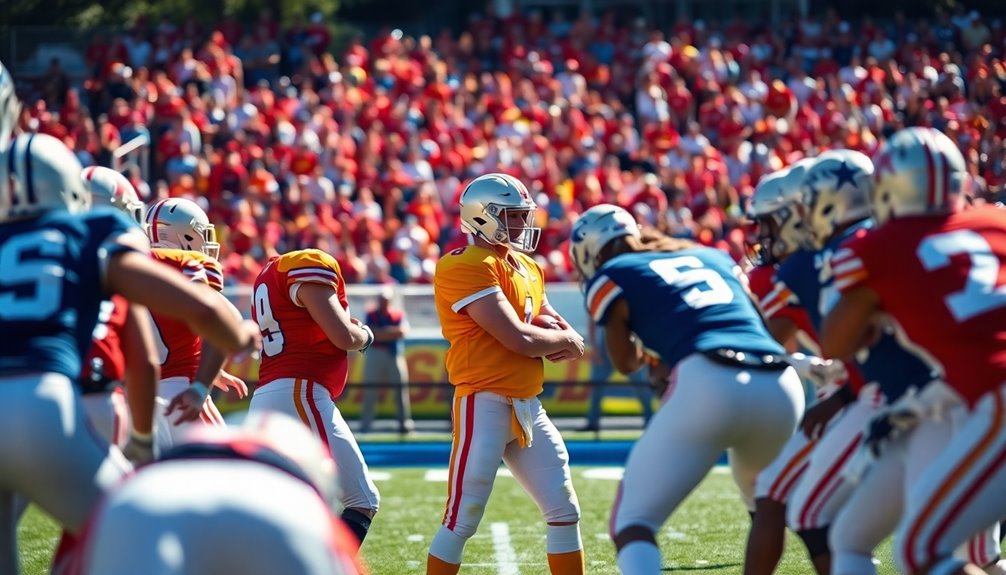
The quarterback is the heartbeat of the offense, leading the team and making essential decisions on every play. With the ability to call audibles and adjust strategies based on the defense, your QB’s leadership is critical. Plus, their passing and hand-off techniques can make or break a drive, pushing the team closer to scoring. Understanding 4 downs to cross midfield is essential for the quarterback to effectively manage the game and keep the offense moving.
Leadership and Decision Making
Leadership is paramount in football, especially when it comes to the quarterback’s role in the offense. As the leader of the offensive team, the quarterback is responsible for calling plays and making crucial decisions in real-time.
You need to communicate effectively with your teammates, ensuring everyone understands their roles for each play. At the line of scrimmage, you have the power to audible—changing the play based on the defense’s alignment.
In every offensive play, you handle the snap and decide whether to pass, hand off, or run. Successful quarterbacks are those who possess strong leadership qualities, quick decision-making skills, and the ability to read defenses effectively, which ultimately drives the team’s success on the field.
Passing and Hand-off Techniques
As the quarterback, mastering passing and hand-off techniques is essential for executing successful offensive plays. You’re the leader on the field, calling plays and making real-time adjustments.
Utilizing various passing techniques, like overhand, sidearm, and touch passes, allows you to deliver the ball effectively to your receivers. Precision is key, especially when executing hand-off techniques; you must smoothly transfer the ball to the running back with perfect timing to avoid fumbles.
Quick decision-making is vital as you read the defense, determining whether to pass, hand off, or run the ball yourself. Regular practice of your footwork and throwing mechanics will enhance your accuracy and velocity, making you a more effective quarterback in every game.
Understanding the Offensive Line Positions
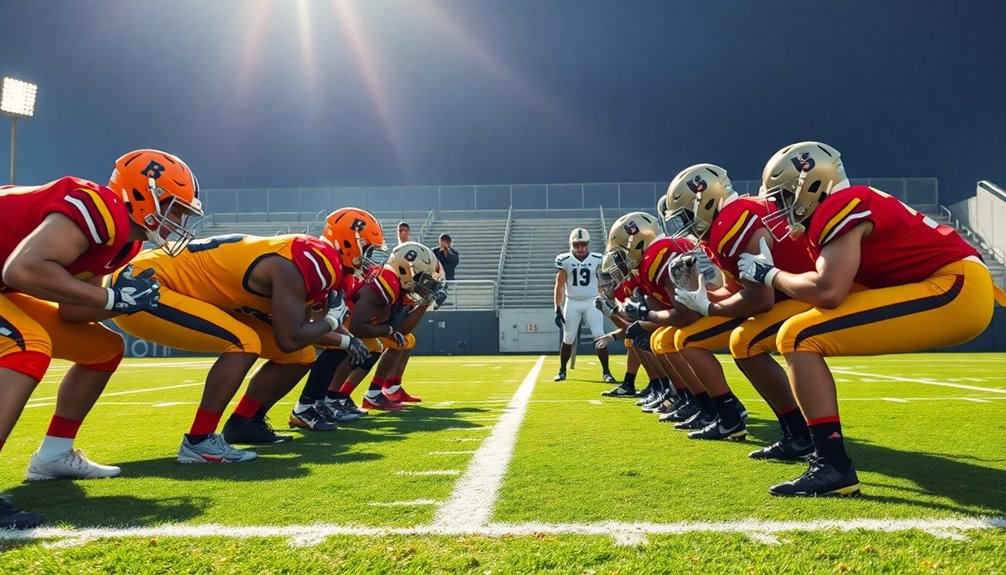
To truly grasp the offensive line’s impact, you need to understand the key roles each player fills. The center not only snaps the ball but also directs blocking assignments, while tackles and guards have distinct functions that protect the quarterback and create running lanes. Each position plays an essential part in the offense’s success, making their collaboration crucial. Additionally, effective communication among teammates can enhance the offensive line’s performance and adaptability during plays.
Key Offensive Line Roles
Understanding the roles within the offensive line is essential for grasping how a football team operates on offense. The offensive line consists of five key positions: the Center, Offensive Guards, and Offensive Tackles.
The Center snaps the ball and calls blocking assignments, ensuring cohesion among the offensive linemen. Offensive Guards, located on either side of the Center, can pull for lead blocks, enhancing the running game’s effectiveness.
Meanwhile, Offensive Tackles protect the quarterback’s blind side, relying on quick footwork and strength. Together, these linemen must work in unison, effectively blocking defensive players to create opportunities for the ball carrier.
This teamwork allows skill position players to advance the ball, making the offensive line a cornerstone of any successful offense.
Center’s Responsibilities
The center plays a pivotal role in the offensive line, serving as the anchor that connects the entire unit. Your primary responsibility is to snap the ball to the quarterback, ensuring accurate timing and delivery.
As the leader of the offensive linemen, you call out blocking assignments, coordinating protection against the defense. This requires a strong understanding of defensive alignments, allowing you to adjust blocking schemes as needed.
Whether it’s a running or passing play, your involvement in blocking schemes is critical. You also need to be agile and strong, facing immediate contact from defensive players right after the snap.
Your effectiveness can greatly influence the success of the offense on each play.
Tackles and Guards Functions
Five key positions make up the offensive line, with tackles and guards playing vital roles in protecting the quarterback and enabling effective run plays.
Offensive guards (OG) line up on either side of the center, blocking defensive players and often pulling to lead runners on outside plays. Their agility and strength are essential for creating running lanes and ensuring a solid pocket for the quarterback.
On the outer edges, offensive tackles (OT) focus on protecting the quarterback’s blind side, preventing edge rushers from reaching him. This position requires exceptional size and quickness, as tackles face some of the fastest defenders.
Together, tackles and guards form the backbone of the offensive line, allowing offensive linemen to execute plays successfully.
The Importance of Running Backs in Offensive Strategy
While many fans focus on quarterbacks and wide receivers, running backs play a pivotal role in any offensive strategy. These players are vital for advancing the ball, often serving as primary ball carriers and playmakers.
Typically categorized as tailbacks or fullbacks, running backs can exploit defensive weaknesses, creating mismatches that draw defenders away from receivers. Their versatility is key; many running backs excel in the passing game, adding an additional dimension to the offense.
A strong rushing game controlled by effective running backs can dictate the tempo, allowing teams to manage the clock and open up downfield passing opportunities. Fundamentally, without skilled running backs, an offense might struggle to find balance and effectiveness. Additionally, a well-executed defensive line formation can significantly impact the effectiveness of running plays, making the role of running backs even more crucial.
How Wide Receivers Impact Offensive Plays
Wide receivers play a pivotal role in offensive plays by mastering route running techniques that create separation from defenders. When they effectively execute their routes, they open up opportunities for big plays and scoring. This precision not only helps the quarterback but also puts pressure on the defense to adjust. Additionally, utilizing quick passing techniques can further enhance their effectiveness in exploiting defensive gaps.
Route Running Techniques
Effective route running techniques are essential for wide receivers, as they directly influence the success of offensive plays. By mastering sharp cuts, quick acceleration, and deceptive moves, you can confuse defenders and create open space.
This precision in route running enhances your ability to exploit mismatches against slower or less agile opponents, making it easier for the quarterback to deliver successful passes. Timing is vital; well-coordinated routes lead to big gains and scoring opportunities.
Additionally, varied route combinations—like slants, curls, and fly patterns—strategically stretch the defense, opening up the field for other offensive players.
Separation From Defenders
Mastering route running not only helps you get open but also plays a pivotal role in separating from defenders. As a wide receiver, your ability to stretch the defense horizontally creates valuable space for other offensive players.
By running precise routes, you draw defenders away from the line of scrimmage, allowing running backs and tight ends to maneuver effectively. Your speed and agility force defenses to commit more resources to coverage, often leading to mismatches against slower defensive players.
When you perform well, you also open up play-action opportunities, compelling defenders to respect potential deep passes.
In formations with multiple wide receivers, you can exploit defensive weaknesses, creating favorable matchups against less skilled defenders and enhancing overall offensive effectiveness.
The Function of Tight Ends in an Offensive Lineup
In an offensive lineup, tight ends play an essential dual role that can transform the dynamics of the game. These hybrid players combine the bulk of offensive linemen with the agility of wide receivers, making them versatile assets.
You’ll typically see one or two tight ends in formations like “11” or “12,” allowing for strategic flexibility.
Here’s how tight ends impact the offense:
Tight ends are pivotal in offense, blending blocking prowess with receiving skills to create unmatched versatility.
- Blocking: They provide significant protection for the quarterback during passing plays.
- Receiving: They run routes to catch passes, creating mismatches against smaller defenders.
- Flexibility: Their unique skill set allows them to excel in both the passing and running game.
With tight ends, you gain a powerful tool for any offensive scheme, as their strategic flexibility enhances overall team performance.
Different Types of Offensive Formations Explained
Offensive formations serve as the backbone of a football team’s strategy, shaping how plays unfold on the field. Each formation typically consists of 11 players, including 5 offensive linemen and 6 skill position players like backs and receivers.
The “I Formation” features a fullback and tailback behind the quarterback, ideal for power running. In contrast, the “Spread Formation” spreads out receivers, creating mismatches against defenders.
The “West Coast Offense” focuses on short, quick passes, utilizing running backs and tight ends for both receiving and blocking. Meanwhile, the “Shotgun Formation” positions the quarterback several yards behind the center, enhancing visibility and quick passing options.
Choosing the right offensive formation is essential based on the opponent’s defense and your team’s strengths, particularly by understanding defensive formations to exploit weaknesses effectively.
Personnel Packages: What Are They and Why Do They Matter?
Personnel packages play an essential role in a football team’s strategy, allowing coaches to tailor their offensive approach based on the game situation and opponents. These specific groupings of offensive players, denoted by a two-digit numerical system, include five offensive linemen and one quarterback, totaling eleven players on the field.
Key reasons why personnel packages matter include:
Key reasons personnel packages are crucial include creating mismatches, ensuring tactical diversity, and maintaining unpredictability against defenses.
- Creating mismatches: Different combinations can exploit defensive weaknesses.
- Strategic diversity: Packages like “21” or “11” serve various tactical purposes.
- Maintaining unpredictability: Adapting to opponents keeps the defense guessing, vital for scoring points. A well-prepared defense can intimidate opponents, enhancing the effectiveness of offensive strategies.
How Do Substitutions Affect Offensive Strategy?
Substitutions can really change the game for your offense. Proper hydration strategies during practice can enhance player performance and readiness for substitutions in real-game scenarios.
Timing of Substitutions
Timing your substitutions in football can greatly impact your offensive strategy. Effective substitutions can keep the defense guessing and enhance your team’s performance.
Here are a few ways how:
- Catch the Defense Off-Guard: Quick substitutions can surprise the defense, forcing them to react without time to adjust.
- Personnel Packages: Use different combinations of offensive linemen and skill players to create mismatches based on the defense’s alignment.
- Control the Tempo: The timing of substitutions affects how fast your offense operates, impacting play execution.
Matchup Exploitation Strategies
When you strategically adjust your lineup, you can create mismatches that put your offense in a better position to succeed. By substituting players, you can exploit defensive units’ weaknesses, like using faster players against slower defenders.
Offensive coordinators often utilize specific personnel packages, such as 21 or 11 formations, to adapt to the defense’s alignment and tendencies. Fresh players help maintain a high tempo, pressuring the defense and capitalizing on fatigue.
Additionally, smart substitutions dictate play types—like using more tight ends for run-heavy situations or wide receivers for passing plays. Focusing on matchup exploitation, you might isolate a running back against a linebacker in coverage, maximizing your offensive efficiency and scoring opportunities.
Special Teams: Their Role in the Offensive Game Plan
Here’s how special teams contribute:
- Placekickers handle field goals and extra points, essential for maximizing scoring chances.
- Punters change field position, helping your offensive players start drives closer to the end zone.
- Return specialists use their speed and agility to gain advantageous field position on kickoffs and punts.
Additionally, effective special teams can significantly enhance team coordination and overall gameplay experience.
Key Skills for Offensive Players
Mastering key skills is crucial for offensive players in football, as each position demands a unique set of abilities.
The quarterback needs strong leadership and quick decision-making skills to execute plays and make audibles effectively.
As a running back, you must combine agility and speed to weave through defenders while also having reliable hands for catching passes.
Wide receivers, too, rely on exceptional speed and precise route-running to successfully receive those passes.
Meanwhile, offensive linemen focus on strength, footwork, and awareness to protect the quarterback and create running lanes.
Each skill set is essential, ensuring the offense runs smoothly and efficiently on the field.
Embracing these skills can elevate your game and contribute greatly to your team’s success.
How Do Offensive Players Communicate During a Game?
Effective communication is essential for offensive players during a football game. The quarterback plays a pivotal role in relaying calls and ensuring everyone understands their responsibilities.
Here are some key methods of communication:
- Verbal Plays: The quarterback calls out plays, using coded terminology that allows for quick understanding.
- Hand Signals: Players use hand signals to convey information quickly, especially under pressure.
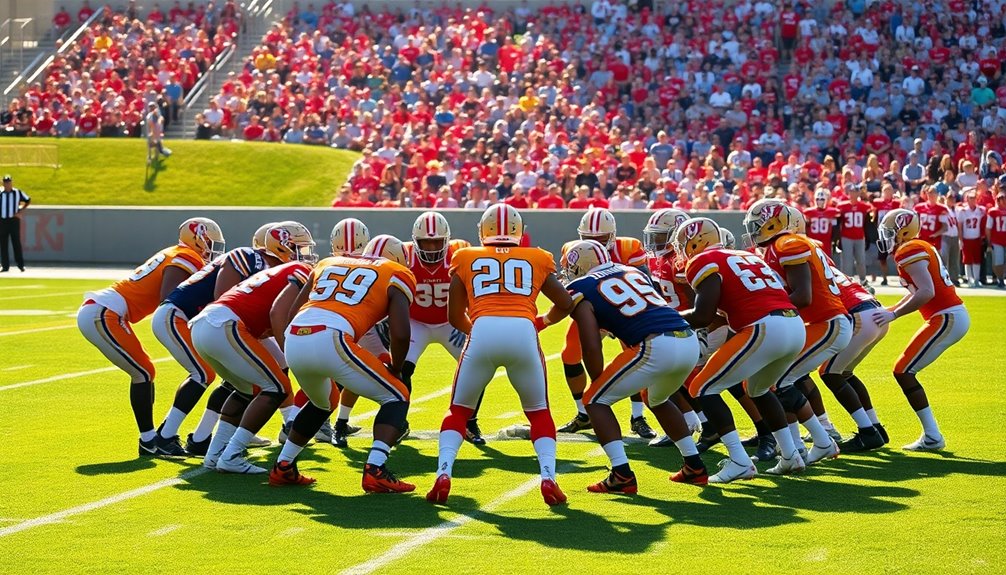
- Huddles: Before lining up, players gather to confirm roles and adjust strategies based on the defense.
During the play, non-verbal cues like eye contact and body language become vital for coordinating last-minute adjustments.
Non-verbal cues, such as eye contact and body language, are crucial for making last-minute adjustments during the game.
This seamless communication among offensive players helps maintain focus, ensuring everyone is aligned and ready to execute the play effectively.
Strategies for Maximizing Offensive Efficiency
To maximize offensive efficiency in football, understanding the right strategies can make all the difference. Start by utilizing strategic formations that fit your personnel. For instance, using 11 or 21 personnel packages allows you to exploit mismatches against the defense.
Your offensive linemen play an essential role here, providing the protection necessary for the quarterback to execute plays effectively.
Incorporate play-action passes and misdirection to keep defenses guessing, creating opportunities for big gains.
Communication is key; your quarterback should call audibles to adjust plays based on defensive alignments. This adaptability, combined with smart formations that enhance spacing, will help you create lanes for runners, ultimately improving your yardage gained on each play.
The Evolution of Offensive Roles Over Time
As offensive strategies sharpened, the roles within a football offense evolved dramatically. Initially focused on running plays, teams adapted to emphasize passing, leading to the emergence of specialized positions.
Key changes include:
- The introduction of wide receivers, designed to exploit defensive weaknesses through the forward pass.
- The rise of hybrid roles, like H-backs, blending the talents of offensive linemen and receivers to create mismatches.
- The influence of analytics, prompting teams to adjust personnel for maximum efficiency based on statistical performance.
In recent years, the spread offense from college football has further shaped NFL strategies, leading to more versatile players and an increased number of wide receivers on the field, enhancing offensive dynamics.
How to Analyze Opposing Defenses for Offensive Advantage
Understanding how to analyze opposing defenses is essential for gaining an offensive advantage. Start by examining defensive formations like the 3-4 or 4-3 to spot weaknesses and tailor your offensive personnel packages accordingly.
Study individual defensive players, focusing on cornerback coverage skills and linebacker speed to exploit mismatches with specific plays. Keep an eye on blitzing patterns to anticipate pressure on your quarterback, allowing for quick adjustments, such as screen passes or quick throws.
Monitor the depth and positioning of defensive backs to determine ideal routes for your wide receivers.
Finally, take note of any substitutions made by the defense during the game to capitalize on mismatches, ensuring your offensive unit stays one step ahead.
Conclusion
In the intricate dance of football, an offense typically fields eleven players, each an essential cog in the machine. From the quarterback orchestrating plays like a maestro to running backs and receivers weaving through defenses, every movement counts. As you explore deeper into strategies and roles, you’ll see how they morph over time, adapting like water through a stream. Embrace this dynamic game, and you’ll find that understanding its layers enhances not just your knowledge, but your passion for the sport.