
Side Steps vs Crossover Steps in Tennis
April 30, 2026In tennis, mastering side steps and crossover steps is essential for your movement on the court. Side steps allow for rapid lateral movement, keeping you balanced during quick exchanges. Crossover steps enable faster acceleration, helping you reach difficult shots. Knowing when to use each technique can enhance your overall performance. By combining these methods effectively, you’ll optimize your footwork and improve your game. There’s so much more to discover about their unique benefits and training techniques.
Understanding Footwork in Tennis
Focus on your stance and balance; when you’re stable, you can respond quicker. Good footwork isn’t just about speed; it’s about movement efficiency. By optimizing your steps, you conserve energy and maintain control, which helps you stay agile during long rallies. Incorporating core strength exercises into your training can significantly enhance your footwork and stability on the court.
Practice drills that improve your lateral and forward movement, and pay attention to your foot placement. The right footwork not only prepares you for each stroke but also minimizes the risk of injury, ensuring you can play at your best for longer periods.
What Are Side Steps in Tennis?
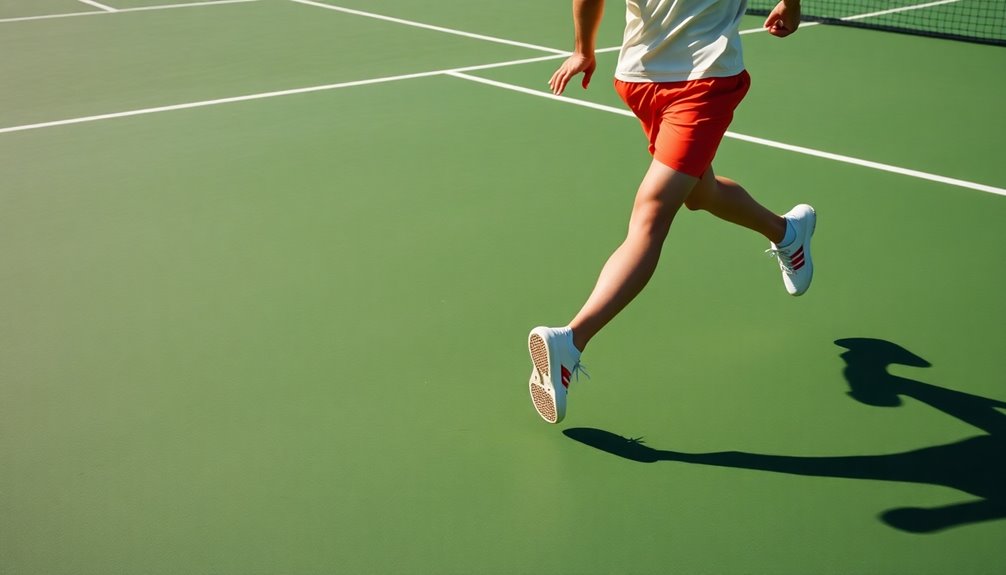
Side steps are essential for maintaining your position on the court, allowing you to quickly adjust your stance and prepare for incoming shots.
Mastering side step mechanics helps you achieve effective positioning, enabling you to respond better to your opponent’s movements. Instead of crossing your feet, you’ll keep your body balanced and agile, sliding laterally to maintain that ideal court coverage.
Practicing these movements can enhance your ability to intercept balls and set up for powerful returns. As you incorporate side steps into your training, focus on your foot placement and body alignment to guarantee you’re ready for any play.
Understanding the importance of field dimensions and equipment requirements can also aid in your overall performance, as proper court setup impacts movement strategies.
With consistent practice, side steps will become a natural part of your game strategy.
Benefits of Using Side Steps
Using side steps can markedly enhance your lateral movement, allowing you to respond quicker to your opponent’s shots. This technique improves your court coverage, ensuring you’re in the right position to return the ball effectively. Plus, it helps you maintain better balance control, giving you a stronger foundation for powerful strokes. Additionally, mastering on-ball off-ball actions can further elevate your performance by improving your overall agility and court awareness.
Enhanced Lateral Movement
Lateral agility plays an essential role in tennis, and embracing side steps can greatly enhance your movement on the court. By focusing on side steps, you improve your foot placement, allowing for quicker and more controlled reactions. This technique helps you maintain balance while moving sideways, which is crucial when you’re chasing down balls or positioning yourself for a shot.
With proper side stepping, you can shift your weight effectively, keeping your center of gravity low and stable. This stability not only enhances your overall agility but also reduces the risk of injury.
As you develop this skill, you’ll notice how much easier it becomes to navigate the court, setting you up for better performance in matches.
Improved Court Coverage
Mastering side steps not only enhances your agility but also greatly improves your court coverage. By utilizing side steps, you can quickly adjust your position based on court angles, allowing for better shot selection.
This movement pattern enables you to maintain strategic positioning while conserving energy, essential during long rallies. Your mental focus sharpens as you anticipate your opponent’s next move, facilitating effective opponent analysis in various match scenarios.
As you glide across the court, you’ll find that your ability to respond to challenging shots increases, keeping you in control of the game. Ultimately, this improved court coverage gives you the upper hand, making it easier to outmaneuver your opponent and dictate play.
Better Balance Control
When you employ side steps on the court, you not only enhance your agility but also gain better balance control. This improved balance is essential for executing shots effectively.
By focusing on your foot placement during side steps, you stabilize your body, allowing for quicker reactions to your opponent’s moves. Using proper balance techniques helps you maintain a centered position, making it easier to shift your weight as needed.
With side steps, you can stay low and grounded, minimizing the risk of losing your balance when you strike the ball. This control translates into more powerful and accurate shots, ultimately giving you a competitive edge.
Ideal Situations for Side Steps
When you’re on the court, side steps are perfect for quick lateral movement, helping you stay balanced. They’re especially useful when positioning for groundstrokes, allowing you to hit with more power and accuracy. Additionally, these steps let you react effectively to your opponent’s shots, keeping you one step ahead in the game. Incorporating dynamic stretches into your warm-up routine can further enhance your agility and responsiveness on the court.
Quick Lateral Movement
While quick lateral movement is essential in tennis, side steps shine in specific situations where agility and balance are crucial.
When you’re responding to a shot close to the sideline, your lateral speed can make or break your return. By using side steps, you maintain better foot placement, allowing you to pivot and strike the ball with more control.
This technique is particularly effective when you need to adjust quickly to an opponent’s unpredictable shots. In these moments, staying low and balanced helps you react faster.
Plus, side steps enable you to cover the court without losing your footing. Mastering this movement will enhance your game, making you a more formidable opponent on the court.
Positioning for Groundstrokes
When you see your opponent preparing a shot, use side steps to adjust your position quickly, ensuring you’re aligned with the ball’s trajectory. Proper shot alignment is vital; it helps you set up for an ideal strike, maximizing your power and accuracy.
As you slide into position, focus on your footwork to stay light and agile. By mastering these elements, you’ll improve your overall game and be ready to respond effectively.
Reacting to Opponent’s Shots
As your opponent prepares to hit the ball, quick reactions can make all the difference in your positioning. By honing your reaction timing and shot anticipation, you’ll enhance your court awareness.
Watch for your opponent’s body language and racket angle to gauge their shot, allowing for effective decision making. In ideal situations, using side steps can improve your movement efficiency, helping you adjust quickly to their positioning.
Focus techniques, like visual tracking, enable you to anticipate where the ball will land. Implementing tactical adjustments—like shifting to the side—will keep you in a strong position.
Ultimately, the better you react, the easier it becomes to counter your opponent’s shots and maintain control of the game.
What Are Crossover Steps in Tennis?
Crossover steps are an essential movement technique in tennis that allow you to quickly adjust your position on the court. This technique involves crossing one foot over the other, enabling you to cover ground efficiently when chasing down balls.
Mastering the crossover step technique can greatly enhance your agility and responsiveness during matches. To improve your skills, you can practice various crossover step drills, focusing on maintaining balance and speed. These drills often include lateral movements and quick direction changes, simulating real-game scenarios. By incorporating these practices into your training routine, you’ll find it easier to reach those challenging shots and position yourself ideally for your next move. Embracing conditioning drills can further elevate your overall athletic performance and support your crossover step execution.
Embrace the crossover step to elevate your game!
Benefits of Using Crossover Steps
Using crossover steps can greatly boost your performance on the court.
You’ll notice improved court coverage, which allows you to reach balls more effectively.
Plus, these steps enhance your agility and speed, making it easier to prepare for your next shot. Furthermore, mastering crossover techniques can lead to increased acceleration and agility, similar to the benefits seen in hockey.
Improved Court Coverage
Tennis players often find that mastering crossover steps greatly enhances their court coverage. By utilizing these steps, you improve your court positioning and movement efficiency, allowing you to reach those hard-to-get shots more effectively.
Here are some emotional benefits you can experience:
- Confidence Boost: You’ll feel empowered knowing you can cover the court better.
- Increased Control: Your ability to hit precise shots improves as you position yourself effectively.
- Enhanced Strategy: With better movement, you can anticipate your opponent’s shots more accurately.
- Less Fatigue: Efficient movement means you’ll conserve energy, keeping you fresh throughout the match.
Incorporating crossover steps into your game can truly transform your performance on the court.
Enhanced Agility And Speed
When you incorporate crossover steps into your movement, you’ll notice a significant boost in your agility and speed on the court. These footwork techniques enhance your overall athlete conditioning, allowing you to execute quick changes in direction.
By integrating agility training and speed drills into your practice, you’ll refine your movement patterns, improving your reaction time. Crossover steps build lateral strength and enhance quickness, essential for responding to your opponent’s shots.
Incorporating quickness exercises and balance exercises will further elevate your performance. As you engage in endurance training, crossover steps will help maintain your speed throughout longer matches.
Better Shot Preparation
Crossover steps can considerably enhance your shot preparation, allowing you to position yourself ideally for each strike. By making this adjustment, you’ll notice improvements in your overall game.
Here are the benefits you can expect:
- Optimized shot selection: You’ll have a clearer view of your opponent’s positioning, enabling better decision-making.
- Improved balance: Crossover steps help maintain your center of gravity, ensuring you’re ready for the next shot.
- Technique refinement: With better footwork, you can focus on perfecting your strokes and shot mechanics.
- Increased confidence: Knowing you’re well-prepared allows you to play more aggressively and effectively.
Incorporating crossover steps into your game can transform your performance on the court.
Ideal Situations for Crossover Steps
While you’re maneuvering the court, crossover steps can be essential in certain situations, particularly when you need to quickly change direction or close the gap to intercept a shot.
These steps offer significant crossover advantages, allowing you to maintain balance and stability while moving laterally. When an opponent hits a wide shot, using crossover steps enhances your footwork efficiency, letting you reach the ball without losing momentum.
Additionally, they’re vital when shifting from the baseline to the net, ensuring you cover ground swiftly. Incorporating effective leg exercises into your training can enhance your overall agility and speed on the court.
Comparing Speed: Side Steps vs. Crossover Steps
Although both side steps and crossover steps are essential for effective movement on the court, their speed and application can vary considerably.
In your speed comparison, consider the following points:
- Quick Reaction: Side steps allow for rapid lateral movements, helping you respond swiftly to opponents’ shots.
- Acceleration: Crossover steps enable faster acceleration when changing direction, vital for reaching that challenging ball.
- Distance Coverage: Side steps are great for short distances, while crossovers can cover longer gaps more efficiently.
- Game Flow: Using the right step can enhance your movement efficiency, keeping you one step ahead in rallies.
Understanding these nuances can dramatically improve your gameplay, making you a more agile and responsive player on the court. Additionally, mastering ball control techniques can further refine your footwork and overall agility during play.
How Footwork Affects Balance and Stability
Effective footwork directly influences your balance and stability on the court. When you master balance techniques, you enhance your overall performance.
Proper foot placement is essential, as it helps maintain body alignment and guarantees effective weight distribution. Practicing stability exercises strengthens your core, which is critical for maintaining control during quick movements.
Additionally, focusing on movement efficiency allows you to react swiftly without sacrificing balance. Incorporating flexibility training into your routine can further improve your range of motion, making it easier to adjust your position. Furthermore, consistent practice of foundational skills enhances your ability to maintain balance during rapid directional changes.
Drills to Improve Side Steps
To sharpen your side steps, incorporate specific drills that target agility and foot speed. Focusing on lateral movement will enhance your performance on the court.
Here are four effective side step drills you can try:
- Side-to-Side Shuffles: Move quickly from side to side, staying low to engage your legs and core.
- Lateral Cone Hops: Set up cones and hop laterally between them, increasing speed as you improve.
- Band Resisted Side Steps: Use a resistance band around your ankles and take quick side steps to build strength.
- Shadow Drills: Mimic your opponent’s movements, focusing on quick lateral shifts to improve reaction time.
Integrating these side step drills into your routine will boost your agility and overall game, as consistent practice enhances muscle memory for quicker reactions.
Drills to Improve Crossover Steps
To sharpen your crossover steps, you’ll want to focus on specific drills that enhance your agility and footwork.
Ladder agility drills, cone navigation exercises, and shadowing partner movements can all make a significant difference in your performance.
Let’s break down how each of these drills can help you move more effectively on the court.
Ladder Agility Drills
While mastering crossover steps is essential for agility on the tennis court, incorporating ladder drills into your training can greatly enhance your footwork.
These drills sharpen your coordination and speed, making you quicker on your feet during matches.
Here are four ladder drills to try:
- In-and-Outs: Step in and out of the ladder rungs for quick foot movement.
- Lateral Shuffles: Move sideways through the ladder, promoting side-to-side agility.
- Single-Leg Hops: Jump through the ladder on one leg to build balance and strength.
- Cross-Over Steps: Practice crossing one foot over the other while maneuvering through the rungs.
Cone Navigation Exercises
Building on the agility gained from ladder drills, cone navigation exercises are excellent for honing your crossover steps in tennis.
Set up a series of cones in a zigzag pattern, spaced about three to five feet apart. As you approach each cone, use proper navigation techniques: pivot on your outside foot and push off to the next cone with your crossover step. Focus on maintaining balance and speed.
You can vary the drill by changing the direction or increasing the distance between cones. Incorporating these cone drills into your practice routine will enhance your footwork, making you quicker and more agile on the court.
Regularly challenge yourself to improve your timing and coordination for peak performance.
Shadowing Partner Movements
Shadowing your partner’s movements is an effective drill to refine your crossover steps in tennis. By practicing these shadowing techniques, you’ll enhance your partner synchronization and improve your overall agility on the court.
Here’s how to get started:
- Choose a Partner: Find someone whose skill level matches yours for better synchronization.
- Mirror Movements: As your partner moves, mimic their footwork, focusing on those crossover steps.
- Vary Speeds: Start slow, then increase your pace to challenge your reflexes and adaptability.
- Incorporate Shots: Add simple shots or volleys to practice while maintaining your shadowing technique.
This drill not only sharpens your footwork but also builds a stronger connection with your partner, making practice more enjoyable!
Common Mistakes With Side Steps
Many players overlook key aspects of side steps, leading to common mistakes that can hinder their performance on the court.
One major pitfall is poor positioning; if you’re not set correctly, you’ll struggle to respond effectively. Incorrect timing also plays a role; stepping too early or late can throw you off balance.
A lack of awareness about your surroundings can lead to misjudged angles, making it tough to anticipate the ball’s trajectory. Inadequate practice means you mightn’t develop the muscle memory needed for efficient movements.
Excessive reach can compromise your stability, while poor balance often results in hesitation issues. By focusing on these areas, you can improve your side stepping and enhance your overall game.
Common Mistakes With Crossover Steps
While mastering side steps is important, players often overlook the significance of crossover steps, which can be just as vital for effective movement on the court.
Common mistakes can hinder your performance, so let’s address a few key areas:
- Ignoring Crossover Timing: Timing’s essential; a late crossover can leave you out of position.
- Poor Foot Placement: Misplacing your feet can lead to imbalance, making it harder to react quickly.
- Overextending: Stretching too far can compromise your stability and speed.
- Neglecting to Bend Your Knees: Straight legs reduce agility; bending helps maintain a low center of gravity for better control.
When to Use Side Steps Over Crossover Steps?
Understanding when to use side steps over crossover steps can greatly enhance your court coverage. Side steps are ideal when you need to quickly adjust your position along the baseline or when you’re facing shots directed to your sides. This footwork technique allows for better balance and quicker direction changes, maximizing movement efficiency.
Conversely, crossover steps are more suitable for larger lateral movements or when you need to close the gap to the net. If you’re at the baseline and anticipating a wide shot, opt for side steps to maintain your stance and readiness.
How to Combine Both Techniques for Optimal Performance
To maximize your performance on the court, combining side steps and crossover steps is essential. This technique integration creates ideal synergy, enhancing your movement efficiency and agility balance.
Here’s how to effectively combine both techniques:
- Practice Drills: Incorporate drills that focus on footwork combination, alternating between side steps and crossovers.
- Movement Patterns: Train your body to switch seamlessly between techniques during rallies for better performance improvement.
- Footwork Awareness: Stay mindful of your foot positioning; it’s vital for maintaining balance during quick shifts.
- Training Strategies: Use video analysis to evaluate your technique integration and improve your agility.
Embrace these strategies, and you’ll see a significant boost in your game!
Conclusion
In tennis, mastering both side steps and crossover steps isn’t just theory—it’s essential for your game. You might think one is better than the other, but the truth is, each serves a unique purpose. By knowing when to use side steps for quick lateral movements and crossover steps for reaching deeper balls, you’ll elevate your performance. So why not experiment with both in your next practice? You might discover a new level of agility and control on the court!