
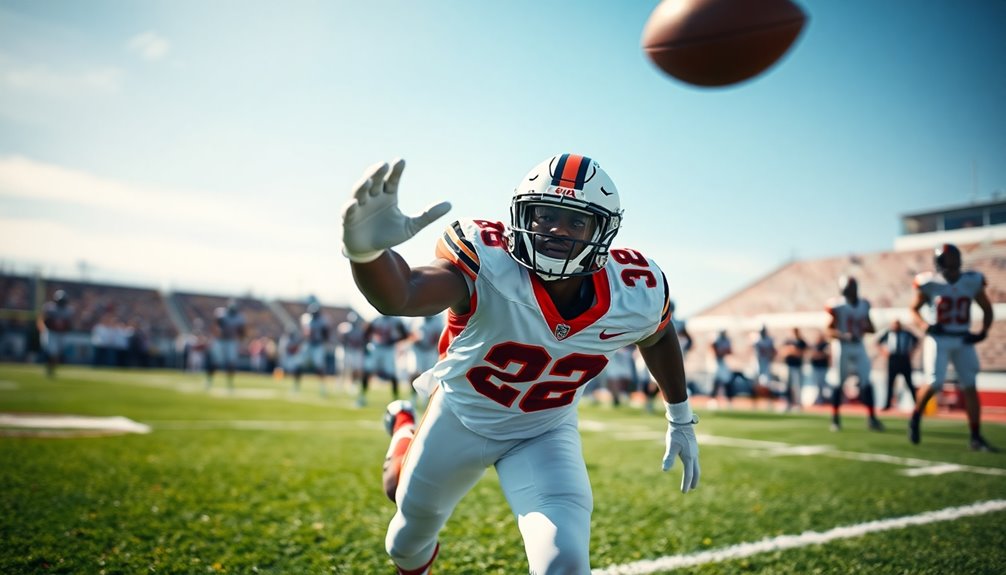
DB Position in Football: Skills You Need to Succeed
March 31, 2026To succeed as a defensive back in football, you need to master essential skills in coverage techniques, physical conditioning, and mental toughness. You’ll want to refine your man-to-man and zone coverage abilities, ensuring you anticipate plays and react quickly. Building key physical attributes like speed and strength is critical, alongside developing strong ball skills and instincts. Mental resilience will help you thrive under pressure. Keep going to uncover more strategies for excelling in this position.
Understanding the Role of a Defensive Back
You’ll need to anticipate routes and maintain proper positioning to outsmart your opponents. Quick reactions to offensive schemes are essential, so a strong grasp of leverage and route recognition is important.
Communicating effectively with teammates helps coordinate coverage and adjustments based on formations. Mastering both man-to-man and zone coverage principles allows you to adapt to various situations.
Effective communication with teammates is crucial for coordinating coverage and adapting to offensive formations. Mastery of coverage principles is essential for success.
Finally, honing your technique and mental preparation is key, as high-pressure scenarios can determine the outcome of a play, making quick decisions imperative for success. Additionally, understanding defensive formations enhances your ability to counter offensive tactics effectively.
Key Physical Attributes for Defensive Backs

To excel on the field, defensive backs need a unique set of physical attributes that enhance their performance. Speed and agility are essential, allowing you to keep pace with fast wide receivers and change direction swiftly during plays.
A strong vertical jump—ideally 35 inches or higher—enables you to contest passes effectively. Maintaining upper body strength is important for jamming receivers and tackling, while overall conditioning guarantees you can endure the game.
Quick reaction time is critical; you must anticipate plays and make split-second decisions. Finally, excellent body control and balance allow you to maintain positioning and recover quickly after being faked or misdirected. Additionally, fostering strong communication among teammates can significantly enhance your effectiveness on the field.
These attributes combined will set you apart as an exceptional defensive back.
Essential Ball Skills for Defensive Backs
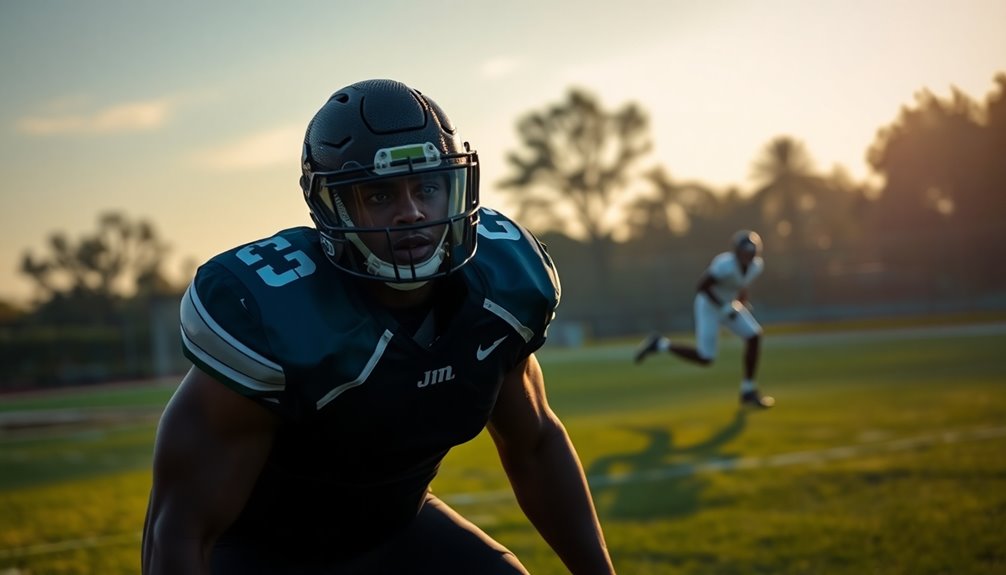
As a defensive back, mastering key interception techniques is essential for turning the tide in a game. You need to prioritize catching drills to develop “All American hands,” which will help you snatch passes out of the air. With practice and a competitive mindset, you’ll enhance your ability to anticipate plays and make impactful stops. Additionally, incorporating agility drills into your training will improve your quickness and ability to change direction effectively.
Key Interception Techniques
Mastering key interception techniques is essential for any defensive back aiming to make impactful plays on the field.
First, consistently practice catching the football outside of team drills to develop “All American hands.” This skill is critical for successful interceptions.
Great defensive backs excel in recognizing interception opportunities, often capitalizing on high interception rates. Use your athletic ability and instincts, honed through studying offensive strategies and game film, to anticipate the quarterback’s decisions.
Timing and positioning are imperative; close in quickly on the receiver once the ball’s in the air.
Finally, maintain mental toughness and a short memory. Recovering quickly from past mistakes keeps you focused and ready to make those critical plays when the opportunity arises.
Importance Of Catching Drills
Catching drills are essential for any defensive back aiming to elevate their game. Regular practice not only enhances your interception rates but also builds the confidence needed in critical moments.
Here are some key benefits of incorporating catching drills into your routine:
- Improved Hand-Eye Coordination: React quickly to opportunities.
- Game Simulation: Use one-handed catches or motion drills to mimic real scenarios.
- Turnover Creation: Capitalize on mistakes made by opposing offenses.
- Increased Reliability: Become a dependable player during high-pressure situations.
Developing All American Hands
Improving your catching skills lays the groundwork for developing “All American hands” as a defensive back. Consistent practice beyond team drills is key to enhancing your overall ball skills.
Hall of Fame defensive backs showcase high interception rates, emphasizing the need to seize every pass opportunity. Focus on honing your catching techniques to excel at intercepting passes and creating turnovers.
Train in various scenarios to boost your hand-eye coordination and confidence—both essential traits for defensive backs. Embrace each chance to catch the ball as a critical moment; this mentality can greatly elevate your performance on the field.
Developing Strong Instincts on the Field
While many skills are essential for a defensive back, developing strong instincts stands out as a game-changer on the field. To enhance your instincts, focus on the following:
- Study offensive strategies and game film to anticipate plays.
- Watch football regularly to understand offensive movements.
- Practice situational awareness to recognize route patterns.
- Engage in repetitive drills and live practice to react swiftly.
These strategies help you develop a “sixth sense” about offensive intentions, especially by analyzing quarterbacks and receivers. Additionally, practicing catching techniques can improve your ability to make impactful plays in critical moments.
Developing a sixth sense for offensive intentions is crucial, particularly through the analysis of quarterbacks and receivers.
The more you immerse yourself in understanding the game, the quicker your reactions will be during critical moments. Strong instincts are pivotal in making impactful plays and elevating your performance on the field.
The Importance of Mental Toughness in Defense
Mental toughness is a cornerstone of success for defensive backs, shaping how you respond to pressure and setbacks on the field.
In high-stakes situations, your ability to quickly recover from mistakes is essential for maintaining confidence and performance. Resilience turns failures into learning opportunities, allowing you to adapt and improve your play against evolving offensive strategies.
Staying focused is imperative, as quarterbacks can exploit any defensive lapses, so constant vigilance is key.
Great defensive backs develop mental toughness through consistent study of the game, sharpening instincts and decision-making. Practicing effective closeouts can further enhance your ability to contest offensive plays under pressure.
Mastering Defensive Techniques for Coverage
Building on your mental toughness, mastering defensive techniques for coverage is essential for your success on the field. To excel, focus on these key skills:
- Proper stance and footwork: Keep your feet shoulder-width apart and your outside foot back for quick reactions.
- Effective jam techniques: Disrupt the receiver’s route by focusing on their numbers and positioning, not reaching.
- Zone coverage awareness: Maintain an eight-yard cushion while tilting towards the quarterback to prevent deep threats.
- Route anticipation: Study film to understand receiver routes and enhance your reaction time during plays.
Incorporating position-specific training into your practice routine will further refine your skills and prepare you for game situations.
Consistent practice of these techniques will improve your positioning and overall effectiveness in coverage, making you a formidable defensive back.
Effective Man-to-Man Principles for Success
Effective man-to-man coverage is essential for a defensive back’s success on the field. Always position yourself so the opposing wide receiver can’t get directly in front of you, ready to react to their movements.
Maintain a proper stance with your feet shoulder-width apart, outside foot back, and a slight forward bend for balance. Use a jam technique effectively—keep your hands active to disrupt the WR’s route while focusing on their numbers.
Force the WR toward the sideline, using it as an extra defender to limit their options. Stay disciplined with constant foot movement and quick reactions to adjust to the WR’s route changes, ensuring you’re prepared for the next play and in the best position to defend effectively. Incorporating option routes can further enhance your ability to anticipate the receiver’s movements and react accordingly.
Strategies for Zone Coverage Mastery
While mastering zone coverage may seem challenging, it becomes manageable with the right strategies in place. Focus on these key tactics to elevate your game:
- Maintain an eight-yard cushion from the receiver to guarantee you can react effectively to both short and deep routes.
- Keep your eyes on the quarterback while tracking the receiver in your peripheral vision. This helps you anticipate passes and adjust your coverage.
- Stay deeper than the deepest receiver in your zone, reinforcing your spatial awareness to prevent deep route completions.
- Close the distance quickly once the ball is in the air. Trust your instincts to make a play instead of waiting for the receiver to catch it.
Regular practice will sharpen these skills, making you a formidable presence in zone coverage. Additionally, understanding the concept of flag pulling can enhance your defensive effectiveness in stopping the ball carrier.
Enhancing Decision-Making Under Pressure
When the game is on the line, your ability to make quick decisions under pressure can define the outcome of a play. As a defensive back, you need to assess when to tackle or drop back into coverage instantly.
Understanding game situations like down and distance helps you make tactical choices that align with team strategies. Staying aware of your teammates’ positions allows you to anticipate passing lanes, making informed decisions about when to support or defer.
Understanding down and distance is crucial for making tactical choices and anticipating passing lanes, ensuring effective teamwork on the field.
Additionally, adapting your strategies based on the opponent’s tactics, such as formations and shifts, enhances your effectiveness. Practicing situational drills that mimic high-pressure environments will sharpen your decision-making skills, ensuring you’re ready for any challenge during critical game moments. A strong focus on effective training techniques can further improve your performance under pressure.
Building Endurance and Fitness for Defensive Performance
To excel as a defensive back, you need high-quality endurance and fitness.
Focus on cardiovascular conditioning techniques and strength training to boost your performance on the field. Incorporating Pain Shuttles Drill into your training regimen can significantly enhance your speed and endurance.
Cardiovascular Conditioning Techniques
Cardiovascular conditioning is essential for defensive backs, as it directly impacts your ability to perform effectively during games.
To enhance your cardiovascular endurance, focus on these techniques:
- Interval Training: Sprint for 30 seconds, then rest for 30 seconds, mimicking the stop-and-start nature of defensive plays.
- Long-Distance Running: Aim for 3-5 miles per session to build a strong aerobic base and sustain energy levels.
- Agility Drills: Incorporate shuttle runs and ladder drills to improve cardiovascular fitness and quick directional changes under fatigue.
- High-Intensity Circuit Training: Combine strength and cardio exercises to mimic game-like intensity and boost overall fitness.
Prioritize recovery techniques like stretching and hydration to maintain your cardiovascular health and optimize performance during critical moments.
Strength Training Benefits
Strength training plays an essential role in enhancing your performance as a defensive back, providing the endurance and fitness necessary to excel on the field. By focusing on muscular endurance, you’ll maintain high energy levels throughout the game, essential for both defensive and offensive plays.
Incorporating compound exercises like squats and deadlifts builds the foundational strength needed for explosive movements and quick changes in direction. Resistance training boosts your overall fitness, equipping you with the stamina to recover quickly between plays.
Developing core strength through targeted exercises enhances your balance and stability, fundamental for effective tackling. Plus, consistent strength training minimizes injury risk and boosts your confidence, empowering you to perform at your peak during critical game situations.
Conclusion
To truly thrive as a defensive back, you need to blend physical prowess with mental mastery. By honing your hustle and hardening your heart, you can tackle tough situations on the field. Remember, it’s not just about speed; it’s about smart decisions and staying strong under stress. With dedicated practice and a passion for progress, you’ll become a formidable force in football, turning potential into performance and leading your team to victory. Keep pushing, keep perfecting!