
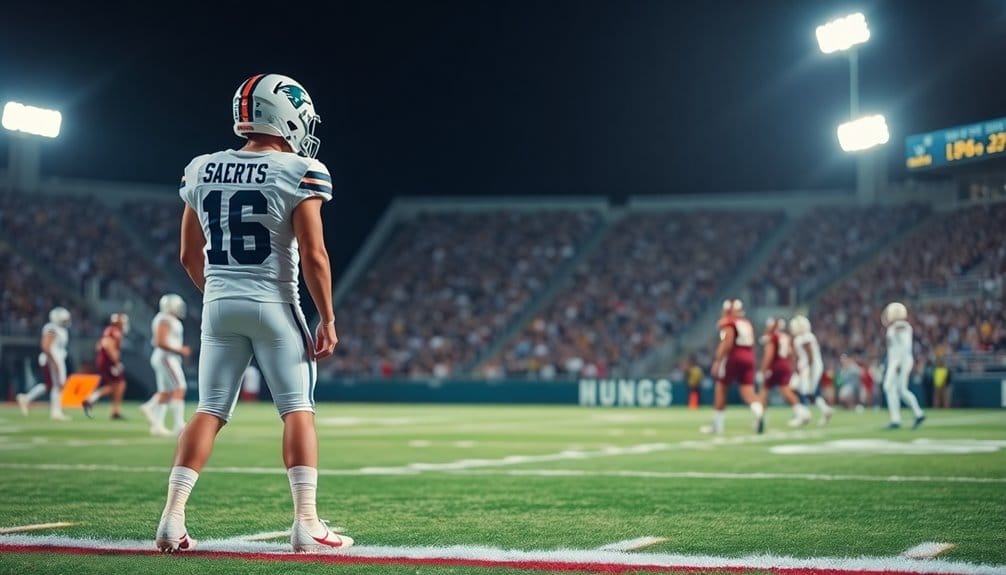
The FS Position Explained: Free Safety Basics
March 31, 2026The Free Safety (FS) is your last line of defense in football, positioned deep in the secondary to prevent big plays. You’ll need to read the quarterback’s eyes, anticipate passes, and cover slot receivers or tight ends effectively. Speed, agility, and strong decision-making are essential for success. Unlike the Strong Safety, who focuses on run defense, the FS specializes in deep coverage. If you’re curious about how this role shapes the game, there’s more to explore!
What Is the Role of the Free Safety in Football?
The free safety plays an essential role in football, serving as the last line of defense against big plays. Positioned deep in the secondary, your main job is to read the quarterback’s eyes and anticipate where the pass will go.
You often cover the pass by taking on slot receivers and supporting cornerbacks in coverage. Your agility and speed enable you to cover large areas of the field, making you vital in preventing touchdowns.
Your agility and speed allow you to cover extensive field areas, crucial for stopping touchdowns and supporting cornerbacks.
Communication is key, as you direct the defensive backs to adjust based on offensive formations. Sometimes, you might even blitz to pressure the quarterback. This multifaceted role requires quick thinking and adaptability to guarantee your team stays strong on defense, especially when leveraging defensive line formations to optimize your positioning against the offense.
Key Responsibilities of the Free Safety

Positioned deep in the secondary, a free safety‘s primary responsibility is to act as the last line of defense against offensive threats. As a defensive player, you need to stay alert and ready to react to the quarterback’s movements.
Here are some key responsibilities:
- Anticipate passing plays to make interceptions or break up passes.
- Help cover slot receivers and tight ends during man coverage.
- Provide assistance to cornerbacks when needed.
- Blitz to add pressure on the quarterback when the situation allows.
- Utilize quickness and agility to cover ground and react swiftly.
- Understanding flag pulling techniques is essential for effectively disrupting plays and ensuring defensive success.
Mastering these responsibilities is essential for a free safety, ensuring you effectively protect against big plays and touchdowns.
Essential Skills for a Successful Free Safety

To excel as a free safety, you need to master reading the quarterback’s intentions, which helps you anticipate plays before they unfold. Your speed and agility are essential for covering ground quickly and reacting to offensive moves. Additionally, understanding key defensive formations can enhance your ability to anticipate and counter offensive strategies effectively.
Reading Quarterback’s Intentions
As you step onto the field, honing your ability to read a quarterback’s intentions becomes crucial for your success as a free safety. You must develop sharp observational skills to anticipate passing plays and make timely interventions for potential interceptions.
Effective communication with your cornerbacks and linebackers is essential, as coordinating defensive strategies based on the quarterback’s movements can turn the tide of the game.
Consider these key points:
- Study game film to identify quarterback tendencies.
- Position yourself deeper in the secondary for a better field view.
- Quickly assess the quarterback’s actions.
- Decide between covering receivers or supporting the run.
- Trust your instincts to react swiftly.
Mastering these skills will enhance your impact on the game.
Speed And Agility
While speed and agility might seem like basic skills, they’re vital for any successful free safety. Your speed allows you to cover the field quickly, whether you’re intercepting passes or tackling ball carriers.
To maintain effective coverage against fast-moving wide receivers and tight ends, you need agility to change direction swiftly. The best free safeties can move sideline to sideline in under 4.5 seconds, highlighting just how significant these traits are. Quick footwork and body control help you navigate blockers and get into position for tackles or interceptions.
Furthermore, effective communication with cornerbacks and linebackers relies on your ability to adjust your positioning in real-time, ensuring your defense remains cohesive and responsive.
How Do Free Safeties Contribute to Defensive Strategies?
Free safeties play an essential role in defensive strategies, often acting as the last line of defense against big plays. They’re vital in preventing offenses from gaining significant yardage and can effectively cover receivers.
Free safeties are crucial to defensive strategies, serving as the last line of defense against big plays and effective receiver coverage.
Here’s how they contribute:
- Anticipate Passes: Free safeties read the quarterback’s eyes to intercept throws.
- Support Coverage: They assist cornerbacks, particularly against slot receivers and tight ends.
- Field Awareness: Their positioning allows them to cover a large area, helping the entire secondary.
- Blitz Pressure: Free safeties can blitz unexpectedly, increasing pressure on the quarterback.
- Aggressive Cornerbacks: By providing security, they enable cornerbacks to play more aggressively, enhancing the defensive strategy.
With these skills, free safeties are pivotal in maintaining a strong defense. Additionally, their ability to maintain cardiovascular endurance helps sustain performance throughout the game.
Differences Between Free Safety and Strong Safety
When you look at the differences between free safety and strong safety, you’ll notice distinct roles in coverage and field positioning.
Free safeties focus on deep coverage, while strong safeties are more involved in run defense.
This contrast in responsibilities and physicality shapes how each position impacts the game. Additionally, understanding leg strength can enhance an athlete’s overall performance, influencing their effectiveness in both coverage and tackling situations.
Coverage Responsibilities Comparison
How do the roles of free safety and strong safety differ on the field? The coverage responsibilities of each position reflect their unique roles in a defensive scheme.
- Free Safety (FS): Covers deep threats, anticipates interceptions, and roams the field.
- Strong Safety (SS): Focuses on the strong side, covering tight ends and supporting run defense.
FS typically positions 10-15 yards back for a better view of the quarterback.
SS lines up closer, around 5-8 yards, to engage with the run game.
In man coverage, FS often handles slot receivers, while SS covers running backs or tight ends.
Understanding these differences can enhance your appreciation of how each player contributes to the team’s success.
Field Positioning Variations
While both safety positions play essential roles in a defense, their field positioning highlights their distinct responsibilities.
The free safety (FS) typically lines up deeper in the secondary, about 10-15 yards from the line of scrimmage. This depth allows you to better cover deep passes and anticipate plays by reading the quarterback’s eyes.
In contrast, the strong safety (SS) positions closer, usually within 5-10 yards of the line, enabling you to effectively support run defense and cover tight ends. This positioning makes the FS the last line of defense, while the SS blends safety and linebacker duties.
Each role requires unique skills, with the FS focusing on agility and coverage, and the SS relying on physicality and tackling.
Physicality and Play Style
Understanding the differences in physicality and play style between the Free Safety (FS) and Strong Safety (SS) is essential for grasping their unique contributions to the defense.
- FS focuses on pass coverage and interception, playing deeper in the secondary.
- SS is positioned closer to the line, emphasizing run defense and tackling.
- FS relies on speed and agility to cover more field, while SS blends speed with physical play.
- Strong Safeties often engage more directly with offensive players, covering tight ends and running backs.
- In modern football, FS prioritizes coverage skills, whereas SS balances coverage with a more physical approach.
Grasping these differences helps you appreciate how each position supports the overall defensive strategy.
Historical Evolution of the Free Safety Position
As football evolved into a more pass-oriented game, the free safety position emerged from its roots as a defensive fullback. Initially known as the “defensive halfback,” the role shifted focus toward coverage rather than just tackling.
As strategies leaned heavily on the passing game, free safeties began anticipating quarterback plays and reading offensive formations, becoming essential to defensive schemes.
Many modern free safeties are converted cornerbacks, leveraging their speed and coverage skills to excel in deep defensive roles.
Today, the free safety stands as a critical last line of defense, capable of making interceptions and providing important support to cornerbacks. This evolution underscores the significance of adaptability in football’s dynamic landscape, much like the offside rule aims to balance the game in soccer.
Notable Free Safeties in NFL History
When you think about the impact of free safeties in the NFL, names like Ed Reed and Ronnie Lott immediately come to mind. These players not only excelled individually but also shaped the strategies of their teams and the league as a whole. Let’s explore how their legendary careers influenced the game and set standards for future generations, much like Nera White’s dominance in women’s basketball paved the way for future athletes.
Legendary Free Safeties
Free safeties have always been the backbone of a successful defense in the NFL, showcasing a blend of intelligence, speed, and instinct. Several legendary free safeties have left their mark on the game, proving essential to their teams’ defensive strategies.
- Ed Reed: Holds the record for 64 interceptions, a true ball hawk.
- Ronnie Lott: Known for his aggressive style, he collected 63 interceptions and played multiple positions.
- Troy Polamalu: A game-changer with eight Pro Bowl selections and two Super Bowl wins.
- Brian Dawkins: A fierce leader, he earned nine Pro Bowl nods and was inducted into the Hall of Fame.
- Earl Thomas: Key player in the “Legion of Boom,” known for his exceptional range.
These players exemplify what it means to be a top-tier defensive player.
Impact on Game Strategy
Legendary free safeties like Ed Reed and Troy Polamalu didn’t just dominate individually; they transformed how teams approached defensive strategies.
Reed’s record for the most interception return yards highlights the significant role of the free safety in creating turnovers and impacting game outcomes. Meanwhile, Polamalu’s instinctual play and ability to blitz showcased the versatility crucial in today’s game strategy.
In the modern game, free safeties are essential in countering high-powered passing offenses, influencing the effectiveness of defenses.
Players like Minkah Fitzpatrick continue this legacy, excelling in coverage while supporting run defense. Their skills prove indispensable in an era dominated by passing, ensuring the free safety position remains a cornerstone of defensive game plans.
Current Stars: Who Are Today’s Top Free Safeties?
Here are a few standout players you should know:
- Minkah Fitzpatrick (Pittsburgh Steelers) – Pro Bowl selections and multiple interceptions each season.
- Kevin Byard (Tennessee Titans) – Consistent performances with over 100 tackles in multiple seasons.
- Jessie Bates III (Atlanta Falcons) – Key player in the Bengals’ Super Bowl run, known for tackling.
- Xavier McKinney (New York Giants) – Versatile in coverage, creating turnovers in critical games.
- Antoine Winfield Jr. (Tampa Bay Buccaneers) – Physical play and an ability to read quarterbacks effectively.
These players exemplify what it means to excel as a free safety today! Their success highlights the importance of reading the quarterback’s eyes in anticipating plays and making impactful decisions on the field.
How Does the Free Safety Impact Game Outcomes?
The impact of a free safety on game outcomes is often underestimated, yet their role can be pivotal. As the last line of defense, the free safety reads the quarterback’s eyes and anticipates pass trajectories, fundamentally preventing big plays.
With top FSs averaging 5-7 interceptions per season, they create significant turnovers that can shift momentum. By covering deep zones and assisting in pass defense, an effective FS forces quarterbacks to alter their throws, resulting in increased incomplete passes and sacks.
This freedom allows cornerbacks to play more aggressively, enhancing overall defensive effectiveness. Ultimately, a skilled free safety influences game dynamics by making critical tackles, disrupting offensive rhythm, and contributing to a team’s scoring through turnovers. Additionally, their ability to read the quarterback’s eyes is crucial for anticipating offensive strategies and making game-changing plays.
Understanding Free Safety Terminology and Roles
Here’s a quick look at what makes the free safety position vital:
- Positioned deep in the secondary, acting as the last line of defense
- Provides support for cornerbacks in coverage
- Often tasked with creating turnovers through interceptions
- Capable of blitzing the quarterback, adding versatility to defensive schemes
- Generally faster and more agile than strong safeties, allowing for greater field coverage
Understanding these roles highlights how significant free safeties are in complementing the defensive line and making impactful plays on the field. Additionally, mastering various defensive formations is crucial for free safeties to effectively anticipate plays and make quick decisions.
Tips for Aspiring Players: Becoming a Great Free Safety
As an aspiring free safety, honing your skills is vital to excelling in this dynamic position. Focus on developing exceptional anticipation skills by studying quarterbacks’ movements and reading their eyes. This will help you predict passing plays effectively.
Speed and agility are imperative; work on improving these traits to cover the field and respond swiftly to offensive threats. Don’t overlook ball skills—practice catching and intercepting passes to turn defensive plays into scoring opportunities for your team.
Enhance your tackling technique to bring down ball carriers decisively when they break through the defense. Finally, maintain consistent communication with teammates to guarantee everyone understands their coverage responsibilities, fostering a cohesive defensive strategy on the field.
Conclusion
In football, the free safety stands as both a guardian and a playmaker, balancing between preventing big plays and creating turnovers. While they often lurk in the shadows, ready to pounce, their ability to read the game sets them apart. Embrace the challenge of mastering this position, where intuition meets strategy. Whether you’re stopping a touchdown or snagging an interception, remember: every decision you make can flip the game from defense to glory.