

Offensive Football Plays by Name: Learn Every Term
March 27, 2026Last updated: · By Jake Turner
This football plays glossary explains the offensive terms you hear on broadcasts and in coaches’ playbooks. A formation is how the offense lines up before the snap, and a play is the set of assignments that follows. Once you know the core terms, such as Power Run, Inside Zone, RPO, Trips, and Wildcat, you can follow what a team is trying to do on most downs.
The terms below are grouped by what they describe: basic vocabulary, formations, running plays, passing concepts, and how to read a play call. Where a term has an official definition, the source is linked.
Key Takeaways
- An offensive formation is the arrangement of the offense’s skill players before the snap, and the NFL’s flag football rules use that wording as their official definition.
- A series of downs is the set of charged scrimmage downs an offense receives, and the NFL’s 2026 rulebook builds its first-down and turnover rules on that concept.
- The Trips Formation places three receivers on one side of the field, while the Empty Formation has no running back in the backfield.
- In a Run-Pass Option (RPO), the quarterback decides after the snap whether to hand off or throw, based on how the defense reacts.
- The Wildcat gained wide attention in 2008, when the Miami Dolphins used a non-quarterback to take direct snaps.
What Are the Basic Football Terms You Need First?
The basic terms are down, series, formation, personnel, and snap. Knowing them makes every other play term easier to follow. Each one describes a different part of the sequence from the huddle to the whistle.
A series of downs is the set of charged scrimmage downs the offense gets to move the ball, according to the 2026 Official Playing Rules of the National Football League. The offense has four downs to gain at least 10 yards, and a first down resets that count.
A formation is the pre-snap arrangement of the offense. The 2025 NFL Flag Football Regular Season Rules define a formation as an arrangement of the offensive skill players, and tackle football uses the same idea with linemen included. Formation names are shorthand, so the same name can look slightly different from team to team.
Personnel describes which players are on the field, usually by a two-digit code. The first digit is the number of running backs and the second is the number of tight ends, so 11 personnel means one running back, one tight end, and three receivers. Coaches change personnel to match the matchups they want, and the most important positions in football explains why certain roles carry more weight in those decisions.
The snap is the handoff from the center to the quarterback or another back that starts the play. Every play begins there, and the snap in football covers how it works and why timing matters.
What Are the Most Common Offensive Formations?
The most common offensive formations are the I Formation, Split Backs, Shotgun, Pistol, Twins, Trips, Ace, Empty, and Spread. Each one changes where the running backs and receivers line up, which changes what the defense has to cover. The table below summarizes what each formation is built to do.

| Formation | Pre-snap setup | Main strength |
|---|---|---|
| I Formation | Fullback and running back lined up one behind the other under center | Power runs and lead blocking |
| Split Backs | Two running backs side by side behind the quarterback | Balanced run and pass options |
| Shotgun | Quarterback several yards behind the center | Faster throws and better view of the defense |
| Pistol | Quarterback a few yards behind the center, with one back deeper | Run and pass options with a quicker handoff |
| Twins | Two receivers lined up together on one side | Mismatches and pick or rub routes |
| Trips | Three receivers lined up on one side | Overloading one side of the defense |
| Ace | One running back with two tight ends | Blocking strength with receiving options |
| Empty | No running back in the backfield | Spacing for quick passes |
| Spread | Multiple wide receivers across the field | Horizontal stretch and one-on-one matchups |
What Is the I Formation?
The I Formation places a fullback and a running back in a line directly behind the quarterback. The fullback typically leads through the hole and blocks for the tailback. The setup also supports play-action passes, because the threat of a run can pull linebackers toward the line.
What Is the Trips Formation?
The Trips Formation puts three receivers on one side of the field, which overloads the defensive coverage on that side. The defense must decide how to cover three threats with its available defenders. The formation often creates one-on-one matchups for the outside receiver and clear routes for the inside receiver.
What Is the Empty Formation?
The Empty Formation removes all running backs from the backfield and spreads receivers across the field. Without a back to block, the offense usually relies on quick throws and short routes. It works best when the quarterback can read coverage quickly and release the ball on time.
What Are the Most Important Running Plays?
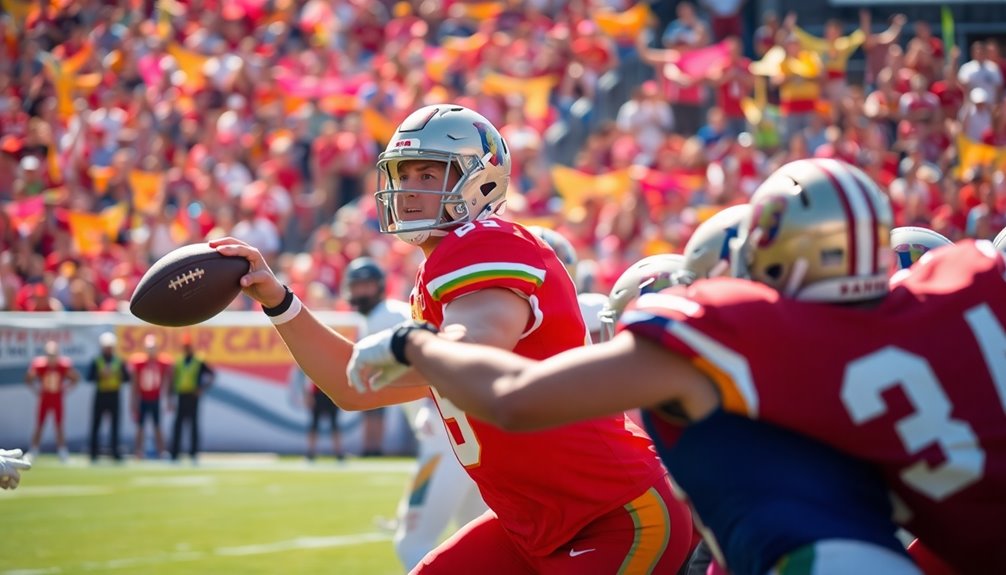
The most important running plays include the Power Run, the Inside Zone, and the Counter-style blocking concepts built on pulling linemen. Each one asks the offensive line and running back to do something different, from creating a hole with a pulling guard to reading gaps in a zone scheme. Learning the blocking assignment is the fastest way to understand the play.
What Is a Power Run?
A Power Run is a gap-blocking play in which a guard pulls across the formation to lead through a hole. The fullback or tight end often serves as the lead blocker, and the running back follows the lead. The play emphasizes strength and timing at the point of attack.
What Is the Inside Zone?
The Inside Zone is a zone-blocking running play in which the offensive line moves laterally and blocks the area in front of it rather than a specific defender. The running back reads the blocks and chooses the best lane to attack. Teams often use it on early downs because it allows cutbacks when the defense overpursues.
What Was the Wishbone Formation?
The Wishbone is a run-heavy formation with three backs arranged in a Y shape behind the quarterback. It was developed in the late 1960s and became prominent through the University of Texas. Multiple ball carriers make the option and sweep plays hard to defend, and it is still seen at the high school level.
What Are the Key Passing Concepts and RPOs?
The key passing concepts are the slant, the smash, the bubble screen, and the run-pass option (RPO). Passing concepts combine routes designed to attack specific zones, while the RPO adds a run threat to the same look. Route knowledge is the foundation, and the flag football routes every player should know guide covers the basic route shapes.
What Is a Run-Pass Option (RPO)?
A Run-Pass Option is a play in which the quarterback reads a defender after the snap and chooses between a handoff and a pass. The read is often a defender who could tackle the runner, and the quarterback throws if that defender moves toward the run. RPOs usually come from the Shotgun or Pistol, which gives the quarterback time to read the defense.
What Are the Slant and Smash Concepts?
A slant is a quick inside route that breaks at a sharp angle, and it is one of the fastest throws in the passing game. The Smash Concept pairs a corner route with a short hitch or flat route to attack a defender in the middle of the coverage. Both concepts are designed to get the ball out quickly against pressure.
What Is a Bubble Screen?
A bubble screen is a short pass to a receiver who has space on the outside, with blockers set up in front of him. It works well against aggressive defenders who crowd the line of scrimmage. Because it is a short throw, it is often used as an extension of a run threat.
What Is the Wildcat Formation?
The Wildcat is a formation in which a non-quarterback takes a direct snap, often a running back, while the quarterback lines up as a receiver or in motion. It creates an extra player who can run or pass without the defense knowing who will carry the ball. Teams use it as a change-of-pace package rather than a base offense.
- Unbalanced line: The alignment can shift the defense and open running lanes.
- Quick start: The runner gets the ball immediately, which speeds up the play.
- Misdirection: Motion and fakes make it hard to tell who has the ball.
How Do You Read a Play Call?
You read a play call by identifying the formation, personnel, and the play concept in that order. Start with the formation, because it tells you where players line up. Then confirm the personnel and look for the blocking or route assignment.
- Identify the formation by where the running backs and receivers line up.
- Check the personnel group to see how many backs, tight ends, and receivers are in the game.
- Watch the offensive line to see whether it is zone blocking or gap blocking.
- Track the quarterback and the running back to see whether the handoff or the pass is the main option.
- Look at the receivers’ routes after the snap to confirm the concept.
Frequently Asked Questions
What is the difference between a formation and a play?
A formation is how the offense lines up before the snap, while a play is the set of assignments the players carry out after it. The same formation can be used for many different plays. For example, the I Formation can run the Power Run or a play-action pass.
What does RPO stand for in football?
RPO stands for run-pass option. The quarterback reads a defender after the snap and decides whether to hand off the ball or throw it. RPOs are common in modern offenses because they create a decision the defense has to respect.
What is the difference between the Shotgun and Pistol formations?
In the Shotgun, the quarterback lines up several yards behind the center. In the Pistol, the quarterback lines up closer to the center with a running back deeper behind him. Both give the quarterback a better view of the defense than a direct snap under center.
Is the Wildcat formation still used?
Yes, but teams use it less often than during its peak attention in 2008. It is usually a small package rather than a base formation. Coaches use it to create a surprise look or to give a specific runner a chance to carry the ball.
Why do teams use different names for the same play?
Teams create their own playbooks, so the same blocking or passing concept can have different names. The terms in this glossary are common ones, but a team’s terminology may differ. When in doubt, check how the announcers or the team describes the play.
Conclusion
This football plays glossary gives you the formations and plays that appear most often on the field. Start with the basic terms, learn the common formations, and then focus on the blocking and reads behind each play. With that foundation, you can follow the strategy of any offense and understand why a play was called.
More on Football Plays Glossary
- Cover 5 Defense vs. Modern Offenses — Explained for Beginners
- Creative 7 on 7 Football Plays to Dominate the Field
- What Is a Snap in Football? The Play That Starts It All
Related guides: The Most Important Positions in Football Ranked · What Does a Flag on the Play Mean? A Guide to Common Football Penalties · Wide Receiver Route Tree Explained (with Diagram)
Free tools: Keto Macro Calculator · Keto Net Carbs Chart