
Why Tennis Is the Perfect Sport for Developing Hand-Eye Coordination
February 23, 2026Tennis is the perfect sport for developing hand-eye coordination because it demands quick visual tracking of the ball and swift motor responses. You learn to judge speed, distance, and trajectory, which refines your reflexes and sharpens your spatial awareness. It also enhances your ability to anticipate opponents’ movements, boosting your overall agility. Plus, the precise execution of shots builds confidence and reduces errors. Curious about how these skills transfer to other sports? There’s more to explore!
How Tennis Engages Your Visual and Motor Skills

As you step onto the court, you mightn’t realize how much tennis sharpens your visual and motor skills. Each time you track the ball, your visual processing kicks into high gear, requiring you to judge speed, distance, and trajectory.
Tennis enhances your visual and motor skills, honing your ability to judge speed, distance, and trajectory with every match.
You’ll notice your eyes darting around, evaluating the opponent’s movements and the ball’s path, enhancing your ability to react quickly.
Your motor control also plays an essential role. As you swing your racket, your brain coordinates muscle movements, ensuring you make precise shots. The combination of these skills not only improves your game but also translates to everyday activities. With practice, you’ll find that your ability to process visual information and execute precise movements becomes second nature, making tennis an incredible training ground for coordination. Additionally, tennis players often develop superior agility and endurance through rigorous practice, which further enhances their overall athletic performance.
The Impact of Tracking the Ball on Coordination
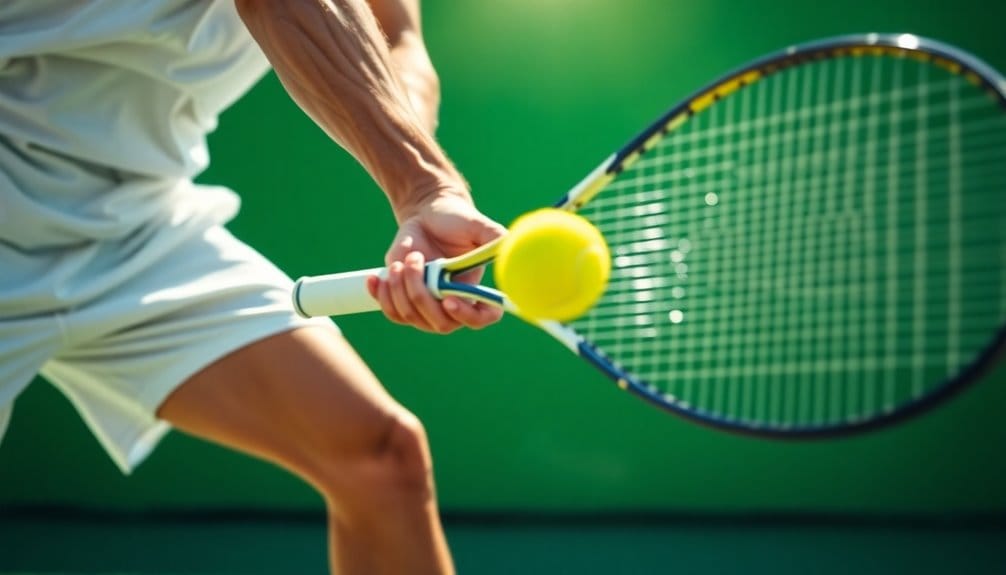
Tracking the ball in tennis greatly influences your coordination skills. As you focus on the incoming ball, you’re not just improving your hand-eye coordination; you’re also enhancing your spatial awareness.
This skill allows you to gauge the ball’s speed and trajectory, helping you position yourself accurately for each shot. Effective ball tracking requires quick adjustments and sharp reflexes, which are vital for precise movements on the court. Additionally, mastering field dimensions and markings can further improve your overall gameplay and positioning during matches.
Anticipating Opponents: A Key to Improved Reflexes?
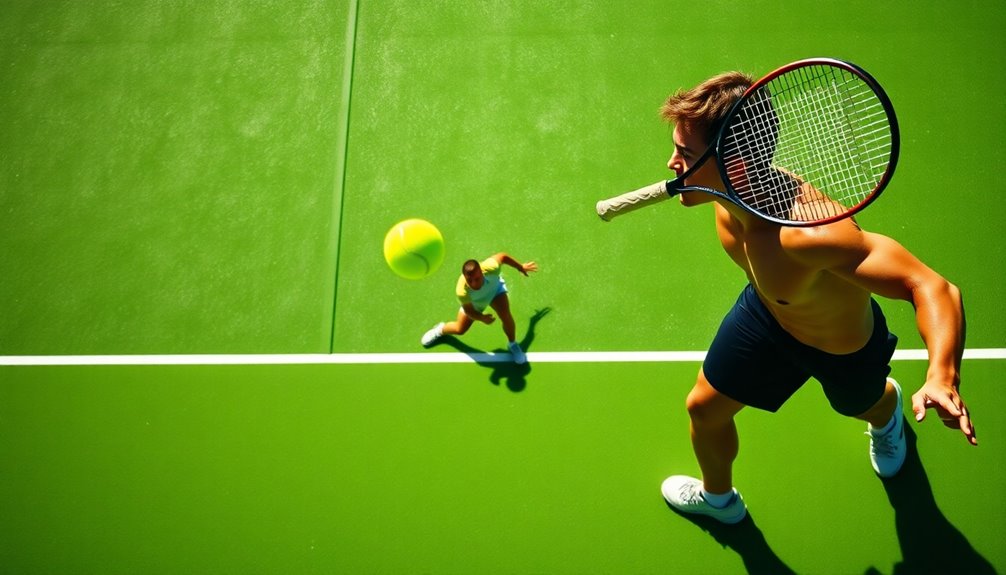
Anticipating your opponent’s next move is essential for sharpening your reflexes on the tennis court. By mastering opponent analysis, you can predict their shots and respond quicker. Pay attention to their stance, grip, and the way they swing their racket. This insight allows you to position yourself strategically, giving you a better chance to return the ball effectively.
As you learn to read their body language, your reactions become instinctual, enhancing your overall game. Practicing this skill not only improves your reflexes but also builds confidence during matches. Incorporating small-sided games into your practice can further enhance your decision-making abilities, allowing for quicker and more effective responses during play.
You’ll find that the more you anticipate, the less time you’ll spend on the back foot, and the more you’ll dominate the court with precise movements and timely responses.
Precision in Shot Execution and Its Benefits
Mastering the art of shot execution can greatly elevate your performance on the court. When you focus on your shot accuracy, you’ll notice significant improvements in your game.
Here are some benefits of refining your technique:
- Enhanced Control: Precise shots allow you to place the ball exactly where you want it.
- Increased Consistency: Regular practice leads to a reliable performance, reducing unforced errors.
- Better Tactical Play: Understanding shot execution lets you exploit your opponent’s weaknesses effectively.
- Boosted Confidence: Knowing you can execute shots accurately builds self-assurance during matches.
Additionally, effective shot execution mirrors the importance of sportsmanship and respect seen in team sports like soccer, emphasizing fair play and competition.
How Tennis Skills Transfer to Other Sports and Activities
While you may think of tennis as a sport that stands alone, the skills you develop on the court can seamlessly transfer to a variety of other sports and activities.
Your hand-eye coordination improves markedly, which benefits basketball passing; you’ll find it easier to anticipate your teammate’s movements and deliver precise passes.
Improved hand-eye coordination from tennis enhances basketball passing, making it easier to anticipate teammates and deliver accurate passes.
The quick reflexes and timing you hone while serving and returning shots translate directly to baseball hitting. You’ll react faster to pitches and connect better with the ball.
Additionally, the footwork from tennis enhances your agility in sports like soccer and badminton. Mastering catching techniques can also improve your overall performance in these sports by helping you become more adept at tracking and catching moving objects.
Conclusion
To summarize, tennis is like a dance between your eyes and hands, where each swing sharpens your coordination and reflexes. As you track the ball and anticipate your opponent’s moves, you’re not just playing a game; you’re honing skills that ripple into other sports and daily activities. So, grab your racket and step onto the court—each match is a chance to elevate your hand-eye coordination to new heights!