

What Is a Snap in Football? The Play That Starts It All
March 16, 2026A snap in football kicks off every offensive play. It’s when the center delivers the ball backward to the quarterback, setting everything in motion. You’ve got different types, like the under-center and shotgun snap, each essential for timing and execution. The center’s role goes beyond just snapping; they also read the defense and initiate the play. Mastering the snap can elevate a team’s performance, and there’s much more to explore about its importance and techniques.
What Exactly Is a Snap in Football?
A snap in football is the critical moment that kicks off an offensive play. It’s the action where the center delivers the ball to the quarterback, usually through a backward pass between their legs.
This shift from a static formation to active play is significant, allowing your team to advance the ball. There are various types of snaps, like the traditional under-center snap or the shotgun snap, which positions the quarterback a few yards behind the center for quicker passes.
Only the center or occasionally other positions can legally perform the snap, making it a specialized skill. The snap count, often signaled by calls like “hut,” is fundamental for timing, as any delay can lead to penalties. Additionally, understanding offensive penalties can help prevent mistakes that occur during the snap process.
Why Is the Snap Crucial for Offensive Plays?
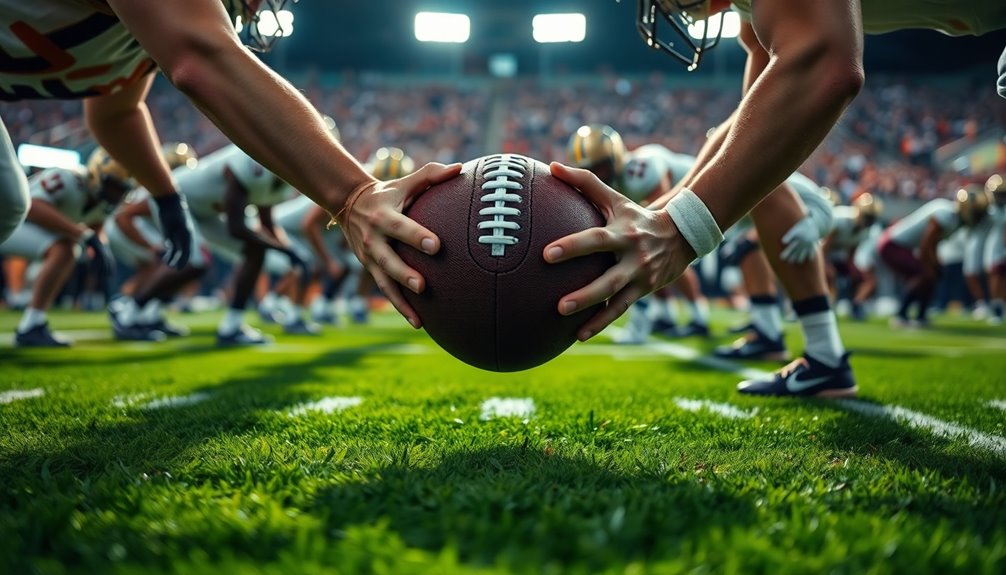
Without a precise snap, the entire offensive play can falter, making it crucial for success on the field.
When the center snaps the ball, it’s the moment that shifts from preparation to action. If the snap isn’t quick and accurate, the timing gets thrown off, disrupting the quarterback’s rhythm. This can lead to missed opportunities or even fumbles.
Effective communication between the center and the quarterback is essential, especially when the quarterback is lined up to read the defense. Mastering different snapping techniques, like shotgun and under-center snaps, guarantees your team can adapt to various defensive strategies. A successful snap sets the tone for the entire offensive play, underscoring its significant importance in football. Additionally, understanding spacing among receivers can help optimize the play right after the snap.
How Does the Snap Initiate Gameplay?

The snap kicks off the action in football by sending the ball from the center to the quarterback, marking the start of the play.
You’ll notice that the timing and technique of the snap are essential; any misstep can throw off the entire offensive strategy. Understanding the different types of snaps and their execution helps you appreciate how important this moment is for success on the field. Additionally, the center must identify potential blitzes to enhance team defense against pressure during this critical moment.
Importance of the Snap
In football, the snap acts as the catalyst for every offensive play, shifting the ball from the ground to the quarterback. You need to understand the significance of the snap; it’s the moment that kicks off the entire play.
The center position is essential here, as the player must accurately and quickly snap the football to guarantee the offensive team can execute their strategy effectively. If the snap isn’t executed correctly, it can lead to fumbles, disrupting the whole offensive plan.
This is why communication before the snap, often through vocal signals like “hut,” is crucial. It makes certain everyone’s synchronized and ready to perform their roles, making the snap the heartbeat of any successful offensive drive.
Types of Snaps
Snaps kick off the action in football, setting the stage for each play. There are three main types of snaps: the under-center snap, shotgun snap, and long snap.
The under-center snap involves the center directly handing the ball to the quarterback, typical in traditional formations. In contrast, the shotgun snap positions the quarterback 5 to 10 yards behind the center, prioritizing speed and accuracy, especially for passing plays.
Long snaps are essential for special teams, as they send the ball 10-15 yards to the punter or holder, requiring precise technique.
Each type plays an important role in gameplay, ensuring the offense can execute its strategy effectively right from the start.
Execution and Timing
Initiating gameplay relies heavily on precise execution and timing during the snap. The center delivers the ball to the quarterback with a quick, backward pass, whether through a traditional snap or a shotgun snap.
Timing is essential; the offensive team uses vocal cues, like “hut,” to signal the snap, ensuring it happens within the play clock’s limit. Effective execution requires the center to maintain the right stance and grip, delivering the ball accurately to avoid fumbles.
Meanwhile, defensive players try to predict this timing to gain an advantage. By varying snap counts, like using silent or hard counts, you can disrupt defensive timing and minimize penalties for offsides, making the snap count a significant part of offensive strategy.
Different Types of Snaps Explained
When you think about different types of snaps, the center snap and its variations come to mind first.
You’ll also want to understand long snap techniques, especially since they play an essential role in special teams.
Let’s break down how these snaps work and why they’re important in the game. Incorporating position-specific training can enhance a player’s ability to execute these snaps effectively under pressure.
Center Snap Variations
Understanding the various center snap variations can greatly enhance your grasp of offensive strategies in football. The center snap is the most common type, delivered between the legs to initiate plays.
In contrast, the shotgun snap has the quarterback positioned 5 to 10 yards behind the center, demanding precision for successful passing.
You’ll also encounter the long snap, primarily used in special teams for punts and field goals, ranging from 10-15 yards for punts and 5-7 yards for field goals.
While less common, the swinging gate snap is a lateral snap often employed during 2-point conversions, allowing for creative tactics.
Each snap type plays a vital role in the offensive line’s execution, requiring specific techniques for ideal performance.
Long Snap Techniques
Long snapping is a specialized skill that sets itself apart from regular center snaps, focusing on precision and speed. As a long snapper, your main goal is to deliver a tight spiral over distances of 10-15 yards for punts and 5-7 yards for field goals.
Unlike the center’s snap, you’re not handing off the ball to a quarterback; instead, you aim for accuracy to guarantee the punter or holder can handle it smoothly. Mastering the technique involves perfecting your grip, body positioning, and follow-through.
Additionally, protection rules in high school and college football enhance your safety during snapping. With practice, you can excel in this unique role, combining agility with precise snapping for successful plays.
The Role of the Center: More Than Just Snapping
While many fans associate the center primarily with snapping the ball, their role encompasses much more. The center initiates the play by delivering the snap to the quarterback but also reads the defense to communicate essential blocking assignments.
With an average of 55 to 66 snaps per game, this position is critical for offensive strategy. Depending on the situation, the center can choose to block for the quarterback or release as a receiver after the snap.
In pass protection, they must quickly identify and neutralize defenders, particularly those in the middle. Mastery of various snapping techniques, like shotgun and under-center snaps, further enhances their effectiveness, making the center a key player in executing successful offensive plays. Additionally, understanding offensive strategies is vital for the center to effectively support the team’s overall game plan.
Understanding Snap Count and Its Importance?
The snap count plays an essential role in the flow of a football game, as it serves as the signal for the offensive team to kick off their play. This pre-determined cue, often vocalized as “hut,” helps synchronize the offense, ensuring everyone is ready.
Effective snap counts can disrupt defensive timing, causing opponents to jump offside and incur penalties. In loud stadiums, you might notice teams using silent or hard counts to minimize confusion.
Remember, if your team doesn’t execute the snap within the play clock, you’ll face a delay of game penalty, highlighting the importance of timing.
It’s vital for the defensive team to refrain from mimicking snap counts, maintaining fairness throughout the game. Additionally, understanding the importance of team coordination can significantly enhance the effectiveness of snap counts during gameplay.
Common Techniques for Effective Snapping
When executing shotgun snaps, lean over the ball and focus on a strong follow-through to guarantee speed and accuracy, especially with the quarterback positioned 5 to 10 yards back.
Mastering these snapping techniques is critical; poor snaps can derail plays and lead to turnovers.
Regular practice on grip, technique, and body positioning will sharpen your skills and enhance performance during games. Additionally, conditioning drills can improve your overall strength and stability, providing a solid foundation for effective snapping.
The Snap’s Historical Evolution in Football
Mastering snapping techniques lays the groundwork for understanding its historical evolution in football. The snap has come a long way since its inception, influencing how the game is played today.
Here are some key milestones:
- In 1880, the snap rule allowed a hand pass to start plays, shifting from rugby practices.
- By the early 20th century, centers shifted from foot play to hand snapping, limiting foot play to forward kicks.
- The Burnside rules of 1923 streamlined gameplay by reducing the scrimmage to just the center.
These changes accelerated the pace of play and refined how the ball is snapped, marking significant progress in football’s evolution. Understanding this history helps you appreciate the snap’s critical role in initiating each play, as it sets the stage for the quarterback’s grip technique and overall execution.
How Does Snapping Differ in Canadian vs. American Football?
While both Canadian and American football share the fundamental aspect of snapping the ball to initiate plays, their approaches differ markedly.
In Canadian football, the snap must be delivered between the legs, while American football allows for hand or foot snaps. Established in 1880, American football’s snap rules enable greater visibility for centers, who often face forward, unlike their Canadian counterparts, who face the defense.
The wider field in Canadian football allows for unique formations, like the single-wing, influencing how snaps are executed. In contrast, American football frequently employs the shotgun snap, focusing on a more structured approach.
These differences in technique and rules shape how each game flows from the very first snap. Additionally, the field dimensions and equipment used in each sport also contribute to the unique styles of play observed.
The Snap’s Impact on Game Strategy and Flow
The snap is the heartbeat of your offense, setting the stage for every play. Timing and execution are vital, as a well-timed snap can disrupt the defense and create opportunities. When you master the snap, you not only enhance your team’s rhythm but also keep opponents guessing. Additionally, understanding defensive line formations can help your offense capitalize on defensive weaknesses during the snap.
Key Role in Offense
In football, the snap serves as the essential ignition point for every offensive play, transforming strategy into action. It’s critical for maintaining the rhythm of your offense and executing plays effectively. A well-timed snap can disrupt the defense, giving your team a strategic edge.
Here are a few key aspects of the snap’s role in offense:
- The center’s snapping techniques, whether shotgun or under-center, directly impact the quarterback’s options.
- Effective communication of snap counts helps coordinate plays and confuses the defense.
- Mastery of the snap is fundamental; errant snaps can lead to fumbles or penalties, hindering your progress.
Understanding these elements can enhance your offensive strategy and improve your chances of scoring.
Timing and Execution
When you consider the flow of a football game, the timing and execution of the snap can make or break a drive. The snap must be precise, as the timing of the snap often hinges on vocal signals like “hut.”
Effective snap execution allows for quicker plays, keeping the defense on their toes and reducing the risk of penalties like delay of game. Variations in snap count, including silent or hard counts, can confuse the defense and enhance your offensive strategy.
A well-timed snap is vital for the quarterback to get the ball back smoothly, enabling faster decision-making and increasing scoring opportunities. Ultimately, the speed and accuracy of the snap directly impact your success on the field.
Disrupting Defensive Strategies
While effective snapping plays an essential role in a team’s offensive success, it also serves as a powerful tool for disrupting defensive strategies. By varying snap counts, you can throw off defensive players, making it harder for them to predict your next move. This often leads to penalties like offsides.
Here’s how you can exploit the snap:
- Effective Communication: Clear signals between the quarterback and center can confuse the defense.
- Silent Counts: In noisy stadiums, using silent counts masks the snap, complicating defensive alignments.
- Pressure on Fumbles: Since the snap is a backward pass, a mishandled snap leads to a fumble, putting even more pressure on defenses to exploit mistakes.
Utilizing these strategies can greatly shift the game in your favor.
Key Drills to Improve Snapping Skills
Improving your snapping skills requires focused practice and specific drills designed to enhance your technique. Start with consistent stance practice; work on both one-hand and two-hand square stances for stability during snapping.
Footwork drills are essential too—emphasize lateral movement and quick pivots to enable effective blocking or release after snapping. For accuracy, use targets like cones or nets during your snapping drills, especially for shotgun snaps aimed at the quarterback.
Emphasize lateral movement and quick pivots in footwork drills for effective blocking and accurate shotgun snaps.
Incorporate game simulation into your practice sessions, allowing you to snap under pressure while communicating with teammates about blocking assignments.
Finally, utilize video analysis to review your snapping technique, focusing on grip, hand placement, and follow-through for peak performance.
Common Mistakes and How to Avoid Them?
Even the most skilled snapper can fall into common pitfalls that disrupt performance. To guarantee you effectively snap a football, keep these tips in mind:
- Snap quickly: Hesitation can lead to delayed plays or penalties. Aim for a seamless motion.
- Maintain proper hand position: Your dominant hand should be on top to guarantee a clean snap and accurate delivery to the quarterback’s hands.
- Communicate effectively: Sync with the quarterback on the snap count to minimize confusion.
Regularly practice snapping techniques, including both shotgun and under-center snaps, to build consistency.
Focus on body positioning; keep your feet shoulder-width apart and knees bent for stability.
Avoiding these common mistakes will greatly improve your snapping performance.
Famous NFL Centers and Their Snapping Techniques
When you think about the art of snapping in football, it’s hard not to acknowledge the legendary centers who’ve shaped the game with their unique techniques.
Jim Otto of the Oakland Raiders showcased a two-hand snap that emphasized precision and speed. Hall of Famer Dwight Stephenson revolutionized quick shotgun snaps, allowing the Miami Dolphins to execute fast-paced plays in the 1980s.
Mike Webster, a key player for the Pittsburgh Steelers, mastered both under-center and shotgun snapping, contributing to their offensive success. Current star Jason Kelce excels at reading defenses and adjusting blocking schemes, highlighting the importance of communication between the center and quarterback.
Centers like Nick Mangold have also enhanced the game with agility, increasing overall offensive efficiency.
Conclusion
In summary, the snap’s essential role in football can’t be overstated. It’s the foundation of every offensive play, setting the stage for everything that follows. Did you know that a well-timed snap can improve a team’s offensive efficiency by over 20%? Mastering this skill not only enhances gameplay but also strengthens team dynamics. So, whether you’re a player or a fan, appreciating the snap’s significance can deepen your love for the game!