
Unveiling the Route Tree: The Go-To Routes Every Receiver and Quarterback Should Know
March 13, 2026Understanding the route tree is vital for you as a receiver or quarterback. It helps optimize your performance and exploit defensive weaknesses effectively. Master key routes like the slant, comeback, curl, out, and go to enhance your teamwork and timing. Each route requires precise execution to create separation and generate yardage. By mastering these essentials, you can elevate your offensive strategy. Stick around to discover tips for avoiding common mistakes and improving your route-running skills.
The Importance of Understanding the Route Tree
Understanding the route tree is essential for any player in football. It serves as a standardized visual guide for route running, helping you and your quarterback communicate effectively.
Mastering the route tree enhances your team’s offensive efficiency, allowing you to exploit defensive weaknesses through precise execution. Each route has unique timing and spacing requirements, which are critical for successful passing plays.
By grasping the route tree, you can quickly adapt to various defensive coverages, making real-time adjustments during games. This knowledge fosters teamwork, as you and your quarterback can anticipate each other’s movements, leading to better decision-making on the field.
Ultimately, understanding the route tree is fundamental for creating separation and maximizing scoring opportunities. Additionally, clear communication between receivers and quarterbacks is vital for executing plays successfully.
Key Routes Every Receiver Needs to Master

Mastering key routes is essential for any receiver looking to elevate their game. The route tree includes several must-know patterns.
Mastering essential routes is crucial for receivers aiming to enhance their performance and impact the game.
The slant route is effective against man coverage; take a few quick steps forward before cutting at a 45-degree angle.
With the comeback route, sprint vertically then break back toward the sideline, perfect for back-shoulder throws.
The curl route lets you break inward after selling vertical, targeting soft spots in zone coverage.
The out route requires running 10-15 yards downfield, then making a sharp cut toward the sideline.
Finally, the go route sees you sprint straight, aiming for a deep pass.
Mastering these routes helps receivers create separation and enhances the quarterback’s options, especially when incorporating diverse offensive routes to keep defenses guessing.
How Does the Slant Route Create Separation?
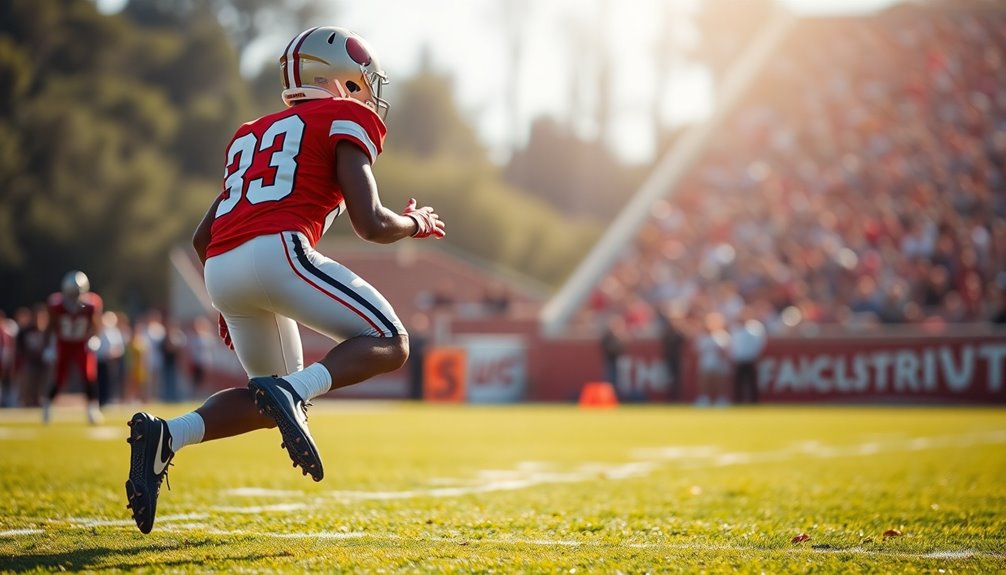
The slant route creates separation by leveraging your quickness and the element of surprise. As you take one or three quick steps forward, cutting sharply at a 45-degree angle, you force defenders to react quickly.
This sudden change in direction often leads to mismatches, especially against man coverage. Timing with your quarterback is vital; a quick release maximizes the route’s effectiveness and minimizes defensive pressure.
Typically, you’ll cover a distance of 5 to 10 yards before making your break, making it ideal for short-yardage situations where quick gains are essential. Mastering proper body alignment enhances your ability to create separation effectively.
Utilizing the Flat Route for Quick Passes
When you utilize the flat route, you’re tapping into a quick, effective option for gaining yards.
This route shines with slot receivers or tight ends who can create immediate separation, especially against zone coverage.
Timing and precision are essential here; you need to deliver the pass swiftly to maximize the receiver’s advantage. Incorporating deceptive routes can further enhance the effectiveness of the flat route by keeping defenders off balance.
Key Advantages of Flat Routes
Flat routes offer a strategic advantage in fast-paced offenses, allowing receivers to quickly exploit defensive weaknesses.
These quick routes involve a swift out-breaking maneuver, where you take three vertical steps before cutting outside. This technique is particularly effective for slot receivers and tight ends, as it targets the defense’s flat zone, creating space for easy completions.
Against zone coverage, defenders often struggle to cover the sideline, making flat routes ideal for gaining quick yardage.
Timing is essential; a fast release from the quarterback capitalizes on your immediate separation from defenders.
Timing and Precision Importance
Executing a flat route hinges on impeccable timing and precision, as these elements can make or break the play. You need to take three quick steps vertically before breaking outside, allowing your quarterback to deliver a swift pass.
Timing is everything; you must create separation from defenders in an instant to secure the catch, especially when they’re applying pressure. This route is perfect for quick passes, minimizing the time your quarterback holds the ball.
When executed effectively, the flat route can exploit soft spots in zone coverage, leading to significant yardage gains. Recognizing when to break and anticipating the throw are crucial to keeping defenders off balance and maximizing your impact on the field.
Ideal Receiver Types
While various receiver types can run the flat route, slot receivers and tight ends excel in this role due to their agility and quickness. They take three vertical steps before breaking outside at a 45-degree angle, which helps create separation for those swift passes.
This route shines against zone coverage, targeting soft spots and allowing for immediate yardage after the catch. To make it effective, you and your quarterback need precise timing; the quicker the pass is delivered, the better you avoid defensive pressure.
Utilizing the flat route not only sustains offensive momentum but also provides reliable options in short-yardage situations, making it an essential tool in your playbook as a receiver.
The Comeback Route: Timing and Execution Explained
When mastering the comeback route, timing and execution become essential for success. You sprint vertically downfield before breaking inside at a 45-degree angle, typically around 12-15 yards deep. This movement creates separation from defenders, especially effective against off-coverage.
As you make the break, it’s important that your quarterback delivers the pass precisely as you turn back. Strong arm strength is critical here, ensuring the throw reaches you accurately, even in tight windows.
To sell the route effectively, you need to initially sell the deep route, making that comeback more convincing. This combination of precise timing and execution between you and your quarterback can turn the comeback route into a reliable weapon on the field. Additionally, mastering route timing is crucial for ensuring the quarterback’s throw aligns perfectly with your break.
Breaking Down the Curl Route for First Downs
Master the curl route to become a go-to option for converting essential first downs. This route involves sprinting downfield for about 10-15 yards before breaking back toward the quarterback. Timing is vital; you need to turn back at just the right moment to avoid defenders and secure the catch.
The curl route is particularly effective against zone coverage, allowing you to find soft spots and settle into open areas while keeping eyes on the quarterback. In critical situations, this route shines as it converts short-yardage plays, giving you the chance to pivot and gain needed yardage.
Successful execution demands precise route depth and a strong connection with your quarterback for accurate passes in tight coverage. Incorporating effective offensive strategies can further enhance your team’s ability to execute this route successfully.
Effective Use of the Out Route in Offensive Strategy
When you utilize the out route, timing and precision are key to success.
You can exploit defensive weaknesses by drawing defenders away from critical areas, creating openings for other plays.
Mastering this route not only enhances your offensive strategy but also keeps the defense guessing. Additionally, incorporating proper finger placement ensures a more accurate throw during the execution of the out route.
Timing and Precision
When the receiver runs 10-15 yards downfield before making that sharp 90-degree cut, creating separation from defenders is vital. The quarterback must anticipate this break, delivering an accurate pass at just the right moment.
This route allows for quick passes to the sidelines, enabling the receiver to gain yardage while staying in bounds and setting up opportunities for yards after the catch.
Strong arm strength plays a key role, as the quarterback’s firm throw must reach the receiver quickly to avoid defensive pressure.
Awareness of spacing and the sideline guarantees successful catches without stepping out.
Exploiting Defensive Weaknesses
To effectively exploit defensive weaknesses, utilizing the out route can be a game-changer in your offensive strategy. This route allows you to target soft coverage and create space along the sidelines.
Here’s how to maximize its effectiveness:
- Identify Defensive Coverages: Understand whether the defense is in man or zone to exploit gaps.
- Timing is Key: Guarantee precise timing between you and your quarterback for accurate passes.
- Stretch the Defense: Use out routes to pull defenders horizontally, opening lanes for deeper routes.
- Strong Arm Required: A quarterback with strong arm strength can deliver the ball quickly, allowing you to catch it while maintaining momentum.
Combining Routes for Maximum Impact on Defenses
Combining routes can markedly elevate an offense’s effectiveness by putting immense pressure on defensive coverages.
Strategic route combinations like the Smash Concept, where an inside receiver runs a corner while the outside settles into a curl, force defenders to choose their coverage.
The Dagger Concept, with an outside receiver on an in route and an inside receiver on a go route, creates mismatches and opens passing lanes.
Similarly, the Sail Concept allows for significant separation against zone defenses, facilitating quick, efficient passes.
The Slant-Flat combination clears space rapidly, providing the quarterback with easy options under pressure.
Against Cover 2, using a go and post route stretches the defense, exploiting gaps and enhancing your team’s passing plays. Additionally, utilizing layered route concepts can maximize spacing and depth, creating further opportunities for successful completions.
Common Mistakes Receivers Make With Route Running
When you’re running routes, timing and depth are essential. Missing the right depth can throw off the quarterback, leading to incomplete passes. Plus, if you don’t maintain your pace, defenders can easily read your movements and react faster. Regular practice of agility drills can significantly enhance your ability to change direction quickly and effectively.
Timing Issues
Although timing is essential in route running, many receivers overlook key details that can hinder their effectiveness. Here are common timing issues you should avoid:
- Rounding the Break: This allows defenders to undercut throws, leading to interceptions.
- Slowing Down: Reducing speed before cuts signals to defenders, limiting your separation and increasing coverage chances.
- Ignoring Route Depths: Disrupting precise route depths messes with timing between you and the quarterback, making plays less effective.
- Excessive Head Movement: Too much movement can throw off your balance and speed, making it easier for defenders to predict your next move.
Consistent execution of detailed route mechanics is vital; even small mistakes can lead to significant failures in play execution.
Route Depth Misjudgment
Timing is key, but route depth is just as critical in executing effective plays. Route depth misjudgment can throw off your timing with the quarterback, leading to routes that are either too short or too long.
For instance, when running a 10-yard out, you should be taking five to seven precise steps. Rounding your breaks instead of making sharp cuts allows defenders to undercut your route, increasing the risk of interceptions.
If you ignore route depth, you’ll likely find yourself out of position, making it harder for the quarterback to deliver accurate throws. Consistent practice in understanding and executing the correct route depths is essential for building chemistry with your quarterback, ultimately boosting your offensive efficiency.
Drills to Enhance Route Running Skills and Precision
Here are some drills to improve your technique:
- Cone Drills: Focus on sharp cuts while maintaining speed during direction changes.
- Pivot and Comeback Drills: Enhance your ability to make quick, explosive turns while keeping balance.
- Box Drill: Refine your 90-degree cuts and direction changes, essential for effective route execution.
- Stem and Stack Drill: Teach effective release techniques against press coverage to initiate routes with confidence.
These targeted exercises guarantee you’re ready for any route that requires agility and precision, helping you become a more effective receiver. Incorporating agility drills into your routine will further enhance your overall performance on the field.
Conclusion
In mastering the route tree, you’re setting yourself up for success on the field. Remember, “practice makes perfect.” By honing these key routes and understanding their nuances, you’ll not only improve your game but also your connection with your quarterback. Keep working on your timing and execution, and soon you’ll see the impact of your skills in every play. So lace up those cleats, hit the field, and watch your efforts pay off!
