
Touchdowns & Penalties: Everything You Need to Know About Flag Football Scoring and Rules
December 1, 2025In flag football, touchdowns score six points by crossing the opponent’s goal line. After a touchdown, you can earn extra points through one-point or two-point conversion attempts, adding strategy to the game. Field goals and safeties offer additional scoring methods. However, penalties like false starts and pass interference can greatly impact your team’s performance. Staying aware of the rules is essential for success. Keep going, and you’ll discover more about effective strategies and gameplay nuances.
Understanding the Basics of Flag Football
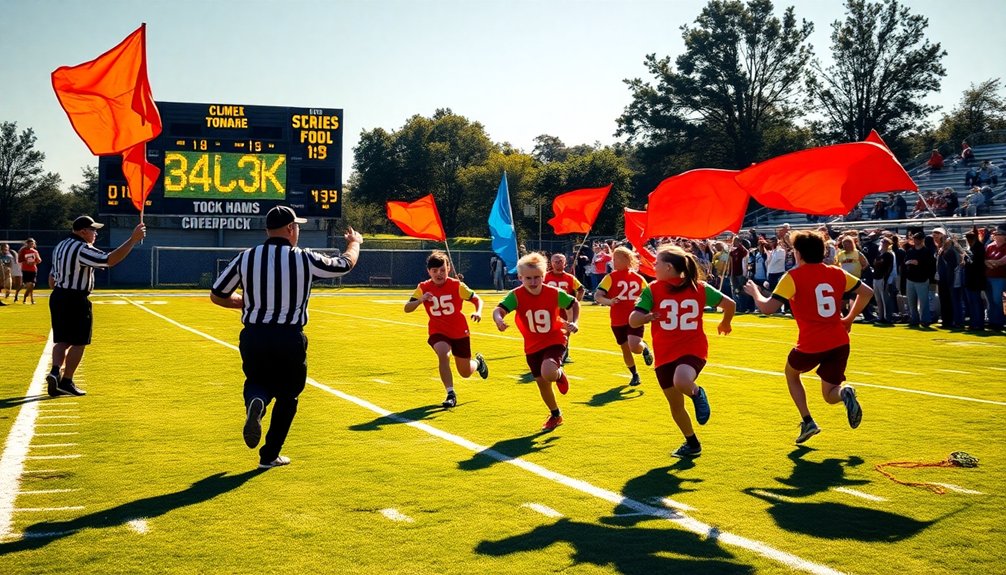
Although flag football shares many similarities with traditional football, it has its own unique set of rules and scoring methods that make it distinct.
Flag football offers a distinct blend of rules and scoring that sets it apart from traditional football.
To grasp the flag football fundamentals, you need to understand the essential player positions. Each team typically features a quarterback, who directs the plays, and various receivers, who aim to catch passes. You might also find defensive players tasked with pulling flags to stop the offense.
While the game emphasizes strategic passing and agility, the absence of tackling sets it apart from traditional football. Familiarizing yourself with these positions and their roles is vital for appreciating the game’s dynamics and improving your skills on the field. Additionally, understanding basic rules and structure can enhance your overall enjoyment and participation in the game.
Immerse yourself, and you’ll see how exciting flag football can be!
Scoring a Touchdown: How It Works
Scoring a touchdown in flag football is your team’s primary way to rack up points.
You’ll not only earn six points for crossing the goal line, but you also have the chance to add more with extra points or conversion attempts.
Understanding these scoring basics will help you strategize and maximize your team’s performance on the field. Additionally, knowing the offside rule can enhance your game strategy and prevent costly penalties.
Touchdown Scoring Basics
When you successfully navigate the field and reach the opponent’s end zone, you’ve scored a touchdown, which is the most significant way to earn points in flag football. Understanding the touchdown significance is vital for your team’s success.
Here are three key touchdown strategies to keep in mind:
- Utilize Quick Passes: Short, accurate throws can catch defenders off guard, allowing your receiver to sprint into the end zone.
- Employ Misdirection: Use fake plays to confuse the defense, opening lanes for your players to capitalize on.
- Create Space: Spread the field with formations that stretch the defense, giving your teammates room to maneuver.
Mastering these strategies will enhance your scoring opportunities and elevate your flag football game.
Extra Points Explained
After you score a touchdown in flag football, you have the chance to earn additional points through an extra point attempt. This is where your extra point strategies come into play.
Typically, you’ll choose between two conversion options: a one-point conversion from a shorter distance or a two-point conversion from further back.
Your choice depends on your team’s confidence and game situation. If you’re feeling bold and want to maximize points, go for the two-point conversion. However, if you need to play it safe, the one-point conversion might be the way to go.
Whatever you choose, remember that executing these extra point attempts effectively can make a significant difference in the game’s outcome.
Conversion Attempts Overview
To convert a touchdown in flag football, your team must successfully complete a conversion attempt, which is vital for maximizing your score.
You have various options for scoring during these attempts, and choosing the right conversion techniques can make all the difference. Here are three common conversion strategies:
- One-point conversion: Attempt from the 5-yard line, where a successful play nets you an extra point.
- Two-point conversion: Try from the 10-yard line, offering a higher reward for a successful attempt—two extra points.
- Catch and run: Utilize quick passes or runs to exploit defensive weaknesses, increasing your chances of success.
Mastering these strategies can elevate your game and help your team secure those vital extra points!
Extra Points: The Aftermath of a Touchdown
Once a team scores a touchdown in flag football, the excitement doesn’t end; instead, it shifts into the essential extra point attempt.
This is where teams can add one or two additional points, depending on their chosen extra point strategies. Typically, you’ll see teams opt for a one-point conversion from the five-yard line or a two-point conversion from the ten-yard line.
Your decision on which to go for can greatly affect the game’s outcome. During conversion attempts, communication and execution are critical, as defenses will be keen to stop you.
The pressure’s on, but a successful extra point can shift momentum and boost your team’s confidence for the rest of the game, especially if you utilize agility drills to enhance your team’s quickness and coordination during these high-pressure moments.
Field Goals and Safeties: Alternative Scoring Methods
In flag football, scoring isn’t just about touchdowns.
You can rack up points with field goals and safeties, adding some strategic depth to the game.
Let’s break down how these alternative scoring methods work. Additionally, understanding the financial implications of different scoring strategies can enhance a team’s overall performance and competitiveness.
Scoring a Field Goal
Scoring a field goal in flag football offers an exciting alternative to traditional touchdown methods, allowing teams to add valuable points from a distance.
To successfully score a field goal, you’ll want to focus on effective field goal techniques and solid kicking strategies. Here are three key elements to take into account:
- Distance Assessment: Determine how far you’re from the goalposts to gauge the difficulty level.
- Kicking Position: Position yourself properly, ensuring your non-kicking foot is planted and aligned with the target.
- Follow-Through: A strong follow-through is essential for accuracy and distance, so keep your kicking leg extended after contact.
Understanding Safety Points
While field goals are a popular way to score in flag football, safeties also offer a unique and strategic method to add points to your team’s total. A flag safety occurs when the opposing team commits a penalty in their own end zone or if you tackle a player in their end zone. This gives your team two valuable points.
Understanding how to leverage safeties can shift game momentum in your favor. Additionally, focusing on player protection is essential; ensuring your teammates stay safe while executing plays can prevent penalties and injuries.
Common Penalties in Flag Football
Here are three key categories to watch out for:
- Offensive Penalties: These include false starts, holding, and illegal motion, which can set your team back and disrupt plays.
- Defensive Penalties: Common infractions like pass interference, roughing the passer, and offside can give your opponents an advantage and lead to critical yardage gains.
- Unsportsmanlike Conduct: This includes any action deemed disrespectful, resulting in penalties for both teams and affecting the game’s overall spirit.
Being aware of these penalties can help you play smarter and avoid unnecessary setbacks, while also emphasizing the importance of team coordination to minimize mistakes and maintain a competitive edge.
The Impact of Penalties on the Game

Penalties can greatly influence the outcome of a flag football game, often turning the tide in favor of one team or the other. When you commit a penalty, the enforcement can lead to significant yardage losses or even automatic first downs for the opposing team.
This shift can alter your game strategy, forcing you to play more conservatively or take risks you wouldn’t normally consider. Understanding the timing and severity of penalties is vital; a late-game foul can be particularly devastating.
You’ll need to stay disciplined and be aware of the rules to minimize mistakes. By managing penalties effectively, you can maintain better control over the game flow and improve your chances of winning. Additionally, yellow cards serve as crucial reminders for maintaining discipline and accountability in soccer, highlighting the importance of sportsmanship in all competitive sports.
Unique Rules of Flag Football
Understanding the unique rules of flag football is essential for any player looking to excel in the game. These rules set flag football apart from traditional tackle football, emphasizing safety and skill.
Mastering flag football’s unique rules is crucial for success, prioritizing safety and skill over traditional tackle football.
Here are three key aspects to remember:
- Flag Pulling: Instead of tackling, players must pull the flag from the ball carrier’s waist to stop the play. This requires agility and quick reflexes.
- Player Positions: Teams often have specific roles, such as quarterback, receiver, and rusher, which dictate how each player should contribute strategically.
- No Contact: Physical contact is generally not allowed, promoting a non-violent environment where strategy and speed take precedence over brute strength. Effective timing and positioning during flag pulls can greatly enhance a player’s defensive capabilities.
Strategies for Scoring and Avoiding Penalties
To score effectively while minimizing penalties, it’s essential to develop a solid game plan that focuses on teamwork and discipline.
Start by implementing diverse offensive strategies, like quick passes and misdirection plays, to keep the defense guessing. Guarantee each player understands their role and communicates effectively to avoid costly mistakes.
On defense, focus on solid defensive tactics, such as maintaining proper positioning and avoiding aggressive contact, which can lead to penalties. Encourage your team to practice situational awareness, so they’re less likely to commit infractions like offside or holding. Additionally, incorporating defensive stance drills can enhance players’ agility and positioning, further reducing the risk of penalties.
Conclusion
In the fast-paced world of flag football, knowing the rules and scoring can feel like maneuvering through a labyrinth. Just as Theseus faced challenges in his quest, mastering strategies and avoiding penalties will lead you to victory on the field. Whether you’re aiming for that elusive touchdown or trying to sidestep a costly infraction, understanding the game’s nuances keeps you ahead. So gear up, play smart, and may your flag football journey be as epic as any ancient hero’s tale!