

Throwing Football: Improving Your Long-Distance Passes
August 12, 2025To improve your long-distance passes in football, focus on mastering your throwing mechanics with long toss drills. Start with a solid stance and work on hip acceleration and arm speed. Position yourself properly, using a Lock and Load technique, and gradually increase distance while tracking your progress. Emphasizing hip speed will boost your arm velocity. By refining these skills, you can enhance your overall passing accuracy and distance. Continue exploring ways to elevate your game further!
The Purpose of Long Toss Drills
Long toss drills play an essential role in enhancing a quarterback’s game performance, especially when you consider the pressure of real game situations. These drills train you to throw quickly and effectively, simulating the urgency you’ll face on the field.
By working from a stationary position, you focus on hip acceleration and arm speed, which are vital for improving your overall throwing mechanics. Long toss drills emphasize higher trajectory throws, helping youth athletes greatly increase their throwing distance with consistent practice.
Key mechanics, like maintaining shoulder tilt and generating distance through hip rotation, maximize your throw velocity. Ultimately, these drills teach you effective throwing angles, with performance improvements measured by both distance thrown and trajectory accuracy. Additionally, incorporating proper nutrition into your training can further enhance your performance and recovery.
Setting Up for Success: Drill Mechanics
To set yourself up for success in long-distance passing, start with the proper stance alignment, ensuring your feet are positioned under your armpits.
From there, shift into the Lock and Load position, keeping your elbows bent and the ball close to your hip.
Adjust your foot placement as needed to maximize throwing efficiency and accuracy. Incorporating footwork drills can further enhance your overall throwing mechanics and stability.
Proper Stance Alignment
While proper stance alignment might seem like a small detail, it plays an important role in setting you up for success in long-distance passing.
Start by getting into the top of the drop stance, positioning your feet under your armpits to create a balanced base. Using a quarterback stride stick helps guarantee your body’s aligned correctly before you throw.
Focus on taking short steps to avoid stepping into the rush, while keeping your back foot stable throughout your follow-through. Remember, maintaining a slight shoulder tilt during your throw is vital for achieving the upward trajectory needed for maximum distance.
With this alignment, you’ll be on your way to becoming the number one passer on the field!
Lock and Load Position
As you prepare for the throw, the Lock and Load position becomes crucial for maximizing your performance. In this stance, your elbows should be bent, with the ball positioned over your hip. This alignment helps maximize hip rotation speed, which is essential for generating powerful throws.
Verify your feet are positioned under your armpits to maintain an effective throwing stance. The Lock and Load position encourages an upward ball trajectory, critical for higher throws.
Foot Placement Adjustments
Foot placement adjustments play an essential role in your throwing mechanics, guaranteeing you maintain balance and stability throughout the process.
The first thing you should focus on is positioning your feet under your armpits for ideal alignment. This setup allows for better control and accuracy.
Practice taking short steps to avoid stepping into the rush, which helps you release the ball quickly under pressure. Additionally, adjust your foot placement based on your receiver’s distance; this keeps your shoulder tilt consistent and guarantees the ball reaches its target with the right trajectory.
Finally, monitor your back foot stability during the follow-through to avoid any hitching or bouncing that could disrupt your throw. Consistent practice will enhance your distance and accuracy considerably.
Step-by-Step Execution of the Long Toss
To effectively execute the long toss, start by positioning your feet under your armpits in a drop stance, using a quarterback stride stick for proper alignment.
Begin in the Lock and Load position with your elbows bent and the ball over your hip to encourage rapid hip rotation. Start throwing the ball at 25 yards, gradually increasing to your maximum distance.
Complete five throws at the farthest distance before returning to the start. Maintain good posture and balance, keeping your head stable while generating velocity from your back foot.
Adjust your shoulder tilt and foot placement based on your receiver’s distance, ensuring you keep proper throwing mechanics throughout the drill for ideal results. Additionally, understanding the standardization of soccer rules can enhance your awareness of game dynamics, which is crucial for making effective passes during gameplay.
Key Observations for Effective Throwing
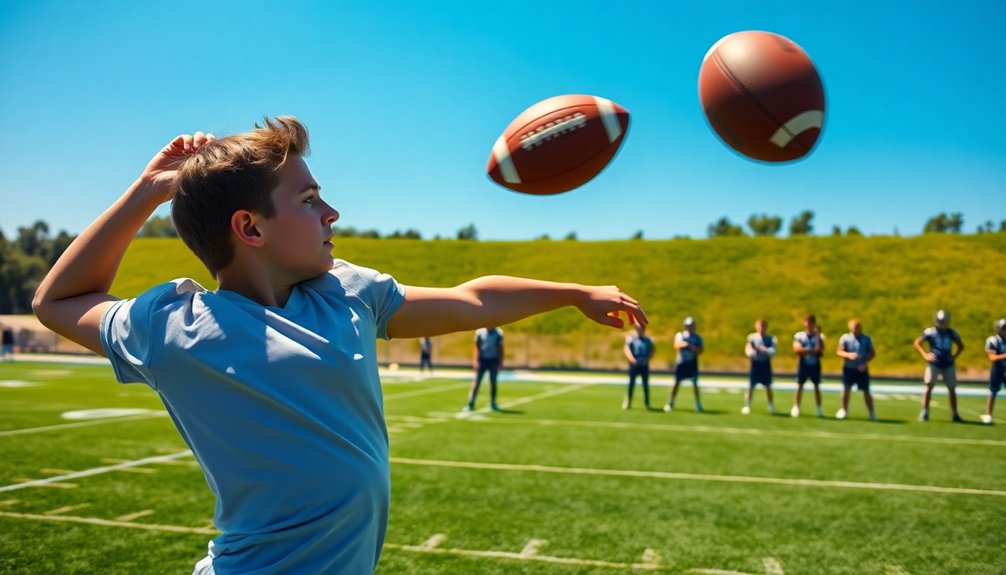
To throw effectively over long distances, you need to focus on your mechanics and posture.
Pay attention to your hip speed, as it plays an essential role in increasing your arm speed and throwing velocity. Additionally, maintaining proper form during your throw can greatly enhance your overall performance and accuracy.
Mechanics and Posture
While you prepare for a long-distance pass, starting in the top of the drop stance is essential for effective throwing mechanics. Position your feet under your armpits to maintain proper alignment and balance.
Next, adopt the Lock and Load position—keep your elbows bent and the ball over your hip. This promotes efficient hip rotation speed, which is number two in importance for your throw.
Focus on taking short steps to prevent stepping into pressure, and tilt your shoulders upward to achieve a higher trajectory. Keep your head stable throughout the motion, as good posture is critical for accuracy and power.
Finally, guarantee your back foot remains stable during the follow-through to maximize velocity and avoid hitches.
Hip Speed Importance
Proper mechanics and posture lay the groundwork for your throw, but hip speed plays a vital role in enhancing your performance. By generating faster hip movement, you can considerably increase your arm speed, leading to greater throwing velocity.
Proper hip rotation not only enhances your mechanics but also prevents hitches or bounces that disrupt the flow of your throw. Athletes with developed hip speed often see remarkable improvements in throwing distance—measured in yards for youth athletes.
Engaging your hips effectively keeps you stable and balanced, especially under pressure. To achieve higher trajectory throws essential for long-distance passes, maximizing hip acceleration during the motion is imperative.
Focus on your hip speed, and you’ll elevate your game.
The Role of Hip Speed in Throwing Performance
Hip speed plays an essential role in throwing performance, as it directly influences arm speed and overall throwing velocity. When you generate powerful hip movement, you push against the ground, maximizing your throw. This proper hip action prevents hitching or bouncing, leading to a smoother motion.
As your hip speed increases, you’ll notice a direct correlation with enhanced arm speed, which can greatly improve your throwing distance. Effective hip rotation allows you to achieve higher trajectory throws, critical for executing long-distance passes. Incorporating drills focused on hip speed into your practice routine can yield substantial gains in your performance on the field. Remember, mastering this number three aspect of your mechanics is fundamental for becoming a more effective quarterback. Additionally, cardiovascular endurance is crucial for sustaining energy, which can enhance your overall athletic performance.
Enhancing Arm Speed Through Proper Technique

To enhance your arm speed effectively, mastering the right technique is crucial.
Here are four key elements you need to use for improving your throwing performance:
- Proper Hip Rotation: Generate distance by accelerating your hips, which powers your throw.
- Stable Shoulder Tilt: Maintain a consistent shoulder position to achieve a higher trajectory, maximizing distance.
- Lock and Load Position: Hold the ball over your hip with bent elbows to facilitate a quicker release.
- Engaged Back Foot: Guarantee stability during the follow-through to transfer power from your lower body to your arm.
Additionally, understanding the importance of teamwork in sports will help you appreciate how proper communication can enhance your overall throwing performance.
Measuring Progress: Distance and Trajectory Accuracy
As you work on your long-distance passing, tracking your progress in both distance and trajectory accuracy becomes vital.
Begin by measuring the maximum distance you achieve during your long toss drills. With consistent practice, you’ll likely notice significant improvements.
Assess your trajectory accuracy by focusing on maintaining proper shoulder tilt and an upward ball trajectory as you increase distance. Adjust your throwing angles based on the distance to your receiver to enhance accuracy.
Pay attention to your back foot’s stability during follow-through, as it’s essential for balance and generating velocity.
Regularly recording both distance and trajectory accuracy provides valuable data, helping you identify areas for improvement and ensuring steady progress in your long-distance passing skills. Additionally, incorporating effective footwork drills can enhance your overall throwing technique and power.
Conclusion
As you step back, feeling the grass beneath your cleats, remember that every long toss is a journey. Picture the ball soaring through the air, a perfect spiral dancing with the wind. You’ve honed your mechanics, felt the power of your hips, and your arm speed is sharper than ever. With each throw, you’re not just measuring distance but also the precision of your trajectory. Keep pushing your limits, and soon, you’ll be sending that ball further than you ever imagined.