
The Running Back Role Explained: What Does a RB Do?
March 17, 2026A running back (RB) is essential to a football team’s success. You hand off the ball from the quarterback and rush to gain yards. Besides running, you catch passes and protect the quarterback from defenders. Speed, agility, and vision help you navigate the field. There are different types of running backs, each with unique roles. Your contributions can shape offensive strategies and influence the game. Stick around to discover more about the evolving role of running backs!
What Is a Running Back and Their Primary Responsibilities?
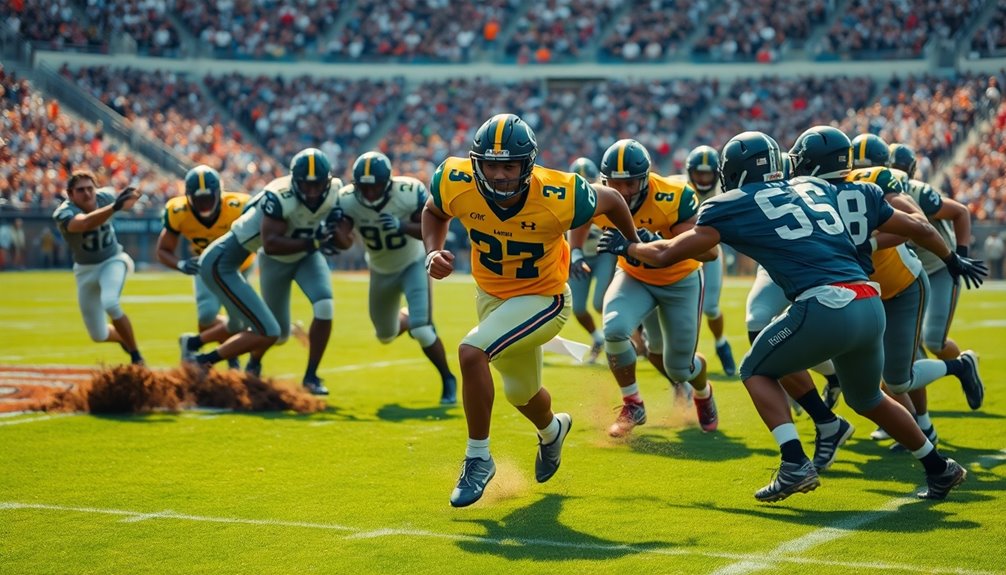
A running back (RB) is an essential player on the football field, primarily tasked with rushing the football to advance the offense. Your primary responsibility is to take handoffs from the quarterback, aiming to gain rushing yards while maneuvering through defenders.
You’ll need to showcase speed, agility, and strength to evade tackles and protect the football. Besides rushing, you often serve as a pass catcher, running routes that give the quarterback a safety valve.
Your role extends to pass protection, where you block blitzing defenders, providing the quarterback extra time to throw. The effectiveness of your performance greatly impacts the team’s offensive strategy, influencing ball control and creating scoring opportunities. Mastering pass protection techniques is vital for ensuring successful offensive plays.
Key Characteristics of an Effective Running Back
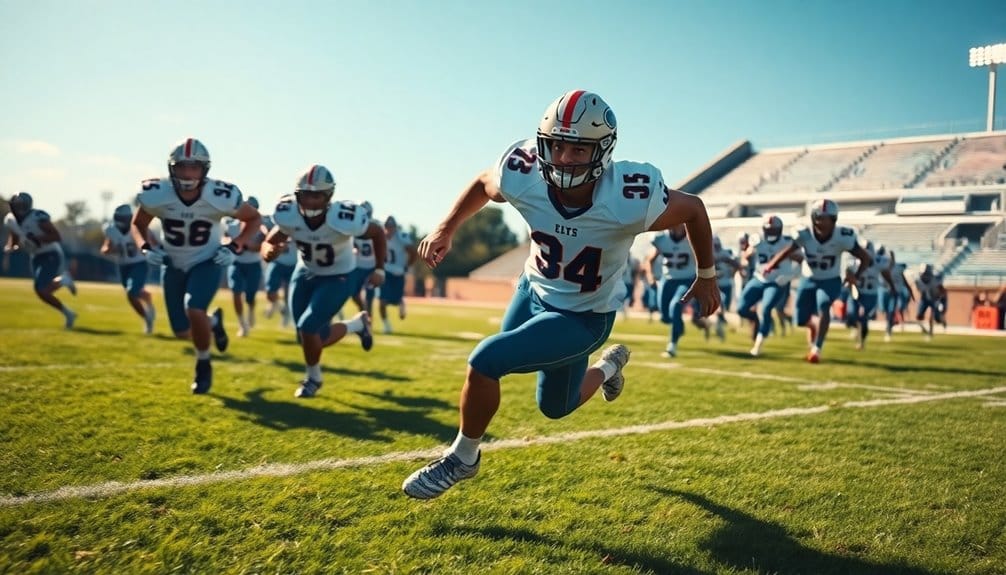
To succeed as a running back, you need a unique blend of skills and physical attributes. Speed and agility are important; they help you navigate through defenses and exploit running lanes.
Succeeding as a running back demands a blend of speed, agility, and the ability to navigate defenses effectively.
You also require excellent balance and toughness to break tackles, turning potential losses into valuable gains. Vision plays a key role in identifying opportunities on the field.
Additionally, being a proficient pass-catcher is essential, as modern offenses often utilize running backs as receivers out of the backfield, enhancing your versatility.
Don’t underestimate the significance of good blocking skills, either. Protecting the quarterback during passing plays makes you a key player in both rushing and passing strategies, ensuring your team can execute effectively on every down. Furthermore, mastering offensive strategies can help you outmaneuver defenders and create scoring opportunities.
Different Types of Running Backs: Halfback, Fullback, and More
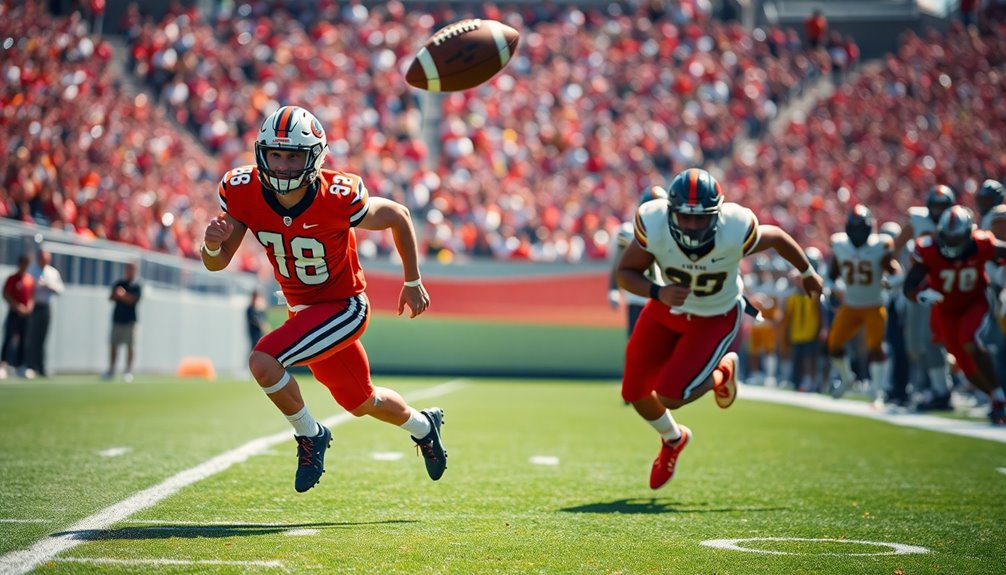
Running backs are the heartbeat of an offense, with different types fulfilling unique roles on the field.
The halfback (or tailback) is often the primary ball carrier, using speed and agility to break through defenses and catch passes out of the backfield.
In contrast, the fullback primarily serves as a lead blocker for the halfback, stepping in during short-yardage situations to create running lanes.
The feature back is typically the team’s main running back, taking on the bulk of rushing attempts and acting as a key playmaker in both the running and passing game.
Modern offenses frequently employ running back committees to leverage these various roles, maximizing skill sets while minimizing injury risks. Additionally, running backs often utilize quick passes to exploit defensive weaknesses, enhancing their impact on the game.
Essential Skills for Success as a Running Back
While the role of a running back varies, certain essential skills are critical for success on the field. Quick feet help you evade defenders and navigate tight spaces effectively during plays.
Your agility and balance allow you to maintain momentum after contact, breaking tackles and gaining those significant extra yards. Strong vision is key, enabling you to spot openings in the defense and make split-second decisions on where to run.
Durability is also important, as you’ll need to withstand repeated hits and recover quickly to keep performing at a high level. Finally, versatility in your skills—like blocking and catching passes out of the backfield—enhances your value and adaptability within various offensive schemes. Incorporating diverse offensive routes adds unpredictability, challenging defenses and improving overall team performance.
The Importance of Blocking and Pass Protection
Although many see running backs primarily as ball carriers, their role in blocking and pass protection is equally important to a team’s success.
Running backs engage blitzing linebackers and safeties, helping to safeguard the quarterback during passing plays. Effective blocking can greatly reduce pressure on the quarterback, especially when they pick up defenders the offensive line might miss.
Running backs play a crucial role in blocking, protecting the quarterback from blitzing defenders and reducing pressure during passing plays.
In modern offenses, you’re often required to block in passing situations, making your blocking skills just as essential as your rushing or receiving abilities. Your ability to read defensive alignments and adjust your blocking assignments is critical for maintaining offensive efficiency.
Ultimately, your success in blocking can directly impact the effectiveness of the team’s passing game, leading to longer completions and fewer sacks. Additionally, understanding defensive line formations can help you anticipate and react to defensive strategies more effectively.
How Do Running Backs Contribute to Offensive Strategy?
Effective offensive strategy hinges on the contributions of running backs, as they play a pivotal role in enhancing ball control and dictating the game’s tempo.
By averaging impressive yards per carry, running backs force defenses to commit resources to the run, creating openings for passing plays. This versatility allows them to be dynamic threats, as they also catch short and intermediate passes, providing safety valves for quarterbacks under pressure.
Additionally, using running back committees keeps players fresh, reducing injury risks while maintaining a fluid offensive approach.
Running backs greatly influence defensive alignments, as teams often adjust their schemes to counter a potent running game, ultimately impacting your overall offensive strategy and effectiveness on the field. Furthermore, a strong defense can create game-changing opportunities, emphasizing the need for teamwork and coordination in both offensive and defensive strategies.
The Evolving Role of Running Backs in Modern Football
In today’s game, running backs are no longer just ball carriers; they’re key players in versatile offensive strategies. You’ll notice that analytics now highlight how a running back’s performance often hinges on their offensive line and overall scheme. This shift not only changes how teams use them, but also how they value these athletes in the draft and contracts. Their ability to evade defenders and contribute to the passing game has become increasingly vital for offensive success.
Versatility in Offensive Strategies
As offenses evolve, running backs are transforming into versatile weapons that can reshape game strategies. You’ll notice how these players now function as both rushers and pass catchers, exploiting mismatches against linebackers and safeties.
The rise of dual-threat backs, like Christian McCaffrey, highlights this shift, enhancing overall offensive productivity. Many teams utilize running back committees, allowing multiple players to share responsibilities and reduce injury risks, which leads to a more dynamic approach.
Modern offenses leverage running backs in various roles, including blocking and even lining up as wide receivers. With this versatility, their effectiveness often hinges on the performance of offensive linemen and team scheming, rather than just individual talent alone.
Impact of Analytics on Usage
The growing influence of analytics has markedly altered how teams view and utilize running backs. NFL teams now focus more on offensive line performance and scheme rather than solely on individual talent.
This shift makes it easier to replace running backs with lower-cost options, as highlighted by the absence of first-round picks in the 2022 draft. Teams increasingly adopt running back committees, sharing duties to reduce injury risks and fatigue.
Analytics show that mid-to-late round backs can match or even exceed the production of higher-drafted players, like Tony Pollard. With the average running back salary dropping to $1.808 million in 2023, it’s clear that the dynamics of running back value are changing drastically in the league.
Analyzing the Value of Running Backs in the NFL Today
In today’s NFL, the value of running backs is shifting as teams lean more toward passing offenses. You’ll notice that analytics highlight the importance of offensive line play and strategy over individual talent, reshaping how teams approach the position. With the rise of running back committees, the traditional star back is becoming less essential to a team’s success. This evolution reflects the increasing emphasis on energy system understanding as teams seek to optimize performance and endurance in their offensive strategies.
Changing Perceptions of Value
While many fans still cherish the running back position, its value in the NFL has shifted dramatically in recent years. The changing perceptions of value are evident as only five of the last 14 Super Bowl winners featured top rushers with base salaries over $1 million.
Historically, just 23 running backs have been picked first overall, with Ki-Jana Carter being the last in 1995. In 2023, the average salary for running backs is about $1.808 million, even lower than that of kickers.
Recent analytics reveal that running back production often hinges more on offensive line play than individual talent, while the rise of running back committees further diminishes the traditional workhorse role, reshaping how teams view running backs in the league in rushing.
Analytics and Team Strategy
As perceptions of the running back position evolve, analytics play a pivotal role in shaping team strategies.
Today, teams focus more on offensive play and the performance of the offensive line than on individual talent. This shift reduces the emphasis on high draft picks for running backs, evidenced by the fact that no running backs were taken in the first round of the 2022 NFL draft.
With only 23 running backs selected first overall in history, teams increasingly opt for late-round picks or low-risk free agents.
Additionally, the rise of running back committees helps manage player fatigue and injury risks, making traditional workhorse backs less common.
Ultimately, analytics influence how rushing touchdowns are achieved and valued in modern football.
Future Trends and Challenges Facing Running Backs
With the rise of running back committees, teams are shifting how they approach the position, aiming to reduce injury risks and manage player fatigue.
Future trends indicate that running backs must adapt to a versatile role, balancing rushing and receiving duties. Here’s what you can expect:
- Increased reliance on multiple backs sharing carries
- Emphasis on yards receiving as a critical measure of value
- Mid-to-late round draft picks replacing high-priced veterans
- Lower average salaries compared to other positions
- A greater focus on offensive line quality impacting performance
- Running backs may also need to incorporate quick passing techniques to enhance their effectiveness in the evolving game.
As the landscape evolves, you’ll see running backs becoming multifaceted players, essential not just for ground games but also for dynamic passing strategies.
Conclusion
In today’s NFL, running backs aren’t just ball carriers; they’re essential to the offensive game plan. Did you know that in the last decade, over 50% of Super Bowl-winning teams featured a top-10 rushing attack? This stat highlights how important your role is in driving team success. As the game evolves, adapting to new strategies and challenges is key. Embrace your skills, stay versatile, and you’ll continue to be a significant part of the game’s future.