The Role of Quickness in Reactive Training for Hockey
August 27, 2025Quickness is crucial in reactive training for hockey. It allows you to respond swiftly in unpredictable game situations, enhancing your agility and decision-making. Incorporating drills like Seated Sprints and Lateral Mirror training sharpens your reaction times and footwork. This training doesn’t just improve physical performance; it also boosts your mental agility by challenging you to anticipate plays and process visual cues faster. There’s so much more to explore about this fundamental aspect of hockey training.
Understanding Quickness in Hockey Training
When you think about quickness in hockey training, it’s all about how fast you can accelerate and change direction. Quickness is essential for effective gameplay, allowing you to respond swiftly to your opponents’ movements.
To develop this skill, you need a blend of speed, agility training, and proper technique. Maintaining a low athletic position maximizes your power and explosiveness during movements. Regularly integrating quickness drills into your training routine—about 1-2 times per week—helps you improve your reaction times, enabling you to seize scoring opportunities. Incorporating agility training into your routine can significantly enhance your overall quickness and effectiveness on the ice.
The Importance of Reactive Training
Reactive training is essential for hockey players because it mirrors the unpredictable nature of real-game situations, compelling you to respond quickly to a variety of stimuli.
By incorporating reactive agility into your routine, you’ll enhance your adaptability on the ice. Engaging in training drills like the Seated Sprint and Lateral Mirror sharpens your visual scanning skills, anticipation, and reaction time.
These drills simulate the chaos of actual games, helping you make split-second decisions under pressure. Additionally, incorporating cardiovascular endurance into your training can further enhance your ability to sustain high performance throughout games. Aim to include reactive agility work 1-2 times a week, ideally before your conditioning sessions, to boost explosiveness and reaction speed.
Key Components of Quickness Development
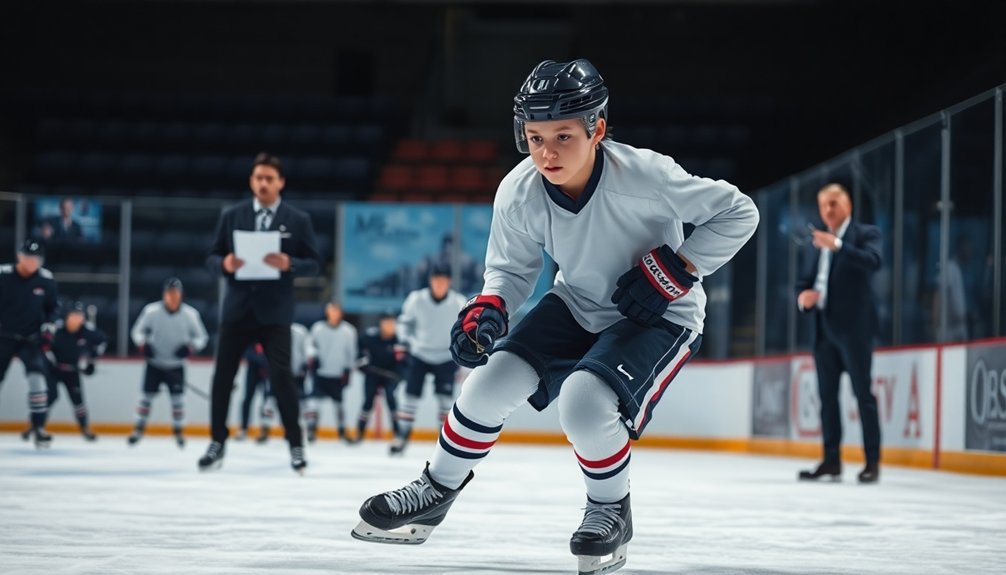
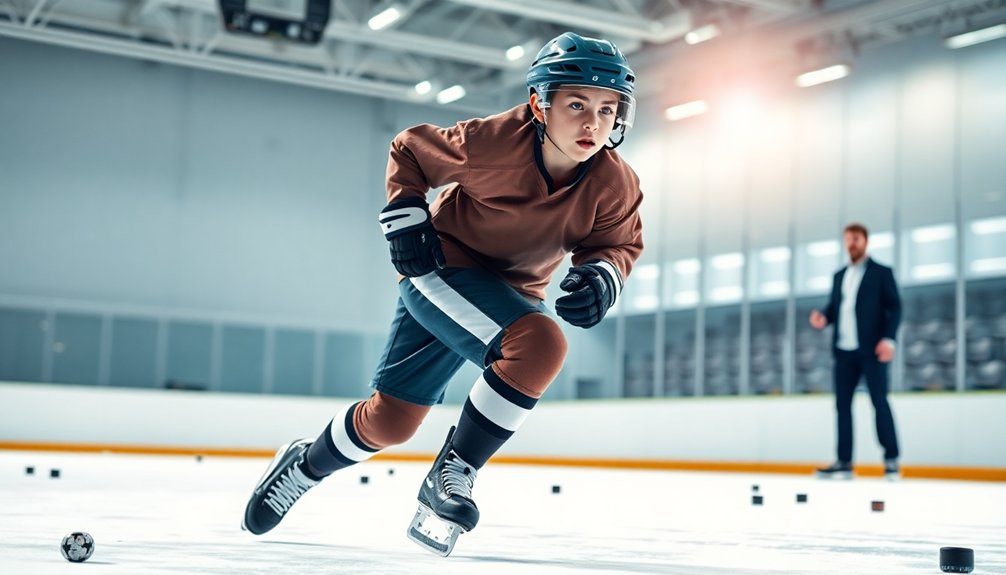
To develop your quickness in hockey, you’ll want to focus on integrating speed and agility into your training. This means combining explosive movements with drills that challenge your cognitive processing, enhancing your ability to react swiftly. Incorporating agility drills can significantly improve your footwork speed and change of direction, which are essential for effective performance on the ice.
Speed and Agility Integration
Integrating speed and agility training is essential for developing quickness in hockey players, as it sharpens their ability to accelerate and change direction swiftly.
By focusing on these components, you can enhance your on-ice performance. Here are key aspects to take into account:
- Quick footwork helps you execute effective pivots and dodges.
- Plyometric exercises, like jump training, boost explosive power for rapid movements.
- On-ice drills that include sprints and slalom patterns simulate game situations.
- Reactive agility drills, such as the Lateral Mirror Drill, sharpen your response time.
- Consistency in practice lays the groundwork for reliable quickness under pressure.
Emphasizing speed and agility will elevate your gameplay and keep you one step ahead of your opponents.
Cognitive Processing Enhancement
While quickness on the ice is often associated with physical speed, enhancing your cognitive processing is equally essential for effective gameplay. Improving your ability to perceive, process, and react to stimuli can greatly enhance your reaction time during games.
Incorporating decision-making drills into your training can sharpen your skills, allowing you to assess situations quickly and respond effectively under pressure. Engaging in reactive agility drills simulates unpredictable game scenarios, helping you adapt your movements based on real-time information.
This dual focus on cognitive and physical training improves overall mental engagement, enabling you to multitask and maintain peak performance. Better cognitive processing leads not only to faster reactions but also to improved anticipation of your opponents’ actions, enhancing your decision-making on the ice.
Drills to Enhance Quickness on the Ice
To boost your quickness on the ice, you’ll want to focus on specific drills designed for rapid movements. Techniques like the Lateral Mirror Drill and Seated Sprint Drill can sharpen your reaction times and acceleration. Incorporating speed, agility, and endurance workouts into your training regimen will further enhance your overall performance on the ice.
Essential Quickness Drills
Quickness drills are essential for enhancing your agility and responsiveness on the ice, allowing you to navigate opponents with ease.
To make the most of your training, incorporate these effective drills into your routine:
- Two Foot Quick Touch: Focus on rapid foot movements while maintaining a low athletic position.
- Lateral Quick Figure-8: Enhance directional changes and lateral speed with this dynamic drill.
- Explosive Crossovers: Work on quick crossovers while keeping proper posture to improve your overall responsiveness.
- Auditory Cue Reacting: Add cognitive challenges by reacting to sounds during quick feet drills for game-like scenarios.
- Regular Practice: Aim for 1-2 sessions per week to maximize the benefits of your quickness drills, as agility requires consistent training.
Techniques for Quick Execution
Enhancing your quick execution on the ice requires targeted drills that sharpen your reaction time and agility.
The Seated Sprint Drill is excellent for improving how quickly a player reacts from a seated position, focusing on explosive starts.
For lateral movement, try the Lateral Mirror Drill, where you mimic a partner’s movements, allowing for quick directional changes.
The 4-Corner Point and Touch drill challenges you to sprint to cones based on your partner’s cues, boosting responsiveness under pressure.
Incorporating agility ladders in your training for hockey enhances foot speed and coordination, while plyometric box jumps build lower body strength and train rapid movements, essential for maintaining speed and agility during gameplay.
Integrating Quickness Into Practice
While you’re honing your skills on the ice, integrating quickness into practice through targeted drills is essential for improving your game.
Here are some effective training drills to enhance your quickness:
- Lateral Quick Figure-8s: Focus on rapid directional changes while staying low.
- Seated Sprint Drill: Develop explosive starts in response to dynamic stimuli.
- Slalom Sprints Around Cones: Boost foot speed and coordination while handling the puck.
- Two-Foot Quick Touches: Build muscle memory and improve reaction time.
- Hockey IntelliGym: Enhance cognitive processing and decision-making in game scenarios.
Incorporating these drills consistently will sharpen your quickness, making you a more agile and responsive player on the ice.
The Connection Between Quickness and Decision Making
When you improve your quickness through reactive training, you also boost your decision-making skills on the ice. Enhanced quickness allows you to perceive and process visual stimuli faster, essential during high-pressure situations.
Research shows that players with superior quickness develop better anticipation skills, enabling them to read plays and make split-second decisions effectively. By integrating cognitive challenges into your reactive drills, you simulate real-game dynamics, sharpening your quickness while improving your decision-making under stress.
Quickness training reduces your response times, with elite players achieving reaction times as low as 0.2 seconds. As you develop your quickness, you’ll gain confidence in your decision-making abilities, allowing you to execute complex plays without hesitation, ultimately elevating your game. Moreover, team coordination is crucial for synchronizing movements, which enhances overall defensive effectiveness in game situations.
Mental Aspects of Quickness in Gameplay
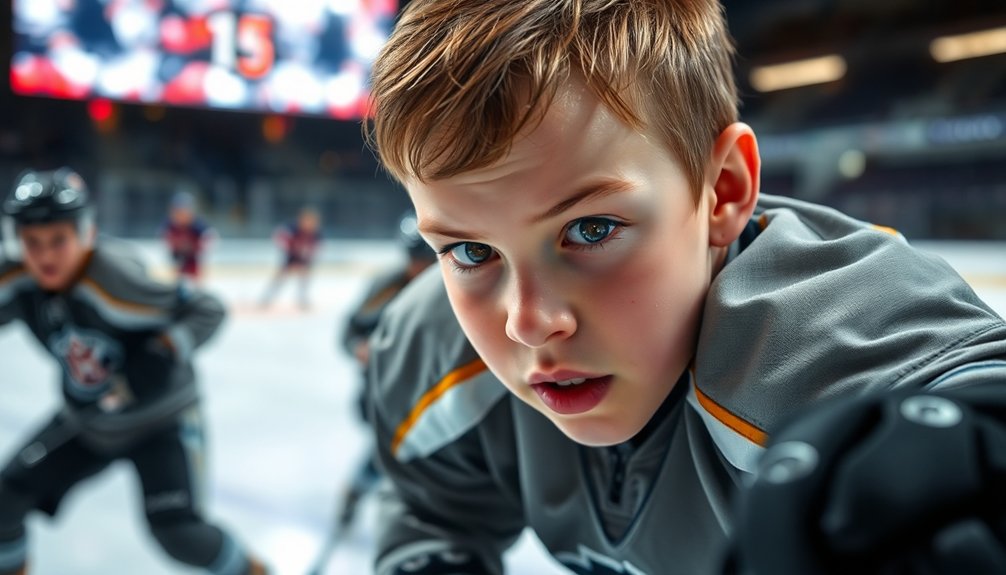
Improving your quickness isn’t just about physical speed; it also hinges on your mental agility.
Quickness in hockey relies on both physical speed and crucial mental agility for enhanced gameplay.
Mental quickness is essential in hockey, as it allows you to process visual cues and anticipate opponents’ movements. Players with sharp mental skills can read the ice effectively, enhancing their gameplay.
To develop this aspect, consider incorporating these strategies into your training programs:
- Practice decision-making drills for cognitive challenges.
- Visualize game scenarios to improve anticipation.
- Focus on maintaining a confident mindset.
- Work on reducing anxiety and mental blocks.
- Engage in mindfulness or relaxation techniques.
Additionally, fostering strong team dynamics can further enhance your mental quickness through improved communication and support.
Integrating Quickness Training Into Regular Practice
Integrating quickness training into your regular practice not only boosts your reaction times but also sharpens your decision-making skills during games.
By including quickness drills like the Seated Sprint and Lateral Mirror Drill at least 1-2 times a week, you can enhance your ability to respond to dynamic game situations.
Incorporate agility and quickness drills into your warm-up routines to establish an athletic position and prepare your body for high-intensity gameplay.
Using equipment like agility ladders and cones can challenge your foot speed and coordination, fostering quicker movements.
Consistent quickness training reinforces the neural pathways for rapid responses, giving you a competitive edge when it matters most on the ice.
Additionally, focusing on speed and agility drills can further improve your overall performance during competitive play.
Make quickness a priority in your training regimen!
Evaluating Progress in Quickness Training
Here are some key ways to evaluate your quickness:
- Timed sprints to gauge speed and responsiveness.
- Successful directional changes during reactive agility drills.
- Video analysis for feedback on movement patterns.
- Performance metrics, like successful puck handling under pressure.
- Reaction times recorded from specific drills, such as the Seated Sprint Drill.
Incorporating sprinting routines into your training can also provide insights into your quickness development and overall performance improvements.
The Future of Quickness Training in Hockey
As technology continues to evolve, quickness training in hockey is poised for a transformation that combines advanced analytics and innovative tools.
You’ll see a shift towards personalized training programs tailored to enhance each player’s ability. Virtual reality (VR) and augmented reality (AR) will create immersive scenarios, helping you practice quickness and decision-making without the pressure of live play.
Research in neuroscience also sheds light on cognitive training, improving your reaction times and quickness. Expect multi-disciplinary training to become standard, merging physical conditioning with core strength exercises that focus on enhancing stability and power generation.
Wearable technology will monitor your performance metrics in real-time, offering immediate feedback and adjustments.
This future focuses on developing well-rounded athletes, maximizing both physical and mental quickness in the game.
Conclusion
Quickness in hockey isn’t just about speed; it’s the spark that ignites your game. Think of it like a tightrope walker—one misstep can lead to a fall. By honing your reactive skills, you’ll make those split-second decisions that keep you balanced and in control on the ice. As you integrate quickness training into your routine, you’re not just improving your agility; you’re sharpening your instincts, turning you into a player who thrives under pressure. Keep pushing forward!