
The Basics of Flag Football Field Dimensions
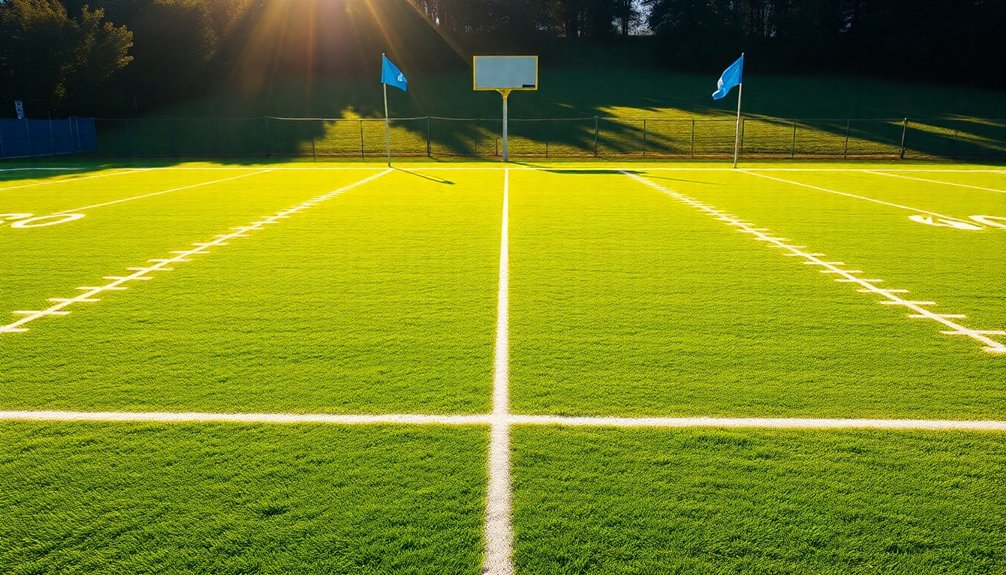
August 15, 2025Flag football fields generally measure 70 yards long and 30 yards wide, featuring two 10-yard end zones. Safety areas of at least 3 yards surround the field’s sidelines and end lines. Markings include dashed lines every 5 yards, with no-running zones 5 yards before each end zone. For beach flag football, fields are shorter—25 yards long with similar end zones. Understanding these dimensions is key to the game. You’ll discover more specifics as you explore further.
Field Size and Layout
When you step onto a flag football field, you’ll notice its standard dimensions are designed for both competitive play and safety.
The standard field length measures 70 yards, including two 10-yard end zones, which gives you a 50-yard play area. You’ll also see that the flag football field width is typically 30 yards, allowing for effective offensive and defensive strategies.
A safety area of 3 yards surrounds the sidelines and end lines, ensuring player safety during games.
For variations like Beach Flag football, the field length is shortened to 25 yards while maintaining the same 10-yard end zones, with a width of 25 yards.
Understanding these field measurements helps you appreciate the thoughtful layout of the game, much like how soccer fields are carefully designed to facilitate different styles of play.
End Zones and Scoring Areas
Flag football’s end zones play a vital role in the game’s scoring dynamics. Each end zone measures 10 yards deep, marking the scoring area where the offensive team aims to score touchdowns.
Here are some key points about the end zones:
- The total length of a standard flag football field is 70 yards, including both end zones.
- To score a touchdown, the offensive team must advance the ball into the opponent’s end zone, earning 6 points.
- After a touchdown, teams can attempt a conversion from the 1-yard, 2-yard, or 3-yard line for extra points.
- No-run zones, located 5 yards before each end zone, require teams to execute a forward pass in these areas to maintain the game’s flow.
- Understanding scoring dynamics in flag football can enhance strategic gameplay, similar to how stoppage time affects soccer matches.
Safety Areas and Surface Requirements
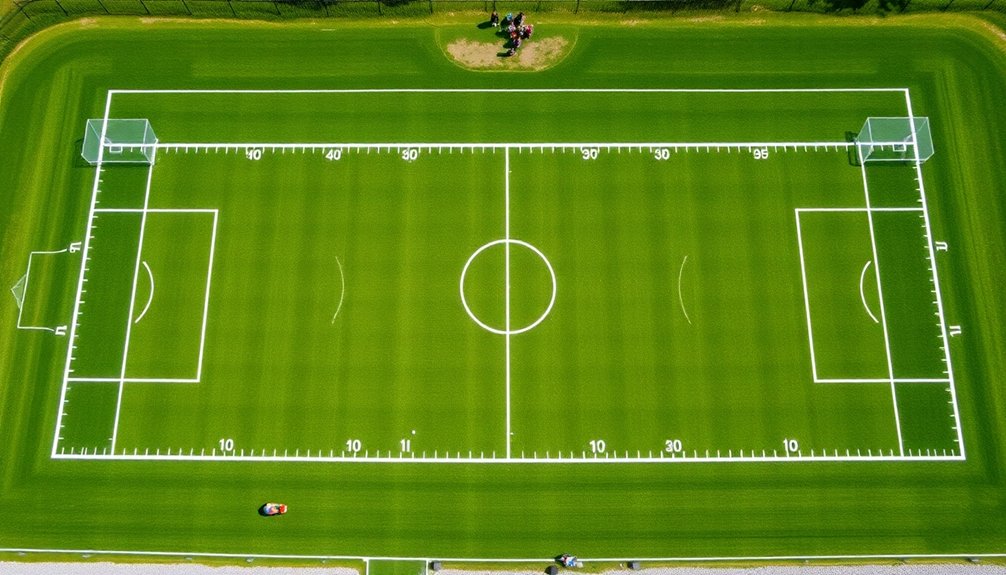
Safety areas and surface requirements are essential for guaranteeing a secure environment during flag football games. Your flag football fields need a solid, level playing surface that’s free of obstacles to promote player safety.
A safety area of at least 3 yards (2.75 meters) outside the sidelines and end lines is vital, maintaining the same level as the field to prevent injuries. For beach flag football, the playing surface is sand, which eliminates the need for a solid ground requirement.
Additionally, you should maintain a minimum distance of 6 yards (5.50 meters) between adjacent fields to provide enough space for teams. These safety area dimensions are the same for both standard and beach flag football, highlighting the importance of player safety across all formats. Furthermore, the global popularity of soccer reflects the significance of maintaining safety standards in all sports.
Markings and Indicators
Here are key features you’ll find:
- Dashed Lines: Marked every 5 yards across the field, these lines help measure distance effectively.
- No-Running Zones: Located 5 yards before each goal line and midfield, these are indicated by disc markers or dashed lines.
- Yard Line Extensions: Each yard line has a 1-yard extension for clarity.
- Down Indicator & Scoreboard: Positioned 2 yards outside the sideline, the down indicator and a visible scoreboard keep everyone updated on the current play and score.
Additionally, maintaining clear communication on the field is essential for ensuring that players understand the game flow and strategies being employed.
International Championship Specifications
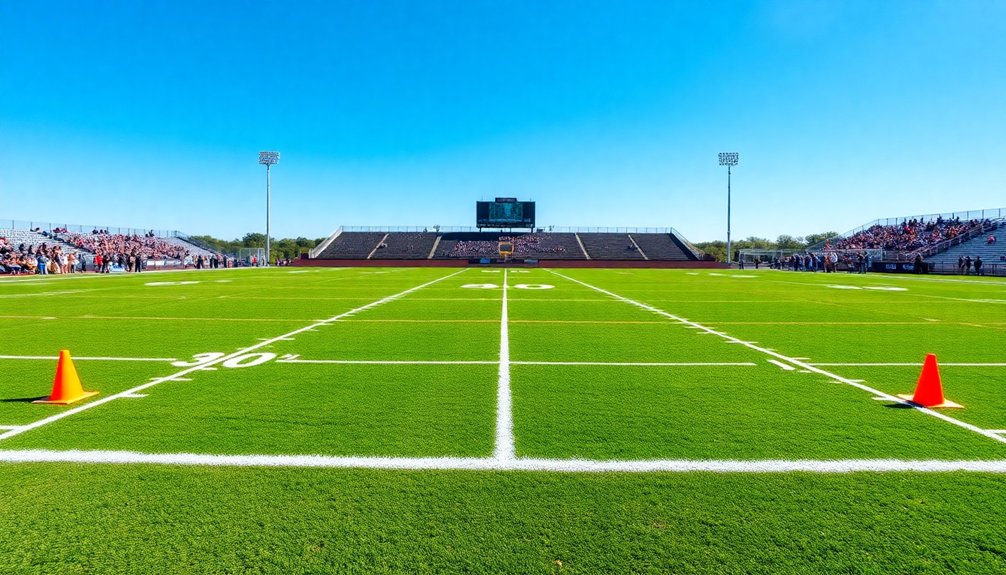
The field measures 50 yards in length, with two end zones of 10 yards each, and a width of 25 yards. You’ll find yard lines every 5 yards, with dashed lines marking no-running zones.
Each yard line extension measures 1 yard long and is positioned 4 inches inside the sidelines. Team areas are clearly designated, and pylons are placed at every intersection of sideline with goal lines and end lines.
Additionally, the IFAF logo is prominently displayed at the center line, ensuring it stretches a minimum of 5 yards in length, adhering to all specifications for the event. The structure of the field, much like the relegation system in soccer, ensures that teams can compete fairly and consistently throughout the championship.
Conclusion
In flag football, every inch of the field pulses with energy, inviting you to dash and dive. You’ve learned how the dimensions shape the game, from the vibrant end zones to the safety areas that cradle each play. As you step onto that expertly marked surface, you can almost feel the thrill of competition in the air. Understanding these basics equips you to navigate the field like a pro, igniting your passion for this fast-paced, exhilarating sport.