

How to Use Agility to Gain a Competitive Edge in Hockey
September 1, 2025To gain a competitive edge in hockey, focus on improving your agility. Quick direction changes, balance, and evasion of opponents can make a big difference. Use drills like cone weaving and lateral movements on the ice, and plyometric exercises off the ice to build strength. Incorporate mental toughness techniques, such as visualization and mindfulness, to enhance focus during gameplay. Understanding how to train your agility can elevate your performance; there’s much more to explore in optimizing your skills.
Understanding the Importance of Agility in Hockey
While you might focus on shooting and passing, agility is just as vital in hockey. This skill enables players to change direction quickly, evade opponents, and maintain balance during those high-velocity movements on the ice.
The chaotic nature of the game demands that you adapt rapidly, especially during 5-on-5 play. With shifts lasting only 30 seconds, agility is essential for accelerating, decelerating, and maneuvering around the rink.
Beyond physical attributes, agility also involves cognitive skills like reaction time and decision-making, making it multifaceted. By incorporating specific training drills that enhance your agility, you’ll greatly boost your performance, leading to better team dynamics and strategic execution during matches. Additionally, agility drills improve maneuverability in fast-paced game situations, increasing your effectiveness on the ice.
Essential Agility Training Techniques
To elevate your agility on the ice, incorporating a variety of training techniques is essential.
Start with high-intensity interval training (HIIT) to build explosive power and improve responsiveness for quick direction changes.
Begin your agility journey with high-intensity interval training (HIIT) to enhance explosive power and quick directional responsiveness.
Implement agility drills, like cone weaving and ladder drills, to enhance your footwork and coordination, enabling fluid movements under pressure.
Engage in small-sided games to practice situational awareness and boost your decision-making skills in confined spaces, simulating real-game scenarios.
Don’t forget cognitive agility drills, where you respond to visual cues or solve simple problems while performing tasks, enhancing your mental processing speed.
Regularly test and measure your agility performance using standardized drills to tailor your training and track your progress effectively. Additionally, incorporating stop-and-go drills can further enhance your agility for quick direction changes, mirroring the dynamic movements required in hockey.
On-Ice Drills for Enhanced Agility
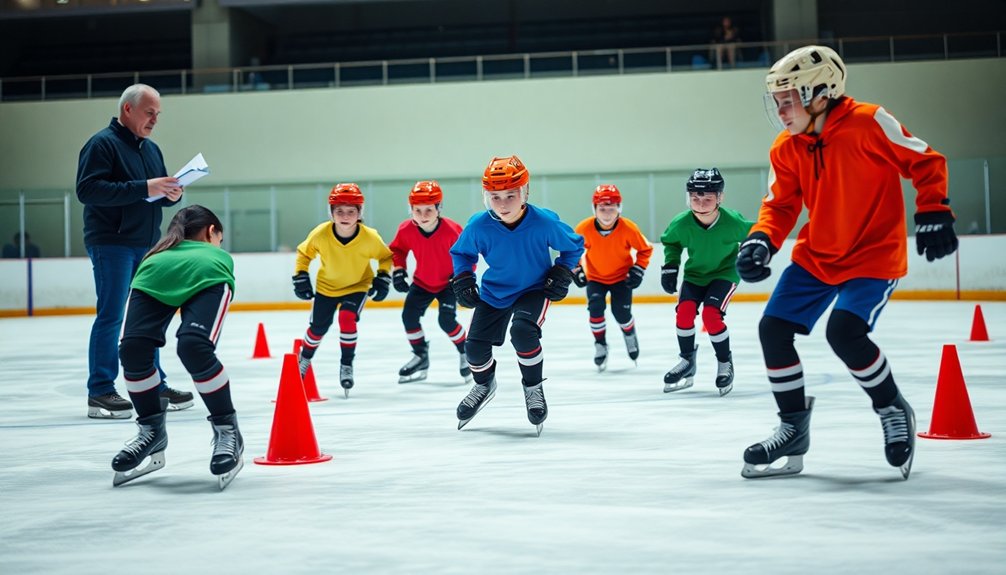
Agility on the ice isn’t just about off-ice training; on-ice drills are essential for sharpening your skills in real game situations. Incorporate cone drills into your training sessions, weaving through cones while puck handling to enhance overall agility and improve quick directional changes.
Figure eight drills develop both agility and puck control, helping you maintain balance during rapid movements. One-on-one scenarios are great for boosting your anticipation and reaction time, vital for staying competitive.
Additionally, lateral movement drills, where you shuffle side to side while controlling the puck, build your side-to-side agility. Finally, backward skating drills improve your overall skating proficiency, enabling you to shift swiftly between forward and backward movements during gameplay. Incorporating pain shuttles drill into your conditioning can further enhance your endurance and speed, crucial for maintaining agility on the ice.
Off-Ice Conditioning for Optimal Performance
To maximize your performance on the ice, focus on off-ice conditioning that builds explosive strength through plyometric exercises like jump squats. Strengthening your core is equally important, as it enhances your balance and stability, making quick movements smoother. When you combine these elements, you’ll see a significant boost in your agility during games. Additionally, incorporating dynamic warm-up routines can help prepare your body for intense activity and reduce the risk of injury.
Plyometric Exercises Benefits
While many hockey players focus on on-ice skills, incorporating plyometric exercises into your off-ice conditioning can greatly enhance your performance.
These exercises, like jump squats and box jumps, develop explosive strength, vital for quick acceleration and improved agility on the ice. By training the stretch-shortening cycle, you’ll generate more force with less effort during high-intensity movements.
Regular plyometric workouts can lead to significant gains in vertical jump height and sprint speed, essential for outmaneuvering opponents. Research shows plyometric training can boost overall athletic performance by 10-20%, translating to faster skating and better agility.
Additionally, these exercises enhance coordination and balance, allowing you to maintain stability while executing rapid direction changes on the ice.
Core Strength Importance
Core strength plays a pivotal role in your overall hockey performance, especially when it comes to maintaining balance and stability during those rapid directional changes on the ice.
A strong core enhances your agility, allowing for quicker skating strides and faster acceleration. Incorporating off-ice conditioning exercises like planks, Russian twists, and medicine ball throws into your training routine targets these essential muscles, which are vital for effective puck handling and shooting.
Improved core strength also supports better posture and alignment, reducing injury risk and enhancing movement efficiency.
As an athlete with superior core control, you’ll react more swiftly to opponents and make better decisions during gameplay, ultimately elevating your overall hockey performance.
The Role of Mental Toughness in Agility

Mental toughness serves as the backbone of agility in hockey, enabling players to stay focused and composed even under the most intense pressure.
This mental resilience directly influences your reaction time and decision-making, allowing you to execute rapid direction changes and evasive maneuvers effectively.
By employing visualization techniques, you can mentally rehearse agility maneuvers and anticipate game scenarios, which boosts your confidence and enhances performance.
Additionally, practicing mindfulness and breathing exercises helps reduce anxiety levels, keeping your mind clear during critical moments.
Cultivating mental toughness through cognitive training and exposure to high-pressure situations not only sharpens your agility but also contributes to overall team success, making it essential for any aspiring hockey player. Furthermore, consistent effort in practice will reinforce the skills needed to maintain agility in competitive situations.
Real-Life Applications of Agility in Game Scenarios
In a fast-paced hockey game, your ability to make quick direction changes can be the difference between scoring and getting shut down by a defender.
Anticipating your opponent’s moves allows you to stay one step ahead, enhancing not just your individual play but also your team’s overall strategy. Incorporating agility and coordination workouts into your training can significantly improve your performance on the ice.
Quick Direction Changes
As you navigate the fast-paced environment of a hockey game, the ability to make quick direction changes can be the difference between maintaining possession of the puck and losing it to an opponent.
To enhance your agility in these scenarios, players must incorporate effective methods into their training. Drills like cone weaving and lateral shuffles are excellent training drills that improve your change of direction speed. This not only sharpens your decision-making but also helps you maintain balance during sudden shifts.
When you master quick direction changes, you not only elevate your individual performance but also contribute to better team dynamics, making your offensive and defensive strategies more effective on the ice.
Anticipating Opponent Moves
Anticipating your opponent’s moves is an essential skill that can greatly elevate your performance on the ice.
With improved agility, you can enhance your reaction time, allowing you to anticipate and respond swiftly to your opponents’ dynamic movements. Incorporating cognitive agility drills, like responding to visual or auditory cues, sharpens your decision-making under pressure, helping you predict and react to plays more effectively.
Engaging in small-sided games during practice boosts your situational awareness, enabling you to read plays better. Focus on agility drills targeting lateral movements and sudden direction changes to evade defenders and position yourself efficiently.
Enhancing Team Strategy
While agility is often viewed as an individual skill, its true power emerges when integrated into team strategy. By enhancing agility training, players develop quicker reaction times, enabling them to make rapid directional changes during game situations. This agility allows you to evade defenders and create scoring opportunities.
Implementing training drills, like small-sided games, fosters teamwork and sharpens decision-making, simulating real-game dynamics. Cognitive agility drills that require reacting to visual cues can boost situational awareness, helping players read the game better.
A well-coordinated team, possessing high agility, executes complex plays, such as quick give-and-go passes, maximizing puck control and increasing scoring chances. Ultimately, agility becomes a vital element in elevating overall team performance.
Conclusion
In hockey, agility isn’t just a skill; it’s your competitive edge. As the saying goes, “You can’t teach an old dog new tricks,” but you can certainly refine your agility no matter your age. By incorporating the training techniques and drills we’ve discussed, you’ll elevate your game and become a more formidable player on the ice. Remember, agility isn’t just about speed; it’s about making quick, smart decisions that can turn the tide in your favor.