

How to Improve Balance in Tennis
May 1, 2026To improve your balance in tennis, focus on your footwork and core strength. Use small, quick steps for stability and maintain a low center of gravity. Incorporate agility drills, like ladder drills and cone sprints, to enhance coordination. Strengthening your core with exercises like planks and Russian twists will support effective movement. Visualize your movements to stay engaged and anticipate your opponent’s actions. Avoid common mistakes like poor stance and overreliance on one foot to enhance your game even further.
Why Balance Is Essential for Tennis Performance

When you step onto the court, balance plays an essential role in your performance. It’s vital for executing powerful serves and accurate shots.
Proper baseline positioning allows you to respond effectively to your opponent’s moves, while maintaining the right weight distribution enables quick adjustments. If your weight leans too far forward or backward, you risk losing stability, making it difficult to hit the ball precisely.
Good balance helps you stay centered, allowing for better footwork and more fluid movement. As you practice, focus on grounding yourself in each shot, ensuring that your body is ready to react. Incorporating core strength exercises into your training can significantly enhance your overall stability on the court.
Key Principles of Maintaining Balance on the Court
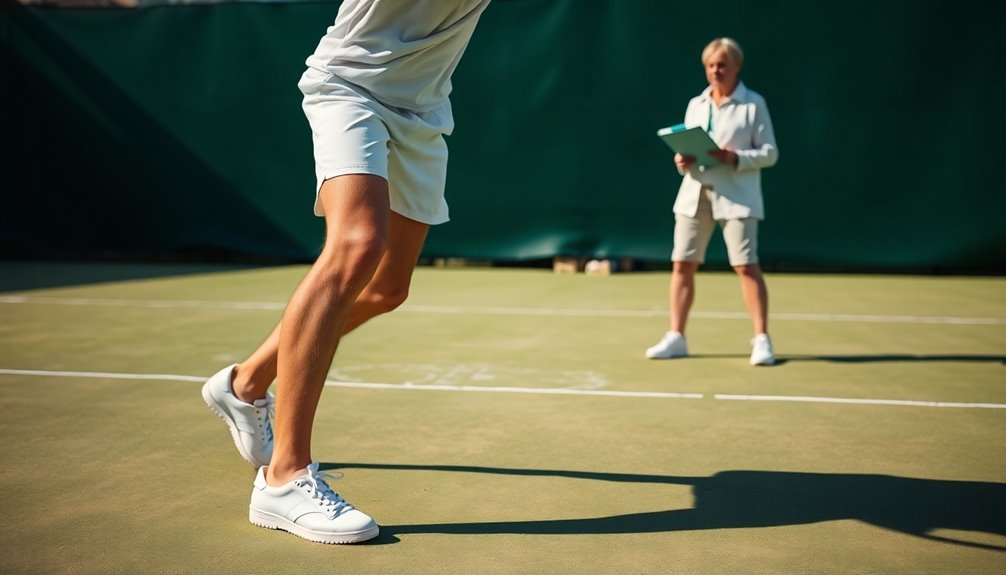
To maintain balance on the court, you need to focus on proper footwork techniques and core strength training.
Good footwork helps you position yourself effectively for each shot, while a strong core stabilizes your movements. Incorporating agility training can further enhance your balance by improving coordination and reaction time.
Let’s explore how mastering these principles can elevate your game.
Proper Footwork Techniques
Mastering proper footwork techniques is essential for maintaining balance on the tennis court. Focus on your foot placement; ensuring your feet are positioned correctly can make a significant difference.
When you’re about to hit the ball, shift your weight smoothly from one foot to the other. This weight distribution helps you stay grounded and ready for your next move. Use small, quick steps to adjust your position rather than long strides, which can throw you off balance.
Always stay light on your feet, keeping your knees slightly bent for better stability. Practicing these techniques will enhance your agility and control, allowing you to respond effectively to your opponent’s shots while maintaining solid balance throughout the match.
Core Strength Training
Building core strength is essential for maintaining balance on the tennis court. A strong core stabilizes your body, allowing for more effective movement and shot execution.
Incorporating core workouts into your routine will enhance your performance. Here are three effective exercises to try:
- Plank Variations: Hold a standard plank or try side planks to engage different core muscles.
- Stability Ball Exercises: Use a stability ball for exercises like ball passes or stability ball rollouts to improve your balance and coordination.
- Russian Twists: Sit on the ground with your feet elevated, twisting your torso to touch the ground beside you to build rotational strength.
Exercises to Enhance Your Core Stability

To improve your core stability, you can incorporate exercises like plank variations and medicine ball twists into your routine. These movements not only strengthen your core but also enhance your overall balance on the court. Additionally, focusing on cardiovascular endurance through high-intensity interval training can complement your core exercises and improve your athletic performance.
Plank Variations
Plank variations offer a dynamic way to enhance your core stability, an essential element for improving balance in tennis. By incorporating different types of planks, you can experience numerous plank benefits, including increased strength and endurance.
Here are three effective variations to try:
- Side Plank: Targets your obliques and improves lateral stability, vital for quick movements on the court.
- Plank with Shoulder Taps: Engages your core while challenging balance, helping you maintain stability during dynamic play.
- Plank to Push-Up: Builds upper body strength and core stability, promoting plank progression as you master the basics.
Incorporate these variations into your routine, and watch your balance on the court improve remarkably.
Medicine Ball Twists
After mastering plank variations, adding medicine ball twists can further enhance your core stability, which is essential for effective movement in tennis.
This exercise focuses on developing your rotational strength, allowing you to generate power during serves and groundstrokes.
To perform the twist, sit on the floor with your knees bent and hold a medicine ball close to your chest. Lean back slightly, engage your core, and rotate your torso to one side, then to the other.
Keep your feet off the ground for an extra challenge. Aim for three sets of 10-15 repetitions on each side.
Incorporating medicine ball twists into your routine won’t only improve your balance but also enhance your overall performance on the court.
Footwork Drills for Better Balance During Play
Mastering footwork drills can greatly enhance your balance during tennis play. Focusing on key aspects like lateral movement and quick feet will improve your overall performance.
Mastering footwork drills enhances balance and boosts performance by honing lateral movement and quick feet in tennis.
Here are three essential drills to try:
- Agility Ladder Drill: Use an agility ladder to work on foot placement and quick lateral movements. This helps with weight distribution and enhances your pivot technique.
- Cone Sprints: Set up cones and sprint to each one, practicing recovery steps as you change direction. This builds agility and balance.
- Dynamic Stretches: Incorporate dynamic stretches before practice to improve flexibility and warm up your muscles, which aids in balance during play.
Integrating these drills into your routine will considerably boost your footwork and help you maintain better balance on the court.
The Role of Proper Stance in Achieving Balance
While you might focus on footwork, the role of proper stance in achieving balance is equally crucial in tennis. A solid stability foundation begins with how you position your feet and body before each shot.
When you adopt a balanced stance, you can react quickly and maintain control during play. Remember to keep your knees slightly bent and your weight distributed evenly between your feet. This allows for quick stance adjustments, enabling you to adapt to your opponent’s shots effortlessly. Incorporating techniques from defensive drills can further enhance your stability and readiness on the court.
Practice finding the right stance for various situations, ensuring you stay grounded and ready. By prioritizing your stance, you’ll enhance your overall balance, leading to improved performance on the court.
How to Use Visualization Techniques for Improved Balance
A solid stance lays the groundwork for balance, but visualization techniques can amplify your performance on the court. By incorporating effective visualization methods, you can enhance your mental imagery and improve your stability. Here’s how to get started:
- Picture Your Stance: Visualize yourself in an ideal athletic position. Focus on the alignment of your feet, knees, and hips.
- Rehearse Movements: Mentally practice your footwork. Imagine moving fluidly between shots while maintaining balance.
- Anticipate Scenarios: Envision various match situations. Picture yourself reacting confidently and staying balanced under pressure. Additionally, understanding soccer field dimensions can help you visualize your positioning relative to your opponents and the court.
Tips for Practicing Balance During Matches
To enhance your balance during matches, focus on integrating specific techniques into your gameplay.
Start by refining your footwork; quick, small steps help you maintain stability while shifting between shots. Use match strategies that emphasize positioning—always aim for ideal ball placement to create favorable angles.
When you anticipate your opponent’s moves, you can adjust your stance and maintain a low center of gravity. Practicing your serve and returns with attention to balance can also make a difference; make sure you’re grounded before hitting the ball.
Finally, stay mentally engaged by visualizing your movements and anticipating challenges. These focused efforts won’t only improve your balance but also elevate your overall performance on the court. Regular practice of defensive techniques can enhance your ability to maintain balance under pressure.
Common Balance Mistakes and How to Avoid Them
Many players unknowingly make common balance mistakes that can hinder their performance on the court.
These balance misconceptions can lead to poor footwork and missed shots. Here are some key balance corrections to help you improve:
- Overreliance on One Foot: Don’t favor your stronger foot. Shift your weight evenly to maintain stability.
- Ignoring Your Stance: A narrow or awkward stance can throw off your balance. Keep your feet shoulder-width apart for a solid foundation.
- Lack of Core Engagement: Weak core muscles can lead to instability. Strengthen your core to enhance balance and control during movements. Incorporating dynamic stretches into your warm-up routine can also improve your overall stability.
Conclusion
Improving your balance in tennis is like fine-tuning a musical instrument; every adjustment makes a difference in your performance. By focusing on core stability, practicing footwork drills, and maintaining a proper stance, you can elevate your game. Remember to visualize your movements and apply balance techniques during matches. Avoid common pitfalls, and you’ll find yourself moving with grace and confidence on the court. Keep practicing, and soon you’ll be dancing around your opponents!