
How to Hold a Football for Maximum Control
August 11, 2025To hold a football for maximum control, position the ball between your index finger and thumb with a slight gap from your palm. Place your index and middle fingers on the laces, while your thumb spreads towards the top third for stability. You might consider a three-finger grip for better control. Keep your wrist neutral and select the right size football for your hand. Master these techniques, and you’ll discover even more tips to enhance your throwing accuracy.
The Most Basic Part Of The Football Grip
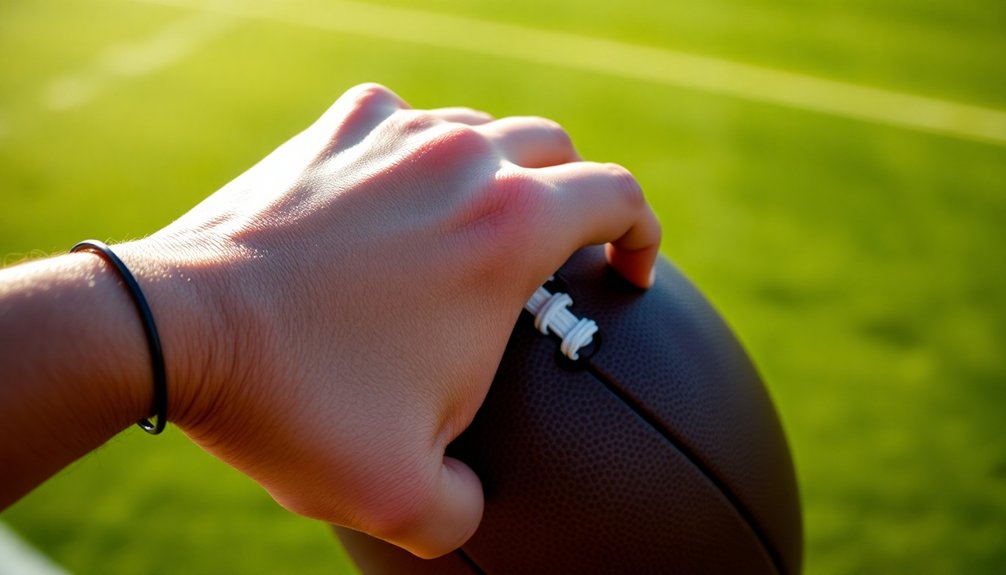
The foundation of a solid football grip lies in how you position the ball in your hands. Start by placing the ball between your index finger and thumb, ensuring there’s a slight gap between your palm and the ball for comfort and control.
For a basic grip structure, put two fingers on the laces—your ring and pinky fingers—while your index finger rests near the top and your middle finger sits above the top lace for added stability. Spread your thumb towards the top one-third of the ball to enhance grip strength.
If you’re a younger quarterback, consider using a three-finger grip, with your middle finger in the first lace for better control. Regular practice will refine your grip and improve your throwing mechanics. Understanding team composition is crucial for developing effective strategies in football.
The Most Common Way To Grip The Football
Many quarterbacks rely on a common grip that enhances control and accuracy when throwing the football. This grip involves placing your index finger and middle finger on the laces, with your index finger positioned near the top of the ball.
Your thumb should spread towards the top one-third for stability. Verify there’s a slight gap between your palm and the ball, allowing it to rest comfortably between your index finger and thumb.
Many players use a two-finger grip on the laces, keeping the ring and pinky fingers below for added security. For better control, some might opt for a three-finger grip. Mastering proper timing and a low center of gravity can also improve your ability to make accurate throws under pressure.
Subtle Adjustments To Hold The Football

To improve your grip on the football, you can experiment with a three-finger grip, especially if you have smaller hands. Adjusting finger placement can make a big difference in your control and the ball’s spiral. These subtle tweaks can lead to better performance on the field, particularly in defensive midfielders who require precise ball control to link play effectively.
Three-Finger Grip Benefits
While mastering the three-finger grip can feel a bit different at first, it offers significant benefits for players looking to enhance their throwing technique. By placing your index, middle, and ring fingers along the laces, you gain improved control during throws, especially if you have smaller hands.
Positioning your middle finger on the first lace stabilizes your grip, leading to better wrist alignment and throwing mechanics. This grip allows the ball to rest comfortably in your hand, reducing palm contact, which promotes a tighter spiral and greater accuracy.
Additionally, experimenting with a three-finger grip can help you find personalized comfort levels, enhancing your performance without sacrificing grip stability, especially when handling larger footballs.
Adjusting for Ball Size
Mastering the three-finger grip sets a solid foundation, but adjusting it for different ball sizes is essential to maximizing your control and accuracy.
When using a larger football, make sure that three fingers contact the laces for enhanced stability. Place your middle finger in the first lace, especially if you’re a younger quarterback or have smaller hands; this improves your grip and manipulation of the ball.
Remember to maintain a slight gap between your palm and the ball, which is vital for comfort and control with larger sizes. Experimenting with finger placement on the laces will help you find what feels best.
Regular practice with various sizes will strengthen your grip and adaptability, ultimately boosting your throwing precision.
Finger Placement Techniques
When you focus on finger placement while holding the football, you’ll notice how subtle adjustments can enhance your grip and overall performance. For ideal control, place your index finger along the seam, ensuring it’s the last to touch the ball when you throw.
Experiment with finger placement techniques like a three-finger grip, positioning your middle finger in the first lace for better stability. Keep a slight gap between your palm and the ball, allowing it to rest comfortably between your index finger and thumb.
If you’re using a larger football, adjust your grip to maintain wrist position effectively. Remember, proper finger placement greatly boosts grip strength, improving your control and accuracy as you throw the ball.
Three Fingers On The Football
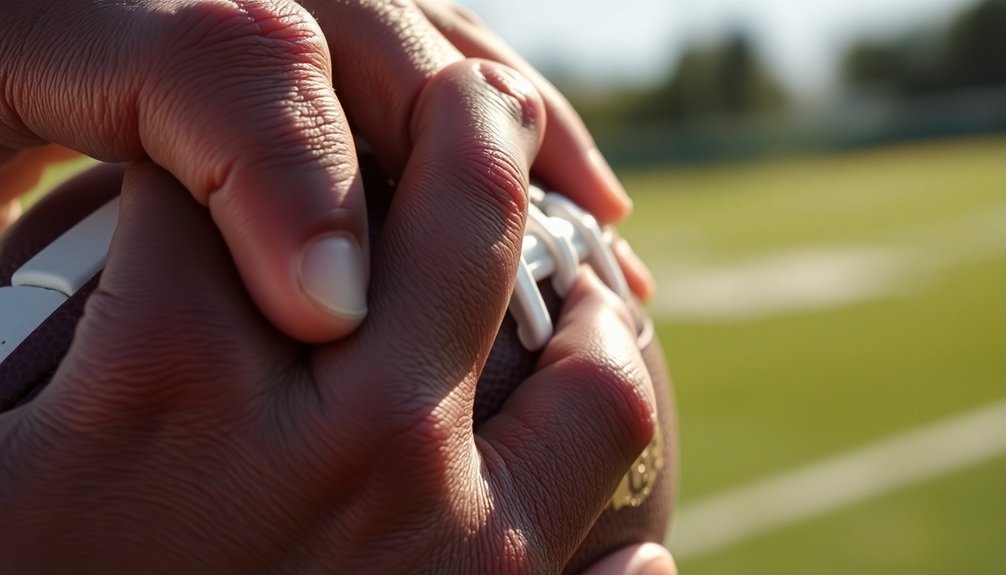
When you grip the football with three fingers, you gain enhanced control and stability during your throw.
Positioning your middle finger in the first lace helps you achieve a more accurate pass while improving wrist positioning.
This grip is especially useful for quarterbacks with smaller hands, allowing for a consistent and confident release. Additionally, mastering defensive stance techniques can further improve your overall throwing accuracy by stabilizing your position.
Enhanced Grip Control
Using a three-finger grip on the football can greatly enhance your control and accuracy during throws. By placing your middle finger on the first lace, you’ll gain better stability and precision, especially if you have smaller hands.
This grip improves your wrist positioning, keeping it neutral or slightly forward for ideal mechanics. With three fingers on the laces, you’ll develop greater finger strength, which translates to increased throwing distance and accuracy.
Spread your thumb towards the top third of the ball to create a secure hold, reducing palm contact and promoting a tight spiral. Regular practice with this grip will help you find your comfort zone and refine your throwing technique for consistent performance on the field.
Improved Throwing Stability
To achieve improved throwing stability, grasp the football with a three-finger grip that centers your middle finger on the first lace. This technique enhances your throwing motion, providing better control and accuracy during passes.
It’s especially beneficial for younger quarterbacks, as it keeps your grip strong without too much palm contact.
Key benefits of a three-finger grip include:
- Alignment: Properly aligns your wrist for consistent throws.
- Spiral Tightness: Helps achieve a tighter spiral, increasing velocity and distance.
- Customization: Experiment with finger placements to find what gives you maximum control and comfort.
Index Finger Higher Up On The Ball
Positioning your index finger higher up on the ball can greatly enhance your grip and control. By placing your index fingers near the top, you improve your throw’s precision and achieve a tighter spiral, which is essential for accuracy and distance.
This grip adjustment allows your index finger to be the last contact point before release, maximizing leverage for a powerful throw. Additionally, keeping your index finger in this position promotes a neutral or slightly forward wrist angle, which is crucial for proper throwing mechanics.
Experimenting with your index finger’s placement helps you find a comfortable grip that aligns with your throwing style, ultimately boosting your performance during both practice and games. Mastering step-over techniques can also improve your overall ball control and maneuverability.
Move Finger Tips On The Lace
Finding the right grip on the football involves adjusting your fingers on the laces, which can greatly enhance your control and accuracy. Position your index and middle fingers on the laces, with your index finger near the top and your middle finger aligned with the first lace.
Finding the ideal grip on the football by adjusting your fingers on the laces can significantly boost your control and precision.
Here are some tips to optimize your grip:
- Move your fingertips along the laces to find a comfortable spot for a solid grip without excessive palm contact.
- Keep your thumb spread toward the top one-third of the ball for added stability.
- Experiment with different placements using two fingers to refine your throwing accuracy. Additionally, maintaining proper finger positioning can significantly improve your overall ball control during gameplay.
Adjust The Wrist
Adjusting your wrist is essential for a successful throw, as it directly impacts your grip and control of the football. Aim for a neutral or slightly forward wrist position; this maximizes your grip and guarantees peak control.
Keeping your wrist aligned with your forearm allows for better power transfer and accuracy during the throw. Proper wrist positioning maintains palm contact with the ball, reducing the risk of losing grip upon release.
A strong wrist also contributes to a consistent follow-through, enhancing both velocity and accuracy. Practicing wrist adjustments can greatly improve the quality of your spiral, helping you achieve the desired spin rate and flight path. Additionally, proper fit in your footwear can enhance your overall stability and control during throwing motions.
Focus on these details to elevate your throwing game.
Choose the Right Football
Choosing the right football is key to improving your game.
You’ll want to contemplate the size that fits your league and the material that feels best in your hands.
A well-chosen football enhances your grip and control, making all the difference when you throw. Additionally, using the correct soccer ball size ensures optimal performance and comfort during play.
Size Matters
When it comes to holding a football, size truly matters. Choosing the right football can greatly impact your grip and throwing accuracy.
Here are some key points to take into account:
- Youth-sized footballs (27.5 inches) are usually easier for younger players to grip than official NFL-sized footballs (28.5 inches).
- If you have smaller hands, experimenting with different sizes can improve your throwing mechanics and enhance control.
- Make sure your fingers can comfortably span the laces for ideal grip; a ball that’s too large can hinder your control and affect distance.
Material Preference
Selecting the right material for your football can make a significant difference in your performance.
Leather footballs offer a superior grip and feel, making them the preferred choice for serious players. You’ll notice that those with a pebble-grain texture enhance grip and control, especially when the weather isn’t cooperating.
Weighing around 14-15 ounces, standard NFL balls strike the perfect balance for control and distance. Pay attention to the laced seams; they allow for better finger placement, guaranteeing you can grip the top of the ball effectively for that perfect spiral.
If you’re a youth player, consider smaller, lighter synthetic options that suit your comfort.
Ultimately, the right material guarantees you maintain control and confidence on the field.
Throwing With A C Instead Of A U
Using a “C” grip instead of a “U” grip can markedly enhance your throwing mechanics. This grip allows your fingers to curve around the ball, providing better control and stability. It specifically emphasizes placing your index finger on the laces, improving grip strength and accuracy.
Here are some key benefits of using a “C” grip:
- Maintains a slight gap between your palm and the ball, promoting a consistent spiral.
- Positions your thumb on the bottom third of the ball, leveraging wrist mechanics for more power.
- Improves throw consistency, aligning with ideal mechanics for executing a tight spiral. Additionally, a strong grip can enhance pressure and cover dynamics during gameplay, as effective control contributes to overall performance.
Not Following Through With Your Throw
Neglecting to follow through with your throw can drastically undermine your performance on the field. When you don’t complete your follow-through, your accuracy and velocity suffer, making it harder to achieve throwing a perfect spiral.
A proper follow-through guarantees your arm extends forward, pointing at the target, which is vital for maintaining spin and distance. Without it, you risk losing valuable yards or facing interceptions.
Studies show that a complete follow-through enhances the spiral quality, with successful throws averaging a spin rate of 600 RPM. Great quarterbacks like Dan Marino and Tom Brady exemplify the importance of meticulous mechanics, proving that a solid follow-through is key to maximizing your throw’s velocity and power. Additionally, mastering passing accuracy ensures better overall performance on the field.
Don’t overlook this critical aspect!
Conclusion
In the game of football, mastering your grip is like finding the perfect dance partner; it’s all about connection and control. By using the right techniques and making subtle adjustments, you can enhance your grip and elevate your game. Remember, it’s not just about holding the ball; it’s about owning it. So, practice these tips and let your throws soar like an eagle, ensuring you have maximum control every time you hit the field.