

How to Create Unstoppable Flag Football Plays
August 14, 2025To create unstoppable flag football plays, you need to master your league’s rules and design effective formations. Focus on exploiting mismatches with formations like Trips and Split-Back. Keep defenses guessing by mixing up your plays and incorporating misdirection strategies. Use route combinations that confuse defenders and vary your defensive tactics to apply pressure. With consistent practice, you can refine these strategies for maximum impact. Stick around to discover even more tips on enhancing your playbook.
Understanding Your League’s Rules
Understanding your league’s rules is essential, especially since they dictate how you design your flag football plays. Start by familiarizing yourself with player eligibility and formations to guarantee compliance during play calling.
Pay close attention to quarterback restrictions; they can’t run beyond the line of scrimmage, impacting your overall strategy. Remember that only direct handoffs behind the line of scrimmage are permitted, which affects timing and player movement.
Additionally, know that ball spotting occurs where the flag is pulled, not where the ball is. Be aware of No Run Zones, typically five yards before midfield and the goal line, where running plays aren’t allowed. This necessitates a strong focus on passing strategies in these critical areas. Understanding the offside rule can also enhance your team’s strategic playmaking during critical moments.
Creating Your Flag Football Playbook
With a solid grasp of your league’s rules, you can now focus on creating an effective flag football playbook. Start by selecting eight to ten core plays that emphasize simplicity, especially for younger players.
Organize your playbook by formations, categorizing plays based on players’ starting locations to enhance clarity. Incorporate a mix of short, medium, and long yardage offensive plays to maintain unpredictability.
Utilize visual aids, like printed plays and wristbands, to help communicate strategies effectively. Regularly practice and refine these plays with your team, making adjustments based on players’ strengths and weaknesses. Additionally, emphasize consistent practice to ensure all players are familiar with their roles and responsibilities.
This approach will guarantee everyone understands their roles and increase your chances to score during games. A well-structured playbook is key to your team’s success!
Effective Offensive Formations
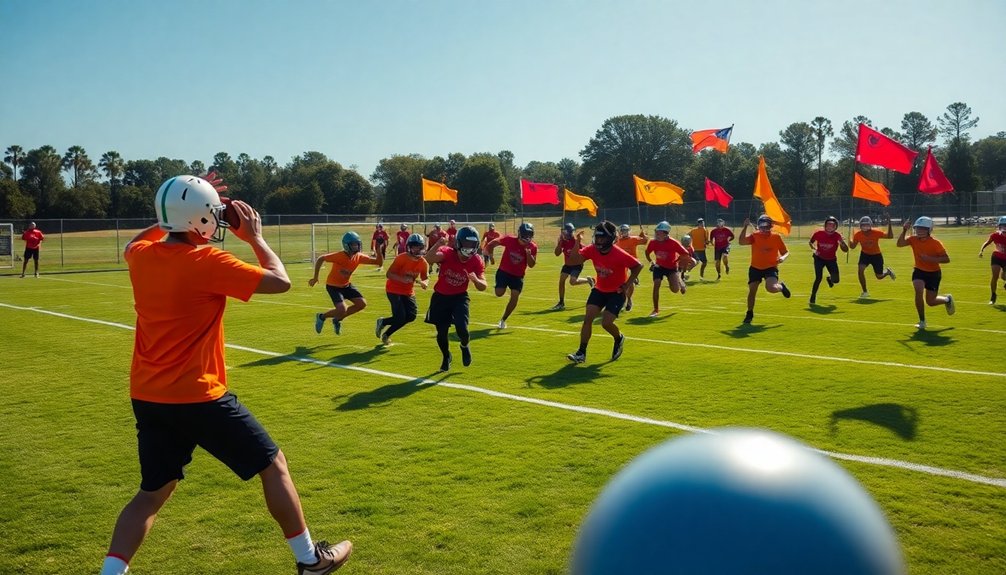
Effective offensive formations are essential for maximizing your team’s scoring potential. By strategically spreading out the defense, you can create effective flag football offensive plays.
The Trips formation, for instance, places three receivers on one side, exploiting mismatches and opening up passing lanes for quick passes. Alternatively, the Split-Back formation positions two running backs behind the quarterback, allowing for flexible handoffs and quick throws.
Prioritize spacing and player positioning to enhance offensive efficiency, ensuring everyone knows their routes and has clear paths to receive the ball.
Tight formations, like Bunch formations, can also confuse the defense, creating openings for screens or slants. Choose the right formation to keep your opponents guessing and maximize scoring opportunities. Additionally, effective player selection is crucial to ensure that each player excels in their role and contributes to the overall offensive strategy.
Designing Dynamic Plays
Here are three key strategies to take into account:
Consider these three key strategies for dynamic flag football plays to keep defenses on their toes.
- Route Combinations: Mix slant and fly routes to confuse defenders, creating mismatches in coverage.
- Formations: Utilize formations like trips or stacks to overload one side of the defense, enhancing passing opportunities for your quarterback.
- Misdirection: Incorporate fake handoffs or reverse routes to keep the defense guessing, giving your receivers room to operate.
Additionally, consider using techniques like deceptive moves to further enhance your play designs and keep defenders on their toes.
Develop a playbook that caters to all skill levels and emphasize practice to improve execution.
Implementing Defensive Strategies
As you focus on creating dynamic offensive plays, don’t overlook the importance of implementing robust defensive strategies to counter them.
Start by implementing a Blitz Defense to disrupt the quarterback’s rhythm, applying immediate pressure that forces quicker decisions. Utilize zone coverage to anticipate offensive movements, which increases your chances of flag pulls on passing plays.
Practicing flag pulling techniques is essential; speed and precision can halt the offense effectively. Adjusting defensive formations based on the offensive setup keeps them guessing, helping you exploit mismatches.
Regularly changing defensive schemes and disguising formations can confuse the offense, leading to mistakes and turnover opportunities. Incorporating transition and recovery drills can also enhance your team’s ability to quickly adapt to changes in offensive strategies.
Conclusion
With creativity as your compass and teamwork lighting the way, you’re ready to release unstoppable flag football plays that’ll leave your opponents in the dust. As you weave through strategies and formations like a skilled artist, remember that every pass and every block paints the story of your game. Embrace the thrill of the field, and let your passion for the game fuel your drive. Together, you’ll not just play; you’ll create unforgettable moments under the sun.