
How Many Players Are on the Ice in Hockey? Understanding the Rules
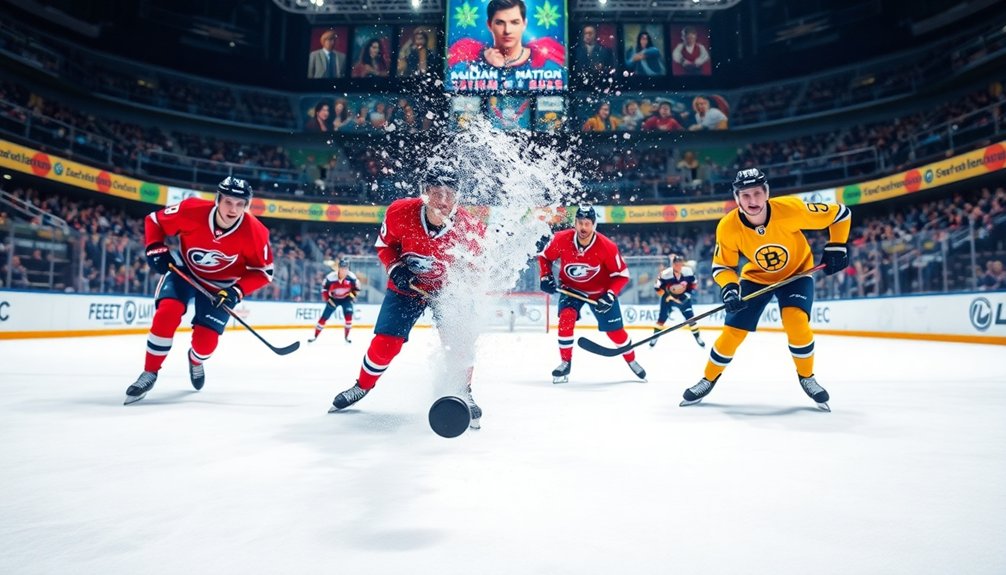
August 20, 2025In ice hockey, there are six players on the ice for each team: one goaltender and five skaters. The skaters usually include three forwards—one center and two wingers—and two defensemen. Teams can have up to 23 players on their roster, but only 20 dress for a game, leading to 18 skaters and two goalies. Understanding these player roles and rules can enhance your appreciation for the game’s strategy and flow. There’s so much more to discover about how the game operates!
Team Composition in Ice Hockey
In ice hockey, each team has six players on the ice at a time: one goaltender and five skaters. The team composition typically includes three forwards—one center and two wingers—and two defensemen. This setup maximizes offensive potential while ensuring defensive capabilities.
A team’s roster can include up to 23 players, but only 20 can dress for each game, which consists of 18 skaters and two goaltenders. During the game, players frequently substitute in and out, allowing for tactical adjustments and maintaining high energy levels.
Understanding these positions is essential, as forwards primarily focus on scoring, while defensemen work to protect the goal and maintain puck possession, shaping the dynamics of ice hockey. The importance of team composition is evident in how it influences both offensive and defensive strategies throughout the game.
Player Positions and Roles
Understanding player positions and roles is essential for grasping how ice hockey functions. Each team has six players on the ice: one goaltender and five skaters.
Here’s a breakdown of the key positions:
- Center: Takes face-offs, orchestrates offensive plays, and supports both defense and attack.
- Forwards: Two wingers (left and right) focus on scoring and puck retrieval in the offensive zone while assisting defensemen in the defensive zone.
- Defensemen: Concentrate on preventing opponents from taking quality shots and regaining puck possession for offensive plays.
- Goaltender: Guards the net, aiming to block shots and keep the opposing team from scoring. Understanding team strategy is crucial for successful gameplay, as it influences how each position interacts on the ice.
These player positions shape the flow of the game, balancing offense and defense effectively.
Substitutions and Line Changes
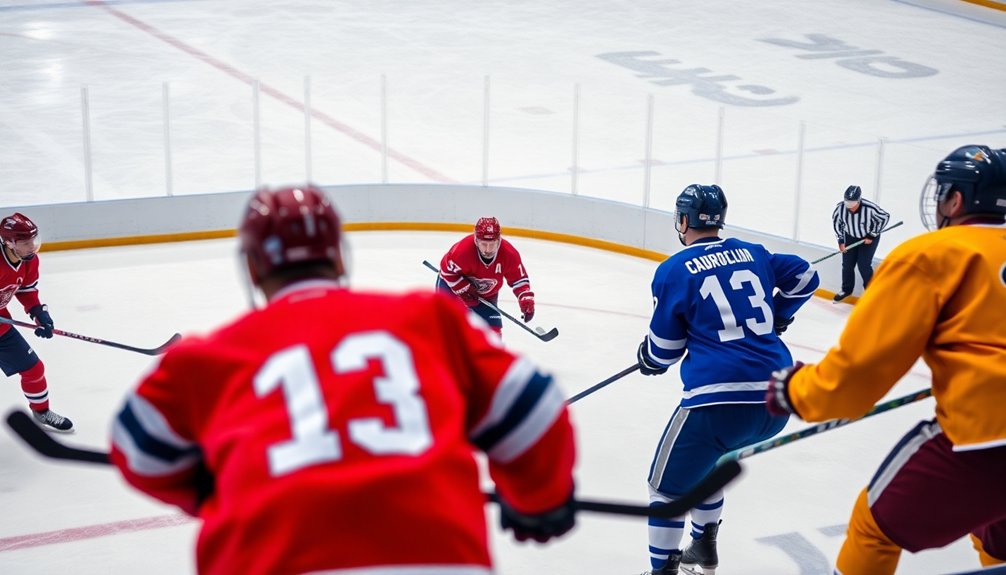
Substitutions and line changes are essential to maintaining a team’s energy and effectiveness during a hockey game. Each team has a maximum of six players on the ice, including one goaltender and five skaters.
To keep up with the fast-paced gameplay, players typically take shifts lasting 45 to 90 seconds before changing out for fresh teammates. This strategy guarantees peak performance and energy management.
Coaches often make strategic substitutions, especially during power plays or critical moments, to create favorable matchups against opponents. Players can switch during ongoing play, enhancing the fluidity of team dynamics and allowing for quick adjustments. Additionally, maintaining player conduct is crucial for ensuring a fair and respectful game atmosphere.
Penalties and Player Count
When a player commits a penalty, the dynamics on the ice shift dramatically as their team faces a disadvantage in numbers. This imbalance can greatly impact the game’s flow.
Here’s how penalties affect player count:
- Minor Penalty: One player sits out for two minutes, giving the opposing team a power play.
- Major Penalty: A player serves five minutes, allowing the opposing team to maintain their advantage regardless of scoring.
- Player Count: During a power play, you might see five skaters against four, increasing scoring chances.
- Multiple Penalties: If several players receive penalties, your team’s numbers can dwindle, leading to fewer players on ice and a higher chance of losing, especially if the game is tied.
This shift tests your team’s ability to adapt and maintain effective team play. Additionally, effective utilization of halftime duration can significantly influence team performance and strategy during critical moments in the game.
Power Plays and Special Situations
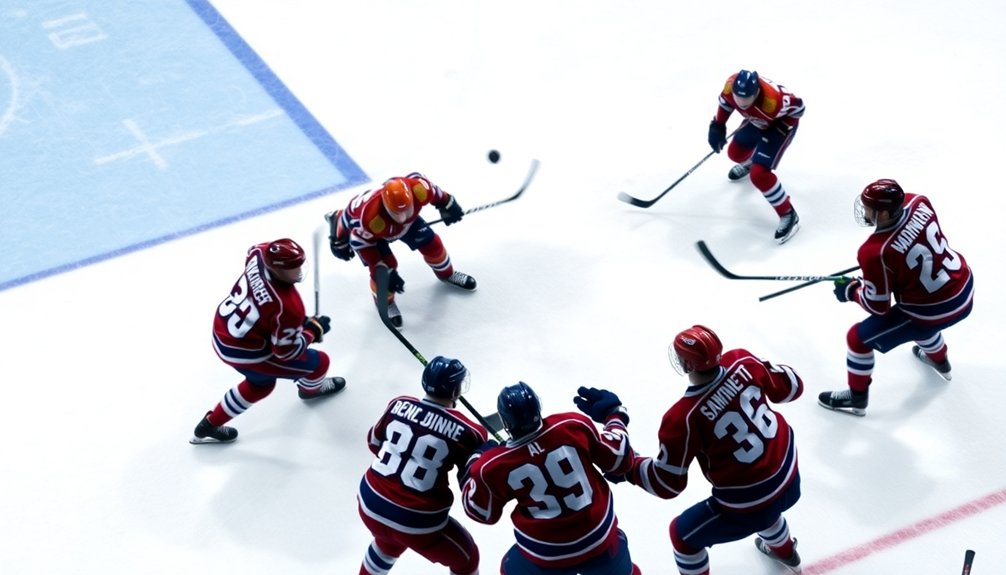
After a penalty, the game shifts considerably, especially during power plays and special situations.
When a team is on a power play, the non-penalized team enjoys a numerical advantage, typically having five players on the ice compared to four from the penalized team. This player advantage usually lasts for two minutes unless the penalized team concedes a goal. In some cases, a major penalty grants a five-minute power play, allowing for extended scoring opportunities.
Special situations like a penalty shot also alter the player composition on the ice surface, enabling one player to take a direct shot while others remain stationary. These scenarios create heightened excitement and strategic adjustments, as teams aim to capitalize on their advantages. Understanding the importance and purpose of yellow cards in maintaining discipline can also influence player behavior during these critical moments.
Impact of Icing and Offside Calls
Icing and offside calls can greatly impact the flow of a hockey game, often altering the dynamics on the ice. Understanding these rules helps you appreciate their significance:
- Icing occurs when a player shoots the puck from their defensive zone past the opposing team’s goal line without touching another player, stopping play.
- Offside is called when an attacking player crosses the blue line before the puck, with both skates needing to be over the line.
- Icing isn’t enforced during power plays, giving the non-penalized team a chance to control the play.
- Officials can waive icing if the goalie plays the puck or if it seems like a pass attempt.
These calls keep the game fair and maintain the action on the ice. Additionally, understanding the impact of offensive strategies from other sports, like basketball’s pick-and-roll, can enhance your appreciation of the strategic elements in hockey.
Historical Context of Player Numbers
As hockey evolved, the number of players on the ice changed considerably, reflecting the sport’s growing complexity and organization.
In the late 19th century, early versions of the hockey game showcased varying player counts, with the first organized indoor hockey match in 1875 featuring nine players per side.
Early hockey saw fluctuating player counts, with the inaugural indoor match in 1875 featuring nine players on each team.
However, the six-on-six format, which includes six players per team—one goaltender and five skaters—gained traction as the standard. Established in 1917, the National Hockey League (NHL) solidified this player count, and it’s been maintained in professional leagues ever since.
While informal games might see variations in player numbers, the six-player system has become the norm in competitive play, ensuring consistency across the sport. This shift mirrors the standardization of soccer rules, as both sports sought to create a more organized structure for gameplay.
Governing Bodies and Rules Enforcement
In hockey, various governing bodies like the NHL, IIHF, and USA Hockey set the rules that dictate the number of players on the ice. You’ll notice that officials play an essential role in enforcing these regulations, ensuring fair play across different levels of competition. Understanding these organizations and their rules helps clarify how player counts are managed in both professional and amateur hockey. Additionally, the influence of expert analysis and insights in broadcasting can provide fans with a deeper understanding of the game’s strategies and player dynamics.
Major Governing Organizations
While various governing organizations oversee the sport of ice hockey, each plays an essential role in maintaining the integrity and consistency of the game. Here are the major governing bodies:
- NHL: The premier professional league in North America, setting rules for teams and players.
- IIHF: Governs international competitions, including the Olympics and World Championships, establishing the rules of hockey.
- USA Hockey: The governing body for amateur and youth hockey in the U.S., promoting the sport’s development.
- Player Regulations: Each governing body enforces rules like the maximum of 20 players per team and six players per side on the ice rink during gameplay.
These organizations work together to guarantee fair play across all levels, from amateur hockey to professional leagues.
Rule Enforcement Mechanisms
Understanding how rules are enforced in ice hockey is essential for appreciating the game’s structure. The NHL and IIHF govern the sport, ensuring consistent rule enforcement.
On-ice officials, including referees and linesmen, monitor the number of players and call penalties. When a player must serve time in the penalty box, the game dynamics shift, impacting both teams. If a penalized player is serving a minor penalty, their team plays short-handed, while the opposing teams capitalize on the opportunity.
If the game is still tied after regulation play, a penalty shootout may occur. Each penalty type—minor, major, or misconduct—has specific conditions, affecting player counts and gameplay flow, ultimately maintaining fairness and integrity in the sport.
International Regulations Overview
The International Ice Hockey Federation (IIHF) plays an essential role in shaping the sport by establishing rules and standards for international competitions.
Here’s an overview of key regulations:
- Each team can have a maximum of 20 players, including 18 skaters and 2 goaltenders.
- Only 6 players are allowed on the ice at any given time during gameplay.
- The IIHF enforces penalty rules that impact team dynamics and maintain competitive balance during power plays.
- Player substitutions are regulated to guarantee gameplay integrity, aligning with evolving safety standards.
Conclusion
In ice hockey, understanding how many players are on the ice at any given time is like mastering the rhythm of a dance. Each team fields five skaters and one goalie, but substitutions, penalties, and special situations can shift this balance. By grasping these rules, you can truly appreciate the flow of the game. So next time you watch, remember that every player counts, each movement choreographed in a thrilling ballet of strategy and skill.