

From Snap to Touchdown: Understanding How Football Plays Are Built
March 20, 2026When you break down a football play, you’ll see it’s all about strategy, execution, and teamwork. From the snap, you need to analyze defensive alignments and make quick decisions. The quarterback reads coverage, while the play design incorporates motion and layered routes to create mismatches. Effective execution turns plans into successful plays, and adapting on the fly keeps defenses guessing. There’s a lot more to uncover about the complexities of crafting these plays.
The Anatomy of a Football Play: Key Components
A successful football play hinges on several key components that come together to create an effective strategy. At the line of scrimmage, the play caller sets the offense’s formation, deciding whether to use unique sets like 3×1 or 3×2 to exploit defensive mismatches.
As the quarterback, you must read the defense, noting alignments and potential vulnerabilities, especially in man-to-man or zone coverage. Execution is essential; integrating concepts like RPOs keeps defenses guessing and stresses linebackers.
When the ball snaps, your quick decision-making can lead to a touchdown, relying on clues from receiver motions and safety positions. Every element, from formation to execution, plays a significant role in crafting a successful play that maximizes your offensive potential, ensuring that your team remains unpredictable and adaptable throughout the game.
Pre-Snap Analysis: Reading Defensive Alignments

As you approach the line of scrimmage, understanding the defense’s alignment becomes critical for making informed decisions. Effective pre-snap analysis helps you identify defensive coverage types, like man-to-man or zone, by observing safety alignment and receiver motion.
Pay close attention to linebacker adjustments and defensive back positioning; these clues reveal potential coverage schemes and predict defensive reactions. Using hard counts can elicit responses from defenders, giving you insight into their strategy before the snap.
Watch for defensive rotations, as they can confuse your reads. Simplifying your focus to open areas with less defensive presence allows you to make quicker, more efficient decisions, ultimately benefiting your offensive team and enhancing your chances of success on the field. Additionally, understanding flag pulling techniques can help you better anticipate defensive strategies and create opportunities for successful plays.
Play Design: Crafting Routes and Concepts
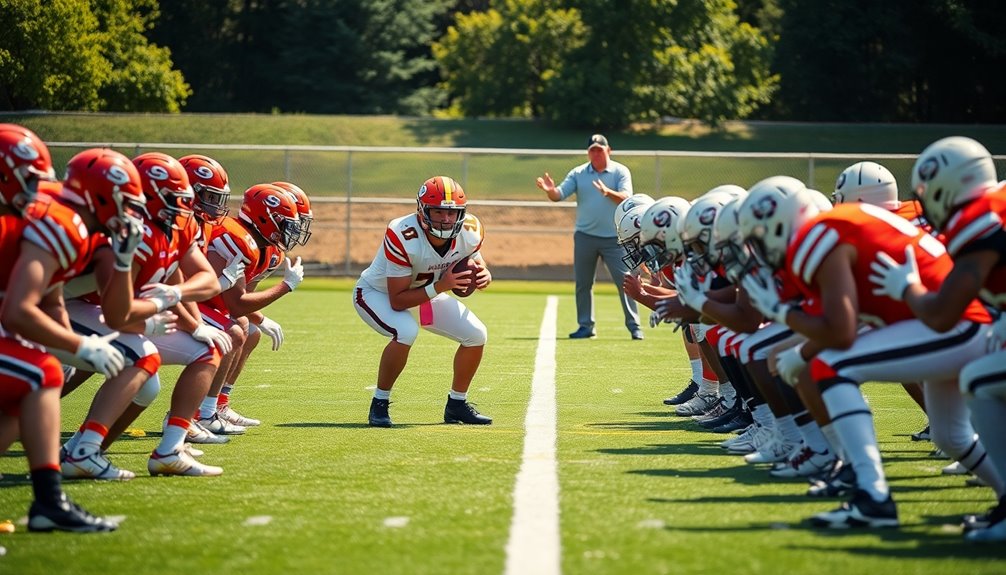
When you design a football play, it’s essential to create routes and concepts that confuse defenders and exploit their weaknesses. Effective play design incorporates layering concepts, stacking different routes to open opportunities for explosive plays.
Using high-low concepts can pressure defensive players in multiple zones, making it easier to complete passes against zone coverage. RPO (Run-Pass Option) strategies simplify reads for quarterbacks, enhancing offensive efficiency by reacting to linebackers’ movements.
Triangular route combinations, like mesh or curl-flat, enhance spacing and stress defenses both horizontally and vertically. Understanding defensive players’ alignments and responsibilities before the snap allows you to craft plays that create mismatches, ultimately leading to successful offensive execution. Additionally, utilizing color-coded wristbands can improve organization and execution during games.
Quarterback Decision-Making: The Crucial Role
Quarterback decision-making is the heartbeat of an offense, dictating its rhythm and success on the field. As a quarterback, your ability to read defensive coverages—whether man-to-man or zone—is essential.
Effective pre-snap analysis helps you identify these coverages, allowing you to exploit weaknesses. By observing receiver motion and defensive alignments, you can adjust your offensive plays accordingly.
Effective pre-snap analysis empowers quarterbacks to identify coverages and adjust plays, turning defensive weaknesses into offensive advantages.
Simplifying your reads by focusing on open areas of the field reduces cognitive overload, enhancing your decision-making speed. Advanced concepts like high-low and run-pass option (RPO) strategies enable you to create mismatches and exploit defensive tendencies.
Ultimately, your decisions can greatly impact the success of each play, making your role one of the toughest and most critical in football. Additionally, incorporating game film analysis into your training can sharpen your decision-making skills under pressure.
Strategic Layering: Creating Mismatches
Strategic layering in football can transform a standard play into a game-changing opportunity. By stacking multiple concepts, you create defensive mismatches that confuse defenders and open avenues for explosive plays.
Coaches like Sean Payton effectively use layering with run-game, play-action, and dropback attacks, keeping defenses off balance. For instance, employing isolation-based routes targets weaker corners, enhancing successful completions by minimizing route intersections.
High-low strategies and triangle formations further pressure defenders, making it tough to cover multiple threats. In a recent game against the Packers, Payton’s strategic layering, particularly with Formation into the Boundary (FIB), showcased how to exploit defensive tendencies. This approach draws on insights from effective offensive strategies, emphasizing spacing and misdirection to keep defenses guessing.
This innovative approach is essential for maximizing your offense’s potential and gaining the upper hand.
Execution: Turning Plans Into Plays
To turn your game plan into successful plays, you need to focus on executing every detail.
Understanding player readiness and making quick, informed decisions can make all the difference on the field.
When you align your strategy with effective execution, you boost your chances of scoring and winning. Mastering throwing techniques can greatly enhance your ability to make accurate and powerful passes.
Game Plan Strategy
While crafting a game plan, understanding how to turn those plans into effective plays is essential for any successful football team.
You need to focus on key elements that lead to victory:
- Utilize diverse personnel to gather intel on defensive tendencies during opening drives.
- Layer offensive strategies by integrating motion and route concepts, keeping defenses guessing.
- Tailor protections based on pre-game studies, allowing for dynamic adjustments.
- Exploit mismatches through strategic play design, aimed at creating explosive plays.
Player Readiness and Execution
Although a well-crafted game plan sets the foundation, player readiness and execution are what truly bring those plans to life on the field. Your preparation is key; coaches like Sean Payton design specific protections to exploit defensive tendencies.
As a quarterback, your decision-making becomes critical—one bad read can drop your team’s winning odds considerably. Effective offensive strategies, such as layering concepts and high-low routes, keep defenses off balance, paving the way for explosive plays.
Pre-snap analysis helps you recognize defensive alignments and identify coverage types, enhancing your execution. Strong communication and teamwork are essential, ensuring everyone is aligned with the game plan.
Together, these elements turn strategies into successful plays, driving your team toward victory.
Adjustments: Adapting to Defensive Changes
When you’re on the field, recognizing defensive coverage is essential for making quick adjustments.
By altering formations, you can exploit weaknesses and keep the defense guessing.
It’s all about adapting your strategy to what you see in real time. Additionally, effective use of motion and misdirection can create confusion for defenders and open up big plays.
Formation Adjustments
As defenses adjust their strategies, formation adjustments become essential for exploiting weaknesses and maintaining offensive momentum.
Here’s how you can make the most of these strategies:
- Utilize Motion: This helps you read defensive alignments and gather intelligence on their tendencies.
- Vary Personnel Groupings: Different combinations create mismatches, forcing the defense to react.
- Incorporate Adaptive Protections: Change your offensive strategy week-to-week to counteract opposing defenses effectively.
- Execute Layered Concepts: Stacking routes can confuse defenders, opening space for your receivers.
Coverage Recognition
Understanding coverage recognition is essential for adapting to defensive changes, especially when you’re looking to exploit weaknesses.
As a quarterback, effective coverage recognition starts with pre-snap analysis. You need to identify the defensive formation and potential coverage types—like man-to-man or zone—using clues such as receiver motion or safety alignment.
Early drives can reveal mismatches, so adjustments based on defensive reactions are vital. When you spot weaker defenders or coverage gaps, adjust your plays to target those areas.
Utilizing concepts like double moves and pick routes enhances your chances against man coverage, demanding quick recognition and adaptation.
Simplifying your reads by focusing on open areas can streamline execution and improve your response to evolving defensive strategies.
Learning From the Game: Continuous Improvement in Play Calling
Continuous improvement in play calling isn’t just a strategy; it’s a necessity for success. To thrive in football, you need to embrace adaptability and refine your offensive approach constantly.
Here are key elements to focus on:
- Game Planning: Analyze defenses weekly to tailor your formations and strategies.
- Opening Drives: Use initial plays to gather intelligence on defensive alignments.
- Layering Concepts: Integrate run-game, play-action, and dropback attacks to keep defenses guessing.
- Simplicity in Reads: Simplify quarterback reads for better decision-making and execution under pressure. Additionally, incorporating agility drills can enhance players’ quickness and footwork, aiding in more effective play execution.
Conclusion
In the fast-paced world of football, mastering play design and execution is essential for success. Did you know that teams with a quarterback who completes over 70% of their passes win approximately 80% of their games? This statistic highlights the importance of effective decision-making and precise execution. By continually analyzing plays and adapting strategies, you can elevate your understanding and appreciation of the game, turning every snap into a potential touchdown.