

Forehand Drills for New Players
April 18, 2026Improving your forehand is essential for success in tennis. Start by mastering your grip and stance, as they set the foundation. Engage in solo drills like shadow swings and wall ball repetitions to fine-tune your technique. Target accuracy drills with cones can boost precision, while partner drills enhance consistency. Don’t forget to work on strength and flexibility to build power. If you want to uncover more effective strategies and tips, there’s plenty more to explore!
Why Your Forehand Matters in Tennis

Your forehand is vital in tennis, as it often serves as your primary weapon during matches. Mastering this shot can greatly impact your performance, making it essential to understand its importance.
Practicing your forehand regularly helps you develop consistency and power. Each stroke builds muscle memory, allowing you to execute shots more effectively under pressure.
Regular practice of your forehand cultivates consistency and power, enhancing your ability to perform under pressure.
Additionally, mental focus plays an important role in your forehand’s success. You need to stay concentrated, especially when reacting to your opponent’s shots.
Visualizing your target and maintaining a positive mindset can enhance your execution. By committing to practice and honing your mental approach, you’ll transform your forehand into a formidable asset on the court, giving you a competitive edge against your opponents. Understanding equipment and attire regulations is also crucial, as it ensures you’re prepared and compliant during matches.
Understanding the Basic Forehand Grip
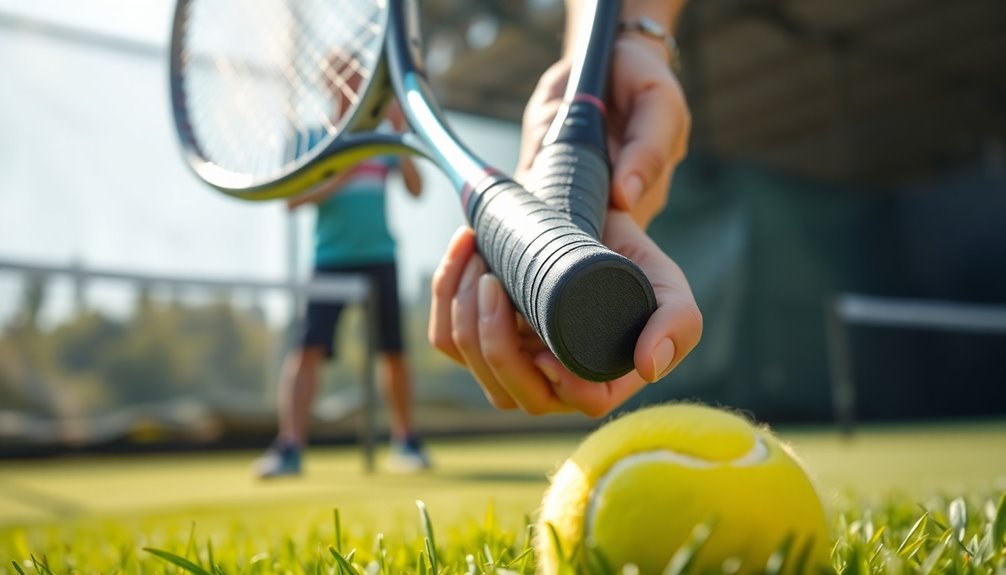
To master your forehand, you need to grasp the basics of grip.
You’ll explore different types of forehand grips, how to apply the right pressure, and the essential hand positioning.
Getting these elements right sets the foundation for a powerful and accurate shot. Additionally, understanding soccer field dimensions can help players appreciate the spatial awareness needed for effective gameplay.
Types Of Forehand Grips
When you step onto the court, understanding the different types of forehand grips can greatly enhance your game.
The Eastern grip allows for a balanced mix of power and control, making it popular among beginners.
The Western grip, on the other hand, promotes heavy topspin, perfect for aggressive play.
If you’re looking for versatility, the Semi-Western grip balances both styles, adapting well to various shots.
The Continental grip is essential for volleys and serves but may require grip changes for the forehand.
As you practice, pay attention to your grip adjustments, considering how grip preferences influence your style.
Experimenting with these grips helps you discover what works best for your game.
Grip Pressure Techniques
While mastering the forehand grip is essential, understanding grip pressure can greatly impact your shot effectiveness.
The balance between grip relaxation and grip tension is vital. You want your grip to be firm enough to control the racket but relaxed enough to allow fluid movement.
Too much grip tension can lead to stiffness, making it harder to generate power and spin. Conversely, too little tension might result in a lack of control during your swing.
As you practice, focus on finding that sweet spot—where your fingers gently hug the racket without constricting it.
Experiment with different levels of pressure until you discover what feels most comfortable and effective for your forehand shots.
It’s all about the right pressure for peak performance!
Hand Positioning Essentials
Finding the right grip pressure sets the stage for effective hand positioning. Proper hand placement guarantees grip stability, allowing for better wrist alignment and body rotation during your forehand swing.
Remember these key aspects:
- Grip Stability: A firm grip maintains control throughout your swing.
- Wrist Alignment: Keep your wrist neutral to enhance power and precision.
- Impact Zone: Position your hand for ideal timing at the ball’s contact.
- Follow Through Technique: Extend your arm fully to finish strong, promoting a smooth swing tempo.
Essential Stance for a Powerful Forehand
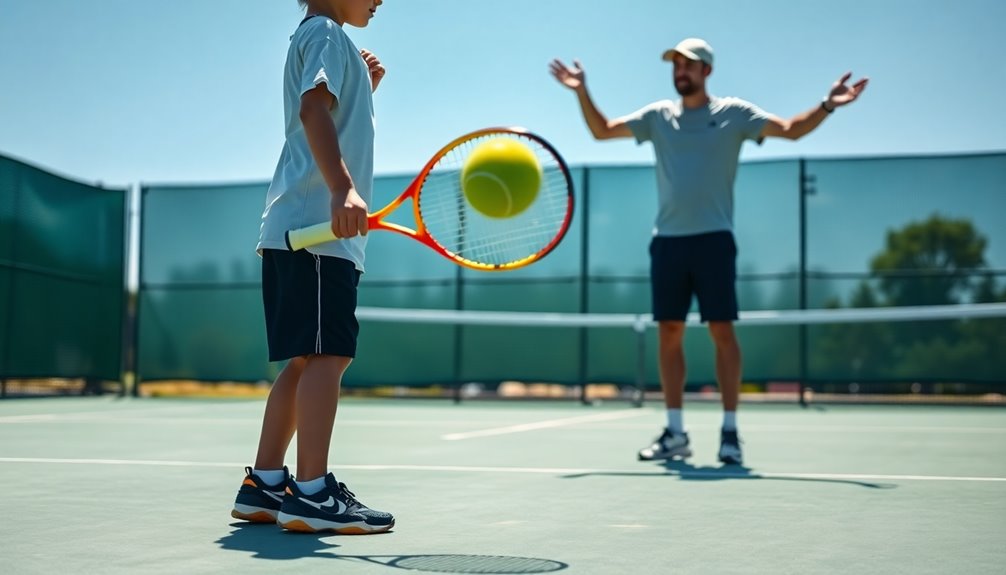
To hit a powerful forehand, your stance is vital. You need proper foot placement and a balanced upper body to generate maximum power and control. Additionally, understanding the impact of racial diversity in sports can enhance your appreciation for the game and its evolution. Let’s break down how grip and racket angle fit into this essential foundation.
Proper Foot Placement
- Position Your Feet: Stand shoulder-width apart, ready to pivot.
- Angle Your Toes: Point your non-dominant foot toward the net to open your hips.
- Bend Your Knees: Lower your center of gravity for better balance and power.
- Shift Your Weight: As you swing, transfer your weight from your back foot to your front foot for maximum force.
Balanced Upper Body
After establishing proper foot placement, it’s time to focus on your upper body. Good upper body alignment is essential for generating power in your forehand. Stand tall, keeping your shoulders relaxed and your chest open. Your arms should be positioned comfortably, allowing for a smooth swing.
Engage your core for stability; a strong core supports your entire movement.
As you prepare to hit the ball, rotate your torso slightly, ensuring your upper body stays aligned with your lower half. This balance helps transfer energy from your legs through your core and into your stroke.
Grip and Racket Angle
A solid grip and proper racket angle are key to executing a powerful forehand. Understanding these elements can elevate your game and boost your confidence. Here are some essential tips to keep in mind:
- Choose the Right Grip: Experiment with grip customization to find what feels comfortable and natural for you.
- Angle Matters: Position your racket at a slight angle to generate topspin and control.
- Stay Relaxed: Tension in your grip can hinder your swing; keep it loose for fluidity.
- Regular Racket Maintenance: Check your strings and grip regularly to guarantee peak performance.
With the right grip and angle, you’ll release your forehand’s full potential, making every match more exciting and rewarding.
How to Execute a Forehand: Step-by-Step Guide
To master the forehand, you’ll want to focus on a few key steps that lay the foundation for a powerful shot.
Start by choosing the right grip variation; the Eastern grip is popular for beginners. Next, position your feet shoulder-width apart and rotate your body sideways to the net. As the ball approaches, step into the shot, transferring your weight from your back foot to your front foot.
Now, focus on your forehand mechanics: keep your racket low and bring it back smoothly. As you swing forward, make contact with the ball at waist height, and follow through high, finishing over your shoulder.
This technique not only enhances your power but also guarantees better control during your game. Additionally, consider how effective communication during halftime can influence your mental focus and readiness before the next rally.
Solo Drills to Master Your Forehand Technique
To really sharpen your forehand technique, solo drills are a game changer.
You can practice shadow swings to perfect your form, hit against a wall for repetitions, and set up target accuracy drills to improve your precision. These exercises will help you build confidence and consistency in your forehand. Additionally, incorporating high-intensity sprints can enhance your overall athletic performance, making your movements on the court more explosive.
Shadow Swing Practice
Mastering your forehand technique starts with shadow swings, where you can focus on form without the pressure of a ball. This practice helps you internalize the mechanics and rhythm of your shot, enhancing your overall game.
Here are some shadow swing benefits to contemplate:
- Improved Technique: Hone your form and eliminate bad habits.
- Enhanced Timing: Develop muscle memory for better shadow swing timing.
- Increased Confidence: Build self-assurance in your swing without distractions.
- Personalized Focus: Concentrate on specific aspects of your swing to make adjustments.
Incorporating these shadow swings into your routine will set a solid foundation for your forehand, ensuring you’re ready when you step onto the court.
Wall Ball Repetitions
After you’ve solidified your shadow swing technique, it’s time to take your practice up a notch with wall ball repetitions. Using wall ball techniques, you’ll focus on consistency and form.
Start by standing a few feet from the wall and hit the ball with your forehand, aiming for a specific spot. This drill emphasizes your follow-through and helps build muscle memory.
The repetition benefits are significant; as you keep hitting the ball, you’ll develop better timing and control. Start with a set number of hits, gradually increasing as you gain confidence.
Don’t forget to mix up your angles and speeds to challenge yourself. Wall ball repetitions are a fantastic way to refine your forehand, making your strokes more reliable in matches.
Target Accuracy Drills
While honing your forehand technique, target accuracy drills can considerably enhance your precision and control. By focusing on specific target zones, you’ll boost your confidence and improve your game.
Here are four impactful drills to try:
- Target Zones: Set up cones or markers on the court. Aim for them with each forehand stroke to develop precision.
- Accuracy Benchmarks: Track how many times you hit your target zones in a row, gradually increasing your goal.
- Shadow Swings: Practice your form without hitting a ball, focusing on your swing’s accuracy towards your target.
- Mini-Games: Create challenges with friends or solo, where you hit targets for points, making practice fun and competitive.
With consistent practice, you’ll see remarkable improvements!
Partner Drills to Enhance Your Forehand Skills
To improve your forehand skills, partnering up for drills can make the learning process both fun and effective.
Start with consistency exercises where you and your partner rally, focusing on shot placement. Use target variations to challenge each other, aiming for specific areas on the court.
Incorporate competitive drills, like timed rally challenges, to boost your intensity and focus. Timing synchronization is essential; make sure you both hit the ball at the right moments.
Movement drills can also enhance your forehand by encouraging you to adjust your position quickly.
Finally, don’t underestimate the value of partner feedback—constructive critiques can help you refine your technique and boost your confidence on the court. Additionally, consider incorporating finishing drills to simulate real-game scenarios, enhancing your overall performance on the court.
Incorporating Footwork Into Your Forehand Practice
Incorporating effective footwork into your forehand practice is essential for developing a powerful and consistent shot.
By focusing on your footwork, you enhance your ability to position yourself correctly and strike the ball effectively.
Focusing on your footwork enhances your positioning and enables you to strike the ball with greater effectiveness.
Here are some key elements to include:
- Footwork Drills: Practice drills that emphasize lateral quickness and dynamic movement.
- Split Step: Master the timing of your split step to get into position faster.
- Balance Training: Work on maintaining balance while executing your forehand.
- Agility Exercises: Incorporate agility exercises to improve your overall coordination.
Additionally, practicing footwork will not only improve your shot accuracy but also enhance your teamwork and communication during match situations.
Tips for Developing Consistent Spin on Your Forehand
Developing consistent spin on your forehand not only enhances your shot’s effectiveness but also increases your control during matches. To achieve this, focus on mastering various spin techniques.
Start by using an open racket face to create topspin; this helps the ball dip quickly after crossing the net. For slice, angle your racket down and brush the ball’s side, allowing it to skid low.
Pay attention to ball placement, aiming for corners or deep shots to keep your opponent guessing. Regular practice will help you refine these techniques, ensuring your forehand becomes a reliable weapon. Additionally, understanding player positioning can help you anticipate your opponent’s moves and improve your overall gameplay.
Common Mistakes to Avoid With Your Forehand
While mastering spin techniques can elevate your forehand, it’s easy to fall into common pitfalls that hinder your progress.
Recognizing these forehand errors is essential for improvement. Here are four mistakes to avoid:
- Neglecting Technique Adjustments: Consistently fine-tuning your form can prevent bad habits.
- Lacking Mental Focus: Stay present during practice; distractions can lead to poor shots.
- Ignoring Practice Consistency: Regular practice is key to building muscle memory and confidence.
- Poor Equipment Choice: Using the wrong racket or strings can hinder your performance and increase injury risk. Additionally, practicing solo or with teammates can help reinforce your skills and build confidence.
How to Track the Ball for Better Forehand Accuracy?
How can you enhance your forehand accuracy? Start by improving your ball tracking skills. Focus on the ball as it approaches, using your eyes to gauge its speed and trajectory. This requires sharp eye coordination, so practice following the ball from your opponent’s racket to your side of the court.
Try drills that involve hitting balls fed from different angles and speeds. As you become more comfortable tracking the ball, you’ll develop the ability to anticipate where it will land. Incorporate this awareness into your stance and swing, ensuring your body is positioned correctly when you make contact. Remember, the better your ball tracking, the more accurate your forehand will be. Consistent practice will lead to noticeable improvements. Additionally, using the right size basketball, such as Size 4 basketball, can enhance your overall hand-eye coordination during training sessions.
Building Power: Strength Training for Your Forehand
Building power in your forehand is essential for hitting more aggressive shots. To enhance your strength and improve your overall game, focus on these key components:
Building power in your forehand is crucial for aggressive shots; focus on strength, core stability, flexibility, and recovery to elevate your game.
- Strength Exercises: Incorporate resistance training to build muscle conditioning, targeting your arms and legs.
- Core Stability: Engage in exercises that strengthen your core, ensuring you have a solid base for explosive movements.
- Flexibility Routines: Don’t neglect stretching; flexibility routines improve your range of motion and help prevent injuries.
- Recovery Techniques: Implement recovery techniques like foam rolling and hydration to keep your muscles primed for action.
Progressing to Live Ball Drills for Game Situations
As you become more comfortable with your forehand, shifting to live ball drills is essential for simulating real-game situations. These drills help you apply your skills under pressure, making the shift from practice to match play smoother.
Start by partnering with a friend or coach to rally using your forehand consistently. Focus on hitting targets and adjusting your footwork in response to their shots.
As you gain confidence, increase the intensity by incorporating game scenarios like point play or set situations. This allows you to experience the dynamics of scoring while refining your decision-making.
Remember to stay aware of your positioning and shot selection. By practicing these live ball drills, you’ll be better prepared for the challenges of actual matches.
Conclusion
Mastering your forehand can greatly elevate your game—did you know that a powerful forehand accounts for over 50% of winning points in matches? By honing your grip, stance, and technique through focused drills, you’ll not only boost your confidence but also improve your performance on the court. Keep practicing those solo drills and remember to avoid common mistakes. With dedication, your forehand will become a formidable weapon, making you a more competitive player in no time!