

15 Essential Youth Soccer Drills That Will Transform Your Child’s Game
February 11, 2026Looking for ways to transform your child’s soccer skills? Essential drills like dribble relays enhance speed and agility, while cone dribbling improves ball control. Passing pairs strengthen communication, and shadow play helps with positioning. Agility ladder drills boost foot speed, and fitness games make conditioning fun. Don’t forget the importance of cool-down stretches for recovery too. Keep exploring, and you’ll discover even more impactful drills that can take your child’s game to the next level.
The Importance of Drills in Youth Soccer

When you think about youth soccer, drills are essential for developing players’ skills and teamwork. They provide structured practice that’s vital for skill development.
By participating in various drills, your child can enhance their ball control, passing accuracy, and tactical awareness. This structured approach not only builds their skills but also boosts their player confidence. As they master each drill, they’ll feel more capable on the field, translating practice into game performance.
Plus, drills encourage teamwork, helping young athletes learn to communicate and collaborate with their teammates effectively. Furthermore, engaging in dynamic warm-up exercises enhances flexibility and prepares muscles for practice, which is crucial for preventing injuries.
How to Set Up a Soccer Training Session
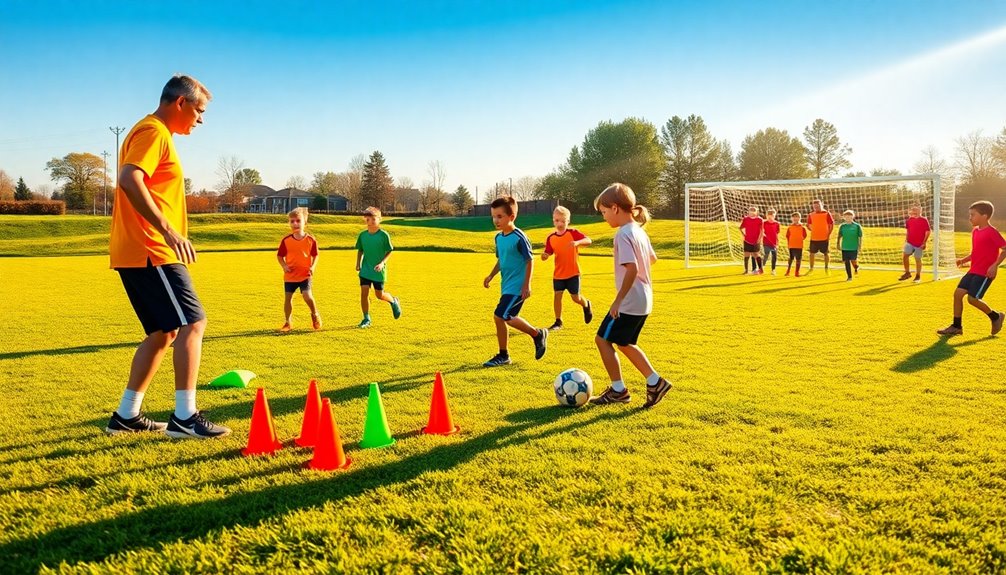
When setting up a soccer training session, you need to establish clear goals and objectives to guide your practice. Make sure you gather all necessary equipment and create an effective setup that promotes skill development. With these elements in place, you’ll create a focused environment for your players to improve. Additionally, incorporating dynamic stretches into your warm-up routine enhances flexibility and reduces injury risks.
Goals And Objectives
Setting clear goals and objectives is essential for an effective soccer training session, as it helps you focus on specific skills and guarantees that players understand what they’re working towards.
Start with goal setting by identifying the skills you want to enhance, such as dribbling, passing, or shooting. Make sure these goals are measurable and achievable within the session.
During training, use performance assessment to evaluate players’ progress toward these goals. Encourage feedback to help them understand areas for improvement.
Finally, adjust your drills based on their performance to keep them engaged and challenged.
Equipment And Setup
To effectively achieve the goals and objectives you’ve set for your training session, having the right equipment and setup is key.
Start by gathering essential soccer equipment like cones, practice balls, goals, and pinnies. Organize your training setup by designating specific areas for drills, ensuring enough space for each activity. For example, use cones to mark boundaries and stations for agility or passing drills.
Arrive early to set everything up, allowing you to adjust based on the number of players and their skill levels. A well-structured environment not only enhances focus but also keeps your young athletes engaged.
Dribble Relay: Enhancing Speed and Agility

As players weave through cones in a dribble relay, they not only enhance their speed and agility but also develop essential ball control skills.
To effectively implement this drill, focus on these key relay strategies:
Focus on key relay strategies to effectively implement this drill and enhance players’ skills.
- Set up cones in a straight line or zigzag pattern, spaced evenly.
- Encourage players to utilize various dribble techniques, like quick touches and changes in pace.
- Time each player as they navigate the course, fostering a competitive spirit.
- Rotate teams after each round to allow everyone to participate and improve.
This engaging drill not only boosts physical attributes but also instills teamwork and communication, making it a valuable addition to your training sessions. Additionally, incorporating small-sided games can further enhance decision-making and ball touches during practice.
Cone Dribbling: Mastering Ball Control
Cone dribbling drills are essential for mastering ball control in soccer. By setting up cone variations in different patterns, you can challenge yourself and improve your dribbling skills.
Start with a straight line of cones, practicing tight touches as you weave in and out. As you gain confidence, switch to zigzag formations or circles to enhance your agility and speed.
Focus on keeping the ball close to your feet while maintaining control. Remember, ball mastery is about precision and touch, so take your time to develop these skills. Incorporating quick touch and pass exercises into your routine can further improve your decision-making speed on the field.
Consistent practice won’t only boost your dribbling ability but also prepare you for game situations. Master these drills, and you’ll notice a significant improvement in your overall performance on the field.
Passing Pairs: Strengthening Communication and Precision
When you work in passing pairs, you’ll quickly realize how vital communication is on the field. Practicing precision passing not only sharpens your skills but also enhances teamwork dynamics. Let’s explore some effective drills that can help you build these important abilities. Incorporating pressure and cover principles during your practice can significantly improve your players’ defensive awareness and overall passing effectiveness.
Importance Of Communication Skills
Effective communication is essential on the soccer field, especially during practice drills like Passing Pairs. By enhancing your child’s communication skills, they’ll improve their game considerably.
Here’s how you can help them focus on key aspects:
- Verbal Cues: Encourage your child to call for the ball and provide clear instructions to teammates.
- Nonverbal Signals: Teach them to use hand signals and body positioning to indicate their intentions.
- Eye Contact: Emphasize the importance of looking at teammates before making a pass, fostering better understanding.
- Active Listening: Remind them to pay attention to others’ calls and feedback, which builds teamwork.
Strengthening these skills will enhance both their confidence and their ability to play effectively as a unit.
Drills For Precision Passing
To improve precision in passing, engaging in drills like Passing Pairs is crucial for young players. In this drill, you’ll pair up with a teammate and focus on short, controlled passes.
Start about five yards apart, gradually increasing the distance as your passing accuracy improves. Encourage each other to communicate effectively, calling for the ball and providing feedback on each pass. This not only hones your technical skills but also enhances your tactical awareness on the field.
As you practice, pay attention to your body positioning and weight of the pass, ensuring it reaches your partner accurately. With consistent practice, you’ll see significant growth in your passing precision, which is essential for successful gameplay.
Enhancing Teamwork Dynamics
Building on the foundation of precision passing, enhancing teamwork dynamics is key to elevating your overall performance on the field.
When you work on passing pairs, you strengthen communication and develop team synergy. Here are four cooperative strategies to implement during practice:
- Two-Touch Passing: Limit touches to enhance quick decision-making.
- Call and Response: Encourage players to call out names before receiving the ball, fostering communication.
- Movement Off the Ball: Create space by moving strategically after passing.
- Circle Passing Drill: Form a circle where players pass to each other, emphasizing precision and teamwork.
Shooting Accuracy: The Target Practice Drill
Target practice drills are essential for improving shooting accuracy in youth soccer.
To start, set up targets within the goal, focusing on different goal placements. You can use cones, small nets, or even painted areas to create these targets.
Encourage your child to practice various shooting techniques, such as instep drives and volleys, while aiming for these targets. As they develop their skills, increase the distance from the goal or challenge them to shoot with both feet.
Regularly incorporating these drills will build their confidence and precision. Remember, consistent practice not only enhances shooting accuracy but also helps your child understand the importance of goal placement when aiming for success during games. Additionally, improving their passing skills will further contribute to their overall performance on the field.
One-on-One Defense: Building Defensive Skills
While mastering defensive skills is essential for any young soccer player, one-on-one defense stands out as a key component of effective gameplay.
To enhance your child’s one-on-one defensive abilities, focus on these vital aspects:
- Defensive Positioning: Teach them to stay low, balanced, and ready to react.
- Tackling Techniques: Practice both standing and sliding tackles to regain possession safely.
- Anticipation: Encourage them to read the opponent’s body language to predict moves.
- Communication: Stress the importance of talking to teammates for support and strategy.
Incorporating shadowing techniques can greatly improve their ability to stay close to the attacker without committing a foul.
Small-Sided Games: Promoting Teamwork and Strategy
Small-sided games are a fantastic way to boost your players’ communication skills on the field. As they work in tighter spaces, they’ll learn to express ideas and strategies more effectively. Plus, these games encourage creative problem solving, allowing players to adapt and innovate during play. Additionally, incorporating rondos in training can further enhance their ball control and decision-making under pressure.
Enhancing Communication Skills
Effective communication is essential for success in soccer, especially during small-sided games that emphasize teamwork and strategy.
To enhance your child’s communication skills, encourage them to focus on these key aspects:
- Active Listening: Teach your child to listen to teammates, understanding their needs and intentions.
- Verbal Cues: Encourage them to use clear, concise verbal signals to communicate plays and strategies.
- Non-Verbal Communication: Emphasize the importance of body language and eye contact to convey messages effectively.
- Encouragement: Foster a supportive environment where players motivate each other, reinforcing positive communication.
Encouraging Creative Problem Solving
Building on the importance of communication, small-sided games offer a fantastic platform for encouraging creative problem-solving among players.
In these games, your child will face unique challenges that require quick thinking and adaptability. With fewer players on the field, they’ll need to explore different strategies and discover innovative ways to navigate tight spaces. This environment fosters creative expression as they experiment with new techniques and approaches.
Encourage your child to collaborate with teammates, discussing potential problem-solving strategies that can lead to success. By emphasizing teamwork, they’ll learn to value collective input and develop a deeper understanding of the game.
Ultimately, these experiences won’t only enhance their soccer skills but also cultivate essential life skills that extend beyond the field.
Juggling Skills: Developing Touch and Coordination
Many young players find juggling to be a fun and engaging way to improve their touch and coordination with the soccer ball.
Juggling techniques are essential touch exercises that can help your child enhance their ball control. Here are four key practices to get started:
- Foot Juggling: Start with simple kicks using both feet to keep the ball in the air.
- Thigh Juggling: Alternate between foot and thigh to develop balance and coordination.
- Head Juggling: Use the forehead to keep the ball up, improving spatial awareness.
- One-Handed Juggling: Use one hand to catch the ball, promoting hand-eye coordination.
Encourage your child to practice regularly, and you’ll see their skills improve dramatically! Additionally, focusing on consistent practice will foster trust among teammates and improve overall performance on the field.
Cross and Finish: Perfecting Attacking Moves
In this section, you’ll focus on mastering the art of crossing and finishing.
By honing these key techniques, you’ll create more scoring opportunities in games. Additionally, integrating finishing drills into your practice routine will significantly enhance your child’s shooting skills and confidence in front of the goal.
Let’s explore some effective drills that will elevate your attacking skills.
Key Techniques for Crossing
Perfecting your crossing technique can elevate your game and create scoring opportunities for your team. To master effective footwork and improve your crossing, focus on these key techniques:
- Positioning: Get into the right spot to deliver an accurate cross. Anticipate where your teammates will be.
- Approach: Angle your run towards the ball for better balance and control.
- Body Alignment: Keep your body square to the field to deliver precise crosses.
- Follow Through: Use a strong follow-through to maintain power and accuracy in your crosses.
Finishing Skills Development Drill
Building on your crossing techniques, mastering finishing skills is essential for converting those opportunities into goals.
To practice, set up a drill where one player crosses the ball while another makes a timed run into the box. Focus on different finishing techniques, such as volleys, half-volleys, and side-foot shots. As you approach the ball, keep your eyes on the target to improve shot accuracy.
Encourage players to strike with confidence and precision, varying their shots based on the cross height and angle. After each attempt, provide immediate feedback on technique and positioning.
This drill not only sharpens finishing skills but also reinforces the importance of teamwork in creating scoring opportunities. Keep practicing, and soon, those goals will start piling up!
Goalkeeper Training: Key Skills for Keepers
While many players focus on scoring goals, goalkeepers play an essential role in a team’s success and must develop specific skills to excel.
Here are four key areas to work on:
- Shot Stopping: Practice saves from different angles to improve your reaction time and shot-stopping ability.
- Footwork Agility: Enhance your movement with drills that focus on quick footwork and positioning for peak saves.
- Distribution Techniques: Work on accurate throws and kicks to initiate counter-attacks, making sure to communicate effectively with teammates.
- Mental Resilience: Cultivate a strong mindset to handle pressure and bounce back after conceding goals.
Incorporating these skills will elevate your game and make you a formidable presence in goal!
Shadow Play: Understanding Positioning and Movement
Understanding the dynamics of positioning and movement is essential for any soccer player, as it can greatly impact your team’s performance on the field.
One effective method to enhance these skills is through shadow play. This drill lets you practice positioning techniques without the pressure of opponents, allowing you to focus purely on movement and spatial awareness. You’ll learn to anticipate plays and understand where you should be on the field, improving your decision-making.
Enhance your soccer skills with shadow play, focusing on movement, positioning, and decision-making without the pressure of opponents.
The shadow play benefits include increased confidence and better communication with teammates, as you’ll develop a clearer understanding of your roles.
Incorporate this drill regularly, and you’ll notice significant improvements in your game, leading to more effective teamwork and strategic play.
Agility Ladder: Boosting Foot Speed
The agility ladder is a powerful tool for enhancing your foot speed and overall agility on the soccer field. Incorporating ladder drills into your training routine can greatly improve your athletic performance.
Here are four effective drills you can try:
- Two-Foot In and Out: Jump both feet in and out of each ladder square quickly.
- Lateral Shuffles: Move sideways through the ladder, placing both feet in each square.
- Single-Leg Hops: Hop on one leg through the ladder, alternating legs every few rounds.
- Icky Shuffle: Step into the first square with one foot, then bring the other foot in, and step out to the side.
These drills won’t only boost your foot speed but also enhance your coordination, making you a more agile player.
Fitness Games: Making Conditioning Fun
When you’re looking to make conditioning more enjoyable, fitness games can transform mundane workouts into exciting challenges. Incorporating fun fitness into your training not only boosts motivation but also enhances teamwork and camaraderie among young players.
Try engaging drills like “Sharks and Minnows,” where kids practice dribbling while avoiding being tagged, or “Capture the Flag,” which promotes speed and strategy. You can also set up relay races that incorporate fitness elements like sprinting, hopping, or weaving through cones.
These activities keep players active and entertained, ensuring they enjoy their time on the field. By mixing in these fitness games, you’ll help your child develop essential skills while fostering a love for the game.
Cool Down: The Importance of Recovery After Drills
Cooling down after drills is essential for every young athlete. It helps prevent injuries and promotes muscle recovery.
Here are some effective recovery techniques you can incorporate:
- Gentle Jogging: Start with a light jog for 5 minutes to gradually lower your heart rate.
- Cool Down Stretches: Focus on major muscle groups, holding each stretch for 15-30 seconds.
- Hydration: Drink water or a sports drink to replenish lost fluids.
- Breathing Exercises: Practice deep breathing to relax and lower stress levels.
Conclusion
Incorporating these 15 essential youth soccer drills into your child’s training can truly transform their game. You’ll not only see improvements in their skills but also in their confidence and teamwork. Research shows that consistent practice enhances muscle memory, making these drills crucial for young athletes. So, embrace these techniques and watch your child flourish on the field. Remember, the right mix of fun and challenge will keep them engaged and enthusiastic to play!