
Tennis Positioning Basics
May 8, 2026Tennis positioning is key to improving your game. It sharpens your court awareness, enhances your shot selection, and boosts your reaction time. Understanding different court zones helps you craft effective strategies for serves, groundstrokes, and net play. Avoid common mistakes, like overcommitting to one side, and tweak your positioning based on your opponent’s style and the court surface. Master these tactics, and you’ll elevate your performance. There’s much more to explore on this essential skill.
Why Court Positioning Matters in Tennis
Court positioning plays a crucial role in your success on the tennis court, as it allows you to respond effectively to your opponent’s shots. By enhancing your court awareness, you can make smarter shot selections that align with your game strategy.
Staying mentally focused helps you analyze your opponent’s tendencies, enabling you to anticipate their moves. This awareness leads to better decision making during critical moments.
Staying mentally focused allows you to read your opponent’s game, leading to smarter decisions when it matters most.
You’ll need to make tactical adjustments based on your opponent’s play, which strengthens your competitive mindset. Positioning yourself correctly not only gives you an edge but also allows you to control the pace of the game. Mastering these elements guarantees you’re ready to capitalize on every opportunity that arises. Additionally, understanding team dynamics can enhance your overall effectiveness on the court.
Understanding the Different Court Zones
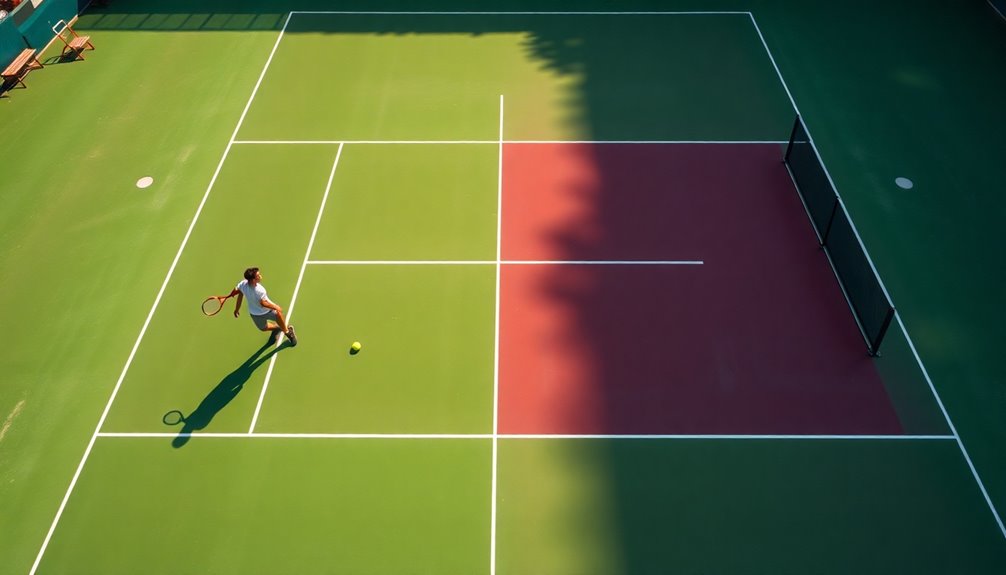
To excel in tennis, you need to understand the distinct court zones and how they affect your game.
The dynamics between the forecourt and backcourt can change your strategy, while the service box plays an essential role in point development. Mastering net play can also give you a significant edge during matches. Additionally, knowing how to exploit court zones can enhance your overall performance on the court.
Forecourt Versus Backcourt Dynamics
While mastering tennis, understanding the dynamics between the forecourt and backcourt is essential for improving your game.
Effectively utilizing both zones can enhance your performance and strategy.
- Forecourt Tactics: Focus on quick reflexes and shot selection to capitalize on your opponent’s weaknesses.
- Backcourt Strategies: Use spacing techniques to maintain court awareness and control rallies from the baseline.
- Positioning Drills: Practice movement efficiency to shift smoothly between zones.
- Zone Awareness: Recognize your placement accuracy in the forecourt or backcourt to optimize player dynamics.
Service Box Significance
Understanding the significance of the service box is essential for any tennis player looking to elevate their game. The service box isn’t just a designated area; it plays a vital role in your overall service box strategy. Proper serve placement can set the tone for the entire point.
By targeting specific zones within the service box, you can disrupt your opponent’s rhythm and create openings for your next shot. For instance, serving wide can pull your opponent off the court, while a body serve may catch them off guard.
Net Play Strategies
After mastering your service box strategy, it’s time to focus on net play, where your positioning can greatly impact the outcome of points.
Developing solid net awareness is vital for effective volley tactics. Here are four essential strategies to enhance your net play:
- Approach with Purpose: Move forward aggressively after hitting a strong shot, positioning yourself for the volley.
- Stay Low: Bend your knees and keep your racket up to react quickly to your opponent’s shots.
- Anticipate Your Opponent: Read your opponent’s body language to predict their shot placement.
- Use Angles: Aim for sharp angles during volleys to make it harder for your opponent to return.
How to Position Yourself for Serves

Position yourself strategically for serves to maximize your effectiveness on the court. Begin with a solid stance, feet shoulder-width apart, and knees slightly bent.
Focus on your serve placement; aim for areas that exploit your opponent’s weaknesses. Before serving, conduct an opponent analysis—note their positioning and tendencies. If they struggle with wide shots, serve to the corners. Conversely, if they prefer a certain return, mix it up to keep them guessing.
Aim your serves to exploit your opponent’s weaknesses; analyze their positioning and tendencies for a strategic advantage.
Remember to balance power and precision; a well-placed serve can lead to easy points. Additionally, consider field dimensions and equipment requirements as they influence your overall court strategy.
Finally, practice your toss consistently, as it’s vital for developing a reliable serve. With these strategies, you’ll enhance your serving game and put pressure on your opponent right from the start.
Ideal Positioning for Groundstrokes
When you’re setting up for groundstrokes, your stance and footwork are essential for balance and power. Make certain you’re at the ideal distance from the ball to guarantee a clean hit, and pay attention to your swing path alignment for accuracy. These elements can greatly enhance your performance on the court. Additionally, focusing on passing accuracy can improve your overall timing and execution during rallies.
Stance and Footwork
Mastering your stance and footwork is essential for executing effective groundstrokes in tennis. Proper positioning enhances your baseline strategies and helps you adapt during pressure situations.
Here are four key elements to focus on:
- Stance Variations: Choose between an open, closed, or neutral stance based on shot selection.
- Lateral Movement: Develop your agility training to move quickly and efficiently along the baseline.
- Balance Techniques: Use proper balance to maintain control during momentum shifts.
- Footwork Drills: Incorporate recovery steps and drills to improve your overall footwork.
Optimal Distance From Ball
To hit effective groundstrokes, knowing the ideal distance from the ball is essential. Position yourself so you can comfortably reach the ball without overextending. This perfect distance allows you to adjust to the ball trajectory, ensuring you’re ready to strike at the right moment.
When you’re too far away, you compromise your timing, making it difficult to generate power and control. Aim to be close enough that you can step into your shot, but not so close that you’re cramped.
As you practice, pay attention to how your distance affects your swing and timing. Finding that sweet spot will enhance your groundstrokes and improve your overall game.
Keep refining this skill to gain a competitive edge on the court.
Swing Path Alignment
Aligning your swing path is essential for hitting effective groundstrokes. Proper swing mechanics guarantee you generate power and accuracy, while also aiding your shot selection.
Here are four key points to focus on:
- Grip: Choose a grip that complements your swing style, affecting the ball’s spin and trajectory.
- Stance: Position yourself with a balanced stance to maintain control and stability during your swing.
- Backswing: Initiate your backswing smoothly to set up for a fluid forward motion.
- Follow-through: Complete your swing with a full follow-through, allowing for better shot placement and consistency.
Mastering the Art of Net Play Positioning
While you may excel at baseline rallies, net play requires a distinct approach to positioning that can elevate your game. Developing strong net awareness is essential; you need to constantly gauge your opponent’s movements and anticipate their shots.
Focus on staying light on your feet and being ready to react quickly. Incorporate positioning drills into your practice routine, such as practicing volleys and overheads with a partner. These drills help you understand ideal positioning for different scenarios.
Remember to keep your racket up and your body angled toward the court, ready to intercept the ball. By mastering net play positioning, you’ll not only improve your volleys but also put pressure on your opponent, making it harder for them to respond effectively. Additionally, integrating on-ball off-ball movements into your training can help enhance your overall court awareness and agility.
Positioning Strategies for Defensive Play
Effective defensive play hinges on three key positioning strategies that can turn the tide in your favor. Mastering these will enhance your defensive tactics and elevate your game.
- Court Awareness: Always know your position relative to your opponent and the ball. This will improve your shot selection and help you anticipate their next move.
- Opponent Analysis: Identify your opponent’s strengths and weaknesses. Adjusting your position based on their tendencies can give you a strategic advantage.
- Recovery Movement: After each shot, focus on returning to a balanced stance. This will aid in rally endurance and maintain your mental resilience.
- Positioning Drills: Regular practice of specific drills can sharpen your ability to react and reposition effectively during points. Incorporating agility and coordination workouts into your practice routine can significantly improve your defensive responsiveness.
Implement these strategies to enhance your defensive play on the court!
When to Adjust Your Positioning During a Rally?
During a rally, you need to constantly anticipate your opponent’s shots to stay one step ahead. Reacting quickly to ball placement can make all the difference in maintaining control of the point. Incorporating quick decision-making during practice can significantly enhance your positioning skills on the court.
Anticipating Opponent’s Shots
As you engage in a rally, anticipating your opponent’s shots becomes essential for maintaining an advantageous position on the court. Effective shot prediction relies on your ability to read cues and understand your opponent’s tendencies.
Here are four key strategies to enhance your anticipation:
- Visual Focus: Keep your eyes on your opponent’s racket and body language to gauge their next move.
- Ball Trajectory: Analyze the ball’s path to determine where it’s likely to land.
- Timing Awareness: Develop a sense of timing to adjust your positioning effectively before the ball arrives.
- Mental Preparation: Stay mentally engaged to anticipate various scenarios and react accordingly.
Reacting To Ball Placement
Reading your opponent’s cues helps you anticipate shots, but responding to ball placement is where your positioning really counts. Pay attention to the ball trajectory and adjust your position based on shot selection.
Quick reaction time is vital; you need to recognize visual cues that signal where the ball will go. Enhance your court awareness through consistent opponent analysis, noting their movement patterns and shot placement tendencies.
Incorporating positioning drills into your practice can improve your angle adjustments during rallies. The better you can read the game, the more effectively you’ll move to intercept shots.
Always stay light on your feet, ready to adapt as the rally unfolds, ensuring you’re in the best position to respond effectively.
Anticipating Opponent Moves Through Positioning
To effectively anticipate your opponent’s moves, you need to be in the right position on the court. This involves understanding various aspects of the game and adjusting accordingly.
Here are some key points to enhance your anticipation:
- Read Cues: Pay attention to your opponent’s body language and shot selection.
- Understand Tendencies: Recognize their preferred play styles and how they react in pressure situations.
- Maintain Mental Focus: Stay engaged with the game flow to anticipate rhythm changes and timing adjustments.
- Develop Spatial Awareness: Know where you’re on the court and predict where the ball is likely to go. Additionally, mastering defensive positioning techniques can significantly improve your ability to react effectively during matches.
The Role of Footwork in Effective Positioning
Footwork plays an essential role in effective positioning on the tennis court, allowing you to reach the ball more efficiently and set up for your next shot.
By incorporating agility drills and balance exercises, you can improve your lateral movement and foot placement. Practice quick steps and stance variations to enhance your reaction time and adapt to directional shifts.
Rhythm training helps you develop a fluid movement pattern, while core strength supports your balance and stability. Additionally, strong leg strength is crucial not only in hockey but also enhances your overall agility and speed on the court.
Rhythm training fosters fluid movement, while core strength enhances your balance and stability on the court.
As you refine your footwork, you’ll position yourself better to respond to your opponent’s shots, making it easier to maintain control of the game.
Ultimately, strong footwork lays the foundation for successful positioning and shot execution on the court.
How to Position Yourself for Winning Shots
Positioning yourself for winning shots is essential in tennis, and mastering this skill can greatly elevate your game.
To enhance your performance, focus on these key strategies:
- Shot Selection: Always choose the right shot based on the rally dynamics and match tempo.
- Player Awareness: Stay aware of your position and your opponent’s location to anticipate their moves.
- Mental Positioning: Develop a mindset that allows you to adapt your offensive strategies and defensive tactics under pressure situations.
- Spatial Awareness: Understand the court layout to effectively analyze your opponent and create opportunities. Additionally, consider how stoppage time in soccer reflects the importance of timing and awareness in your game.
Common Positioning Mistakes to Avoid
When you’re on the court, it’s easy to fall into common positioning traps that can cost you points.
Overcommitting to one side, ignoring your court position, and lacking anticipation can undermine your game.
Let’s explore these mistakes so you can sharpen your skills and play more effectively.
Overcommitting to One Side
While it’s tempting to favor your dominant side during play, overcommitting can lead to significant gaps in your defense.
To enhance your court awareness and maintain balance, consider these tips:
- Practice Positioning Drills: Focus on lateral movement and shot anticipation to improve your responsiveness.
- Vary Shot Selection: Don’t solely rely on cross court shots; mix in down-the-line shots to keep your opponent guessing.
- Master Recovery Steps: Develop quick recovery steps to return to a balanced position after each shot.
- Utilize Angle Creation: Learn to create angles that can pull your opponent wide, allowing for better court coverage.
Ignoring Court Positioning
Focusing too much on your dominant side can lead to neglecting overall court positioning, which is essential for effective play.
If you ignore your baseline positioning, you might find yourself out of balance, making it harder to execute strong shots. Proper court positioning allows you to respond better to your opponent’s shots and improves your shot selection.
Instead of always leaning toward your favorite side, stay centered and ready to move. This way, you can adapt to different situations and angles, ensuring you’re in the right spot to hit your best shots.
Poor Anticipation Skills
- Watch your opponent’s body language – Their stance and swing can give away their next move.
- Practice anticipation drills – Regularly engage in drills that simulate match situations to sharpen your instincts.
- Develop mental preparedness – Stay focused and visualize potential plays before they happen.
- Analyze past matches – Review your games to identify moments where better anticipation could’ve changed the outcome.
Adapting Your Positioning for Different Playing Styles
Understanding how to adapt your positioning based on your opponent’s playing style can greatly enhance your game.
If you’re up against an aggressive baseliner, use counterpuncher positioning to absorb their power and redirect it.
For a serve and volley player, anticipate their approach by adjusting your stance to cover the net effectively.
When facing an all court player, stay versatile with your movements, blending clay court positioning for longer rallies and grass court dynamics for quick responses.
During indoor play, focus on tight angles and quick footwork to keep pace.
In doubles, employ doubles positioning techniques to create space and opportunities.
The Impact of Court Surface on Positioning
Your positioning on the court isn’t just influenced by your opponent’s playing style; it’s also shaped by the surface beneath your feet. Different court surfaces have unique effects on your movement and strategy due to their varying surface speeds.
Here’s how to adapt your positioning based on the surface:
- Clay: Expect slower surface speed; position yourself deeper to anticipate longer rallies.
- Grass: With fast surface speed, stay closer to the net to capitalize on quick points.
- Hard Court: A balanced surface speed allows for versatile positioning; adjust based on your opponent’s strengths.
- Indoor vs. Outdoor: Indoor courts may have less wind, allowing for more aggressive positioning.
Understanding these court surface effects helps you refine your strategy and improve your on-court performance.
Practicing Positioning Techniques to Improve Your Game
Mastering your positioning on the court can greatly elevate your game. To improve, focus on positioning drills that enhance your strategic awareness and spatial awareness.
These exercises develop a tactical mindset, allowing you to anticipate your opponent’s moves. Incorporate reaction training to sharpen your response time and improve court awareness.
Work on movement efficiency to guarantee you get to the right spot quickly, enabling better shot selection. Practicing angle execution will enhance your ability to hit precise shots, while maintaining balance control will keep you steady during play.
Conclusion
In tennis, mastering your court positioning isn’t just for advanced players; it’s essential for everyone. You might think it’s too complex, but with practice, you’ll find it becomes second nature. By understanding the different court zones and adapting your positioning based on your opponent’s style, you’ll elevate your game. So, embrace these basics and watch your confidence soar as you play smarter, not harder. Positioning can truly transform your performance on the court!