
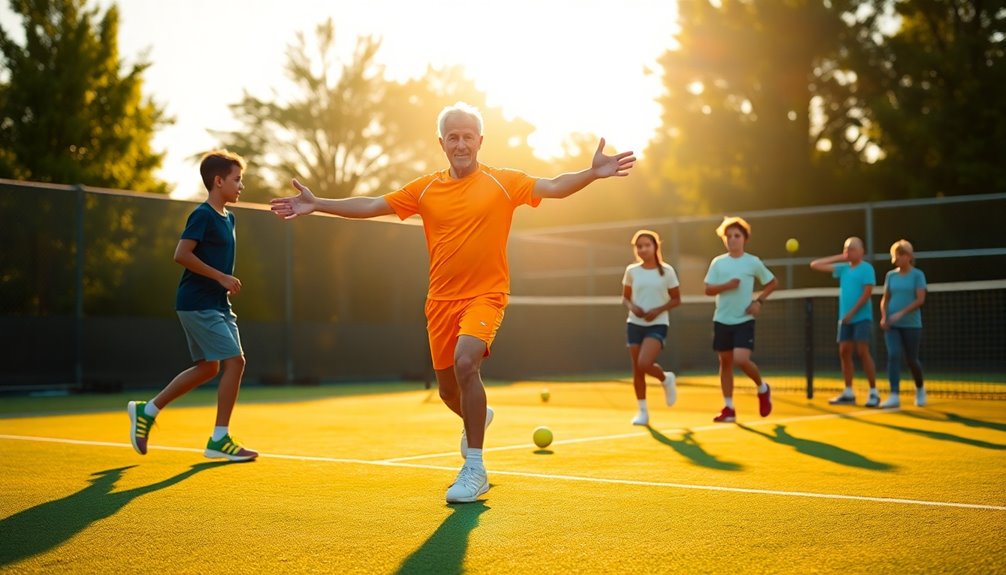
Movement Lesson Plan for Tennis Coaches
May 2, 2026To create an effective movement lesson plan for tennis, focus on agility, footwork, and player engagement. Start with dynamic warm-ups, followed by targeted footwork drills and balance training. Incorporate reaction time exercises to sharpen quick responses. Assess each player’s skill level and use feedback loops for continuous improvement. Rotate drills and introduce technology like video analysis to keep players motivated. This approach not only enhances performance but also makes learning enjoyable. There’s plenty more to explore to elevate your coaching!
Understanding the Importance of Movement in Tennis
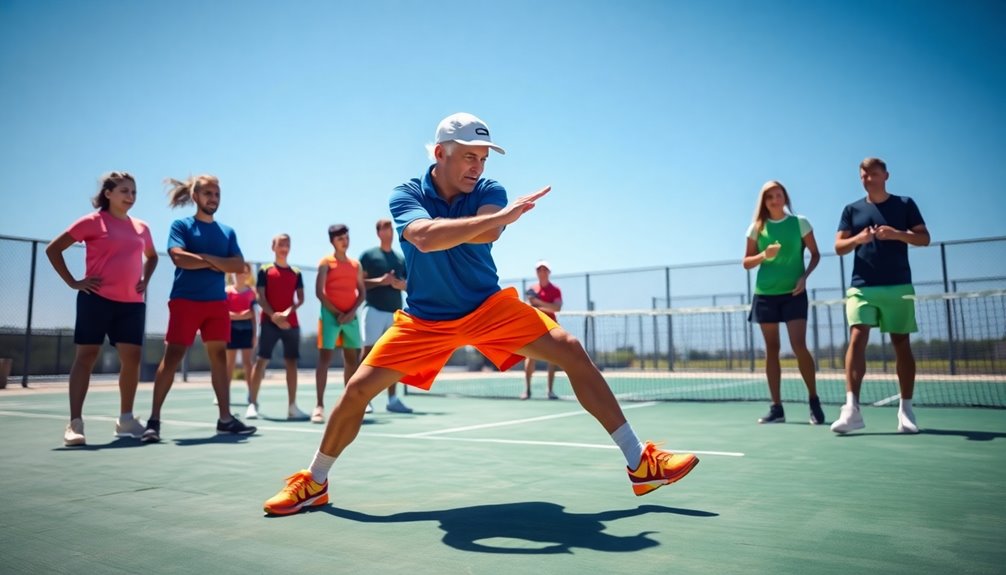
When you think about tennis, movement often takes a backseat to technique and strategy, but it’s essential for success on the court. Mastering the movement fundamentals can elevate your game considerably.
It’s not just about hitting the ball; it’s about how you position yourself to hit it effectively. Fine-tuning your footwork allows you to reach shots more efficiently, leading to better shot selection and execution.
As you work on technique refinement, don’t underestimate the power of agility and balance. A strong foundation in movement means you can respond to your opponent’s plays with confidence. Incorporating agility and coordination workouts can significantly enhance your overall performance on the court.
Key Components of a Successful Movement Lesson Plan
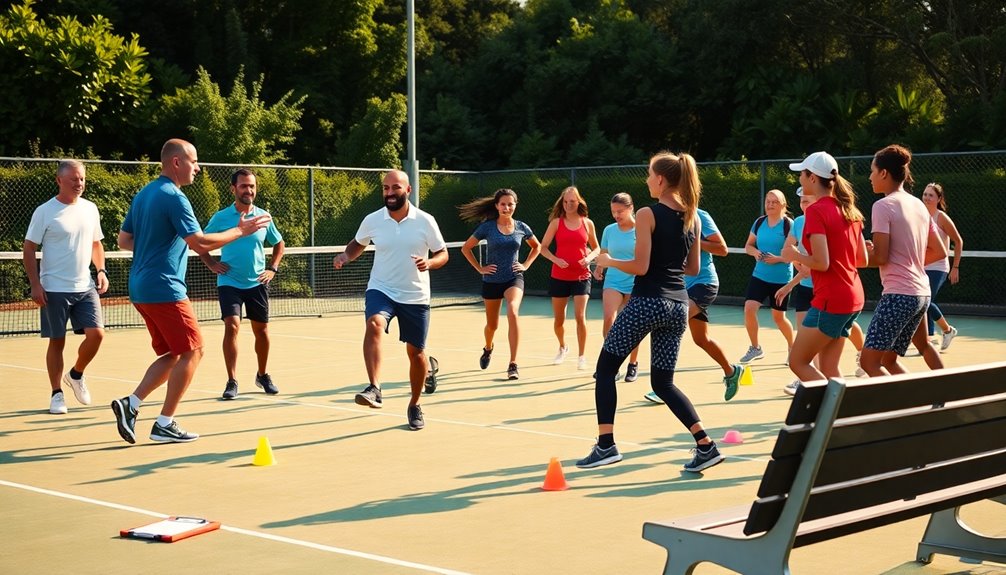
To create a successful movement lesson plan, you need to focus on several key components that enhance players’ agility, balance, and footwork. Incorporating these elements not only improves performance but also emphasizes injury prevention.
Focusing on agility, balance, and footwork is essential for enhancing performance and preventing injuries in movement lesson plans.
- Dynamic warm-ups: Start sessions with movements that activate muscles and increase heart rates.
- Footwork drills: Include exercises that develop quick and precise movements on the court.
- Balance training: Implement activities that challenge stability and core strength.
- Reaction time exercises: Use drills that require quick responses to stimuli.
- Cooldown routines: End with stretches to promote recovery and flexibility.
Incorporating elements from Pain Shuttles Drill can significantly enhance players’ cardiovascular endurance during your training sessions.
Assessing Player Skill Levels for Tailored Movement Training
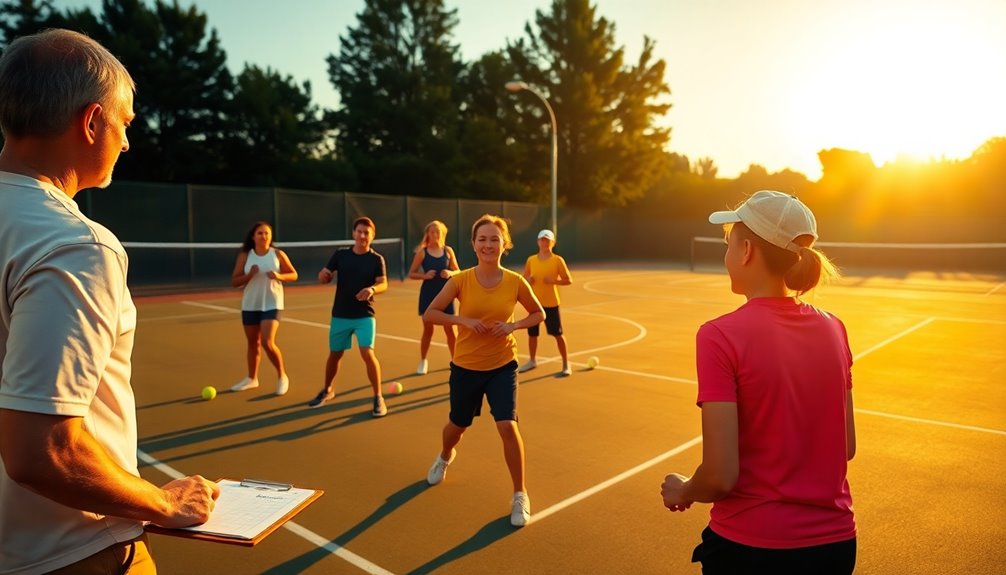
How can you effectively assess player skill levels to tailor movement training? Start with a thorough skill assessment that evaluates movement patterns and identifies strengths and weaknesses.
Use performance metrics to gauge their current abilities and align these with their training goals. Incorporate player feedback to understand their perspectives and experiences, which will enhance your individualized coaching approach.
Implement progress tracking to monitor improvements and adjust training strategies accordingly. This ongoing evaluation helps you refine adaptation strategies, ensuring players develop in a personalized manner. Additionally, consider incorporating finishing drills to enhance their shooting skills and overall confidence on the court.
Designing Drills to Enhance Footwork and Agility
To improve your players’ footwork and agility, you’ll want to focus on essential techniques that build a strong foundation. Incorporating a variety of agility drills can keep training engaging while targeting specific movement skills. Additionally, emphasizing effective communication during drills can enhance teamwork and overall performance. Let’s explore some effective drills that can elevate your players’ performance on the court.
Essential Footwork Techniques
Mastering essential footwork techniques is crucial for any tennis player aiming to improve their agility and on-court performance.
Focus on various drills that enhance your footwork patterns and overall coordination. Incorporate the following elements into your training:
- Lateral movement drills to boost side-to-side agility
- Sprint mechanics exercises for explosive starts
- Recovery steps to reposition quickly after shots
- Balance exercises to maintain stability during play
- Visualization techniques to mentally rehearse movements
These techniques won’t only enhance your reaction time but also improve your overall game.
By integrating coordination drills into your practice, you’ll develop the agility needed to outmaneuver your opponents effectively.
Keep pushing your limits, and you’ll see significant improvements on the court!
Agility Drill Variations
Enhancing agility on the court requires innovative and varied drills that challenge your footwork. Integrate an agility ladder into your routine to develop quick foot movement patterns.
Incorporate cone drills to improve your spatial awareness and direction changes. Lateral shuffles can boost your side-to-side agility, while plyometric exercises enhance explosiveness.
To sharpen your reaction time, use partner drills where one player calls out directions. Combine sprint intervals with these exercises for a thorough agility workout.
Each drill pushes your limits, helping you stay light on your feet during matches. By mixing these variations, you’ll not only improve your agility but also gain confidence in your movement on the court.
Keep it dynamic, and watch your game elevate!
Incorporating Spatial Awareness Into Movement Lessons
As you introduce movement lessons, integrating spatial awareness is essential for players to navigate the court effectively. Developing this skill enhances their spatial orientation and improves court positioning.
Focus on key elements like:
- Body awareness to understand movement patterns
- Visual tracking of the ball and opponents
- Proprioceptive feedback to enhance balance and control
- Environmental adaptation to adjust to different court conditions
- Kinetic awareness to optimize movement efficiency
Encourage players to practice drills emphasizing these aspects. Additionally, incorporating conditioning drills can significantly enhance their stamina and speed, contributing to more effective court navigation.
Progressing Movement Skills: From Basics to Advanced Techniques
Building on the foundation of spatial awareness, players can start progressing their movement skills from basic to advanced techniques.
Begin with dynamic warm ups to enhance flexibility and prepare for lateral movements. Focus on court positioning to improve tactical awareness during play.
As players advance, incorporate strength conditioning to boost power and endurance, essential for injury prevention. Use performance metrics to track progress and adjust training accordingly.
Encourage mental focus, emphasizing the importance of skill transfer between drills and match situations. Implement recovery strategies to guarantee players stay fresh and ready for high-intensity sessions. Additionally, integrating conditioning drills can significantly enhance players’ stamina and overall performance on the court.
Using Technology to Analyze Movement and Improve Performance
While traditional coaching methods have their merits, incorporating technology can revolutionize how you analyze movement and improve performance on the tennis court.
Using tools like video analysis and motion capture, you can gain deeper insights into biomechanics and refine your techniques. Wearable technology helps with performance tracking, allowing you to monitor metrics in real time.
Training apps enhance data visualization, making it easier to understand your progress. Establishing feedback loops guarantees you can make adjustments based on objective data. Moreover, understanding soccer field dimensions can provide valuable insights into spatial awareness on the court.
- Video analysis for technique refinement
- Motion capture for precise movement assessment
- Wearable technology for real-time tracking
- Data visualization for clearer insights
- Feedback loops for continuous improvement
Embracing these innovations will elevate your coaching game.
Common Mistakes in Movement Training and How to Avoid Them
When athletes neglect proper movement training, they can easily fall into common pitfalls that hinder their development. One major issue is falling for movement misconceptions, like believing that speed alone suffices.
To counter this, use corrective strategies that emphasize technique and control. Incorporating consistent practice helps solidify these skills while also enhancing player motivation.
Emphasizing technique and control through consistent practice not only solidifies skills but also boosts player motivation.
Remember the importance of feedback; constructive critiques can guide athletes toward improvement. Regular performance analysis also plays an essential role in identifying areas for growth and ensuring injury prevention. Incorporating agility training can significantly enhance overall performance.
By addressing these common mistakes, you’ll foster a more effective training environment, ultimately leading to enhanced performance and a more resilient athlete.
Focus on these elements, and watch your players thrive.
Tips for Keeping Players Engaged During Movement Lessons
Movement training can easily become monotonous if players aren’t engaged, which is why keeping their interest high is essential.
To boost player motivation during lessons, try incorporating a variety of strategies:
- Engaging activities: Rotate drills to maintain excitement.
- Interactive games: Use tennis-related games to promote fun formats.
- Feedback strategies: Provide constructive feedback to encourage improvement.
- Competitive challenges: Foster a friendly competition to spark enthusiasm.
- Teamwork exercises: Encourage collaboration through group drills.
Additionally, incorporating elements of high-intensity interval training can enhance their overall fitness and keep sessions dynamic.
Conclusion
Incorporating movement lessons into your tennis coaching isn’t just beneficial—it’s essential. By understanding and applying the key components of movement, you’re not only enhancing players’ skills but also fostering their overall game strategy. While some argue that technique trumps movement, the truth is that fluidity and agility can elevate performance remarkably. So, keep experimenting with your drills and embrace technology; it’s all about creating well-rounded athletes ready to excel on the court.