

How to Generate Power on the Backhand
April 21, 2026To generate power on your backhand, focus on your technique and footwork. Maintain a balanced stance and use a grip that feels comfortable for you. Anticipate the ball and shift your weight from your back foot to your front foot during the swing. Incorporate strength training and shadow swings to enhance muscle memory. Consistent practice helps improve your timing and accuracy. Stick around, and you’ll discover more tips to elevate your backhand game.
The Importance of a Powerful Backhand

When you consider the dynamics of tennis, a powerful backhand can be a game-changer. This shot not only allows you to hit with greater force but also opens up a variety of strategic options.
The backhand benefits you by enabling you to dictate play, forcing your opponent to react rather than control the tempo. It’s essential to maintain mental focus during this shot; a moment’s distraction can lead to errors.
By practicing your backhand consistently, you build confidence and enhance your overall performance. Remember, a strong backhand can shift momentum in your favor, turning a defensive position into an offensive one.
Incorporating endurance training techniques into your routine can further enhance your power and consistency during this stroke.
Prioritize this stroke in your training, and you’ll see significant improvements in your game.
Key Elements of Backhand Technique

Here are some essential aspects to take into account:
- Stance: Maintain a balanced, athletic position to enhance stability.
- Grip: Verify you’re using a grip that feels comfortable for you.
- Preparation: Anticipate the ball and prepare early to set up your shot.
- Follow-through: A complete follow-through aids in generating power and accuracy.
- Body rotation: Engage your core and hips to add force to your swing.
Additionally, incorporating leg strength training into your routine can significantly enhance your overall power and performance on the backhand.
Choosing the Right Grip for Power
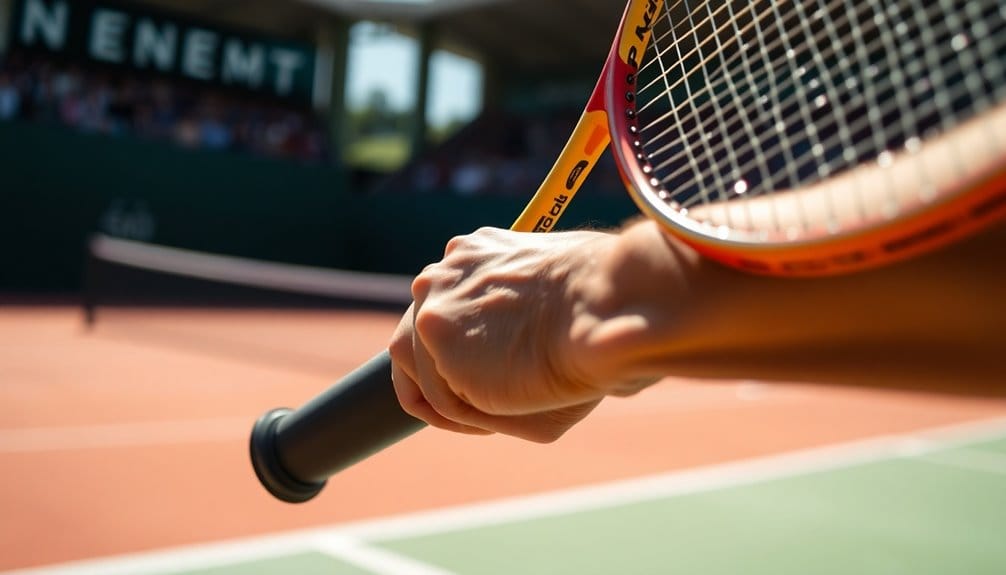
A strong backhand not only relies on technique but also on the grip you choose. Different grip styles, like the eastern or semi-western, can enhance your power and control. The eastern grip allows for a flatter stroke, while the semi-western helps with topspin.
Experiment with grip pressure, too; a firmer grip can generate more power, but don’t overdo it. Too much tension can hinder your fluidity and timing. Find a balance that feels comfortable yet powerful.
Ultimately, the right grip should feel natural and give you confidence as you strike the ball. Additionally, soccer ball specifications can help inform your understanding of how different equipment influences performance. Test various grips during practice to see which one complements your style and maximizes your backhand power.
Footwork Fundamentals for Backhand Strength
Although solid technique is essential, effective footwork is equally important for generating power in your backhand.
Mastering your footwork sets the foundation for strong shots, allowing you to position yourself effectively and maintain balance. Here are some key aspects to focus on:
- Balance training: Strengthen your core to improve stability during shots.
- Lateral movement: Practice shuffling to quickly reach the ball.
- Foot positioning: Confirm your feet are shoulder-width apart for better leverage.
- Weight transfer: Shift your weight from back foot to front foot as you hit.
- Quick recovery: Get back into position after each shot to prepare for the next.
Incorporating finishing drills can also enhance your overall coordination and power during backhand shots.
Drills to Enhance Backhand Power
To truly harness the power of your backhand, incorporating targeted drills can make a notable difference.
Start with backhand variations, like the one-handed and two-handed backhand, to develop versatility. Practice hitting against a wall or with a partner, focusing on generating power through your legs and core.
Combine these drills with strength training exercises, such as medicine ball slams and resistance band rotations, to build muscle specifically for your backhand.
Use interval training to simulate match conditions, alternating between powerful backhands and quick footwork.
Finally, film your sessions to analyze your technique, ensuring you’re maximizing your power. Incorporating lower body strength into your training will also enhance your backhand performance.
Consistent practice with these drills will notably enhance your backhand strength and overall game performance.
Common Mistakes to Avoid on the Backhand
When working on your backhand, it’s easy to fall into some common traps that can hinder your power.
You mightn’t realize how a poor grip, inadequate footwork, or a lack of follow-through can affect your shot. Effective communication among teammates can also enhance your overall performance, making every shot count.
Let’s break down these mistakes so you can improve your game.
Poor Grip Technique
Mastering your backhand starts with grip technique, and poor choices here can sabotage your efforts.
If you want to generate power and maintain control, pay attention to these common mistakes:
- Using excessive grip pressure can hinder your swing fluidity.
- A loose grip may lead to instability, affecting shot accuracy.
- Holding the racket too high or low disrupts balance.
- Failing to adjust grip for different shots can limit versatility.
- Neglecting to practice grip stability during drills may result in inconsistent performance.
Inadequate Footwork Positioning
Poor grip technique can lead you to overlook another key aspect of your backhand: footwork positioning. Inadequate footwork can throw off your balance and power. To improve, focus on positioning techniques that get you into the right stance. Being too far back or too close can hinder your shot.
Incorporating footwork drills into your practice routine is essential. Work on lateral movement, so you can quickly adjust to the ball’s angle.
Remember to keep your knees bent and weight balanced. This will allow you to generate more power and control during your swing.
Don’t underestimate the impact of proper footwork—it’s the foundation for a strong backhand. Prioritize these elements, and watch your performance elevate.
Lack of Follow-Through
While many players focus on setup and swing mechanics, a lack of follow-through can severely undermine your backhand’s effectiveness.
Poor follow-through can lead to inconsistent shots and reduced power. You need to incorporate proper follow-through techniques that engage your wrist flexibility and enhance shot precision.
- Maintain a smooth shift from swing to follow-through.
- Keep your eyes on the ball until contact.
- Extend your racket fully after the hit.
- Use your body weight to drive through the shot.
- Follow through in the direction you want the ball to go.
How to Practice Consistently for Improvement
To improve your backhand, you need a focused drills routine that hones in on key techniques. Consistent timing practice is essential for building power and accuracy. Additionally, incorporating conditioning drills into your training can enhance overall performance and stamina.
Focused Drills Routine
Mastering your backhand starts with a focused drills routine that hones your skills and builds consistency. Implementing specific backhand exercises and incorporating strength training will enhance your power and precision.
Here’s how to structure your routine:
- Shadow Swings: Practice your form without a ball to refine technique.
- Target Practice: Set targets to aim for, improving accuracy.
- Partner Drills: Rally with a partner, focusing on backhand shots.
- Resistance Bands: Use bands for strength training to build muscle memory.
- Video Analysis: Record your swings to identify areas for improvement.
Consistent Timing Practice
Consistent timing is essential for improving your backhand, as it directly impacts your shot’s power and accuracy. To enhance your timing, incorporate specific timing drills into your practice routines.
Start by focusing on your footwork; good positioning helps you hit the ball at the right moment. Use a metronome or rhythmic counting to develop a steady tempo.
Practice with a partner or against a wall, aiming to strike the ball consistently within the same time frame. Gradually increase the pace as you become more comfortable.
Conclusion
As you step onto the court, imagine the crack of your racquet connecting with the ball, sending it slicing through the air like a bolt of lightning. With each practice session, you harness the raw power of your backhand, transforming it into your secret weapon. Embrace the journey of improvement, and soon, your opponents will feel the shockwave of your skill. Keep refining your technique, and watch as your backhand becomes a force to be reckoned with.