

Common Forehand Mistakes Beginners Make
April 17, 2026One common mistake beginners make with their forehand is improper grip. If your grip is too tight, it restricts fluid movement; if it’s too loose, you’ll struggle with control. Foot positioning also plays an essential role; a narrow stance can throw you off balance. Timing your swing is critical for solid contact, and tension in your body can lead to inconsistencies. By adjusting these elements, you can improve your game considerably. You’ll discover more tips to refine your technique.
Understanding the Importance of a Proper Grip

When you grasp your racket correctly, you set the foundation for a powerful forehand. The way you hold your racket influences your swing, control, and overall performance.
Different grip styles, such as the eastern or western grip, cater to various playing styles and preferences. It’s essential to experiment and find what feels comfortable for you.
Grip pressure is equally important; too tight, and you’ll lose fluidity in your swing, while too loose can lead to mishits. Striking a balance is key.
You want enough grip to maintain control without tension. By mastering your grip, you’ll enhance your confidence and accuracy on the court, allowing for more effective shots and a better overall game. Additionally, a proper grip can significantly impact your overall performance on the field.
Common Grip Mistakes Beginners Make
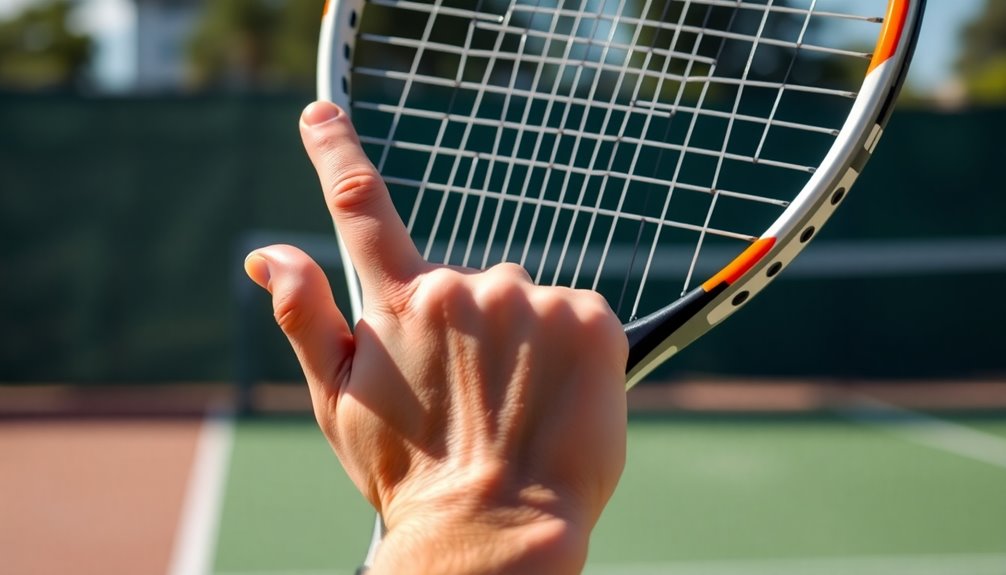
Many beginners make essential grip mistakes that can hinder their forehand performance. One common error is using too much grip pressure. When you grip the racket too tightly, it limits your wrist’s flexibility, impacting your shot’s speed and spin.
Conversely, if you grip it too loosely, you risk losing control during your swing.
Another issue isn’t choosing the right grip type. Different grip types, like the Eastern or Western, serve different styles of play. Using the wrong grip can make it difficult to generate power or accuracy.
Choosing the right grip type is crucial; the wrong one can hinder your power and accuracy on the court.
To improve your forehand, focus on finding a comfortable grip pressure and selecting the appropriate grip type for your game. This simple adjustment can lead to significant improvements in your performance, especially when considering proper techniques that enhance control and precision.
How to Position Your Feet for a Better Forehand

Getting your feet right is essential for a powerful forehand.
You’ll want to focus on the width of your stance, how you distribute your weight, and aligning your body properly.
These elements can make a big difference in your shot effectiveness. Incorporating effective leg exercises into your training can significantly enhance your shot power and accuracy.
Feet Width Matters
To achieve a powerful forehand, the width of your feet plays an essential role in maintaining balance and generating force. Proper foot positioning allows you to transfer energy effectively from your legs into your swing.
A stance width that’s too narrow can throw off your balance, making it harder to strike the ball cleanly. Aim for a stance that’s about shoulder-width apart; this gives you a stable base while still allowing for quick movement.
If you find yourself off-balance after your shot, reevaluate your stance width. Experiment with different foot positions to discover what feels most comfortable and effective for you.
With the right positioning, your forehand will become more consistent and powerful.
Weight Distribution Techniques
Achieving the right weight distribution is essential to enhancing your forehand. Start by focusing on your weight transfer; shift your weight from your back foot to your front foot as you prepare to hit. This movement helps maintain your center balance and guarantees effective body rotation during the stroke.
Keep your shoulders aligned with your target for better accuracy. Incorporate footwork drills to improve your agility and positioning, allowing you to set up correctly for each shot.
Proper Stance Alignment
Incorporate alignment drills into your practice to reinforce these concepts. For instance, stand against a wall and practice your foot positioning without swinging.
Focus on keeping your body balanced and aligned throughout the motion. As you improve your stance, you’ll notice an increase in your forehand’s effectiveness.
The Role of Stance in a Successful Forehand
Your stance plays an essential role in executing a successful forehand.
Proper foot placement guarantees you’re balanced and ready to transfer your weight effectively during the shot.
When you get your stance right, you’ll set yourself up for more powerful and accurate hits. Additionally, maintaining proper technique can help prevent injuries and enhance your overall performance.
Proper Foot Placement
Use these foot positioning tips: pivot your back foot and step forward with your front foot as you prepare to hit. This ideal footwork helps you generate power and maintain control.
When you move to the ball, keep your weight balanced and shift it from your back foot to your front foot during the swing.
Importance of Balance
While executing a forehand, maintaining balance is essential for achieving accuracy and power. Your stance directly influences your ability to hit the ball effectively.
When you practice solid balance techniques, you’ll find it easier to control your shots and generate force.
To improve your balance, consider the following:
- Feet shoulder-width apart: This provides a stable base for your swing.
- Knees slightly bent: This helps you stay agile and ready to move.
- Engage your core: A strong core stabilizes your body during the shot.
Incorporating balance drills into your training can enhance your overall performance.
Focus on these aspects to guarantee you’re grounded and prepared to hit a successful forehand every time.
Weight Transfer Techniques
To execute a powerful forehand, mastering weight transfer techniques is vital. Start by positioning your feet shoulder-width apart, ensuring a stable stance.
As the ball approaches, initiate weight shifting from your back foot to your front foot. This movement not only helps you maintain balance but also generates power.
While you shift your weight, engage in body rotation; turn your hips and shoulders towards the net. This rotation creates torque, enhancing your shot’s speed and precision.
Remember, timing is essential—transfer your weight just as you begin your swing.
By combining effective weight shifting with proper body rotation, you’ll enhance your forehand and avoid common mistakes beginners often make.
Focus on these techniques to elevate your game.
Timing: Why Does It Matter for Your Forehand Shot?
Timing plays an essential role in executing an effective forehand shot, as it directly influences your ability to make solid contact with the ball. When you master your timing, you enhance your shot rhythm, allowing for smoother and more powerful strikes.
- Proper timing helps you hit the ball at the ideal point in its trajectory.
- It enables better weight transfer, contributing to greater shot power.
- Using timing drills can improve your anticipation and reaction speed.
- Incorporating high-intensity sprints can further enhance your overall athleticism, benefiting your timing on the court.
The Impact of Follow-Through on Shot Accuracy
Your follow-through plays an essential role in the accuracy of your forehand shot.
Many players overlook common errors in this phase, which can lead to inconsistent results. Mastering your follow-through can significantly enhance your ball control, allowing for better precision in your shots.
Importance Of Follow-Through
A proper follow-through can make all the difference in shot accuracy, ensuring the ball travels where you intend. When you focus on your follow-through techniques, you set yourself up for success with each shot.
Here’s why mastering your follow-through is essential:
- It helps maintain balance, allowing for better control over your shot.
- It enhances the spin and speed of the ball, making your shots more effective.
- It reinforces muscle memory, leading to consistent performance through follow-through drills.
Common Follow-Through Errors
While mastering your follow-through is vital, many players overlook common errors that can undermine shot accuracy. One major issue is follow through height; if your racket doesn’t finish at the right level, it can alter the ball’s trajectory.
Similarly, follow through direction matters; an off-target finish can send the ball wide. Follow through speed plays a significant role as well; too slow or too fast can impact your shot’s consistency.
Additionally, timing is key; a mistimed follow-through can lead to erratic results. Pay attention to follow through rotation and make certain your racket rotates properly to maintain control.
Finally, achieving a solid follow through finish will help you solidify your technique and improve overall performance on the court.
Tips For Improved Accuracy
To improve your shot accuracy, focusing on your follow-through is essential. A strong follow-through helps guarantee that your racket path remains consistent, enhancing your shot consistency.
Here are some tips to refine your technique:
- Practice targeting drills: Set specific targets on the court to aim for during your practice sessions. This builds precision.
- Maintain a fluid motion: Avoid abrupt stops. A smooth follow-through encourages better ball control and placement.
- Visualize your shot: Before hitting, picture your ideal trajectory. This mental practice can enhance your focus and accuracy.
Overcoming Tension: Relaxing Your Body for Better Shots
When you feel tension in your body during a forehand shot, it can lead to inconsistent swings and missed opportunities. To improve your game, focus on tension release and body relaxation.
Start by taking a deep breath before your shot; this helps calm your muscles. As you prepare to hit, visualize your body loosening up, allowing for a natural swing.
Start with a deep breath to calm your muscles and visualize relaxation for a smoother, more natural swing.
Keep your grip relaxed on the racket—too tight can create unnecessary stiffness. Remember, a fluid motion comes from a relaxed body, enabling better control and accuracy.
Practice engaging your core while letting your arms and shoulders move freely. With time, you’ll notice how relaxation enhances your forehand, transforming tension into precision and power. Additionally, incorporating dynamic warm-up routines can help prepare your body for optimal performance.
The Significance of Eye Coordination in Tennis
Eye coordination plays an essential role in your tennis game, as it directly impacts your ability to anticipate and react to the ball. Developing strong hand-eye coordination enhances your eye focus and visual tracking, allowing you to improve your spatial awareness on the court. This skill boosts your reaction time, enabling you to respond quickly to incoming shots.
- Practice concentration techniques to sharpen your focus.
- Use mental imagery to visualize successful shots and target selection.
- Strengthen your peripheral vision to better recognize the ball’s trajectory. Additionally, mastering game rules can enhance your understanding of play dynamics, further improving your overall performance.
How to Practice Your Forehand Effectively
Mastering your forehand requires consistent practice and focus. Start by incorporating drill variations into your routine. For instance, alternate between hitting cross-court and down-the-line shots to develop versatility. Use cones to set targets, helping improve your accuracy and control.
Partner exercises can elevate your practice sessions. Work with a friend to rally back and forth, focusing on consistency and footwork. Challenge each other by increasing the pace or adding spin.
Don’t forget to record your practice sessions. Reviewing footage helps identify areas for improvement. Additionally, consider implementing finishing drills to enhance your overall technique and decision-making skills.
Finally, always warm up before hitting to prevent injuries and guarantee you’re fully prepared. By practicing effectively, you’ll see noticeable improvements in your forehand performance.
When to Seek Professional Coaching for Improvement?
Wondering if it’s time to seek professional coaching for your forehand? Recognizing coaching indicators can help you decide. If you’re consistently making the same mistakes despite practice, or if your progress has stalled, it might be time for expert guidance.
Consider these signs:
- You struggle with technique and can’t identify issues.
- You want to improve faster and achieve specific goals.
- You’re preparing for competition and need advanced strategies.
Professional coaching can provide invaluable training benefits, offering tailored feedback and drills that suit your style. They can help refine your skills, boost your confidence, and enhance your overall game. Additionally, mental skills training can help you adapt to game dynamics and improve focus during competition.
Don’t hesitate to seek help—investing in coaching could be the key to revealing your potential!
Conclusion
Now that you know the common forehand mistakes, you’re just a few adjustments away from transforming your game. Imagine stepping onto the court with confidence, executing perfect shots that leave your opponents stunned. But will you take the leap and practice these techniques? The choice is yours. Embrace the journey of improvement, and who knows? You might just find yourself dominating the court sooner than you think. Are you ready to elevate your forehand?