
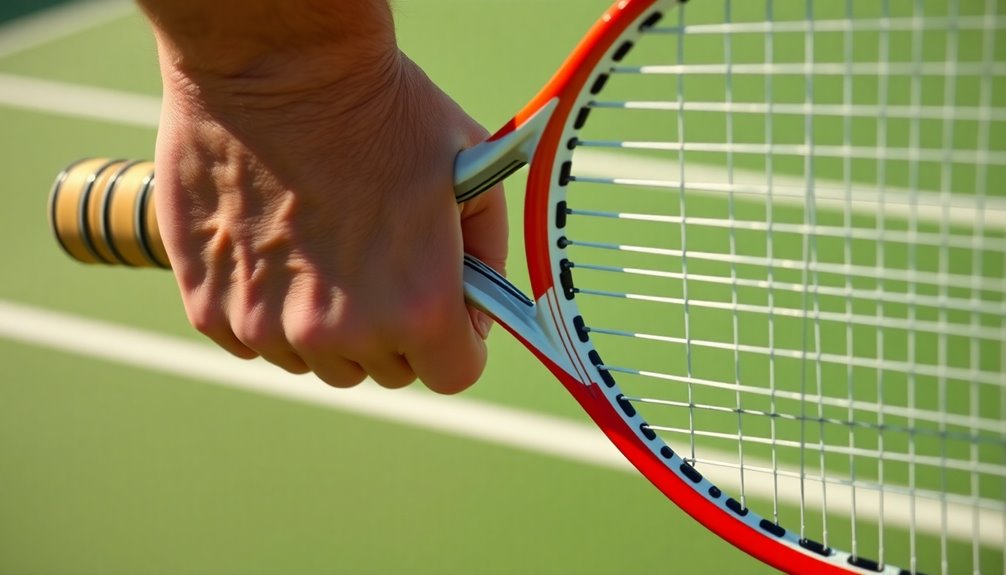
How to Use Your Non-Dominant Hand on the Forehand
April 16, 2026Using your non-dominant hand in your forehand can enhance your balance and control. Focus on keeping it engaged during your swing to stabilize your grip and boost shot accuracy. Experiment with different grips and positioning to find what feels comfortable. Pay attention to your balance and footwork for best performance. By incorporating practice drills for coordination and grip strength, you can improve your technique considerably. There’s much more you can explore to refine your game effectively.
Why Your Non-Dominant Hand Matters in Forehand Shots
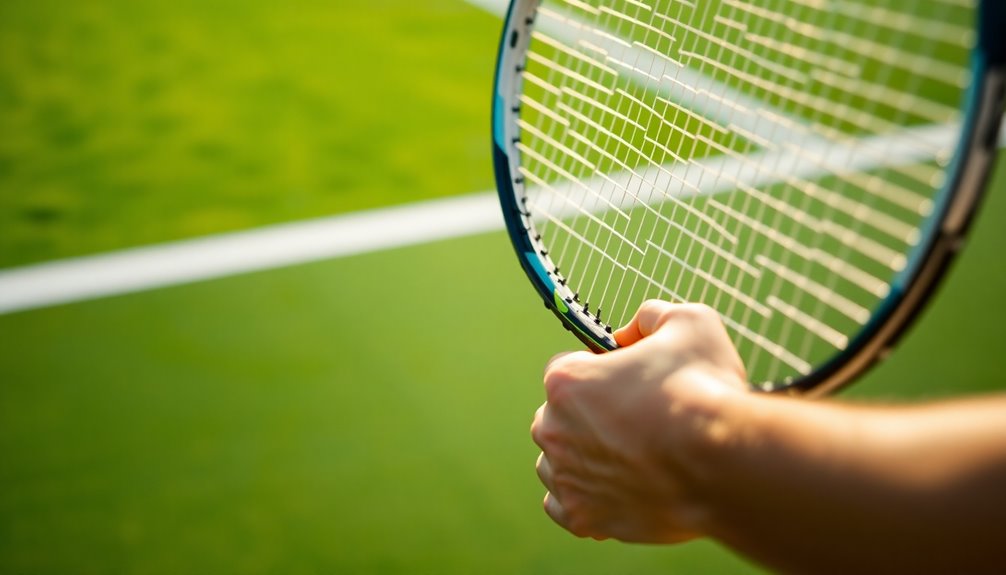
When you’re hitting a forehand shot, your non-dominant hand plays an essential role in your overall technique. By using it effectively, you can enjoy significant non-dominant benefits, such as improved balance and control.
Your non-dominant hand helps stabilize your grip, allowing you to swing more fluidly. This hand coordination is vital for generating power and accuracy in your shot. When you extend your non-dominant arm during the stroke, you create a more open stance, positioning your body for better follow-through.
This technique not only enhances your shot but also prepares you for the next play. Incorporating agility training drills into your routine can further enhance your overall performance on the court. So, don’t underestimate the power of your non-dominant hand; it can make a noticeable difference in your forehand performance.
Understanding the Role of Balance in Your Game
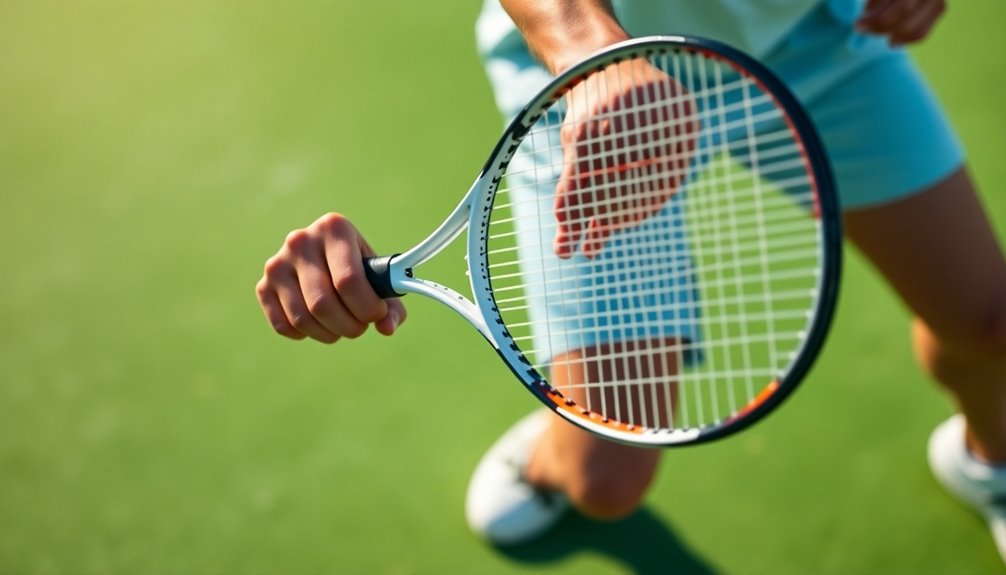
Balance is essential for your performance on the court.
By focusing on core stability, enhancing your footwork agility, and maintaining proper posture, you can improve your overall game.
When you master these elements, you’ll find your shots become more powerful and precise. Additionally, implementing core strength exercises will further enhance your balance and stability during gameplay.
Importance of Core Stability
While many players focus on their strokes and footwork, core stability often gets overlooked, yet it’s essential for maintaining control and power in your game. A strong core supports your movements, allowing you to execute shots with precision.
By enhancing your core strength, you’re setting a solid foundation for your performance.
Consider incorporating these stability exercises into your routine:
- Planks: Strengthen your entire core and improve balance.
- Russian twists: Enhance rotational strength, essential for powerful shots.
- Bird-dogs: Promote coordination and stability while engaging your core.
Enhancing Footwork Agility
To excel on the court, you need to prioritize agility in your footwork, as it plays an essential role in your overall balance and performance.
Improving your footwork isn’t just about speed; it’s about being able to move smoothly and respond quickly. Incorporate footwork drills into your routine to enhance your lateral movement and quickness.
Simple exercises like ladder drills or cone shuffles can sharpen your agility. Additionally, agility exercises such as jump rope and plyometric movements will condition your legs and improve your reaction time.
Consistently practicing these methods will give you a solid foundation for better positioning and control, allowing you to execute your non-dominant hand techniques more effectively.
Stay focused, and watch your game elevate!
Maintaining Proper Posture
Proper posture is essential for maintaining stability and control during your game, as it directly influences your ability to execute shots effectively.
Achieving the right posture alignment helps you leverage your upper body and enhances your overall performance.
Here’s how to maintain proper posture:
- Keep your feet shoulder-width apart for balance.
- Engage your core to support your upper body.
- Bend your knees slightly to stay agile and ready.
How to Grip the Racket With Your Non-Dominant Hand

When it comes to gripping the racket with your non-dominant hand, understanding the different grip types is essential.
You’ll want to position your hand comfortably for maximum control and stability. This is similar to how equipment and attire regulations ensure uniformity in soccer, contributing to overall performance.
Let’s explore how these elements come together to enhance your forehand.
Understanding The Grip Types
Although gripping the racket with your non-dominant hand might feel awkward at first, mastering the different grip types can greatly enhance your forehand technique.
Understanding grip variations is essential for achieving ideal grip stability and dynamics. You’ll need to experiment with grip pressure and angles to find what works best for your style.
Here are some key points to keep in mind:
- Grip adjustments: Fine-tuning your grip can improve your control.
- Grip shifts: Smoothly changing between grips can enhance your game.
- Grip evolution: Adapting your grip to different situations is critical for success.
Positioning Your Non-Dominant Hand
To effectively grip the racket with your non-dominant hand, focus on positioning it just above the dominant hand on the handle. This non-dominant grip plays an essential role in stabilizing your swing.
Confirm your fingers wrap comfortably around the handle, allowing for a relaxed yet firm hold. Your thumb should press against the back of the racket, providing additional support.
This hand positioning not only helps maintain balance but also enhances your control during the swing. Keep your non-dominant elbow slightly bent, which aids in fluid motion as you prepare to strike the ball.
Adjusting For Comfort And Control
Adjusting your grip for comfort and control is essential for an effective forehand. When you integrate your non-dominant hand, you’ll find that comfort adjustments can greatly enhance your performance.
Here’s how to grip the racket properly:
- Hold the racket with your non-dominant hand: This stabilizes your swing and adds power.
- Keep your fingers relaxed: Tension can lead to poor control and discomfort during play.
- Experiment with grip pressure: Finding the right balance will improve your feel for the racket.
As you practice these adjustments, you’ll discover how non-dominant integration can lead to a more fluid and controlled stroke.
Integrating the Non-Dominant Hand Into Your Swing
When you integrate your non-dominant hand into your forehand swing, you’ll find it can greatly enhance your control and power.
Start by ensuring proper hand coordination; your non-dominant hand should help guide the racket rather than just support it. As you prepare for your swing, engage that hand to stabilize your grip and position.
During the swing, maintain a fluid motion, using the non-dominant hand to facilitate the follow-through. This approach will improve your swing mechanics by allowing for a more balanced and dynamic stroke.
Practicing this integration consistently will lead to greater precision and a stronger shot, making your forehand more effective in matches. Embrace the power of your non-dominant hand! Additionally, incorporating small-sided games into your training can enhance overall coordination and decision-making on the court.
Common Mistakes When Using Your Non-Dominant Hand
Here are some common pitfalls to watch out for:
- Incorrect grip pressure: Holding the racquet too tightly can restrict your wrist movement, limiting your swing’s fluidity.
- Neglecting wrist movement: Failing to engage your non-dominant hand properly can lead to a stiff wrist, impacting your shot accuracy and power.
- Inconsistent hand positioning: Not maintaining a steady position with your non-dominant hand can cause imbalance, affecting your overall stroke.
Additionally, players must remember that engaging their non-dominant hand promotes fair play and sportsmanship, reinforcing the importance of technique in improving performance.
Exercises to Strengthen Your Non-Dominant Hand
To boost your performance with the non-dominant hand, incorporate targeted exercises into your routine.
Start with grip strength exercises, like squeezing a stress ball to enhance finger dexterity and wrist strength.
Agility drills can improve hand coordination and fine motor skills; try quick hand movements with small objects.
Balance exercises help develop proprioception training, ensuring better control and stability.
Add flexibility training to prevent injuries and increase range of motion.
For muscle memory, practice simple tasks, such as writing or tossing a ball with your non-dominant hand.
Incorporating agility ladder drills will enhance coordination and quickness, further improving your overall performance.
Consistently integrating these exercises will lead to noticeable improvements in your non-dominant hand’s strength and performance, making your forehand shots more effective and precise.
Drills for Improving Hand Coordination
Here are some effective methods:
- Timing Drills: Use a metronome to practice your swings, syncing your movements with the beats.
- Reaction Training: Have a partner toss balls at varying speeds and directions, reacting quickly with your non-dominant hand.
- Rhythm Practice: Perform slow, deliberate strokes, gradually increasing speed while maintaining control.
These drills improve your hand-eye coordination and proprioception training, ensuring you’re ready for any on-court scenario. Incorporate variety of drills into your routine to challenge your skills further and enhance your overall performance.
Focus on targeting techniques as you integrate these practices into your routine, and watch your performance with your non-dominant hand soar.
Enhancing Your Follow-Through With Your Non-Dominant Hand
A strong follow-through is essential for maximizing the effectiveness of your forehand, especially when using your non-dominant hand. By integrating your non-dominant hand into your follow-through, you create a powerful non-dominant synergy that enhances your overall stroke.
Focus on maintaining a smooth, controlled motion as your racket completes its swing. This isn’t just about power; it’s about follow-through finesse. As you finish your stroke, allow your non-dominant hand to guide and stabilize the racket, ensuring it flows naturally towards your target. Incorporating consistent effort in honing techniques will further enhance your performance on the court.
Practice this technique regularly, and you’ll notice improved accuracy and consistency in your shots. Embrace your non-dominant hand, and watch your forehand transform into a more dynamic and effective weapon on the court.
The Psychological Benefits of Using Both Hands
While many players focus on physical technique, incorporating your non-dominant hand can also boost your mental game. By engaging both hands, you enhance your cognitive flexibility, allowing you to adapt more easily to challenges on the court. This practice not only sharpens your skills but also promotes mindfulness techniques that keep you present during matches.
- Reduces performance anxiety by shifting focus
- Encourages creative problem-solving in gameplay
- Strengthens mental resilience through new challenges
Using your non-dominant hand shifts your perspective, making you more aware of your movements and decisions. Additionally, practicing mental skills training can significantly improve your performance by helping you maintain concentration under pressure.
Using your non-dominant hand enhances awareness, deepening your understanding of movements and decisions on the court.
Embracing this dual-handed approach can transform not just your play but also your overall mindset, leading to greater enjoyment and success in the game.
How to Adapt to Different Playing Styles?
To adapt to different playing styles, you need to recognize your opponent’s patterns quickly. Adjusting your grip and stance can make a big difference in how effectively you respond. Practicing versatile techniques will help you stay one step ahead during the match. Incorporating situational drills into your training can significantly enhance your ability to read the game.
Recognizing Opponent’s Patterns
Recognizing your opponent’s patterns is essential for adapting to different playing styles. By honing your pattern recognition skills, you can perform a more strategic analysis of their game.
Here are some strategies to help you identify those patterns:
- Observe shot selection: Pay attention to the types of shots they favor in certain situations.
- Watch court positioning: Notice where they stand during different rallies—this can reveal their strengths and weaknesses.
- Analyze their reactions: Take note of how they respond to various plays, especially under pressure.
Adjusting Grip and Stance
Adjusting your grip and stance can make a significant difference when facing various playing styles.
Start by experimenting with grip pressure; a firmer grip can help you generate power against aggressive opponents, while a relaxed grip allows for more finesse.
Pay attention to your hand positioning as well; aligning your non-dominant hand properly on the racket can enhance control and stability.
If your opponent employs a flatter ball, widen your stance and lower your center of gravity to prepare for quick movements.
For higher, looping shots, a more open stance can help you engage your core effectively.
Practicing Versatile Techniques
While mastering versatile techniques can seem challenging, it’s essential for adapting to different playing styles effectively. By focusing on your non-dominant hand, you can access several benefits that enhance your game.
Here are some effective practice strategies:
- Focus on hand strength: Use resistance bands to improve your grip and coordination improvement.
- Experiment with technique variations: Try different grips and swings to boost shot versatility.
- Incorporate drills: Use target practice to refine your skill development and game adaptation.
These strategies not only elevate your non-dominant benefits but also help you become a more well-rounded player.
As you practice, you’ll find that adapting to various opponents becomes easier, allowing you to exploit their weaknesses effectively.
Tips for Consistency in Your Forehand Shots
To achieve consistency in your forehand shots, it’s essential to focus on your grip and stance. Make certain your grip is firm yet relaxed, allowing for better hand coordination during your swings.
Your stance should be balanced, with your weight evenly distributed to help generate power and control.
Incorporate non-dominant drills into your practice routine. By training your non-dominant hand, you enhance overall coordination and boost your confidence.
Try hitting forehands while switching hands or using both hands for balance. This not only strengthens your weaker side but also improves your muscle memory.
Consistency comes from repetition and focus, so dedicate time to these drills, and you’ll notice a significant improvement in your forehand shots.
Analyzing Professional Players Who Use Both Hands
Many professional players have successfully integrated the use of both hands in their forehand shots, showcasing the versatility and effectiveness of this technique. By analyzing these players, you can gain insights into the dual handed technique and how it enhances performance.
Here are some key takeaways from player comparisons:
- Varied Grip Styles: Different players adapt their grips to suit their strengths.
- Strategic Shot Placement: Using both hands allows for better control and placement on the court.
- Increased Power and Spin: The dual handed technique can generate more force and spin, making your shots more challenging for opponents.
Troubleshooting Common Issues With Your Forehand
When your forehand isn’t firing like it should, it’s time to take a closer look at your grip and stance.
Adjusting how you hold the racket can make a huge difference, and finding the right balance will improve your overall performance.
Let’s tackle these common issues to get your game back on track.
Grip Adjustment Techniques
Adjust your grip to enhance your forehand and tackle common issues that arise when using your non-dominant hand. Proper grip pressure and hand positioning are essential for a successful shot.
Here are some techniques to refine your grip:
- Experiment with grip pressure: Too tight can hinder fluidity; too loose may cause loss of control.
- Check hand positioning: Confirm your non-dominant hand supports the racquet correctly to maintain stability.
- Adjust grip style: Switching between eastern, western, or continental grips can help you find comfort and improve shot consistency.
Stance and Balance Tips
Mastering your stance and balance is essential for executing a powerful forehand with your non-dominant hand. Start by experimenting with stance variations, such as an open or closed stance, to find what feels most comfortable and effective for you.
Make sure your feet are shoulder-width apart for stability, and keep your knees slightly bent to maintain agility.
Incorporate balance drills into your practice routine. Try standing on one leg while swinging to enhance your core stability and focus.
Additionally, practice your forehand shots while shifting your weight from back foot to front foot, reinforcing good balance and follow-through.
Tracking Your Progress: Measuring Improvement Over Time
Tracking your progress as you learn to use your non-dominant hand on the forehand can be a game-changer. It helps you identify areas for improvement and stay motivated.
To effectively measure your growth, consider these tracking methods:
- Video Analysis: Record your practice sessions to visually assess your technique and compare over time.
- Practice Journals: Document your drills, noting specific progress benchmarks and areas where you feel improvement.
- Performance Metrics: Track your success rate in drills or matches to quantify your advancement.
Conclusion
So, as you work on using your non-dominant hand for your forehand, you might just discover it’s the secret weapon you never knew you needed. After all, who would’ve thought that a little balance and grip adjustment could transform your game? Embrace the irony of relying on what you thought was your weaker hand—because sometimes, the unexpected path leads to the best results. Keep practicing, and soon enough, your forehand might just become your strongest asset.