

All WR Routes Explained in Simple Terms
March 28, 2026Wide receiver routes are categorized into a numbered route tree, making them easier to understand and execute. Basic routes like flat, slant, and curl are essential for quick gains. Intermediate routes, including post and dig, help you gain more yardage. Deep routes like go and seam stretches defenses for big plays. Combining routes strategically can confuse defenders. Mastering these routes and techniques enhances your game, and there’s plenty more to discover about elevating your skills.
Understanding the Route Tree Concept
The route tree is an essential blueprint for wide receiver routes, streamlining play-calling and communication on the field. It organizes routes into a numbered system, simplifying everything from short routes to more complex in-breaking and out-breaking routes.
Understanding this structure helps you as a wide receiver to exploit defensive coverage effectively. For instance, odd-numbered routes often lead to out-breaking patterns like Flat or Comeback, while even-numbered routes focus on in-breaking patterns like Slant or Dig.
This knowledge is vital for creating separation from defenders and executing offensive strategies. Coaches tailor the route tree to fit their schemes, ensuring you can use your unique strengths to gain an edge against the defense. Additionally, incorporating diverse offensive routes adds unpredictability and challenges defenses, making your execution even more effective.
The Importance of Route Running for Wide Receivers
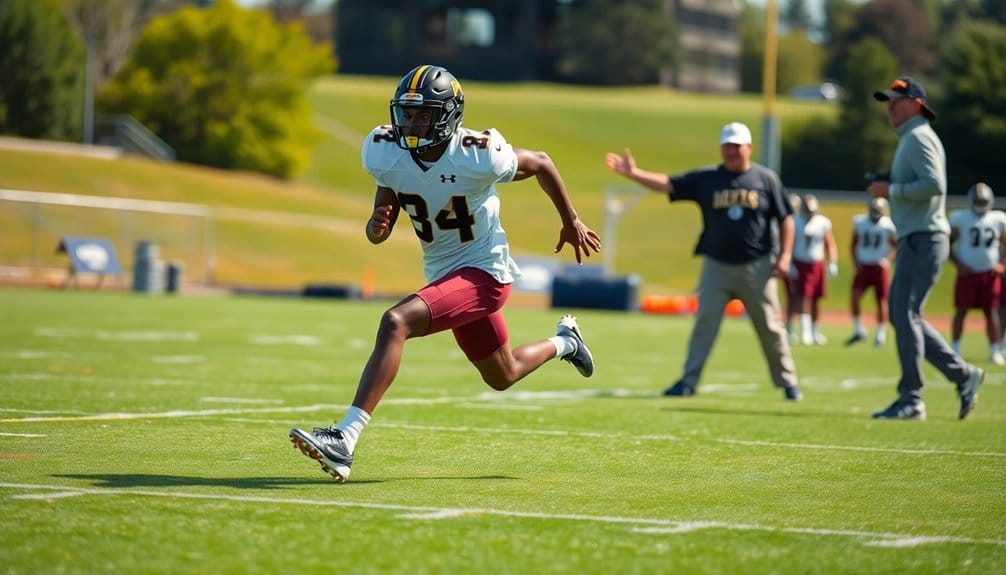
Understanding the route tree lays the foundation for mastering route running, which plays a pivotal role in a wide receiver’s success. Effective route running helps you create separation from defenders, essential for successful pass completions. By mastering various routes, like slants and corners, you can exploit defensive weaknesses and maximize yardage. Sharp cuts enhance your ability to evade coverage while maintaining speed, increasing your chances of making a catch. Additionally, strong timing and chemistry with your quarterback lead to more accurate throws and scoring opportunities. Consistent practice allows you to adjust routes on the fly, making you a dynamic threat in any game situation. Ultimately, honing your route running skills is fundamental for your effectiveness as a wide receiver. Moreover, utilizing motion and misdirection can further enhance your ability to confuse defenders and create open space for successful plays.
Basic Routes Every Receiver Should Know
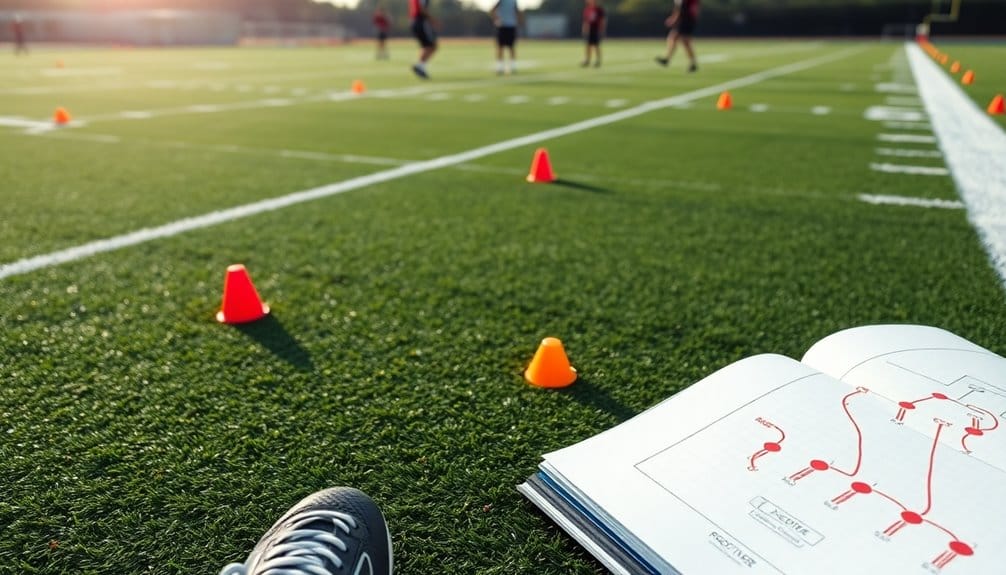
Every receiver should master at least five essential routes to elevate their game.
Start with the flat route, a quick out-breaking maneuver perfect for gaining immediate yardage.
Next, the slant route allows you to take a few steps forward before cutting sharply inside, helping you create separation from defenders for a quick throw.
The comeback route involves running deep, then breaking back toward the sideline, ideal for back-shoulder passes.
The curl route has you sprinting downfield before turning back to the quarterback, finding soft spots in zone coverage.
Finally, the out route requires you to run straight, then make a sharp break toward the sideline, useful for gaining ground near the boundaries.
Mastering these basic routes is vital, as enhancing pass accuracy can significantly improve your effectiveness as a receiver.
Intermediate Routes: Expanding Your Skill Set
Here are four key intermediate routes to focus on:
- Post Route: Sprint straight before breaking toward the goal posts at 10-12 yards, effective against two-high safety defenses.
- Dig Route: Execute a sharp break to the middle at 10-15 yards, gaining yardage in the heart of the defense.
- Corner Route: Break at a 45-degree angle toward the sideline, typically run from the slot.
- Square Out Route: Run vertically before sharply breaking to the sideline at a 90-degree angle, targeting defenders who play off too far.
Mastering these intermediate routes is effective for any receiver, particularly when incorporating strong communication to enhance teamwork on the field.
Deep Routes: Stretching the Defense
Deep routes are essential for stretching the defense and creating big-play opportunities.
You’ll encounter various types, like the Go/Fade and Corner routes, each designed to exploit coverage gaps.
To succeed, mastering timing and technique is vital, ensuring you create separation and give your quarterback a clear target. Incorporating misdirection plays can also enhance your effectiveness by confusing defenders and opening up space for deeper routes.
Importance of Deep Routes
Vertical threats in football are essential for stretching the defense and creating space for other plays. Deep routes like Fly, Post, and Corner are vital in the passing game. Here’s why they matter:
- Exploiting Defensive Weaknesses: They target gaps, especially against two-high safety coverages.
- Creating Space Underneath: With defenders focused on vertical routes, shorter options become available.
- Enhancing Running Lanes: Defenders respect the deep threat, opening opportunities for the run game.
- Successful Execution: Speed and timing between the quarterback and receiver are critical for maximizing yardage.
2. Types of Deep Routes
Stretching the defense requires a strategic mix of deep routes, each designed to exploit specific weaknesses.
The corner route breaks toward the sideline at a 45-degree angle, creating space against zone defenses, while the post route runs straight before angling in toward the goalposts, targeting two-high safety coverages.
The go route, or fade, involves sprinting vertically to stretch the defense and demands precise timing for deep throws.
The seam route attacks the area between linebackers and safeties, making it a favorite for tight ends and slot receivers.
Finally, the deep cross route moves horizontally across the field at depth, confusing defenders and exploiting open zones.
Each of these routes plays a significant role in keeping defenses on their toes.
3. Techniques for Success
Mastering deep routes requires a blend of technique and strategy. To excel, focus on these key techniques for success:
- Timing: Sync your route with the quarterback’s drop; this guarantees ideal throw timing and improves your chances of a catch.
- Speed: Maintain a quick release and explosive pace throughout the route to gain separation from defenders.
- Read Defensive Coverages: Understand how the defense is aligned. Adjust your route based on the cornerback’s positioning—break inside on a post or stay straight on a fade.
- Practice Drills: Incorporate resistance sprints and cone drills to enhance your explosion and footwork, making you more effective on deep routes.
Implementing these techniques will elevate your overall performance on the field.
How to Execute a Flat Route Effectively
Executing a flat route effectively starts with your footwork. As a receiver, take three quick vertical steps before cutting sharply towards the sideline.
Timing’s vital here; the quarterback should deliver the ball as you break outside. This maximizes your chances for yards after the catch, especially in situations where you need to evade defensive pressure.
Be aware of your proximity to the sideline to guarantee you make the catch in bounds. Flat routes are versatile, often run by slot receivers, running backs, or tight ends. Additionally, mastering offensive strategies can enhance the effectiveness of your flat route execution.
Mastering the Slant Route: Tips and Techniques
While you might think a slant route is simple, mastering it requires attention to detail and timing. Here are some tips to enhance your effectiveness:
Mastering a slant route may seem straightforward, but it demands precision and timing for optimal effectiveness.
- Footwork: Start with a quick, sharp cut at a 45-degree angle after one to three steps to create separation from defenders.
- Timing: Work closely with your quarterback; a quick throw right after your cut is essential to capitalize on that separation.
- Deception: Use your body language and footwork to mislead defenders into thinking you’ll run deeper routes.
- Practice: Regular drills can improve your ability to adjust your break, enhancing overall route effectiveness.
- Sock Selection: Consider wearing moisture-wicking technology socks during practice to keep your feet dry and comfortable.
The Comeback Route: Timing and Deception
When you’re running a comeback route, your ability to create separation hinges on timing and deception. You’ll sprint downfield at full speed, making defenders think you’re continuing your route. This initial burst is key to selling the vertical route.
At around 12-15 yards, you’ll sharply cut back toward the quarterback, drawing on your deceptive footwork to mislead defenders. The timing between you and the quarterback is essential; the throw should arrive just as you turn to catch the ball.
This route is effective against both man and zone coverage, allowing you to find soft spots in the defense. Incorporating effective drills can help you consistently gain valuable separation and keep the chains moving. Mastering this technique can help you consistently gain valuable separation and keep the chains moving.
Curl and Dig Routes: Creating Separation
Curl and dig routes are essential for creating separation between you and the defender.
By mastering sharp cuts and timing, you can exploit gaps in zone coverage or outpace defenders in man coverage. Incorporating quick passing techniques allows receivers to enhance their effectiveness in executing these routes.
Let’s break down the techniques that make these routes so effective.
Route Purpose Explained
Creating separation in football is vital for effective passing, and two routes that excel in this aspect are curl and dig routes. Here’s how they help you create space:
- Curl Routes: You run downfield, then stop and turn back, using the defender’s momentum against them.
- Dig Routes: You sprint vertically before sharply cutting toward the middle, targeting soft spots in zone coverage.
- Timing: It’s essential to maintain the right depth for a smooth quarterback throw.
- Precision: Accurate route execution leads to significant yardage gains, especially on important third downs.
Both curl and dig routes allow receivers to exploit defensive gaps, ensuring effective passing opportunities when executed correctly.
Techniques for Separation
To effectively gain separation on curl and dig routes, mastering specific techniques is essential.
For the curl route, sell the vertical by accelerating, then quickly decelerate and pivot back toward the quarterback, using your body to shield the defender. Timing with the quarterback is vital here, ensuring an accurate throw.
On dig routes, execute a sharp, controlled break at a 90-degree angle, ideally 10-15 yards downfield, to gain leverage and create a clear passing lane. Utilize head and shoulders movement to mislead defenders, making them commit the wrong way.
Finally, focus on footwork fundamentals—quick and explosive steps will help you change direction effectively, maximizing your chances of creating space and achieving separation.
Combining Routes for Strategic Advantage
Here are some effective combinations:
- Slant-Go: Start with a slant to throw off defenders, then break deep to create space for receiving targets.
- Post-Corner: Fake an inward break before cutting outward, manipulating defensive coverages and stretching defenses.
- Hitch with a Deep Route: Pair a short hitch with a deeper route to stretch defenses both vertically and horizontally.
- Crossing Routes: Utilize timing and spacing to confuse defenders, making it hard for them to choose which receiver to cover.
Incorporating strategic route concepts can further enhance the effectiveness of these combinations by maximizing offensive opportunities.
Adjusting Routes Based on Defensive Coverages
Defenders often struggle with route combinations, but recognizing how to adjust your routes based on their coverage can be a game changer.
Start by reading coverage; identify if it’s man or zone. In zone coverage, utilize a zone coverage strategy to find soft spots, settling into space for an easy catch.
Start by reading coverage to determine if it’s man or zone, then exploit soft spots for easy catches.
Against man coverage, apply man coverage tactics; use sharp cuts and speed changes to create separation from your defender.
Don’t hesitate to make route modifications based on defensive alignment—alter your depth or angle as needed.
Always prioritize timing and communication with your quarterback; seamless interaction lets you exploit defensive shifts effectively and guarantees you’re both on the same page, maximizing your chances for success.
Building Chemistry With Your Quarterback
When you spend extra time practicing together, you’ll start to anticipate each other’s movements, making adjustments on the fly easier.
Plus, developing non-verbal cues can streamline your communication during games, ensuring you’re always on the same page.
Timing and Rhythm
- Consistent Practice: Work on specific routes, like slants and curls, to enhance your timing and synchronization during games.
- Understanding Route Depths and Angles: Develop a shared comprehension of these factors to maintain rhythm in your passing game.
- Film Sessions: Regularly analyze past performances together, refining your timing on routes and improving communication.
- Quick Releases and Three-Step Breaks: Practice these techniques to guarantee your routes are sharp and on time, preventing defenders from recovering.
Non-Verbal Communication
Effective non-verbal communication can make all the difference in a receiver’s connection with their quarterback. Using subtle hand signals or eye contact allows you to quickly make adjustments during high-pressure situations without saying a word.
Through consistent practice sessions, you and your quarterback can synchronize your movements, enhancing your chemistry on the field. Pay attention to body language; leaning or positioning can signal your intent to break off a route, enabling seamless adjustments mid-play.
Regular film study helps both of you analyze past performances, fostering trust and understanding of each other’s tendencies. Practicing route variations in different scenarios builds that trust, ensuring you can anticipate each other’s decisions during games, leading to successful plays.
Drills to Enhance Route-Running Skills
To sharpen your route-running skills, incorporating various drills can make a significant difference. Here are four effective drills to help players improve:
- Cone Drills: Set up cones to mark cutting points. This helps you practice sharp turns while maintaining speed during your routes.
- Resistance Sprints: Use bands or sleds to build explosive acceleration, essential for quick breaks and deep routes.
- Sideline Toe-Taps: Run along the sideline, focusing on toe-tapping. This enhances your balance and control.
- Route Depth Markers: Place markers on the field to guarantee you hit your designated spots consistently.
Don’t forget to include film study in your routine. Analyzing practice sessions can reveal areas for improvement, making you more effective against both man and zone coverage.
Conclusion
In summary, mastering wide receiver routes isn’t just about memorizing patterns; it’s about understanding how to read defenses and adjust on the fly. By honing your skills in basic, intermediate, and deep routes, you’ll not only become a more versatile player but also build that vital chemistry with your quarterback. Embrace the challenge of route running, and you’ll find that the game becomes even more enjoyable and rewarding. Keep practicing, and watch your performance soar!