

Understanding Trips Formation in Football
March 28, 2026The Trips formation in football positions three receivers on one side to create mismatches and exploit defensive weaknesses. You’ll see various alignments like “Trips Right” and “Trips Left,” enhancing the offense’s versatility. This formation allows for crossing routes and rub concepts, confusing defenses and opening passing lanes. Spacing plays a vital role too, optimizing receiver options. Keep exploring to uncover strategic advantages, key variations, and how teams maximize their effectiveness with the Trips formation.
What Is the Trips Formation in Football?
The Trips Formation in football is a strategic alignment that puts three receivers on one side of the field, creating favorable matchups against defenders.
In this setup, at least two receivers must be off the line of scrimmage to be eligible receivers, which differentiates it from formations like “bunch.” This formation often includes a mix of wide receivers, tight ends, or running backs, ensuring versatility in your offensive plays.
By utilizing crossing and rub routes, you can exploit defensive weaknesses and create mismatches for your receivers.
Variations like “Trips Right” and “Trips Left” let you adapt based on the defense, maximizing your chances of success on each play.
Embrace the Trips Formation to enhance your offensive strategy, as it encourages option routes that allow receivers to exploit defensive weaknesses.
Historical Evolution of the Trips Formation

You might find it fascinating how the Trips Formation evolved alongside changing offensive strategies in football.
By exploring key historical milestones, you can see how teams adapted this formation to create mismatches and enhance their playbooks.
This evolution has greatly impacted modern football, making the Trips Formation a staple in both college and professional settings. The incorporation of quick passing techniques has further solidified the formation’s effectiveness in today’s game.
Key Historical Milestones
Emerging from a shift in offensive strategies, the Trips Formation revolutionized how teams approached the game. Gaining popularity in the late 20th century, it marked a change from traditional rushing offenses to a focus on passing attacks.
In the 1990s, teams like the San Francisco 49ers integrated it into the West Coast offense, exploiting defensive weaknesses effectively. By the early 2000s, college football programs, including the University of Florida, embraced the Trips Formation for its versatility in both passing and running plays.
The rise of spread offenses further cemented its role, allowing for mismatches and quick decision-making by quarterbacks. By the 2010s, variations of the Trips Formation became staples in both NFL and college football playbooks, enhancing offensive football strategies.
Evolution of Offensive Strategies
As teams sought to adapt to changing defensive schemes, they began to embrace the Trips Formation, which transformed offensive strategies in football. Emerging in the late 20th century, this formation gained traction as teams prioritized passing strategies over traditional run-heavy offenses.
Influenced by the West Coast offense in the 1990s and 2000s, the Trips Formation emphasized quick passes and effective spacing. Early versions were simple, but as route combinations and receiver alignments improved, their effectiveness against various defenses skyrocketed.
This formation allowed offenses to create mismatches, exploiting weak coverage and opening passing lanes. Historical trends reveal that teams using the Trips Formation successfully diversified their play-calling, leading to increased scoring opportunities and overall offensive effectiveness.
Impact on Modern Playbooks
While the Trips Formation has roots in the late 20th century, its impact on modern playbooks is undeniable. As offenses shifted to prioritize passing and spacing, the Trips Formation gained traction, especially with the West Coast offense in the 1990s and 2000s.
This formation enhances offensive versatility by creating mismatches and diversifying play-calling options. Coaches now integrate complex variations, using motion and alignment changes to further confuse defenses.
In today’s game, the Trips Formation serves as a foundational element in both passing schemes and running strategies. By stretching defenses, it considerably boosts the chances of successful pass plays, making it an essential component of any modern offensive playbook.
Key Strategic Advantages of Trips Formation
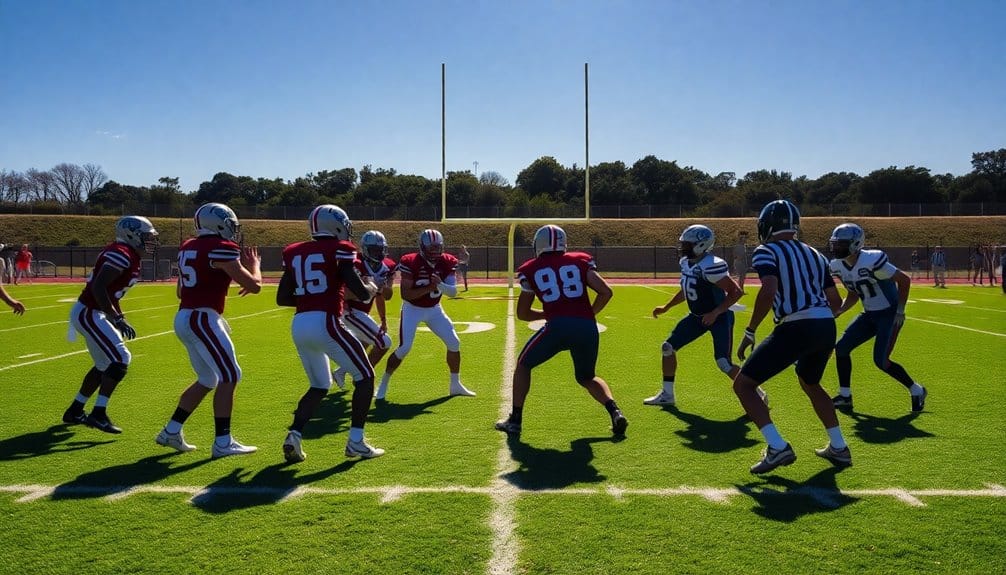
When offenses deploy the Trips Formation, they gain several strategic advantages that can greatly tilt the game in their favor. By aligning three eligible receivers on one side, you create mismatches that can exploit defensive weaknesses effectively.
This setup enhances spacing on the field, offering multiple route options for the quarterback and increasing your offensive versatility. The formation can also confuse defensive coverage assignments, forcing quick adjustments that may lead to breakdowns.
Utilizing crossing routes and rub concepts, Trips allows your receivers to create separation, complicating defenders’ ability to maintain coverage. Additionally, analyzing defensive setups before the game helps identify opportunities to exploit these mismatches.
Common Variations of Trips Formation
Now that you understand the key advantages of the trips formation, let’s explore its common variations. You’ll see how each setup offers unique offensive strategies and poses challenges for defenses. Incorporating layered route concepts can enhance the effectiveness of the trips formation, creating confusion for defenders and opening up scoring opportunities.
Trips Formation Basics
The Trips Formation offers a dynamic approach to offensive strategy in football, showcasing several variations that can be tailored to exploit defensive weaknesses.
You’ve got options like “Trips Left” and “Trips Right,” where three eligible receivers line up on either side. The “Trips Bunch” variation clusters receivers closely, creating confusion and potential rub routes.
On the other hand, “Trips Spread” spaces them out to maximize field width, allowing for varied routes and better separation. Additionally, “Motion Trips” shifts receivers before the snap, disrupting defensive alignments and creating mismatches.
Each variation strategically manipulates defensive coverage, giving your offense opportunities to capitalize on weaknesses, whether in the passing game or the run game.
Offensive Strategies Employed
Utilizing the Trips Formation opens up a variety of offensive strategies that can effectively exploit defensive weaknesses. You can align in variations like “Trips Right” or “Trips Left,” and even use tighter clusters in “Trips Bunch” or more spaced options in “Trips Spread.”
By employing motion before the snap, you can create mismatches, confusing defenders and enhancing your offensive strategies. Common plays include quick slants, screens, and deep routes, allowing eligible receivers to gain separation.
Specific route combinations, such as “Smash Drive” or “Post-Wheel,” manipulate defensive coverage, maximizing your chances for big plays. Overall, the Trips Formation allows you to overload one side, creating isolation opportunities and optimizing offensive spacing.
Defensive Countermeasures Discussed
Defensive teams must adapt quickly to counter the advantages of the Trips Formation. One popular strategy is using zone coverage, which helps manage the space created by three receivers on one side.
However, man coverage can lead to mismatches, especially if a linebacker ends up covering a faster receiver. To combat this, defenses often roll a safety down for extra support against quick passes or deep routes.
Another effective tactic is the “trap” technique, where one defender feigns coverage while another is ready to jump a route, disrupting the quarterback’s timing.
Additionally, shifting a cornerback to linebacker can help address the speed and agility needed to defend against vertical routes from the Trips side.
How Does Spacing Affect the Trips Formation?
How does spacing impact the effectiveness of the Trips Formation? Proper spacing between receivers maximizes route effectiveness, allowing them to avoid congestion and create clear passing lanes for the quarterback.
Keeping an ideal distance of 5 to 10 yards enhances sightlines, making it easier for you to read defensive coverages. Well-spaced receivers challenge defensive schemes, forcing defenders to choose which route to cover, thereby creating mismatches and isolation opportunities.
Adjusting spacing based on defensive alignment can exploit weaknesses, especially when defenses shift or misalign against the trips side. In compressed formations, receivers can create natural picks and rub routes, complicating defensive assignments and improving your offensive execution.
Effective spacing is key to revealing the full potential of the Trips Formation, as it also helps minimize offensive penalties that can disrupt the flow of the game.
Importance of Receiver Alignment in Trips Formation
Receiver alignment in the Trips Formation plays a crucial role in creating offensive mismatches, especially when you consider how it forces defenders into challenging coverage situations.
By properly aligning your receivers, you can exploit defensive weaknesses, making it tough for defenders to keep up. A compressed bunch formation enhances quick releases and enables natural picks, complicating navigation for defenders.
Ideally, spacing between your receivers should be 5 to 10 yards to maximize route effectiveness and maintain clear sightlines for the quarterback.
Additionally, varying alignments—like stacking or spreading receivers—can confuse defensive schemes, prompting adjustments that might lead to breakdowns.
Effective receiver alignment lets quarterbacks read defenses pre-snap, optimizing route combinations for a higher success rate in passing plays. Moreover, incorporating moisture-wicking fabrics into your uniform can help players maintain focus by keeping them dry and comfortable during intense plays.
Essential Routes Run From the Trips Formation
The Trips Formation offers a dynamic array of routes that can keep defenses off balance. With receivers lined up close together, you can run several common routes effectively.
Slant routes allow receivers to cut quickly towards the center, perfect for beating man coverage. Out routes create separation, ideal for short to intermediate passes. For deeper threats, post routes make diagonal cuts toward the goalposts, requiring timing and strong arm strength from the quarterback.
Slant routes enable quick cuts to beat man coverage, while out routes create separation for effective short to intermediate passes.
Additionally, screen plays leverage your receivers’ speed, getting them the ball in space to exploit mismatches. Finally, corner routes stretch the defense horizontally, opening passing lanes behind defenders.
Each of these routes enhances the Trips Formation’s versatility and effectiveness in your offensive strategy. Incorporating agility drills can further improve receivers’ quickness and footwork, making these routes even more effective.
Analyzing the Smash Drive Concept
One of the most potent strategies in the Trips Formation is the Smash Drive Concept, designed to exploit defensive weaknesses effectively.
This concept combines a corner route by the outside receiver with a deep dig route from the inside receiver, attacking both zones and man coverage. In addition, the running back typically runs an arrow route to the flat, giving you another option as the quarterback.
The #3 WR’s deep dig and the #2 WR’s shallow cross create natural picks against defenders, particularly effective against Cover 2 or single-high safety defenses.
The alignment in the Trips Formation allows for quick reads, enabling faster decision-making and execution, making it easier for you to utilize your eligible receivers effectively in this dynamic play. Incorporating diverse route combinations can further enhance the effectiveness of this strategy.
Exploring the Follow Concept
While exploiting defensive weaknesses, the Follow Concept in the Trips Formation stands out by utilizing a shallow route paired with an angle route to create mismatches.
In this setup, the #3 receiver runs a vertical route to draw the linebacker’s attention, allowing the #1 receiver to execute a follow-up angle route. This strategic movement attacks both man and zone defenses effectively.
Coaches, like those at Jackson State, have seen success by using the #3 WR to pull coverage away from the angle route, maximizing offensive potential.
Additionally, the North Carolina variation employs a compressed bunch set to confuse defenders further.
Ultimately, timing and execution are essential, making it critical for quarterbacks to read the defense accurately for best results. A well-prepared defense can intimidate opponents, enhancing the effectiveness of offensive strategies like the Follow Concept.
Understanding the Post-Wheel Concept
In the Post-Wheel Concept, you’ll see how vital timing and execution are for creating mismatches against defenders. The #2 receiver’s post route can mislead defenders, opening up space for the #3 receiver’s wheel route. This strategy is enhanced by proper timing techniques, which ensure that both routes are run in sync for maximum effectiveness.
Key Components of Execution
Understanding the Post-Wheel Concept requires recognizing its key components, especially in how a receiver’s post route can manipulate defensive coverage. When executed from a trips formation, this concept can exploit mismatches effectively.
Here’s what you need to focus on:
- Timing and Coordination: The quarterback and eligible receivers must sync up to read and react to defensive movements quickly.
- Defensive Manipulation: The post route draws defenders, creating space for the wheel route to thrive behind them.
- Play Action Integration: Using play action can enhance the effectiveness of this concept, further confusing defenders.
Defensive Misinterpretation Opportunities
Effective execution of the Post-Wheel Concept hinges on creating opportunities for defensive misinterpretation. In the trips formation, the #2 receiver fakes a tunnel screen, drawing defenders in with misdirection. As he releases into a wheel route, the #3 receiver runs a post, causing confusion among the defense.
This creates a mismatch that you can exploit, especially if the defense overcommits to the initial screen threat. Teams like Western Kentucky have successfully used this strategy, taking advantage of coverage misalignments against linebackers or safeties.
Your key is recognizing the defense’s reaction quickly and delivering the ball to the open receiver. By mastering this concept, you’ll enhance your offensive effectiveness and keep defenses guessing.
How Does the China Go Concept Work?
While the China Go Concept may seem complex at first, it’s designed to create mismatches and exploit defensive weaknesses. This strategy relies on the trips formation, where the #3 receiver runs a corner route while the #1 and #2 receivers execute 5-yard in routes.
The China Go Concept leverages mismatches in a trips formation to exploit defensive weaknesses effectively.
Here’s how it works:
- Creates horizontal conflict with the outside linebacker.
- Utilizes precise timing and spacing for clear passing lanes.
- Incorporates deception, with the #2 receiver performing a double move.
Rooted in the Air Raid offense, it effectively counters various defensive coverages.
The Double Corner Switch Explained
As you explore the Double Corner Switch, you’ll find it’s a dynamic strategy designed to overwhelm defenders.
Typically executed from a Trips formation, this concept features two eligible receivers running corner routes at different angles. The #1 WR pulls defenders deep with a vertical route, while the #2 and #3 WRs run low and high angle corners, respectively. This creates confusion in defensive coverage, especially when defenders are outnumbered.
A great example of this was Ohio State’s execution in 2019, where the strategy effectively exploited a defense that struggled to cover multiple threats.
Quick decision-making by the quarterback is essential, enabling a swift focus shift to the wide side of the field for a potential touchdown pass.
Defensive Challenges Against Trips Formation
Defensive teams often find themselves at a disadvantage when facing a Trips formation, especially since they’ve only four defenders to cover three receivers. This often leads to mismatches that can be exploited by the offense.
Here are some key challenges you might encounter:
- Linebackers struggle with vertical routes, leaving open passing lanes.
- Defensive backs may use trail techniques, resulting in separation on quick routes.
- Coverage adjustments made post-snap can create confusion, allowing the offense to capitalize.
Additionally, if safeties roll down to help cover, they might leave gaps in deep coverage, making your defense vulnerable to big plays.
To succeed, you’ll need to anticipate these challenges and adjust your strategies accordingly.
Maximizing Offensive Effectiveness With Trips Formation
Facing the challenges posed by the Trips formation can be intimidating for defenses, but for offenses, it presents a unique opportunity to capitalize on mismatches.
By strategically spacing eligible receivers 5 to 10 yards apart, you enhance route effectiveness and put pressure on defensive coverage schemes. Quick slants and screens are common plays that exploit soft coverage, allowing your speedy receivers to gain quick yards.
Strategic spacing of receivers enhances route effectiveness, applying pressure on defenses and creating opportunities for quick gains through slants and screens.
Pre-snap reads are essential, helping you identify defensive alignments and choose the best route combinations for maximum offensive effectiveness.
Additionally, using motion within the Trips formation can confuse defenses, creating further mismatches and adding to your offensive versatility.
Embrace these strategies to elevate your game and increase scoring opportunities.
Conclusion
To sum up, embracing the trips formation can really elevate your game. You’ll find that its strategic advantages shine through, especially when you master spacing and concepts like the China Go. As you navigate the field, remember that the double corner switch can catch defenses off guard. So, whether you’re on offense or tackling defensive challenges, you’ll discover that with trips, it’s all about coordination and timing—making every play feel like a perfectly executed dance.