
Unleash Your Offense: 7 on 7 Plays and Formations That Will Leave Defenders in Your Dust
December 2, 2025To release your offense in 7 on 7 football, focus on formations like the Spread and Trips to exploit defensive gaps. Use quick routes to maximize yards after the catch and incorporate play action to keep defenses off balance. Don’t forget the power of motion and misdirection to create mismatches. Timing between the quarterback and receivers is essential for success. Knocking out the competition is just the beginning—there’s much more you can do to elevate your game.
Understanding the Basics of 7 on 7 Football
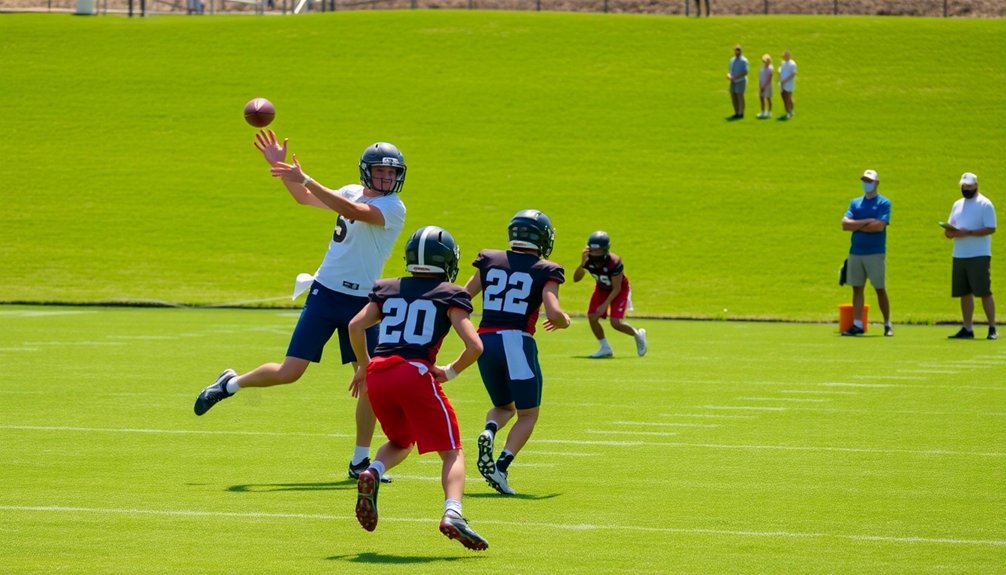
When you plunge into the world of 7 on 7 football, you’ll quickly realize it’s a fast-paced, skill-oriented game that emphasizes passing and receiving over traditional tackling. Understanding the football basics is essential for success.
In this format, each team fields seven players, typically including a quarterback, receivers, and a center. The absence of linemen means you’ll focus on quick plays and sharp routes. You’ll need to hone your throwing accuracy and catching skills, as every throw counts.
The game often takes place on a smaller field, allowing for rapid interactions and strategic plays. By mastering these fundamentals, you’ll set the foundation for effective teamwork and a dynamic offense that can keep opponents on their toes. Moreover, effective communication is crucial for maintaining proper positioning and executing plays successfully.
Key Offensive Formations That Dominate the Field
Mastering the basics of 7 on 7 football sets the stage for exploring key offensive formations that can elevate your game.
Understanding these formations helps you exploit defensive alignments and create scoring opportunities. Here are three formations to contemplate:
- Spread Formation: This formation spaces out the receivers, making it harder for defenders to cover everyone.
- Trips Formation: By stacking three receivers on one side, you can overload a specific area, confusing defenders.
- Empty Backfield: With no running backs in the backfield, you keep the defense guessing, allowing for quick passes and open lanes.
Utilizing these offensive formations strategically can give you a significant edge on the field, keeping defenders on their toes and maximizing your scoring potential. Team composition plays a crucial role in determining the effectiveness of these formations and how well they can capitalize on defensive weaknesses.
Effective Passing Plays to Outmaneuver Defenders
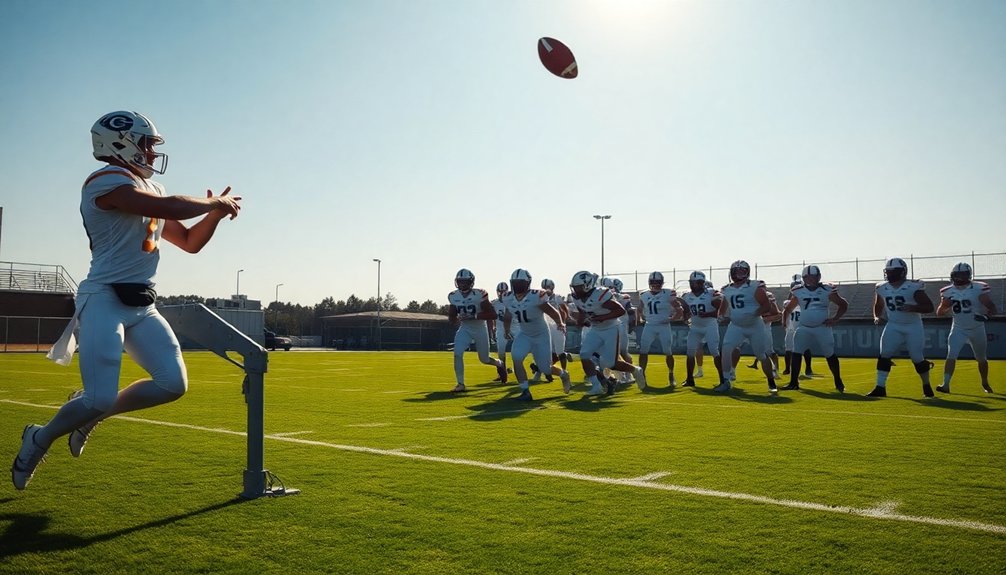
Effective passing plays are essential for outmaneuvering defenders in 7 on 7 football. A solid passing strategy can turn the tide of the game.
Start by utilizing quick slant routes; they exploit gaps in coverage and allow your receivers to gain yards after the catch. Pair this with deep post routes to stretch the defense vertically, creating space for underneath plays.
Implementing out routes can also confuse defenders, as they must choose between covering deep or short. Don’t forget the importance of timing between you and your receivers; precise execution on these routes guarantees successful completions. Additionally, incorporating communication on the field enhances the effectiveness of your passing plays, ensuring that all players are synchronized in their movements and intentions.
Utilizing Motion and Misdirection in Your Offense
Motion and misdirection can be game-changers in your offense, creating confusion for defenders.
You’ll want to explore different types of offensive motion and how to effectively implement misdirection techniques.
With the right timing and execution, you can keep your opponent guessing and open up big plays. Effective player selection is crucial for ensuring that each player understands their role in executing these strategies.
Types of Offensive Motion
While incorporating various types of offensive motion can elevate your team’s performance, understanding how to effectively use misdirection is essential.
Using motion can confuse defenders and create openings. Here are three key types of offensive motion to evaluate:
- Pre-snap Motion: Shift players before the snap to assess defensive alignment and create mismatches.
- In-Flight Motion: Players move during the play, disrupting the defense’s focus and allowing for quick passes or handoffs.
- Counter Motion: One player moves in one direction while the ball goes the opposite way, capitalizing on defensive overcommitment.
Misdirection Techniques Explained
Incorporating misdirection techniques into your offense can greatly enhance your team’s effectiveness on the field. Using misdirection drills, you can train your players to execute fakes and shifts that confuse defenders.
Deceptive formations play a vital role in this strategy. By aligning your players in unexpected ways, you’ll create opportunities for big plays. For example, consider using a player motioning away from the intended play direction to draw defenders’ attention. This distraction can open up running lanes or passing opportunities.
Practicing these techniques regularly will guarantee your team can seamlessly integrate misdirection into various plays. Remember, the element of surprise can turn the tide in your favor, leaving defenders guessing and unable to react effectively.
Timing and Execution Tips
Timing and execution are vital when utilizing motion and misdirection in your offense. To maximize effectiveness, focus on these tips:
- Practice Timing Drills: Regularly run drills that emphasize synchronization among players. Timing is essential, especially for handoffs and routes.
- Develop Execution Strategies: Create clear strategies for each play. Make sure every player understands their role in the motion and misdirection to avoid confusion.
- Film Study: Analyze game footage to identify successful and unsuccessful plays. Use this insight to fine-tune your timing and execution.
The Power of Quick Routes and Timing
Quick routes can be game-changers in 7 on 7 football, allowing offenses to exploit defenses before they can react. The effectiveness of quick routes hinges on timing precision.
When you and your receiver sync up perfectly, you create a split-second advantage that can lead to big plays. Practice your routes until they’re second nature; this builds trust and guarantees everyone knows their responsibilities.
Make certain your quarterback reads the defense quickly and delivers the ball with confidence. A sharp, well-timed route can catch defenders off guard, opening up options for yards after the catch. Incorporating speed endurance drills into your training can further enhance your team’s quickness and responsiveness on the field.
Incorporating Play Action to Keep Defenses Guessing
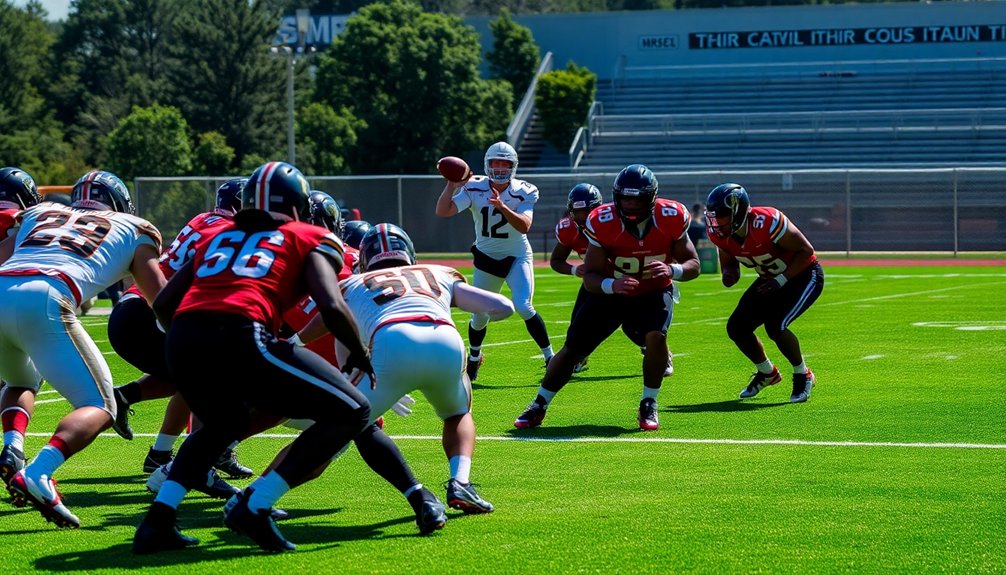
To keep defenses on their toes, you need to master play action. Understanding the basics, key routes, and the timing of your execution can turn a good play into a great one. Let’s break down how to effectively incorporate play action into your strategy. Additionally, employing formations like the 2-3-1 Formation can enhance your team’s ability to create scoring opportunities while maintaining defensive stability.
Understanding Play Action Basics
Although play action may seem straightforward, mastering its nuances can keep defenses on their toes. Understanding play action fundamentals is crucial for any offense.
Here are three key components to weigh:
- Fake the Hand-off: The running back must sell the fake to draw in defenders, creating space for the pass.
- Quarterback Responsibilities: As the quarterback, you must execute the fake convincingly and quickly scan the field for open targets.
- Timing and Rhythm: Proper timing is critical; you want to verify your offensive line holds their blocks long enough for the play to develop.
Key Routes to Utilize
Incorporating play action into your offense opens up a variety of routes that can exploit defensive weaknesses. By using effective route combinations, you can create mismatches that force defenders to make tough decisions.
Consider pairing a deep post route with an underneath drag; this forces the safety to choose between covering the deep threat or the short, quick option.
Pay attention to route timing as well—timing is essential for maximizing the effectiveness of your play action. The fake has to sell well, giving your receivers time to break free from coverage.
When executed correctly, these routes not only keep defenses guessing but also open up the field for big plays. Get creative, and watch your offense thrive!
Timing and Execution Tips
Executing play action effectively hinges on precise timing and coordination among all players on the field.
To keep defenses guessing, focus on these execution strategies:
- Timing Drills: Regularly practice your timing drills to guarantee every player knows their role and timing in the play.
- Fake the Defense: The quarterback should sell the fake with convincing footwork and ball placement, drawing defenders in.
- Receiver Routes: Have receivers run crisp, well-timed routes to maximize separation after the fake, making the pass more effective.
Analyzing Defensive Strategies to Counterattack
As you explore the intricacies of 7 on 7 play, understanding defensive strategies to counterattack becomes essential. Analyzing various defensive formations helps you anticipate how opponents might adjust to your offensive plays.
For instance, when facing a zone defense, your counter defensive strategies should focus on quick, precise routes that exploit gaps. On the other hand, against man coverage, utilizing pick plays can create mismatches and open up opportunities.
Always be prepared to adapt your formation based on the defense’s alignment. By recognizing their strengths and weaknesses, you can effectively counter their strategies, ensuring your offense stays one step ahead. Additionally, understanding defensive formations enables you to better exploit the gaps in their coverage.
Adapt your formation to the defense’s alignment, exploiting their weaknesses to keep your offense ahead of the game.
Mastering these concepts won’t only improve your game but also keep defenders guessing.
Conclusion
So, there you have it—your ticket to leaving defenders scratching their heads and questioning their life choices. With these plays and formations, you won’t just score points; you’ll make opponents wonder if they should’ve stuck to chess. Embrace the chaos of motion, the elegance of quick routes, and the art of deception. Now go out there, release your offense, and remember: if they can’t keep up, it’s not your fault they skipped leg day!