
The Field From a to Z: a Guide to Soccer Field Dimensions, Markings, and Rules
November 1, 2025Last updated: · By Jake Turner
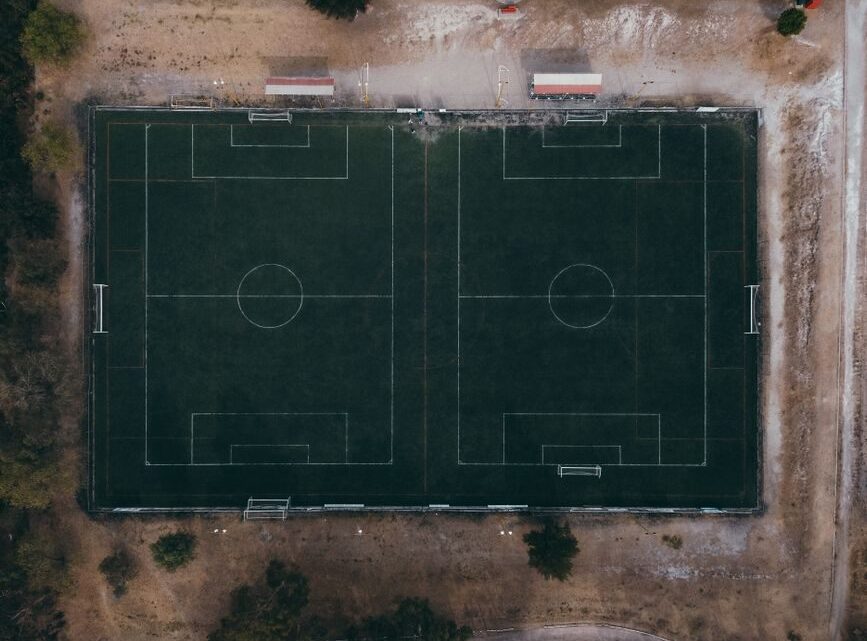
Soccer field dimensions depend on the level of play, but a few numbers matter most: the pitch length and width, the 18-yard penalty area, the 6-yard goal area, and the 8-by-24-foot goal. Under Law 1 of the Laws of the Game, an international pitch measures 100 to 110 meters long and 64 to 75 meters wide. This guide covers the standard sizes, every key marking, the restart rules that depend on them, and where field sizes can legally change.
Key Takeaways
- International matches use a pitch 100 to 110 meters long and 64 to 75 meters wide, according to Law 1 of the Laws of the Game.
- The NFHS recommends a high school field of 110 yards by 65 yards.
- The center circle has a 9.15-meter (10-yard) radius, and the penalty mark sits 11 meters (12 yards) from the goal line.
- The penalty area extends 16.5 meters (18 yards) from the goal line, and the goal area extends 5.5 meters (6 yards).
- A standard soccer goal is 8 feet (2.44 meters) high and 24 feet (7.32 meters) wide.
What Are the Standard Soccer Field Dimensions?
The standard soccer field is a rectangle, and its exact size depends on the level of play. International pitches have the largest permitted range, while the NFHS gives U.S. high schools one recommended size. The table below compares the main levels.
| Level | Length | Width |
|---|---|---|
| International match | 100 to 110 meters (109 to 120 yards) | 64 to 75 meters (70 to 82 yards) |
| U.S. high school (NFHS recommended) | 110 yards (about 100.6 meters) | 65 yards (about 59.4 meters) |
| Youth and recreational | Set by the league or association | Set by the league or association |
How Long and Wide Is a Regulation Pitch?
A regulation pitch is one that falls within the length and width limits in Law 1. The long sidelines are called touchlines, and the short ends are called goal lines. Practice on a field close to the size you will play on, since space changes how players move and pass.
What Size Is a High School Soccer Field?
The NFHS recommends a high school field of 110 yards by 65 yards, as shown in its 2023-24 soccer field diagram. The same diagram sets a minimum slope of 1.5% for surface-drained natural turf fields, which helps water run off the playing surface. Local fields may not match the recommendation, so confirm the size with your school or league.
How Are the Key Markings Laid Out on a Soccer Field?
The key markings are the halfway line, the center circle, the penalty area, the goal area, the penalty mark, and the corner arcs. Each one tells players where play restarts, where a set piece is taken, or where a player must stand. Learning their positions is the fastest way to read a match.
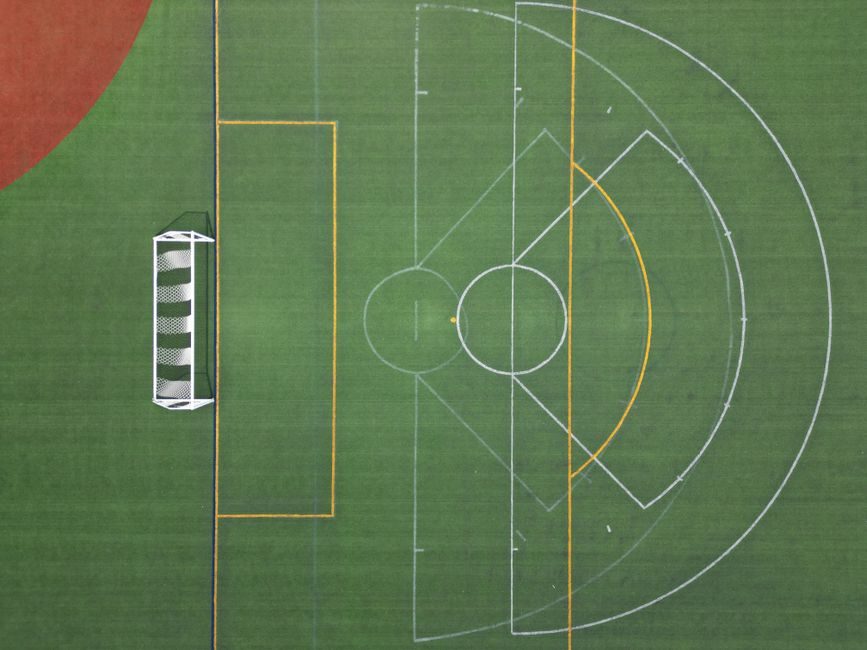
Here are the markings and what each one does:
- Halfway line: divides the pitch into two halves and runs between the touchlines.
- Center circle: marks where kickoffs are taken.
- Penalty area: the large box where defensive fouls lead to penalty kicks.
- Goal area: the smaller box where goal kicks are taken.
- Corner arcs: the quarter circles at each corner flag where corner kicks are taken.
What Is the Center Circle?
The center circle is a circle with a 9.15-meter (10-yard) radius, centered on the midpoint of the halfway line. Opponents must stay outside it during kickoffs until the ball is in play. Its fixed radius gives both teams a clear distance to respect at the restart.
How Big Is the Penalty Area?
The penalty area, often called the 18-yard box, extends 16.5 meters (18 yards) from the goal line and spans about 40.3 meters (44 yards) across. The penalty mark sits 11 meters (12 yards) from the midpoint of the goal line. Only the goalkeeper may handle the ball inside their own penalty area during play.
What Is the Goal Area?
The goal area, or six-yard box, extends 5.5 meters (6 yards) out from the goal line and measures 18.3 meters (20 yards) wide. Goal kicks are taken from inside it, and the opposing team must stay outside the penalty area until the ball is in play.
What Are Corner Arcs?
A corner arc is a quarter circle with a 1-meter (about 1-yard) radius, drawn inside the field from each corner flagpost. Under Law 1, unauthorized marks on the field can lead to a caution, so only the official markings should be on the pitch. The ball must be placed inside the arc for a corner kick.
How Big Are Soccer Goals?
A standard soccer goal is 8 feet (2.44 meters) high and 24 feet (7.32 meters) wide. The frame is made of the two goalposts and the crossbar, and it must be anchored so it cannot tip over during play. Check the net and anchoring before every session.
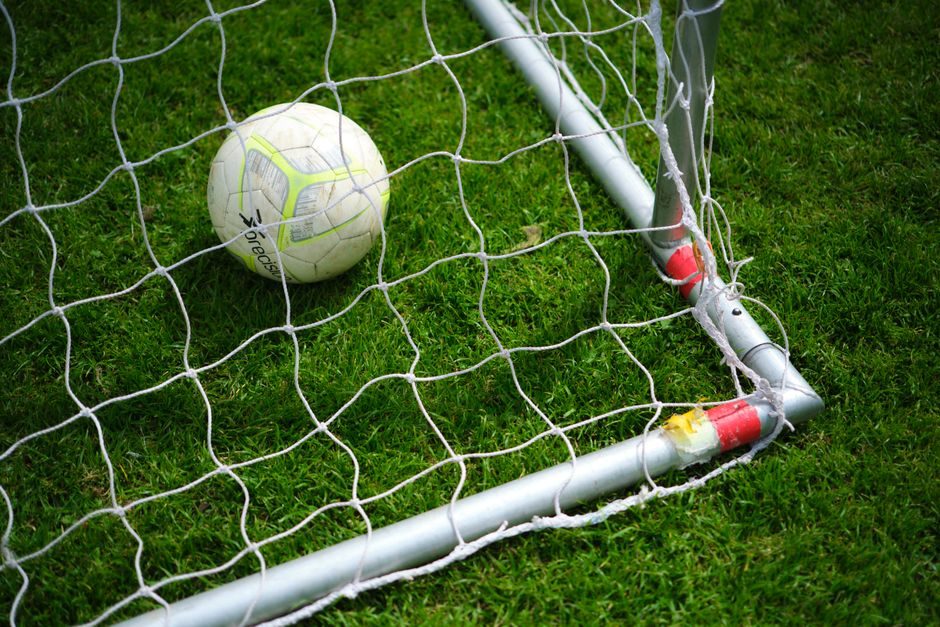
Goals that are not secured can fall onto players, especially in wind or during rough play. Anchor each frame to the ground according to the manufacturer’s instructions and inspect the anchors regularly.
What Do the Touchlines and Goal Lines Do?
The touchlines are the long sidelines, and the goal lines are the short ends. The ball is out of play when it fully crosses either line. A goal is scored when the whole ball crosses the goal line between the goalposts and under the crossbar.
The restart depends on where the ball leaves the field. A ball that crosses a touchline is restarted with a throw-in. If the attacking team last touched the ball before it crossed its own goal line, the defending team takes a goal kick. If the defending team last touched it, the attacking team takes a corner kick.
How Do Restarts Use the Field?
Restarts use the markings to set distances and positions for each kind of play. Most restarts follow the same pattern: the ball is placed at a defined spot, the opposing team keeps its distance, and play resumes when the ball is kicked or thrown. Here are the main restarts.
- Kickoff: The ball sits on the center spot and is kicked forward, and opponents stay outside the center circle until it is in play. For more detail, read our guide to kickoff rules in soccer.
- Free kick: Opponents must stay at least 9.15 meters (10 yards) from the ball until it is in play.
- Throw-in: The thrower uses both hands, delivers the ball from behind and over the head, and keeps both feet on the ground on or behind the touchline.
- Goal kick: The ball is placed in the goal area, and opponents stay outside the penalty area until it is in play.
- Penalty kick: The ball is placed on the penalty mark, 11 meters from the goal line.
How Do Field Sizes Change by Level of Play?
Field sizes can change for several player groups, and the Laws allow flexibility when the change is agreed. Law 1 of the 2015/16 Laws of the Game allows the field size and other elements to be modified for under-16 players, women, veterans over 35, and players with disabilities. That modification requires agreement from the member association. Your local league sets the actual size, so check its rules before scheduling a match.
How Big Are Youth Soccer Fields?
Youth fields are generally smaller than full-size pitches, and the exact dimensions come from the league or association running the games. Smaller formats such as 7v7 use smaller fields and fewer players per side. For a breakdown of positions in those formats, see our guide to soccer positions in 7v7, 9v9, and 11v11 formations.
Do Artificial Fields Have Different Rules?
Artificial pitches also have surface requirements. The 2011/12 edition of the Laws of the Game required artificial pitches to be green. For international and FIFA-affiliated matches, the surface must meet the FIFA Quality Concept for Football Turf or the International Artificial Turf Standard unless FIFA grants dispensation.
What Should You Check on a Soccer Field?
Before a match or practice, a quick check confirms that the field meets the dimensions and markings your level requires. Use this checklist to catch common problems early.
- Confirm the length and width match your league’s size rules for the age group or format.
- Check that the halfway line, center circle, penalty area, and goal area are visible and straight. Our guide to understanding soccer field markings covers the details.
- Confirm the penalty mark is 11 meters (12 yards) from the goal line and the center circle has a 9.15-meter (10-yard) radius.
- Confirm each goal is 8 by 24 feet and anchored to the ground.
- On natural turf, confirm the surface has at least the 1.5% minimum slope the NFHS recommends for surface-drained fields.
Frequently Asked Questions
What Is the Standard Size of a Soccer Field?
There is no single standard for every level. International pitches are 100 to 110 meters long and 64 to 75 meters wide, and the NFHS recommends 110 by 65 yards for U.S. high schools. Youth and recreational fields are set by their governing league.
How Big Is the Penalty Area in Soccer?
The penalty area extends 16.5 meters (18 yards) from the goal line and is about 40.3 meters (44 yards) wide. A foul by the defending team inside it results in a penalty kick, which is taken from the penalty mark 11 meters (12 yards) from the goal line.
How Big Are Soccer Goals in Feet?
A standard soccer goal is 8 feet high and 24 feet wide. These are the measurements for full-size goals. Smaller goals are common in youth play, so confirm the size with your league.
Can Soccer Fields Be Smaller for Kids?
Yes. Law 1 allows the size and other elements to be modified for under-16 players, subject to agreement by the member association. Local leagues usually publish the dimensions for each age group, so check those before a game.
How Far Must Opponents Stand From a Free Kick?
Opponents must stay at least 9.15 meters (10 yards) from the ball until it is in play. This distance gives the kicking team room to restart play cleanly.
Conclusion
Soccer field dimensions set the frame for every match, from the pitch length and width to the center circle, penalty area, goal area, and the 8-by-24-foot goal. Learn the numbers for your level, and the restart and boundary rules become much easier to follow. Use the checklist above before your next practice or match to confirm the field meets the rules.
More on Soccer Field Dimensions
Related guides: Flag Football Field Dimensions and Layout Tips · “What’s a Draw in Soccer?” A Guide to Soccer Rules and Lingo · Set Pieces That Score: Corner Kick Plays and Other Strategies to Win the Game
Free tools: Keto Macro Calculator · Keto Net Carbs Chart