
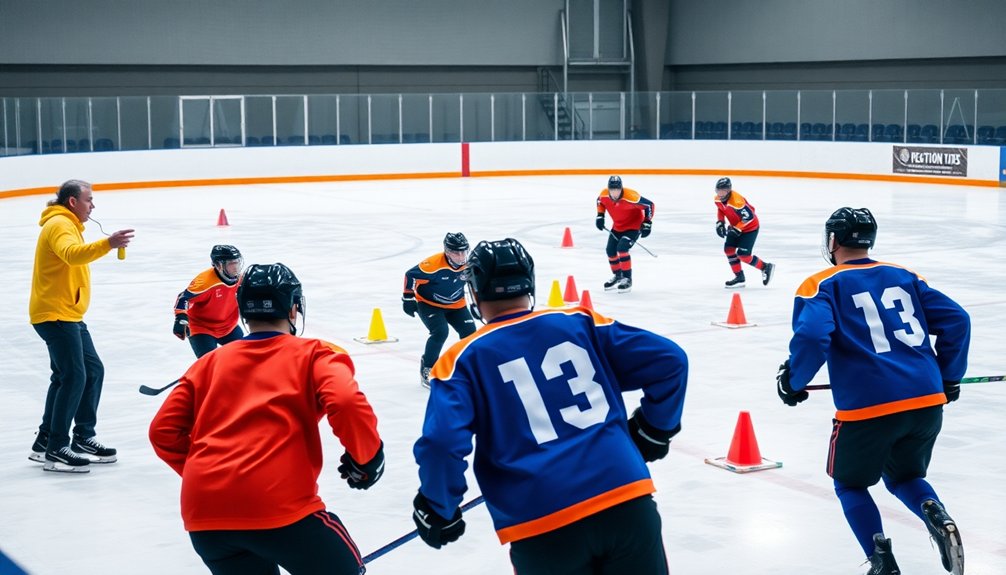
Fun and Effective Reaction Time Exercises for Hockey Players
August 25, 2025Improving your reaction time is essential for hockey success, and there are plenty of fun exercises to help you do just that. Try the reactive ball drop drill to enhance hand-eye coordination or partner up for a mirror shuffle drill to boost agility. Incorporating virtual reality systems can also make practice engaging while improving your skills. Keep training with dynamic warm-ups and varied drills; there’s even more to discover about enhancing your performance.
What Is Reaction Time?
When you think about reaction time, it’s the essential link between seeing a play unfold and making your move on the ice.
Reaction time is the duration it takes for you to respond to a stimulus and make a decision, which is especially important in fast-paced sports like hockey. It’s measured by the interval between when you perceive a stimulus and when you react, with elite athletes achieving times of 0.2 seconds or less.
Unlike reflexes, reaction time involves cognitive processing in your brain, allowing for more complex decisions and movements. Additionally, understanding the offside rule in soccer can enhance your strategic thinking and anticipation skills on the ice.
Importance of Reaction Time in Hockey
Understanding reaction time’s role in gameplay is important for hockey players. Your ability to respond quickly to fast-moving stimuli can greatly impact your decision-making and performance on the ice.
Players with faster reaction times can seize scoring opportunities and defend effectively against opponents, making this skill essential for all positions, especially goalkeepers. Elite athletes achieve visual reaction times of 0.2 seconds or less, while average players hover around 0.3 seconds.
To improve your reaction, engaging in reaction time drills is necessary. Remember, it’s not just about speed; it’s also about reading the game and making quick decisions. Yellow cards serve as crucial reminders for maintaining discipline and accountability in sports, which can parallel the need for quick reactions in hockey.
Training to enhance your reaction time can lead to better agility and overall performance as you adapt swiftly to unpredictable game situations.
Techniques to Improve Reaction Time
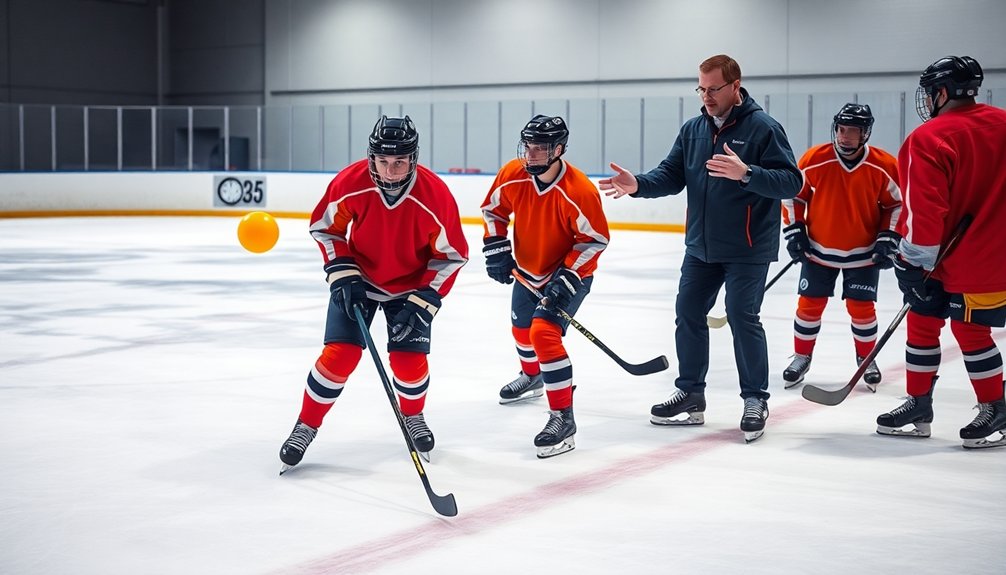
To enhance your reaction time on the ice, you can incorporate a variety of effective techniques into your training regimen.
Start with mental overspeed training, where you react to stimuli faster than typical game situations. This can involve drills with quicker players.
You might also consider consuming caffeine, which can markedly boost your reaction time, but be cautious if you have health concerns.
Engaging in first-person shooter video games can improve your reaction time by up to 25%.
Don’t forget the importance of a proper warm-up; dynamic stretches can reduce your reaction time by 0.08 seconds.
Finally, practice unpredictable drills like the reactive ball drop to effectively enhance both your reaction time and agility. Additionally, engaging in cardio training methods can further support your overall athletic performance and readiness on the ice.
Recommended Reaction Time Drills
To boost your reaction time on the ice, try the Reactive Ball Drop drill, where you’ll catch a ball dropped unexpectedly to sharpen your hand-eye coordination.
Another effective drill is the Partner Mirror Shuffle, which has you mimic a partner’s movements, enhancing your lateral agility.
Incorporating these drills into your training can make a significant difference in your on-ice performance. Moreover, adding high-intensity interval training to your routine can improve overall fitness and reaction times, further enhancing your skills on the ice.
Reactive Ball Drop
When a coach unexpectedly drops a ball, you’ll need to rely on your instincts and quickness to catch it before it bounces twice. This Reactive Ball Drop drill is designed to enhance your hockey reaction time and hand-eye coordination.
Stand about 5 yards away from your coach, allowing enough space to react and sprint toward the ball. Focus on catching it in an athletic position without diving, which helps develop proper technique and body control.
To increase the challenge, your coach can vary the distance or use multiple balls with assigned numbers or colors. This drill effectively simulates real-game scenarios, training you to respond quickly to unpredictable events on the ice, making you a better player.
Partner Mirror Shuffle Drill
The Partner Mirror Shuffle Drill is a dynamic exercise that enhances your agility and reaction speed.
To perform this drill, stand one meter apart from your partner. One of you’ll shuffle or make random movements, while the other mimics those actions. This not only improves your coordination but also trains your body to respond quickly, simulating real-game scenarios.
Execute the drill for 30 seconds per set, aiming for at least four sets to maximize effectiveness. The unpredictable nature of this drill keeps you engaged and sharpens your reflexes.
It’s adaptable for all skill levels, making it suitable for players of any age. Incorporate this exercise into your routine and watch your reaction speed and agility soar!
Fun Partner Drills for Enhanced Reaction
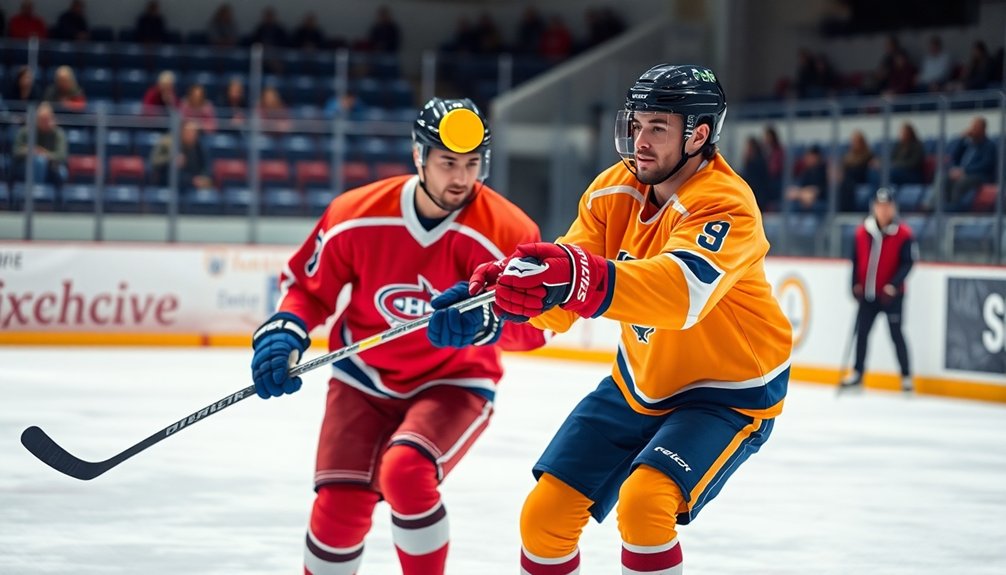
Enhancing your reaction time on the ice can be both effective and enjoyable with partner drills that incorporate fun elements.
Try the Ball Drops Drill, where one partner drops a racquetball, and you sprint to catch it before it bounces twice. This boosts your visual reaction time and first-step quickness.
The Reactive Ball Drop Drill adds excitement as your partner drops a ball unexpectedly, enhancing your hand-eye coordination and reflexes.
For more skill development, combine lateral movement with the Lateral Shuffle With Reactive Catches, where you react to throws while shuffling side-to-side.
Finally, Partner Call Out T-Test Runs improve your mental processing speed and physical responsiveness, making these drills essential for sharpening your reaction time on the ice. Additionally, focusing on consistent training helps players adapt to various game situations and enhances overall performance.
Incorporating Technology in Training
Incorporating technology into your training can greatly boost your reaction time on the ice.
Using virtual reality systems lets you practice game scenarios, helping you react quicker to unexpected plays.
Reaction time apps also offer instant feedback, so you can track your progress and see your improvements over time. Additionally, consistent effort in utilizing these technological tools can significantly enhance your overall performance.
Virtual Reality Training
As hockey players seek to elevate their performance, virtual reality (VR) training offers a cutting-edge solution that immerses you in realistic game scenarios.
This technology helps you improve your puck handling and overall hockey skills by simulating unpredictable situations in a controlled environment. Studies show that athletes using VR can boost their reaction times by up to 20% compared to traditional methods.
With VR systems tracking your movements and responses, you get instant feedback to pinpoint areas for improvement. This allows you to repeatedly face high-pressure scenarios, enhancing your ability to react quickly and effectively during actual games.
As the sports VR market grows, now’s the time to incorporate this innovative training into your routine for peak development.
Reaction Time Apps
While virtual reality training immerses you in lifelike scenarios, reaction time apps offer a practical way to sharpen your skills anytime, anywhere. These apps provide interactive drills that simulate real-game situations, enhancing your decision-making speed and reflexes.
With visual and auditory cues, you’ll find yourself challenged to react promptly to various stimuli, essential for youth hockey players. Many popular reaction time apps let you track your progress, offering insights into your performance and areas needing improvement.
Incorporating these apps into your training routine can lead to measurable enhancements, as elite scores often fall under 0.2 seconds in visual reaction tests. By boosting your hand-eye coordination and response times, you’ll be better equipped for success on the ice.
The Role of Warm-Ups in Reaction Time Improvement
To enhance your reaction time on the ice, a proper warm-up is essential, because it elevates your core temperature and increases your range of motion.
Research shows that dynamic warm-ups can reduce reaction time by up to 0.08 seconds, which can greatly boost your performance. Engaging in specific stretches prepares your body for those quick, explosive movements required in hockey.
Dynamic warm-ups can cut reaction time by 0.08 seconds, significantly enhancing your hockey performance.
Here are some key components to include in your warm-up:
- Dynamic stretches (leg swings, arm circles)
- Sport-specific drills (stickhandling, passing)
- Agility exercises (ladder drills, cone sprints)
- Plyometric movements (jump squats, bounding)
- Mental visualization techniques
Implementing consistent warm-ups not only sharpens your reaction time but also enhances decision-making during gameplay. Additionally, focusing on reaction training can further improve your response time and overall performance on the ice.
Conclusion
Incorporating these fun and effective reaction time exercises into your training can really pay off on the ice. By sharpening your reflexes, you’ll be one step ahead of your opponents, turning the tide in your favor during pivotal moments. Remember, practice makes perfect, and with a little dedication, you’ll see your skills soar. So, lace up your skates and get ready to take your game to the next level—after all, every second counts in hockey!