Everything You Need to Know About Hockey Balance Boards
August 24, 2025Hockey balance boards are crucial tools for improving your stability, coordination, and overall performance on the ice. They work by challenging your balance, engaging stabilizing muscles, and enhancing core strength. With various types available, these boards support training drills that boost stickhandling and skating endurance. Plus, they promote quicker reactions during gameplay. However, they have limitations, so it’s important to incorporate additional training methods for best results. Stick around to discover tips for using balance boards effectively!
What Are Balance Boards?
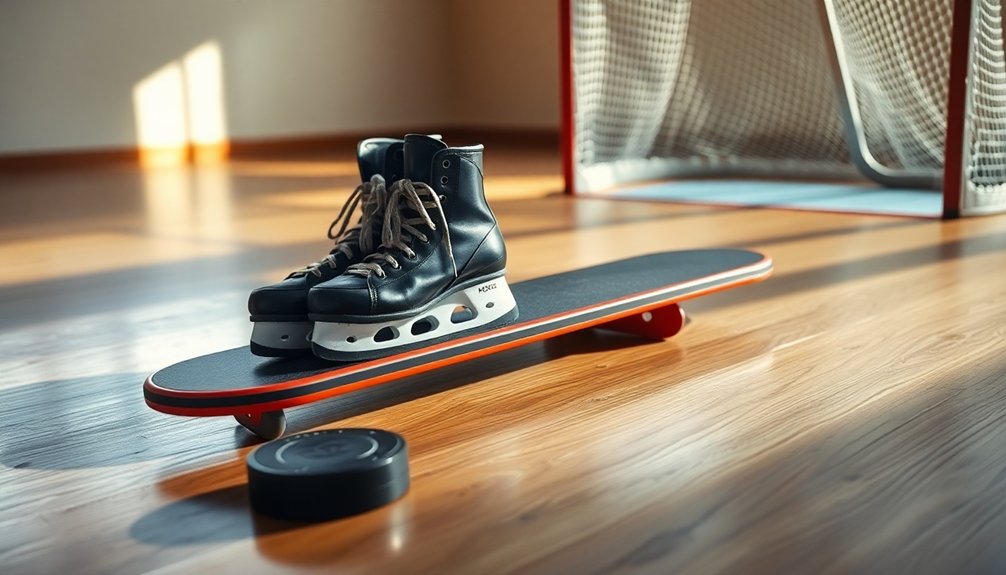
Balance boards are innovative tools designed to enhance your stability and coordination.
Originally inspired by a toy concept during World War II, these boards were patented in 1952 to create unstable surfaces for balance challenges.
Inspired by a World War II toy concept, balance boards were patented in 1952 to create challenging unstable surfaces.
You’ll find various types, including side-to-side and 360-degree designs, each aimed at improving balance while keeping things enjoyable.
When you use balance boards, they force you to maintain your center of mass over a base of support, which enhances your overall balance skills through consistent practice.
They’re especially popular among athletes for injury rehabilitation and prevention, as they challenge the stabilizing muscles around joints.
Plus, balance boards stimulate the vestibular system in your inner ear, boosting your core strength and overall body control. Incorporating speed and agility development into your training routine can further enhance your performance and balance on the field.
How Do Balance Boards Work?
Balance boards work by creating an unstable surface that challenges you to keep your center of mass in check.
As you practice, you engage your stabilizing muscles and stimulate your vestibular system, enhancing your balance and coordination.
This training strengthens your neural pathways, making your body quicker and more efficient in responding to balance-related tasks. Additionally, incorporating core strength exercises into your routine can further enhance your balance and overall athletic performance.
Mechanism of Balance Boards
When you stand on a balance board, you’re engaging in a workout that challenges your core and stabilizer muscles by forcing you to adapt to an unstable surface.
This mechanism creates a dynamic environment where your body constantly adjusts to shifting weight, mimicking the movements in sports like hockey. Your core muscles play an essential role in maintaining balance, as they help stabilize your body during these adjustments.
The balance training you get from using a balance board enhances your proprioception, which is critical for understanding your body’s position.
Through regular practice, you’ll not only improve your balance but also sharpen your coordination, ultimately boosting your performance in athletic activities.
Neural Pathway Engagement
As you engage with a balance board, your body’s neural pathways become more active, allowing for improved communication between your brain and muscles. This stimulation enhances your vestibular system, essential for perceiving gravity and movement, which elevates your overall balance skills.
By challenging yourself to maintain equilibrium on an unstable surface, you’re promoting the development of these neural pathways for better information processing related to balance. Consistent practice on balance boards strengthens your stabilizing muscles and boosts the efficiency of balance pathways, leading to quicker response times and improved coordination.
Furthermore, the challenge encourages fine motor control, enabling you to make subtle adjustments without over-correcting, while also enhancing your concentration skills, which is significant during athletic performance.
Benefits of Using Balance Boards in Hockey Training
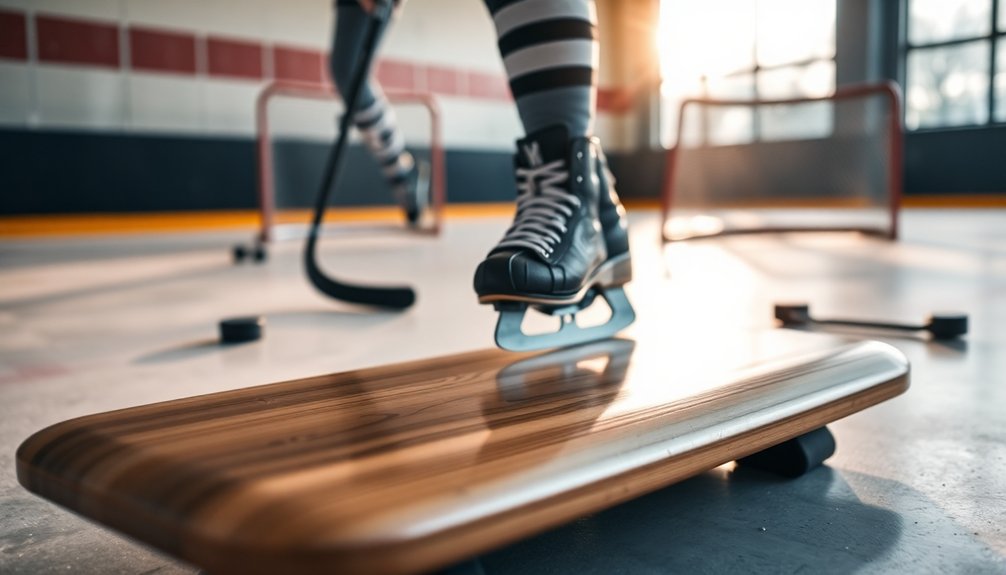
Utilizing balance boards in your hockey training can greatly enhance your performance on the ice. These tools considerably improve your core strength and stability, which are essential for effective skating and gameplay.
Regularly using balance boards enhances coordination between your upper and lower body, leading to better stickhandling skills during games. Training on these boards engages stabilizer muscles around your hips and ankles, boosting your explosive skating and endurance.
Balance board exercises mimic the unpredictable nature of ice, preparing you for real-game scenarios and enhancing your adaptability. Incorporating balance board drills into your training routine can also lead to faster reaction times, allowing you to make quicker decisions and outmaneuver your opponents on the ice. Additionally, improving agility and speed development through balance training can significantly contribute to your overall performance on the ice.
Key Specifications of Hockey Balance Boards
When choosing a hockey balance board, it’s essential to take into account the weight limit, which can vary by brand—some models support up to 300 lbs.
You’ll appreciate that most boards are lightweight, typically weighing between 1 to 3 pounds, making them easy to transport.
Plus, their durability guarantees they can handle your training sessions without a hitch. Additionally, ensuring a snug fit is crucial for maintaining balance and preventing injuries during your training.
Weight Limit Considerations
Understanding the weight limit of hockey balance boards is essential for guaranteeing your safety and optimizing training effectiveness.
Different brands have varying weight limits, with models like Sniper’s Edge supporting up to 300 lbs. Before using a balance board, check the manufacturer’s rating, especially if you weigh over 300 lbs. This helps prevent accidents and guarantees the board performs as intended.
The construction materials also play a significant role in the board’s durability and stability. Strong materials can withstand the impact from intense training sessions, enhancing your overall experience.
Portability and Durability Features
While you focus on improving your hockey skills, portability and durability are key features of balance boards that shouldn’t be overlooked.
Most hockey balance boards weigh between 1 to 3 pounds, making them easy to transport and store. This lightweight design guarantees you can take your training sessions anywhere, from home to the rink.
Additionally, these boards are built to last, with durable materials that can handle rigorous workouts without showing signs of wear. Many also feature a non-slip surface, enhancing your safety and stability whether you’re a beginner or an experienced athlete.
With options like Sniper’s Edge supporting up to 300 lbs, you’ll find a balance board that meets your needs for both portability and durability.
Training Drills for Balance Board Use
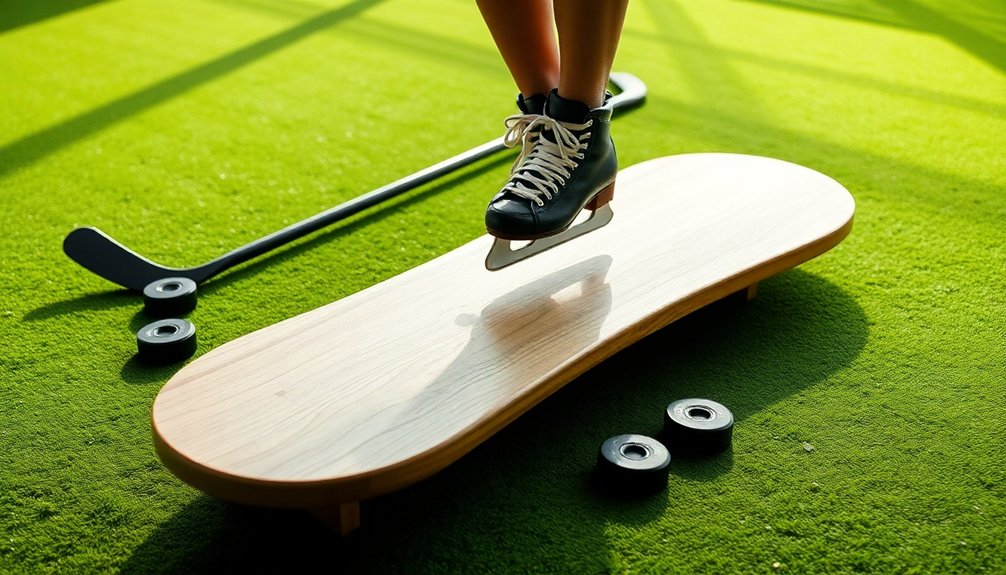
Incorporating balance board drills into your training can greatly enhance your on-ice performance.
Start with the Balance Board Snap Shots drill, performing 8 reps for 5 sets to develop elite flex and boost your shooting accuracy and power.
Enhance your shooting accuracy and power with 5 sets of 8 reps in the Balance Board Snap Shots drill.
Next, try Stability Passes, executing 8 reps for 4 sets while practicing receiving and passing to improve your overall accuracy and control.
For puck control and core engagement, do Forehand Pulls with 10 reps for 4 sets.
Incorporate Balance Board Push Ups, 8 reps for 4 sets, to engage multiple muscle groups and strengthen your core.
Finally, include Balance Board Squats in your routine with 10 reps for 3 sets to develop lower body strength and stability, essential for hockey performance. This training also emphasizes the importance of consistency and goal setting to track your progress and enhance your overall performance.
Enhancing Coordination and Stick Handling
To enhance your coordination and stick handling, balance boards offer a dynamic way to challenge your skills on and off the ice.
By improving the connection between your upper and lower body, these boards help you develop the essential coordination needed for effective stick handling in hockey.
Training on a balance board simulates the unpredictable nature of a real game, allowing you to practice controlling the puck under varying conditions.
Engaging your core during stick handling drills adds an extra challenge, refining your muscle memory and precise coordination.
The unpredictable rhythms of balance board workouts mirror the dynamic movements of live gameplay, boosting your adaptability.
Suitable for all ages, this training method enhances your overall hockey skills, particularly in coordination and stick handling. Additionally, incorporating quick acceleration drills can further enhance your ability to maneuver effectively while stick handling.
Strength and Stability Improvement
Balance boards can greatly boost your strength and stability, essential components for any hockey player.
By incorporating balance board training into your routine, you can target key areas that enhance your performance:
- Core Strength: Improve your core strength for better control and stability during skating and gameplay.
- Stabilizer Muscles: Strengthen the stabilizer muscles around your hips and ankles, aiding explosive skating and smooth changes.
- Endurance: Commit to at least 15 minutes daily to greatly increase your stamina and endurance on the ice.
Using balance boards prepares you for the chaotic conditions of gameplay, enhancing your ability to adjust and maintain balance effectively. Additionally, incorporating speed and agility drills into your training can further improve your overall athletic performance.
Prioritize this training to elevate your overall strength and stability, leading to better performance on the ice.
Limitations of Balance Board Training
While balance boards can considerably improve strength and stability, they do have their limitations when it comes to hockey training.
Primarily, these boards enhance bilateral balance but fall short in developing the unilateral balance vital for on-ice performance. Relying too heavily on bilateral stances may hinder your ability to adapt to the dynamic situations faced during games.
Additionally, balance boards can’t fully replicate the unpredictable movements of real hockey, leaving gaps in your training. This is especially true for goalies, who need a blend of both bilateral and unilateral balance.
To address these shortcomings, you might want to shift to single-leg training and incorporate other unstable tools that target the specific balance skills essential for hockey. Furthermore, the evolution of soccer over centuries has shown the importance of teamwork and agility in sports, which can be paralleled in hockey training.
Incorporating Balance Board Training Into Your Routine
Incorporating balance board training into your routine can greatly enhance your hockey skills, especially when you commit at least 15 minutes daily.
To get started, focus on these key steps:
Begin your balance board training by focusing on essential techniques to enhance your skills effectively.
- Set Up: Confirm your balance boards are on a flat surface and practice basic balance techniques.
- Drills: Incorporate specific exercises like Balance Board Snap Shots and Stability Passes, which help build strength and coordination.
- Consistency: Regularly integrate these exercises to improve your core strength, stability, and reaction times. Additionally, incorporating cardio training can significantly support your overall performance on the ice.
Conclusion
Incorporating balance boards into your hockey training can transform your game, just like a perfectly timed pass leads to a winning goal. Picture yourself gliding across the ice, effortlessly maneuvering past opponents, all thanks to the strength and coordination you’ve built. As you practice, each wobble becomes a step closer to mastering your balance, turning those moments of uncertainty into confidence. So, embrace the challenge, and watch your skills soar like a puck soaring into the net.