

Train Smarter With These Hockey-Specific Workouts
August 20, 2025To train smarter with hockey-specific workouts, focus on enhancing agility, speed, and explosive strength. Incorporate exercises like the Bulgarian Split Squat and Calf Jump to a Lunge for functional leg development. Balance strength with conditioning through interval training and plyometrics, ensuring you build both endurance and explosive power. Finally, pay attention to nutrition to support your training efforts. There’s so much more to explore about maximizing your performance on the ice, so keep going to find out!
Key Benefits of Hockey-Specific Workouts
When you engage in hockey-specific workouts, you’re not just training; you’re enhancing your agility, speed, and explosive strength in ways that directly improve your on-ice performance.
Enhance your agility, speed, and explosive strength with hockey-specific workouts for improved on-ice performance.
These workouts utilize movements like the Bulgarian Split Squat, targeting essential muscle groups while promoting injury prevention and structural balance.
By focusing on both aerobic and anaerobic conditioning, you’re preparing your body for the sport’s intermittent demands.
This tailored hockey training program gradually increases in intensity, ensuring a thorough approach to strength and conditioning.
Additionally, regularly updated sessions and elite coaching keep you engaged and committed to your fitness journey.
Incorporating goalkeeper training essentials can further enhance your overall athleticism, making you a more versatile player on the ice.
These key benefits lead to significant performance enhancement, making you a more effective player on the ice.
Essential Exercises for Improved Performance
To boost your performance on the ice, incorporating essential exercises into your training regimen is crucial.
Focus on enhancing lower body strength through targeted off-ice training. Here are three key exercises to include:
- Bulgarian Split Squat: Promotes functional leg development while minimizing spinal loading.
- Calf Jump to a Lunge: Develops explosive speed and power for quick skating bursts.
- Extreme Slow Slap Shot: Engages multiple muscle groups, improving shot power and overall strength. Additionally, incorporating cardio training can enhance your endurance and overall athletic performance on the ice.
The Importance of Lower Body Strength

Lower body strength is the foundation of a successful hockey player’s performance on the ice. It directly impacts your skating efficiency, explosiveness, and overall hockey performance.
Lower body strength is crucial for hockey players, enhancing skating efficiency and overall performance on the ice.
Incorporating effective training methods, like the Bulgarian Split Squat, can enhance functional leg development while reducing injury risks. Focus on strengthening your quadriceps, especially the vastus medialis, to maintain knee stability and prevent common injuries.
As you build your lower body strength, you’ll notice improvements in agility and acceleration, essential for quick directional changes during gameplay. Research shows a strong correlation between lower body strength and vital performance metrics, including skating speed and shooting power. Additionally, consistent practice of agility training enhances movement and reaction time, making players faster and more effective on the ice.
Prioritize this area in your training regimen to elevate your game and reach your full potential.
Incorporating Agility and Speed Training
To elevate your game, incorporating plyometric drills and agility ladder workouts is essential. These exercises boost your explosive strength and improve foot speed, making you more agile on the ice. Additionally, core strength exercises play a vital role in enhancing your balance and stability, further contributing to your overall performance.
Plyometric Drills Importance
While many aspects contribute to a hockey player’s success, incorporating plyometric drills into your training routine greatly boosts your agility and speed on the ice.
These exercises enhance explosive power and improve lower body strength, which is essential for quick acceleration and agile movements.
Consider the following benefits of plyometric drills:
- Increased Explosive Power: You’ll notice improved acceleration and rapid directional changes.
- Enhanced Lower Body Strength: Exercises like box jumps and depth jumps target fast-twitch muscle fibers, increasing skating speed.
- Improved Neuromuscular Coordination: This helps you react quickly during games, maintaining puck control and executing plays effectively.
Regularly practicing these drills not only elevates your performance but also reduces the risk of injury through better joint stability and muscle balance.
Agility Ladder Benefits
Plyometric drills lay a strong foundation for explosive movements, but incorporating agility ladders into your training can take your speed and coordination to the next level.
Agility ladders enhance foot speed and coordination through quick, precise movements, which are essential for effective skating and puck handling. By integrating these drills, you’ll improve your lateral quickness and change-of-direction abilities, important for outmaneuvering opponents on the ice.
Regular use of agility ladders boosts neuromuscular efficiency, allowing you to react faster during games and elevate your overall performance. Plus, they help reduce the risk of lower body injuries by strengthening stabilizing muscles.
Agility ladder workouts are adaptable for all skill levels, making them perfect for both novice and experienced players aiming to enhance their agility and speed.
Conditioning for Endurance on the Ice
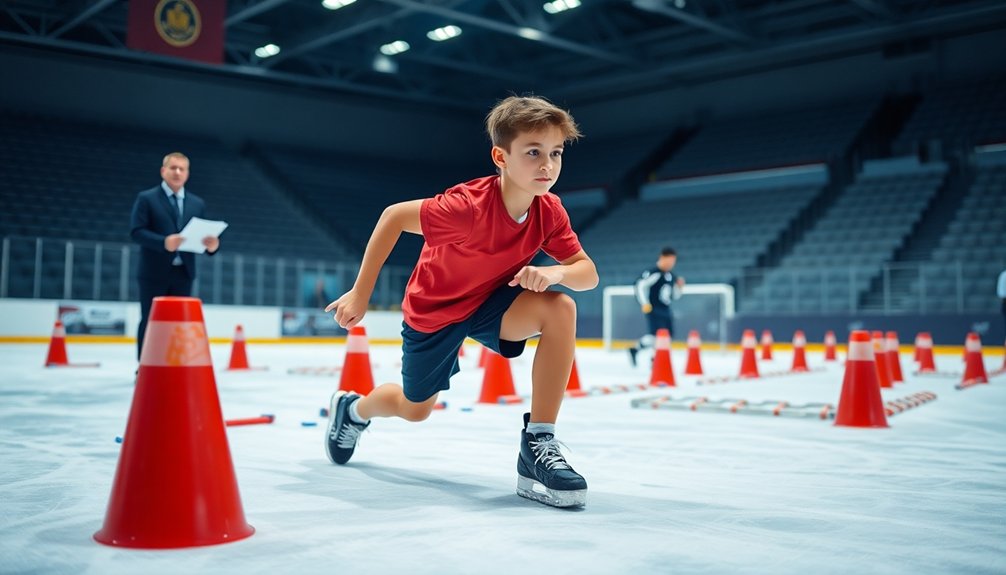
Conditioning for endurance on the ice is essential for hockey players, as it combines the need for sustained energy with the ability to deliver explosive power during critical moments.
Effective conditioning is crucial for hockey players, blending endurance with explosive power for peak performance on the ice.
To optimize your conditioning, focus on building your aerobic capacity first before ramping up intensity. Here are three key strategies:
- 3 Minutes on, 3 Minutes off: Perform intervals at 90% Maximal Aerobic Speed (MAS) to enhance your aerobic capacity.
- 1-Minute Sprints: Incorporate high-intensity sprints followed by 30 seconds of rest at 100% MAS to boost your anaerobic capacity.
- Structured Progression: Follow a conditioning hierarchy, progressing from lower intensity/higher volume to higher intensity/lower volume, targeting different fitness aspects essential for hockey.
Additionally, players can benefit from pain shuttles drill to improve their endurance and quick directional changes.
These methods will help you improve your endurance and performance on the ice.
The Role of Mobility in Hockey Training
Endurance plays a significant role in your performance on the ice, but it’s only one piece of the puzzle. Mobility is equally essential.
By enhancing your joint range of motion, you can execute complex skating and shooting movements more effectively. Improved mobility helps prevent injuries, particularly in the hips, groin, and lower back, areas commonly stressed during play.
Incorporating dynamic mobility drills into your warm-ups increases blood flow, preparing your body for high-intensity efforts and optimizing performance. Regular mobility training also addresses muscle imbalances, like the common quadriceps imbalance in hockey players, boosting your overall leg strength and stability.
Plus, a dedicated mobility routine aids in post-game recovery, reducing soreness and improving flexibility for long-term athletic longevity. Additionally, a combination of dynamic and static stretches enhances recovery and injury prevention, ensuring you remain at peak performance throughout the season.
Techniques for Explosive Power Development
To excel on the ice, developing explosive power is essential for your performance.
Here are some effective techniques to enhance your strength and power off-ice hockey:
- Olympic Lifts: Incorporate cleans and snatches to improve your rate of force development, vital for explosive power during games.
- Plyometrics: Add box jumps and depth jumps to your routine to boost your muscular power and speed, enhancing your acceleration and agility.
- Bulgarian Split Squats: This lower body exercise not only promotes explosiveness but also addresses muscle imbalances, ultimately improving your skating speed. Incorporating strengthening exercises can further enhance your overall performance on the ice.
Creating a Balanced Training Program
To create a balanced training program, you need to focus on training frequency, exercise variety, and goal-specific workouts. Incorporating different types of exercises not only prevents boredom but also addresses all aspects of your performance on the ice. Additionally, incorporating dynamic warm-up routines can enhance performance and reduce the risk of injuries.
Training Frequency Importance
While committing to a high training frequency of six times per week may seem challenging, it’s essential for maximizing strength gains and minimizing muscle soreness.
By focusing on a balanced program, you can develop the necessary physical qualities for elite hockey performance. Here are three key components to take into account:
- Incorporate full-body workouts: These optimize training frequency and enhance overall athletic development.
- Balance strength and power training: This approach builds speed, agility, and conditioning, vital for hockey.
- Monitor soreness and adjust intensity: Keeping tabs on how your body feels helps prevent injuries and supports effective recovery.
Exercise Variety and Balance
A well-rounded training program is essential for any hockey player aiming to enhance their performance on the ice. Incorporating exercise variety is vital; it keeps your workouts fresh and engaging while targeting strength, speed, agility, and conditioning.
Utilize compound lifts like squats and deadlifts alongside hockey-specific movements such as the Bulgarian Split Squat to improve functional strength and address muscular imbalances. Balance aerobic and anaerobic conditioning sessions, progressively increasing intensity to build both endurance and explosive power.
Mix bodyweight, free weights, and plyometric drills to prevent plateaus. Regularly assess and modify your training program based on your strengths and weaknesses, ensuring continuous improvement and reducing the risk of injury as you develop into a stronger, more effective player.
Goal-Specific Workouts
Creating a balanced training program tailored for hockey players focuses on enhancing specific performance attributes that translate directly to on-ice success.
To achieve this, incorporate goal-specific workouts that improve skating speed and overall explosiveness during off-season training. Consider the following key areas:
- Strength: Exercises like the Bulgarian Split Squat build lower body strength and help prevent injuries.
- Agility: Incorporate drills that enhance quick direction changes and reaction time.
- Conditioning: Structure sessions to progress from lower intensity/higher volume to higher intensity/lower volume, targeting both aerobic and anaerobic fitness.
Regular assessments of your training outcomes are essential, allowing you to make necessary adjustments and keep your program aligned with your performance goals.
Nutrition Tips for Optimal Performance
To achieve ideal performance on the ice, maintaining a balanced diet is key for hockey players. Focus on consuming lean proteins, whole grains, fruits, and vegetables to support muscle recovery and enhance your overall performance.
Stay hydrated by drinking at least 3 liters of water daily, especially during intense training or games. For pre-game meals, eat 3-4 hours beforehand, including a mix of carbohydrates and proteins for sustained energy.
Incorporate healthy fats from nuts and avocados to reduce inflammation and support joint health. Avoid processed foods and excessive sugars, as these can lead to energy crashes, negatively impacting your performance and recovery. Additionally, regular cardio training is essential for improving endurance and performance, which can be beneficial for both hockey and soccer players.
Following these nutrition tips will help you maximize your potential on the ice.
Setting Goals for Continuous Improvement
Here are three tips to help you set effective goals for continuous improvement:
- Be SMART: Guarantee your goals are Specific, Measurable, Achievable, Relevant, and Time-bound to create a focused plan.
- Self-assess regularly: Identify your strengths and weaknesses, allowing you to tailor your training accordingly.
- Embrace challenges: Gradually increase weights or add new exercises to promote adaptation and sustained performance improvements. Additionally, understanding defensive strategies can enhance your overall gameplay and contribute to your success on the ice.
Conclusion
Incorporating hockey-specific workouts into your training routine can really help you elevate your game. By focusing on strength, agility, and endurance, you’ll not only enhance your performance on the ice but also set yourself up for continuous improvement. Remember, practice makes perfect, so stay committed to your goals and keep pushing your limits. With the right balance of training and nutrition, you’ll be skating circles around the competition in no time!